
Companies are loving our eBOL Specific Scanner
I mean who would not? It turns paperwork into structured digital data in just seconds
AI can generate infinite versions of correct.
What it can’t generate is the strange thing you love for reasons no dataset can explain...
https://medium.com/@2016huangxj/ai-can-learn-good-taste-it-will-never-learn-yours-ff86a710f423
Output Speed
- Output tokens per second · Higher is better
- Comparison of first-party API performance
'I feel like I dug my own grave': The workers caught in the AI transition
https://www.bbc.com/news/articles/cgr7nxve05go
On AA100 from New York to London, a woman flies the Atlantic the same night she is named chief executive.
The best seat on the plane, and the only person on it who cannot sleep. A story about what the crown actually costs, and what it is for.
Camille got everything she had ever wanted at four o'clock this afternoon, and now, at thirty-eight thousand feet, she is the only person awake on the whole aeroplane.
They told her in the boardroom. The chairman said her name, and then he said the word unanimous, and there was a moment of real warmth, hands and congratulations and someone actually applauding, and she smiled and thanked them and felt, underneath it, the strangest thing come over her.
Not joy. She waited for the joy. She had been waiting twenty-five years for the joy.
What came instead was a kind of quiet, like a door closing softly somewhere behind her.
Read more on North Atlantic Briefing at: https://aidoos.com/resources/north-atlantic-briefing/uneasy-lies-the-head-that-wears-the-crown/
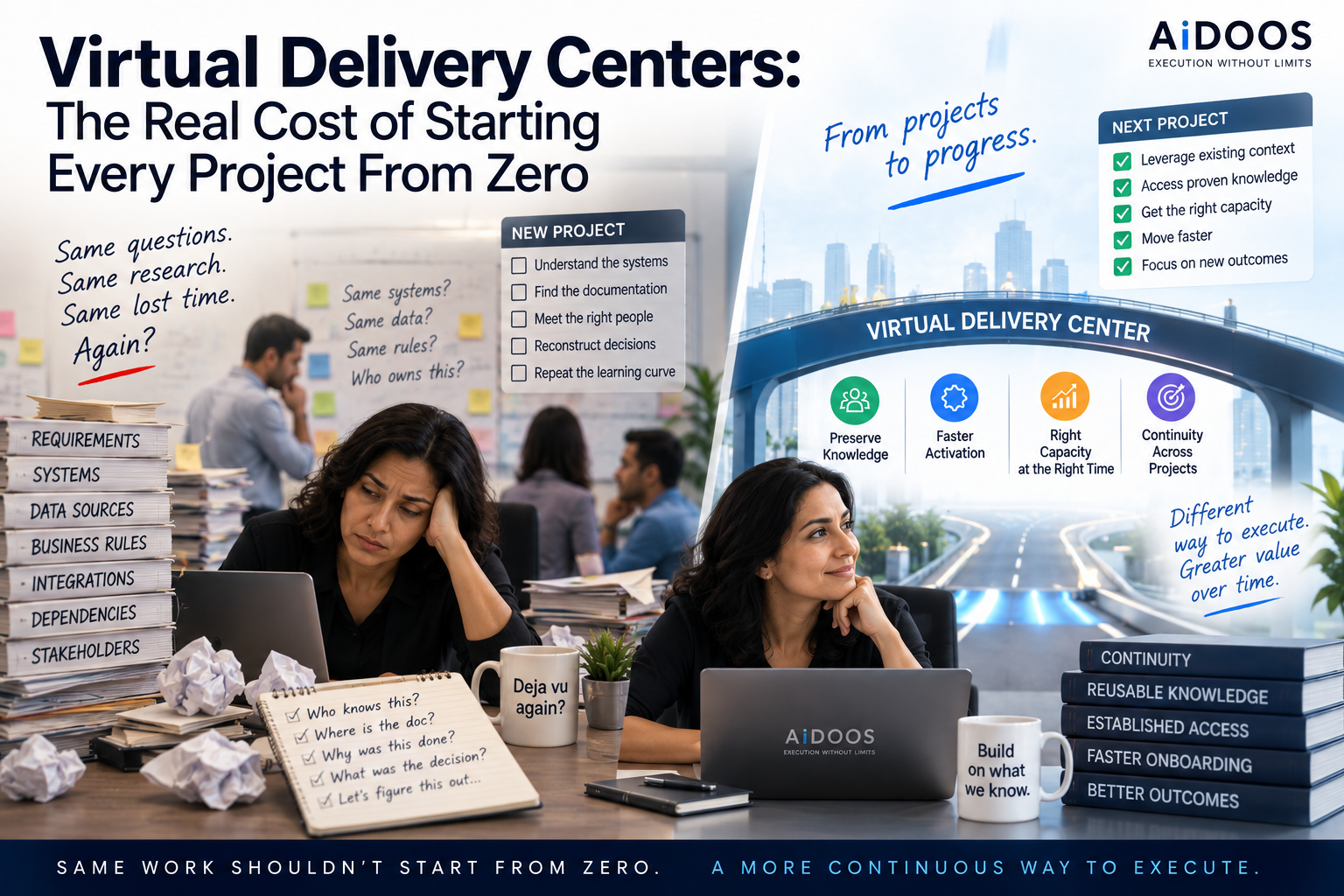
VDC vs Outsourcing vs Hiring: Which Execution Model Should You Choose?
Hire when the capability must belong permanently to the enterprise.
Outsource when a stable function can be transferred and managed through clear service expectations.
Use a VDC when the execution mandate persists but the required combination of capabilities, people, agents, and systems must keep changing.
Read more on AiDOOS blog at: https://aidoos.com/blog/vdc-vs-outsourcing-vs-hiring/
Few things in American healthcare are as universally disliked as prior authorization.
A doctor recommends a treatment, and before the patient can receive it, someone at the health plan has to review the request against the plan's medical policies and decide whether to approve it.
Done slowly, it delays care, sometimes dangerously. Done at scale, it consumes armies of nurses and clinicians on both sides. The work is high-volume, high-stakes, document-heavy, and deeply rules-bound, which is exactly the shape of problem AI is now good at.
A New York company called Anterior has built clinician-led AI to take it on.
Its platform reads a prior-authorization request, checks it against the plan's clinical criteria, and helps the payer approve appropriate care in seconds instead of days.
This is a deep look at what Anterior does, the results it reports, and, just as important, what it actually takes to deploy this inside a health plan so it delivers the return on investment it promises.
That last part is where healthcare AI succeeds or fails.
Read more on this on AiDOOS blog at: https://aidoos.com/blog/anterior-ai-prior-authorization/
The Subject: AI writing in Linkedin Posts
The Verdict: Lazy, cheap, obvious.
The Breakdown:
You can spot them in two seconds flat. Every post starts with the exact same fake enthusiasm, five paragraphs of generic bullet points, and a cheesy summary that tells you nothing. People post them because they think it makes them look smart and consistent. In reality, it just tells everyone in your network that you do not care enough to share an actual human thought.
Bending Spoons is Buying Airtable
At its peak, Airtable was known as a SaaS company that was doing “everything right.” In 2021, it raised capital at a post-money valuation of $11.735 billion.
This morning the firm announced it had agreed to be acquired by Bending Spoons for an enterprise value of $1.285 billion.
What Airtable actually sells
Airtable is a relational database with a top hat. It makes that database as friendly and accessible as a spreadsheet. (This sounds simple, but is actually quite a hard product to pull off.) To upsell it beyond hobbyists, the company would bundle in the usual stuff like permissions, integrations, and internal application building.
Tools like Lovable, Replit, Claude Code, and ChatGPT can increasingly generate everything you need besides the database itself. For a small dataset, a company can use Notion or something inexpensive. If the application gets too big, your AI agent can connect you to Snowflake, Databricks, or a host of other options.
Monthly spending on data center construction in the United States
I tried Kimi first time yesterday - Unlike ChatGPT or Claude, it was genuinely neutral and does not try to impress you.
Has anyone tried? If yes, what's your take?
Best article about how the tech behind AI drives the business of AI -
https://www.thealgorithmicbridge.com/p/the-actual-reason-why-google-fell?r=18ke&triedRedirect=true
Legal drafting has a productivity ceiling set by how fast a
human can write and check language.
Much of a transactional lawyer's day is not novel reasoning. It is redrafting standard clauses, comparing a counterparty's paper against the firm's preferred positions, and searching old matters for the precedent that already solved this problem.
The expertise sits idle while the expert does repetitive work, and the volume of contracts a team can turn around is capped by that friction.
Spellbook was built to remove it. The company began life as Rally, founded in 2018 in St. John's, Newfoundland, by CEO Scott Stevenson and his co-founders, before launching Spellbook in 2022 as one of the first generative AI contract-drafting tools.
The design choice that made it spread was deceptively simple: rather than ask lawyers to learn a new platform, it lives inside Word as a copilot, powered by GPT-4 and other models fine-tuned on legal data, drafting and reviewing up to several times faster than manual work.
Read more on this on AiDOOS blog at: https://aidoos.com/blog/spellbook-legal-ai-contract-drafting/
#LegalAI #Spellbook
Somewhere right now, a dispatcher is squinting at a driver's handwriting trying to read a BOL. Somewhere else, a driver's waiting on him to figure it out. We fixed that
#logistics
Running Kimi K3 locally is easy.
You just need:
- 1.5 TB of GPU memory
- roughly 8H100s
- A small power substation
Why do we feel so confident using generative AI while our AI literacy lags behind?
https://thedecisionlab.com/biases/ai-literacy-gap
Olix raises $312M at $3.3B valuation from Netflix’s Reed Hastings, Arm, to build Nvidia rival
Olix says it treats a data centre running AI inference like a factory that produces tokens. Each token needs hundreds of operations and different hardware.
Most companies use a single general-purpose chip for everything, but Olix’s X-1 platform distributes the model across several specialised chips, each handling a specific task. The system uses a flexible compute fabric instead of locking in a model’s design.
The chips use an optical interconnect, sending data via light rather than copper. Olix says this lowers latency and saves energy. The first chip, DX-1, is a decode accelerator for the stage when a model creates its output.
For models with 100 billion parameters, Olix claims that DX-1 can deliver over 10,000 tokens per second per user and use less power than general-purpose chips for large batches. The design is meant to scale to models with 10 trillion parameters or more.
Olix has over 140 employees in London, Bristol, Toronto, Austin, and San Francisco. The new funding will help launch DX-1 to its first customers in the second half of 2027, and support more platform development and manufacturing to increase chip production.
From Loyalty to Leverage: The New Compact Between Talent and Enterprise
Companies can no longer guarantee security in exchange for loyalty. The future requires a fairer compact built around capability, trust, portability, and mutual leverage.
Loyalty is often discussed as a moral virtue.
In employment, it was also a rational economic choice.
A person joined a company and accumulated value over time.
They learned:
The organization’s systems
Its customers
Its politics
Its unwritten rules
Its decision-makers
Its history
Its technical architecture
Its market
This context increased their usefulness.
The organization benefited from continuity.
The employee benefited from increasing trust and internal opportunity.
Loyalty could lead to:
Promotion
Greater authority
Higher compensation
Better assignments
Informal influence
Job protection
Retirement benefits
The longer the relationship lasted, the more valuable it could become to both sides.
The company and employee invested in each other.
This was not universal.
Many people remained in poor jobs because they lacked alternatives.
Many employers extracted loyalty without rewarding it.
But the model contained the possibility of compounding.
A career was not merely a sequence of transactions.
It could be a long relationship through which capability, trust, and responsibility grew together.
More on it at https://aidoos.com/blog/from-loyalty-to-leverage/