
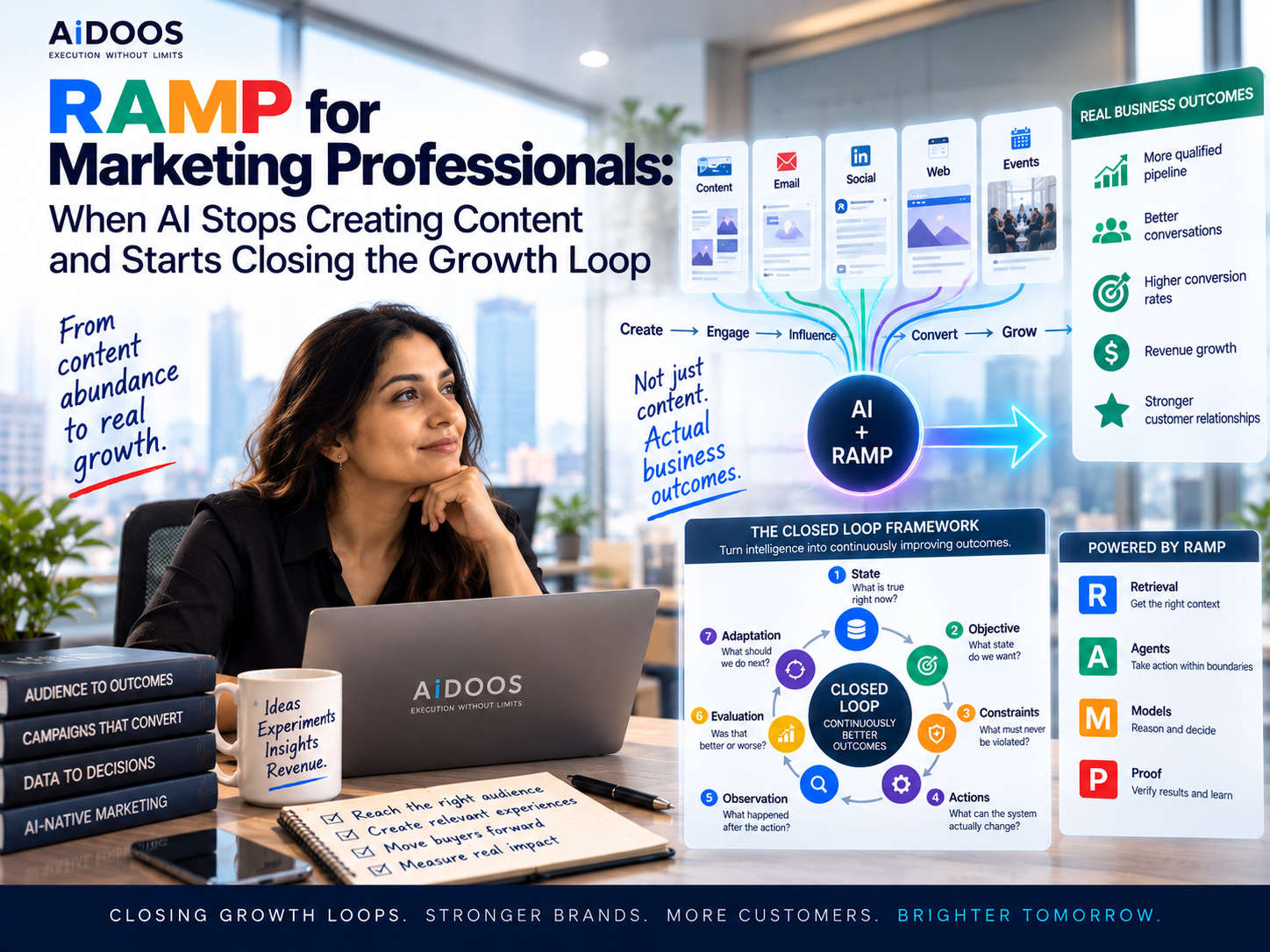
RAMP for Marketing Professionals: When AI Stops Creating Content and Starts Closing the Growth Loop
Maya has a problem most marketers would have considered a luxury a few years ago.
Her team can create almost anything.
A campaign idea that once took several days can now be explored before lunch. AI can draft the landing page, generate twenty headline variations, prepare social posts, create images, summarize competitor campaigns, suggest target segments, and rewrite the same message for six different audiences.
The marketing calendar is full.
The content pipeline is overflowing.
Yet when Maya sits down with the CEO at the end of the quarter, the conversation becomes uncomfortable.
Pipeline growth is flat.
Website traffic increased. Content production almost doubled, engagement improved on several channels, and the team ran more experiments than ever before.
The CEO looks at the numbers and asks a simple question.
“Did all of this create more business?”
Maya knows there is no clean answer.
Some campaigns produced leads. Some leads eventually became opportunities, while others disappeared somewhere between marketing automation, sales follow-up, and the customer's changing priorities.
The team knows what it published.
It knows how many people clicked.
What it understands far less clearly is which marketing actions actually changed a buyer's state.
That distinction is becoming more important as AI enters marketing.
The first wave of generative AI made marketing dramatically better at creating things.
The next wave has to make marketing better at changing outcomes.
That is where RAMP and Closed Loops come together.
1. AI solved the production bottleneck before marketing solved the outcome bottleneck
For much of modern marketing, production was expensive.
Research took time. Copy took time. Design took time, and producing enough variations to test an idea properly could consume a meaningful part of the campaign budget.
That scarcity shaped the organization.
There were content teams, design teams, campaign teams, agencies, editorial calendars, approval processes, and complicated workflows designed partly around the fact that creating another artifact required additional effort.
AI changes that economics.
Maya's team can now generate fifty subject lines more easily than it once generated five. It can create industry-specific landing pages, personalized outreach assets, product comparisons, videos, and social content at a scale that would previously have required a much larger team.
This is genuinely useful.
It also creates a strange new problem.
When producing another piece of content costs almost nothing, producing content stops being evidence that useful marketing happened.
The market does not care how efficiently the campaign was generated.
A buyer does not reward the company because an agent produced forty variations overnight. Revenue does not increase because the marketing organization became exceptionally productive at filling the internet with more material.
The value sits somewhere later in the chain.
Did the right person notice?
Did they care?
Did their understanding change?
Did they take an action?
Did the action eventually create an opportunity, a purchase, an expansion, or some other meaningful commercial outcome?
Marketing has always known these questions matter.
The difference now is that AI makes it difficult to hide behind output.
When production becomes abundant, the bottleneck moves from creation to consequence.
That is the opportunity for Closed Loops.
2. Retrieval is not “do more research”; it is understanding the buyer’s current state
Maya decides to examine one campaign that looked successful but produced almost no qualified pipeline.
The engagement metrics were excellent.
The topic clearly resonated, the landing page converted well, and several hundred people downloaded the report. Yet very few progressed into serious conversations.
Her first instinct is to ask AI why.
The model gives several plausible explanations.
Perhaps the audience was too broad. Perhaps the call to action was weak, the offer attracted researchers rather than buyers, or the campaign reached people too early in their purchase journey.
All of those explanations are possible.
None of them is evidence.
So Maya starts retrieving context.
Who actually downloaded the report?
Which companies were they from? What roles did they hold, what had those accounts done before the campaign, and did any of them already exist in the CRM?
Had they visited other pages?
Were they hiring for relevant roles?
Had someone from the same company spoken with sales previously?
Were some accounts already customers?
Suddenly the campaign looks very different.
A large portion of the downloads came from practitioners who genuinely liked the content but had little purchasing authority. A smaller group came from accounts that matched the company's target profile unusually well.
One of those companies had visited pricing twice and had three people from the same organization interact with different pieces of content within ten days.
That account looked identical to every other download in the campaign dashboard.
It was not identical at all.
This is Retrieval inside RAMP.
For marketing, Retrieval is not merely asking AI to search the internet or summarize customer research.
It is assembling enough context to understand the current state of a buyer, account, market, or segment before choosing the next action.
That context may come from website behavior, CRM history, product usage, customer interviews, sales conversations, support interactions, industry events, hiring activity, intent signals, and public information.
The marketing system has traditionally seen fragments.
The website knows the visit.
The CRM knows the account.
Sales knows the conversation.
Product knows the usage.
Customer success knows the frustration.
A RAMP-ready marketer starts trying to connect those fragments around the outcome rather than treating every channel as a separate universe.
That is what makes the next action more intelligent.
3. Agents should not create more campaigns; they should help marketing move the buyer
Once Maya can see richer account context, the next question becomes what the system should do.
This is where agents become interesting.
The obvious use of a marketing agent is to create something.
Write the email.
Produce the social post.
Build the campaign brief.
Generate the image.
Those are useful applications, but they barely scratch the surface.
A Closed Loop needs actions that can change the state.
Suppose the system identifies a target account where several relevant employees have engaged with content, one executive has visited a product page, and the company recently announced an operational initiative closely related to what Maya's company solves.
What should happen next?
An agent could surface the account to sales with the relevant context.
It could prepare a personalized piece of content around the company's specific situation. It might invite the relevant people to a small executive briefing or route the account into a different nurture sequence.
Perhaps nothing should happen immediately.
The system might wait for another signal rather than converting every sign of curiosity into another automated email.
That is an important possibility.
Good marketing is not simply knowing what action to take.
Sometimes it is knowing when not to take one.
This is the Agents capability in RAMP.
The marketer defines what the system can do and under which conditions.
Low-risk actions can happen automatically.
The system might change the next piece of content a visitor sees, choose a more relevant nurture path, or alert sales when account activity crosses a meaningful threshold.
More consequential actions deserve stronger boundaries.
Should an agent contact a senior executive directly?
Can it make a commercial claim?
Should it invite a prospect into an account-specific experience without human review?
Can it reference information learned from previous conversations?
These questions are not merely automation questions.
They are brand, trust, privacy, and commercial judgment questions.
The RAMP-ready marketer therefore becomes a designer of market-facing machine behavior.
That is a very different skill from operating a campaign tool.
4. Models make experimentation cheap, which makes bad experimentation dangerous
Maya's team can now test almost everything.
Different messages.
Different audiences.
Different creative directions.
Different offers.
Different landing-page structures.
Different sequencing.
AI can generate the alternatives and analyze the results faster than the team ever could manually.
This should make marketing dramatically more scientific.
It can also make marketing exceptionally good at discovering meaningless patterns.
Suppose one headline converts 18% better than another.
Is that meaningful?
Perhaps.
Or perhaps the sample was too small.
Maybe one audience segment happened to receive the campaign during a favorable week. Maybe the headline attracted more clicks but fewer qualified buyers.
A model can find relationships everywhere.
The marketing professional still has to understand whether the relationship matters.
This is where the Models capability in RAMP becomes more sophisticated than simply choosing a generative AI system.
Different intelligence belongs at different parts of the loop.
A language model may help understand customer interviews.
A predictive model might identify accounts showing meaningful behavioral change, while a recommendation system may decide which content is appropriate for a particular visitor.
A reasoning model can help examine why a campaign behaved unexpectedly.
Sometimes the correct solution is not AI.
A simple business rule may be more reliable.
If someone is already an active customer, they probably should not receive a campaign designed for completely new prospects. The organization does not need an advanced reasoning model to discover that every time.
The mature marketing organization does not ask how many models it can put into the journey.
It asks where intelligence improves the decision.
That distinction becomes more important as experimentation becomes cheap.
When the organization can generate infinite variations, the scarce skill is no longer creativity alone.
It is knowing which experiment is worth running.
5. Proof forces marketing to follow the signal beyond the click
A few weeks later, Maya's team launches a highly personalized account campaign.
The early numbers are excellent.
Open rates are strong. Several executives engage, the landing page performs well, and multiple people from target accounts return to the website.
The campaign dashboard turns green.
In the old operating model, this might be enough to call the campaign successful.
Maya now asks what happened next.
Did the accounts progress?
Did sales conversations begin?
Did an existing opportunity move faster?
Did the customer understand the company differently?
Did the campaign influence a decision?
Those questions are harder because the evidence crosses organizational boundaries.
This is Proof.
For marketing, Proof cannot simply mean that the action worked technically.
The email was delivered.
The advertisement ran.
The content was viewed.
Those events are observations.
The business needs to know whether they moved the desired state.
Suppose an account engages heavily with the campaign but never enters a sales process.
Perhaps the campaign was excellent content but irrelevant to purchase intent.
That is useful learning.
Suppose another account barely interacts with marketing material, but one executive forwards an article internally and the company requests a meeting two weeks later.
The dashboard may understate the campaign's influence.
This is why marketing attribution has always been difficult.
Closed Loops do not magically solve attribution.
They create a more disciplined question.
What evidence tells us that the state changed after our action?
Sometimes the evidence will be strong.
A buyer clicks an offer, begins a trial, and purchases.
Sometimes it will remain uncertain.
Enterprise decisions can involve dozens of interactions over months.
Proof should not manufacture certainty where certainty does not exist.
Instead, the loop should become better at recognizing which signals genuinely predict progress and which merely make the dashboard look busy.
That is a healthier relationship with measurement.
6. The growth loop becomes much more interesting than the campaign funnel
Maya's team takes one strategic account segment and maps the work using the same seven-step Closed Loop framework.
The State is the current relationship with the account.
Who is engaged?
What do they appear to care about?
What interactions have happened?
Which commercial, operational, or organizational signals are visible?
The Objective is not “get engagement.”
It may be something more concrete, such as moving the account from general awareness to a qualified conversation around a particular business problem.
The team then defines Constraints.
Do not contact people who have opted out.
Do not make unsupported claims.
Do not overwhelm an account with communication from several internal teams.
Do not automatically interpret content consumption as buying intent.
Then come the available Actions.
Show a more relevant piece of content.
Invite the account to a briefing.
Alert the salesperson.
Generate an account-specific point of view.
Wait.
Ask a different question.
Introduce a customer story that addresses the exact problem the account appears to be exploring.
After the action comes Observation.
What happened?
Did the person respond?
Did others inside the account engage?
Did the account visit a deeper product page?
Did sales get a response?
Did activity stop completely?
Then comes Evaluation.
Was that movement meaningful?
Did the account move closer to the desired state, or did the action simply generate another interaction?
Finally comes Adaptation.
If the account progressed, the next action should reflect the new state.
If nothing changed, the system might try another approach, wait for new evidence, or determine that continued attention is not justified.
The sequence remains familiar:
State → Objective → Constraints → Actions → Observation → Evaluation → Adaptation
But marketing begins to look different when this becomes continuous.
The traditional funnel assumes buyers move through stages.
A Closed Loop recognizes that real buyers move forward, backward, sideways, and sometimes disappear entirely.
The system keeps observing.
The objective remains.
The next action changes with the state.
This is much closer to how markets actually behave.
7. Humans by exception changes what the marketing team spends its time doing
Six months later, Maya's team produces less generic content.
That was not the original goal.
It happened naturally.
Agents can generate routine assets whenever the system needs them. Campaign operations require less manual coordination, while AI handles much of the first-pass research, segmentation, variation, and performance analysis.
The team spends more time on questions that machines struggle to settle alone.
What does the market actually care about now?
Why are customers describing the problem differently from six months ago?
Which narrative could change how buyers understand the category?
Which signal is meaningful enough to justify a sales intervention?
Why did a seemingly excellent campaign fail to create demand?
What should the company stop saying?
Those are not production questions.
They are judgment questions.
This is what humans by exception looks like in marketing.
The machines do not replace the marketing organization.
They absorb enough execution that people can concentrate on situations where interpretation, taste, creativity, ethics, customer understanding, and strategic judgment matter.
The exceptions are also informative.
If the loop keeps escalating a certain type of account because the system cannot decide what to do, perhaps there is an unresolved segmentation problem.
If human marketers repeatedly reject a particular agent-generated message, perhaps the model does not understand the brand well enough.
If strong engagement repeatedly fails to produce commercial movement, perhaps marketing is optimizing the wrong signal.
Exceptions teach the organization where its intelligence is incomplete.
That makes them valuable.
The goal should never be zero human involvement.
The goal is to stop requiring human involvement simply because the systems cannot carry the process forward themselves.
8. RAMP turns marketing from a content machine into a learning system
Maya still creates campaigns.
She still cares about brand, positioning, content, design, channels, storytelling, and creativity.
None of that disappears.
What changes is what those activities sit inside.
A campaign is no longer the final object.
It is an intervention inside a loop.
A piece of content is not successful merely because it performed well.
It is an action intended to change something.
A lead is not an outcome.
It is evidence that the state may have changed.
A model score is not truth.
It is intelligence that may influence the next decision.
This is where the relationship between RAMP and Closed Loops becomes powerful.
Retrieval helps marketing understand the buyer, market, and current state rather than operating from generic personas.
Agents allow the organization to execute appropriate actions continuously without requiring humans to coordinate every step.
Models provide intelligence for research, prediction, reasoning, personalization, and experimentation.
Proof forces the organization to examine what actually happened rather than confusing activity with impact.
Closed Loops connect those capabilities around an objective and keep the system adapting as reality changes.
That is more valuable than simply teaching marketers how to use AI.
The marketer's future advantage will not come from knowing how to generate more content than everyone else.
Everyone will be able to do that.
It will come from understanding people well enough to decide what deserves to be said, recognizing when market behavior contradicts the company's assumptions, and designing systems that learn from those contradictions continuously.
Maya's CEO may still ask the same question at the end of the quarter.
“Did all this create more business?”
The difference is that marketing is becoming better equipped to answer it.
Not because attribution suddenly became perfect.
Because the organization stopped designing its AI around the production of marketing artifacts and started designing it around the movement of business outcomes.
That is the growth loop.
And once marketing starts thinking that way, the question is no longer how much content AI can create.
The question becomes how quickly the organization can learn what changes the market, act on that learning, observe what happened, and adapt again.
That is a much more interesting future for marketing.