
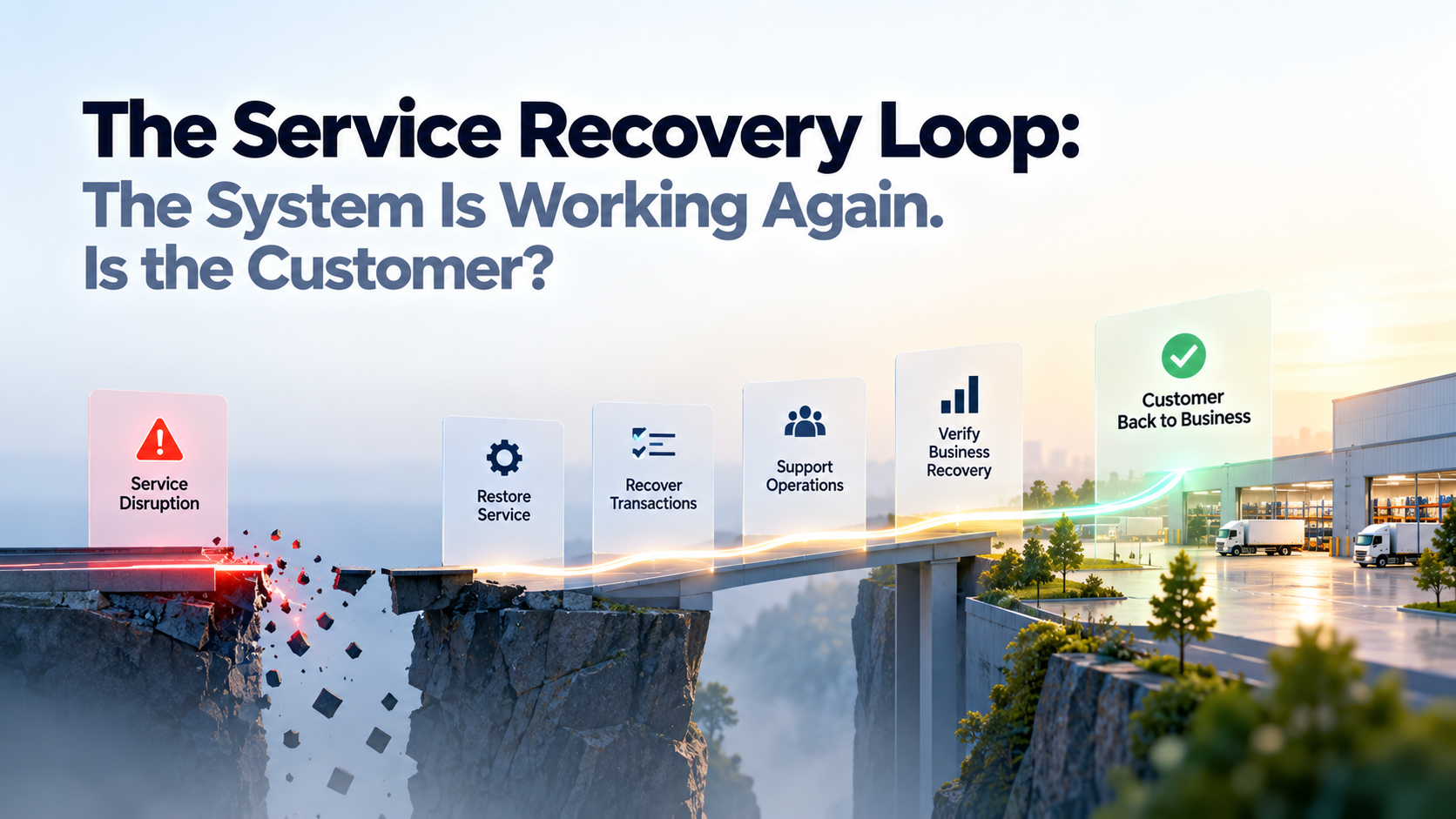
The Service Recovery Loop: The System Is Working Again. Is the Customer?
At 9:30 on a Monday morning, the support team at a software company received an urgent call from one of its largest retail customers.
An overnight integration had failed. Several hundred online orders had not reached the retailer's fulfillment system, and employees at three warehouses were trying to determine which orders needed immediate attention.
The support engineer investigated the issue and identified a configuration change that had disrupted the integration. By 10:15, the connection was restored, new transactions were flowing normally, and the incident was marked as resolved.
The support dashboard showed a successful recovery in forty-five minutes. The team had met its service-level commitment, the technical problem had been corrected, and the support ticket was closed.
But inside the retailer, the problem was far from over.
The orders that failed overnight had not automatically reappeared. Some customers had already received confirmation messages for orders that the warehouse could not see. Several orders required manual verification because employees were unsure whether retrying the transactions would create duplicates.
The warehouse manager asked the finance team to check payment records, while customer service began receiving complaints about missing delivery updates. By late afternoon, employees were still reconciling the backlog.
The software was working again, but the customer was not.
This is a hypothetical situation, but the operating problem is familiar to anyone who has supported business-critical technology. Restoring an application is not necessarily the same as restoring the customer's business.
That distinction deserves far more attention than it receives.
For decades, enterprise support organizations have concentrated on detecting incidents, resolving tickets, restoring services and meeting response-time commitments. These are important capabilities, and companies have invested heavily in the systems and practices required to perform them reliably.
Yet the customer rarely experiences an incident as a technical event alone.
The customer experiences delayed work, interrupted operations, confused employees, missed commitments and sometimes direct financial loss. When the application becomes available again, those consequences do not always disappear.
This is where a different kind of execution responsibility becomes necessary.
A Service Recovery Loop is a closed business loop that observes the impact of a service failure, coordinates the actions required to restore the customer's affected business outcome, verifies recovery and uses the experience to improve future service reliability.
The technology may be fixed in minutes. The relationship depends on what happens afterward.
1. We measure how quickly the service returns, but not always how quickly the customer recovers
Modern support systems are extraordinarily good at managing incidents.
They record when a problem was reported, how quickly someone responded, which team received the ticket, how long resolution took and whether the service-level agreement was met.
These measurements are useful because they create accountability. Without them, support organizations would struggle to prioritize work, coordinate teams or understand operational performance.
But there is a subtle problem with making the ticket the principal unit of success.
The ticket belongs to the support system. The problem belongs to the customer.
Consider the failed integration from our opening story. The technical service was unavailable for several hours overnight, and the support team successfully restored it soon after the issue was reported.
From the vendor's perspective, the incident had reached a valid technical resolution.
From the retailer's perspective, hundreds of orders still needed attention. Staff had to reconstruct what happened, check for duplicates, update customers and determine whether fulfillment commitments could still be met.
The vendor's recovery clock stopped when the integration was restored. The customer's recovery clock continued running.
Both clocks matter.
One measures the reliability and responsiveness of the technology provider. The other measures the duration of the business disruption experienced by the customer.
A support organization can improve the first without meaningfully improving the second.
This is one reason customer satisfaction can remain disappointing even when reported support performance looks excellent.
A company may consistently meet its SLAs and still create substantial work for customers after every disruption. The customer sees the total inconvenience, while the vendor measures only the portion its support process directly controls.
That difference becomes particularly important for business-critical applications.
A payroll system can return to service while employees are still waiting for payments. A healthcare application can become available while clinical teams continue reconciling records. A logistics platform can resume processing new shipments while earlier transactions remain incomplete.
These are not necessarily failures of incident management. Incident management is designed primarily to restore normal service quickly, while problem management addresses underlying causes and recurrence, a distinction recognized in established IT service management practices.
What is often missing is a persistent operating mechanism connecting technical restoration with the customer's actual business recovery.
That is the responsibility of the Service Recovery Loop.
2. The damage caused by an incident does not disappear when the incident ends
Imagine a manufacturing company that depends on a cloud application to coordinate production schedules.
The application becomes unavailable for two hours.
The vendor restores service, confirms that the application is responding normally and closes the incident. Technically, the immediate problem has been resolved.
But during the interruption, supervisors made temporary decisions using spreadsheets and telephone calls. Several production orders were rescheduled manually, and some changes were never reflected in the application.
When the system returns, it contains an incomplete picture of what actually happened on the factory floor.
The manufacturing company now faces a second problem.
It must determine which records are accurate, reconcile conflicting production information and ensure that the restored system does not trigger actions based on outdated assumptions.
If everyone simply resumes normal operations, new errors may emerge from the temporary workarounds used during the outage.
The technical incident lasted two hours. Its operational consequences may continue for days.
This creates a useful way to distinguish different states of recovery.
First, the technical service must be restored. Second, the business transactions or activities affected by the incident need to be reconciled. Third, the customer needs evidence that the agreed business operations are functioning acceptably again.
Where the incident reveals a recurring or systemic weakness, a related improvement process must also address the causes and reduce the likelihood of repetition.
These responsibilities are connected, but they should not be confused.
It would be impractical to keep every customer incident open until the organization can guarantee that nothing similar will ever happen again. No technology provider can make that promise.
A Service Recovery Loop needs a more precise closure condition.
The affected business state must be restored or brought to an explicitly accepted resolution, with remaining exceptions assigned clear ownership. Longer-term corrective work can continue through a connected engineering or problem-management process.
This matters because closure should represent an actual condition, not simply an administrative action.
For the retailer in our opening story, technical recovery occurred when the integration began functioning again.
Business recovery required something more.
The missing orders had to be identified, duplicate processing had to be prevented, fulfillment records needed reconciliation, and affected customer commitments had to be understood.
If any orders could no longer be fulfilled as promised, the retailer needed an appropriate exception or recovery process.
Only then could the vendor and customer reasonably consider the immediate business disruption resolved.
The distinction sounds obvious, but it is rarely represented as one continuous responsibility across support, engineering, operations and customer success.
3. The real problem is the space between support, engineering and customer operations
When a significant customer incident occurs, several teams may become involved.
Support diagnoses the problem and works toward technical restoration. Engineering investigates defects or infrastructure issues, while customer success manages communication and the broader relationship.
The customer's own operations team handles the immediate business disruption. Finance may become involved if transactions need reconciliation, and product management may need to consider whether the incident reveals a larger design weakness.
Each group has a legitimate role.
The difficulty begins when the problem moves between them.
Suppose support restores a failed integration but identifies a backlog requiring additional processing. Engineering needs to determine whether replaying the transactions is safe, and the customer's operations team must confirm which records have already been handled manually.
Someone creates a follow-up ticket. Someone else requests a report, while another person waits for customer confirmation.
Hours pass.
The original incident is closed, but the remaining work is scattered across several queues and conversations.
Nobody necessarily has a complete view of the customer's recovery state.
This is a familiar form of human latency.
The actual engineering work may be relatively small. The analysis required to understand the backlog might take twenty minutes, and implementing the approved correction might take another thirty.
But coordination can stretch the recovery across several days.
Support waits for engineering. Engineering waits for customer data, and the customer waits for someone to explain what action is safe.
Everyone is busy, but the outcome is not moving.
A closed Service Recovery Loop changes the continuity of responsibility.
It maintains a shared understanding of the affected business state, the required recovery actions, outstanding dependencies and evidence of completion.
If engineering needs information, the loop keeps that requirement visible. If the customer must approve an action, it preserves the context and resumes the process once the decision is available.
If an automated recovery action fails, the system observes that failure and determines what additional intervention is appropriate.
The objective is not to eliminate communication between departments.
It is to prevent the customer's business problem from becoming dormant whenever responsibility changes hands.
That requires a different kind of execution architecture.
4. The Service Recovery Loop must know what the customer was trying to accomplish
A support ticket usually begins with a symptom.
The application is unavailable. An integration failed, a report is incorrect, or a transaction cannot be completed.
Those descriptions tell the support team where to investigate.
They do not necessarily explain the business consequence.
An integration failure may be a minor inconvenience for one customer and an operational emergency for another.
A reporting issue may affect an internal dashboard or a regulatory submission. A delayed transaction may be harmless in one workflow but prevent payroll, healthcare delivery or time-sensitive logistics in another.
The same technical incident can therefore require different recovery responses.
The Service Recovery Loop must understand what the affected service was supposed to enable.
For our retailer, the integration existed to move customer orders into fulfillment. Restoring the connection matters because it supports the larger objective of processing orders accurately and delivering customer purchases.
Once the incident occurs, the loop needs to understand the affected transactions, their current state, any temporary actions already taken and the consequences of further delay.
It also needs to know which actions are permitted.
Replaying failed transactions might restore missing orders, but it could create duplicates if employees have already processed some manually. Updating customer records might correct an operational inconsistency, but changes to financial information may require additional authorization.
This is why autonomous service recovery cannot simply mean allowing an AI agent to retry every failed operation until it succeeds.
Some retries are safe. Others can make the problem considerably worse.
A reliable loop needs context, constraints and evidence.
The canonical Loop Engineering architecture describes these requirements through ten primitives: Goal, State, Context, Constraints, Actions, Observation, Evaluation, Memory, Escalation and Learning.
In service recovery, the goal is the agreed business recovery condition. State describes what is currently working, what remains affected and which transactions or activities need attention.
Context includes the customer's operating environment, contractual obligations, critical dependencies and actions already performed.
Constraints establish the boundaries within which recovery may proceed, including data integrity, security, financial authority and customer approvals.
Actions may involve technical remediation, transaction reconciliation, communication, operational workarounds or the mobilization of specialized expertise.
Observation and evaluation determine whether those actions actually improved the customer's condition.
Memory preserves the incident history, while escalation brings in the appropriate people when a decision exceeds the system's authority. Learning helps the organization improve future recovery procedures and identify recurring weaknesses.
Together, these capabilities create an operating system for recovery rather than another sequence of support tasks.
The principle is straightforward.
A recovery action has not succeeded merely because the system executed it. It succeeds when the affected business state has been verified against an agreed condition.
5. The customer should not have to become the integration layer
One of the more frustrating experiences in enterprise support occurs when the customer must coordinate the vendor's internal teams.
The customer reports a problem to support. Support asks engineering, engineering requests information from another team, and customer success joins when the situation becomes commercially sensitive.
Each interaction may be reasonable.
But the customer repeatedly explains the same problem.
They send screenshots, provide logs, describe the business impact and answer questions that were already covered in earlier conversations.
Eventually, the customer starts coordinating the recovery process simply because no single system or person maintains the complete picture.
This is an expensive way to manage a customer relationship.
It also changes how customers perceive the vendor.
A technical failure can be forgiven, particularly when the vendor responds responsibly and communicates clearly. But being forced to chase several teams while the business remains disrupted can create a much deeper loss of confidence.
The problem is no longer only the defect.
It is the customer's experience of working with the company that caused or failed to prevent it.
A well-engineered Service Recovery Loop should reduce that burden.
The customer should not need to determine which internal department owns the next action. The recovery system should maintain that responsibility and coordinate the required capabilities behind the scenes.
It should preserve the information already collected, communicate meaningful progress and avoid repeatedly asking for details that are available in connected systems.
This does not mean overwhelming customers with automated messages.
In fact, one of the better outcomes may be fewer communications.
Customers do not necessarily want hourly updates containing little new information. They want to understand what happened, what is being done, whether there is anything they need to do and when they can reasonably expect the next meaningful development.
Some situations require immediate communication. Others benefit from a carefully agreed update cadence.
The loop should support that judgment.
It should also recognize when the appropriate response is not another message but an actual operational intervention.
If a failed integration requires a specialist to reconcile data, generating a beautifully written apology does not solve the problem.
The organization needs the specialist.
That brings us to a challenge many enterprise support organizations encounter as their products and customers become more complex.
6. When recovery needs engineering, who brings the engineers?
Consider a software company serving several hundred enterprise customers.
Its support organization handles everyday incidents efficiently. The team can resolve common configuration problems, explain product behavior and escalate more difficult issues to engineering.
But certain customer problems do not fit neatly into a standard support process.
A customer has a specialized integration that needs modification. Another has accumulated inconsistent records after a system interruption, while a third has changed its operating process and now requires adjustments to the workflow.
The support team understands the problem, but resolving it requires execution capacity beyond ordinary incident handling.
Engineering has competing product priorities. Professional services may be structured around separate projects, and the customer success manager has neither the authority nor the technical resources to perform the necessary work.
The customer's problem remains open.
This is where conventional organizational boundaries begin to work against the desired outcome.
The business has technical knowledge somewhere. It has engineering capability somewhere else, and it may even possess AI tools capable of accelerating diagnosis, integration and remediation.
But those capabilities are not organized around the customer's immediate recovery objective.
The company needs a way to bring them together without assembling a permanent team for every complex customer issue.
This is where the Virtual Delivery Center model becomes valuable.
A Service Recovery VDC provides on-demand execution capacity combining the appropriate engineers, domain specialists, AI agents and tools around a defined recovery outcome.
It is not simply another support queue or an external staffing arrangement.
The VDC is responsible for engineering and delivering the approved recovery work, while the enterprise retains the relevant business, security and operational authority.
Return to the retailer's failed order integration.
A Service Recovery VDC could bring together an integration engineer, a data specialist and the relevant customer-domain expertise to understand the affected transactions and design a safe recovery process.
AI tools may help inspect logs, identify transaction patterns, compare source and destination records and prepare reconciliation reports.
The engineers validate the proposed actions and execute them within the permitted environment.
The system then verifies whether the missing orders have been accounted for, whether duplicates have been avoided and whether the customer's fulfillment operation has returned to an acceptable state.
When an exception requires human judgment, the relevant person is brought into the process with the necessary evidence.
The loop maintains continuity, while the VDC supplies the capability to make meaningful changes.
At AiDOOS, this is the relationship we see between Loop Engineering and Virtual Delivery Centers.
Loop Engineering defines how a business outcome is observed, pursued, verified and improved. The VDC provides the coordinated execution capacity to build and operate the capabilities required to close that loop.
This distinction matters because AI agents alone may not possess the authority, domain knowledge or engineering access needed to resolve a complex customer problem.
The answer is not always more autonomous agents.
Sometimes the answer is a qualified engineer with the right context. Sometimes it is a domain specialist who understands the customer's process, and sometimes it is a controlled software change that must be designed, tested and deployed.
The VDC brings those capabilities together when they are needed.
The enterprise can then scale that execution capacity according to the complexity and volume of recovery work, rather than maintaining a permanently enlarged internal team for every possible situation.
7. Every recovered incident should make the next incident less expensive
There is another dimension to service recovery that may prove even more valuable over time.
Learning.
Most organizations already conduct some form of incident review, root-cause analysis or corrective-action process, especially after significant failures.
That is established good practice.
The opportunity with Loop Engineering is to connect what the organization learns from recovery with the systems and procedures used in future execution.
Suppose several customers experience similar problems after a particular integration change.
Each incident is resolved. Support documents the workaround, engineering makes corrections, and customer success ensures that affected customers receive appropriate communication.
But what happens to the accumulated evidence?
Does it change how future integrations are tested? Does it lead to better monitoring, safer deployment procedures or earlier detection of inconsistent transactions?
Does the organization recognize that a recurring customer recovery task could be automated safely, or that a frequently requested workaround indicates a product-design weakness?
If the answer is no, the company is paying repeatedly to rediscover the same problem.
A Service Recovery Loop should help the organization distinguish immediate adaptation from longer-term learning.
Adaptation changes the response to the current situation. Learning changes the operating system so that future situations can be handled more effectively.
The difference is important.
An engineer may discover a safer way to reconcile transactions after an integration failure. That approach can become a verified recovery procedure rather than remaining inside one person's experience.
A customer may repeatedly encounter a problem because an implementation assumption no longer matches its business process. The lesson may require changes to onboarding or integration design.
A support team may notice that incidents classified as low priority frequently create substantial downstream operational work for a particular customer segment.
That evidence may justify changing the prioritization model.
Not every incident requires a major engineering investigation. The cost of prevention must be weighed against the frequency, severity and likely consequences of recurrence.
A minor inconvenience experienced once may not justify substantial investment. A small technical defect that repeatedly interrupts business-critical transactions may deserve immediate attention.
The learning system needs to understand those economics.
This is where a VDC can create value beyond the individual recovery.
The same engineering capability that resolves customer problems can turn verified solutions into reusable assets, improve integrations and help strengthen the underlying product or operating environment.
Over time, more incidents can be prevented, detected earlier or recovered from with less intervention.
That is a stronger outcome than simply reducing the average number of minutes needed to close a ticket.
It means the organization is becoming better at protecting the customer's business.
8. The next generation of customer service may be measured by business recovery
Imagine a customer support dashboard several years from now.
It still shows response times, incident severity, technical resolution and SLA performance. Those metrics remain essential because customers need reliable services and accountable support organizations.
But alongside them is a different view.
The organization can see how long customers remain operationally affected after technical restoration, which incidents leave unresolved downstream consequences and where recovery depends on manual coordination.
It can measure the proportion of affected transactions successfully reconciled, the frequency of repeat incidents and the amount of execution effort required to restore business operations.
For some customers, recovery may mean restoring transaction processing and verifying data integrity. For others, it may mean resuming production, reconciling financial records or ensuring that interrupted customer commitments have been addressed.
The appropriate metrics will differ by industry and service.
A healthcare application, a logistics platform and a financial system should not share an identical definition of recovery simply because they all generate support tickets.
This is precisely why Loop Engineering begins with the business outcome.
The customer and provider need to agree on what matters, what can be observed, what the provider can reasonably control and what constitutes acceptable closure.
The system should then make it possible to maintain responsibility for that outcome across the necessary people, applications and engineering capabilities.
This also creates a more credible way to evaluate AI investments in customer service.
A company may deploy a highly capable support agent that resolves thousands of common questions without human intervention. That can be valuable, particularly when customers receive accurate answers quickly.
But automated ticket resolution alone does not establish that the broader customer experience has improved.
The company should also examine repeat contact, unresolved business impact, customer effort, recovery time and whether automated responses are masking problems that require actual intervention.
A lower support cost can be a meaningful business result. It becomes less attractive if customers must spend substantially more effort resolving the consequences themselves.
The strongest service organizations will understand both sides of that equation.
They will use AI to improve response speed and knowledge access, but they will also use Closed Loops to maintain accountability for what happened after the initial response.
And when the recovery requires engineering rather than communication, they will have a practical way to mobilize the necessary execution capacity.
That is where the combination of Loop Engineering and Virtual Delivery Centers becomes particularly compelling.
Return to the retailer from the beginning of our story.
The integration fails overnight, and the technical team restores service on Monday morning. This time, however, the recovery process does not end with confirmation that new transactions are flowing.
The system identifies the affected orders and makes the remaining business impact visible. The appropriate specialists are engaged to reconcile the records, validate safe recovery actions and help the retailer restore its fulfillment process.
The customer receives meaningful information about what has been corrected and what still requires attention.
Once the agreed recovery conditions have been met, the immediate business loop can close. The incident evidence then informs a connected engineering effort to reduce the likelihood or impact of similar failures.
The software company has not become infallible. Its systems can still fail, customers can still encounter problems, and some incidents will always require difficult human decisions.
But the customer no longer has to assume that the vendor's responsibility ends when the technical dashboard turns green.
The organization has learned to follow the problem all the way to its business consequences.
That is a significant change in how we think about customer service.
The next great service organization may not be the one that closes the most tickets or produces the fastest automated responses.
It may be the one that understands what its customers were trying to accomplish, recognizes when that outcome has been interrupted and has the execution capability to help restore it.
Because when a customer calls to report that something is broken, they are rarely asking for a ticket to be closed.
They are asking to get their business working again.
And that is the outcome worth engineering.