
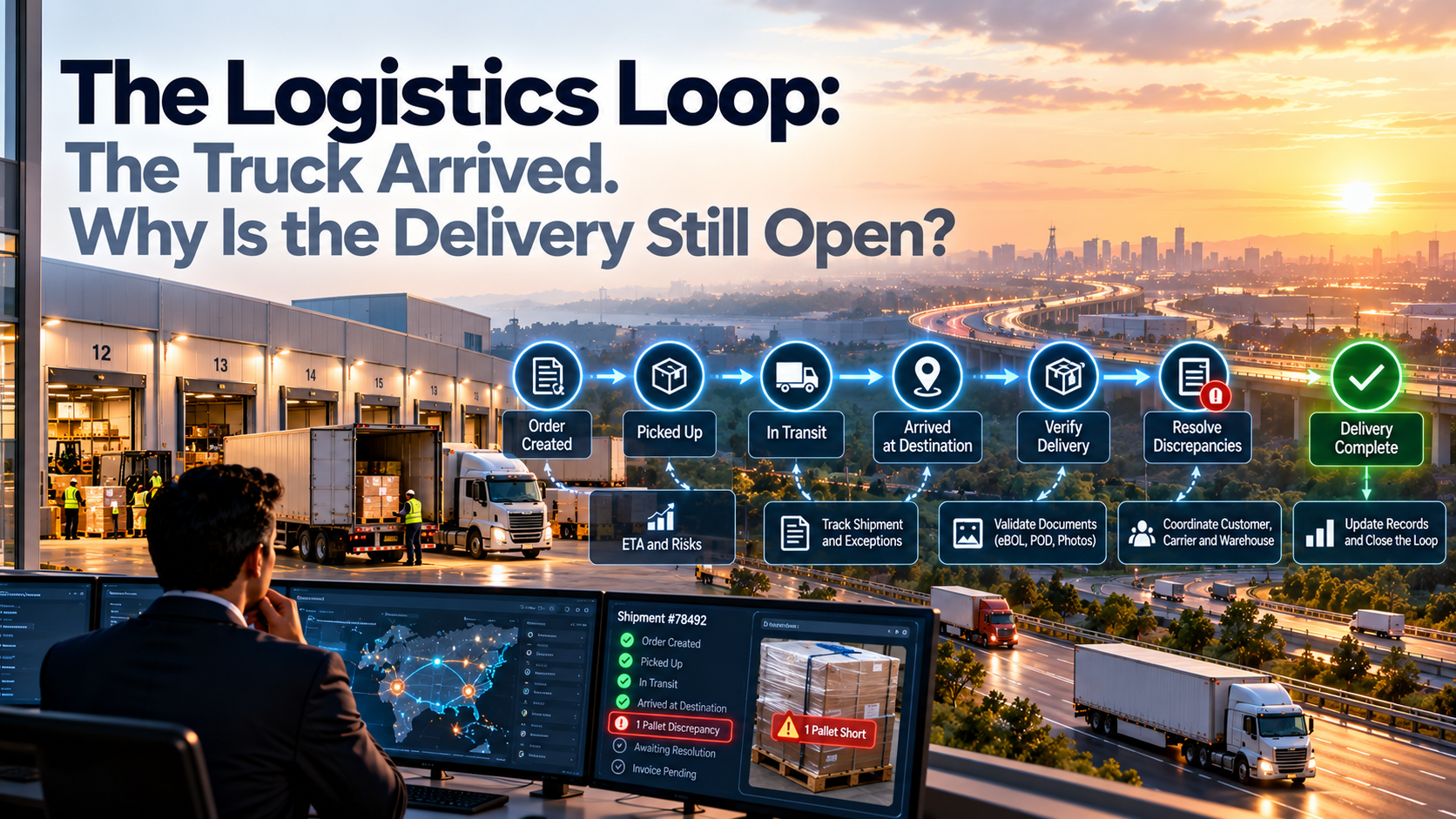
The Logistics Loop: The Truck Arrived. Why Is the Delivery Still Open?
The truck arrived at the customer's warehouse at 8:12 AM, almost twenty minutes ahead of schedule. The transportation management system recorded a successful delivery, the tracking dashboard turned green, and the dispatcher moved on to the next shipment.
By every conventional operational measure, the delivery appeared successful.
But something happened at the unloading dock that the tracking system did not know. The customer had ordered 28 pallets, but only 27 were accepted. One pallet had been damaged, and the receiving clerk recorded the discrepancy on a paper document that the driver photographed before leaving.
The truck departed. The shipment status remained "Delivered."
Two days later, the customer's accounts payable team rejected the invoice because the billed quantity did not match the goods received. The carrier's operations team believed the delivery was complete, the customer believed there was an unresolved shortage, and the finance team could not determine which record represented the truth.
Someone began searching for the photograph. Another person called the driver. The warehouse checked its receiving records, while customer service tried to establish whether a replacement had been promised.
A shipment that appeared to be completed in the transportation system was still creating work across four organizations.
Nothing particularly unusual happened here. Anyone who has spent time around logistics operations will recognize some version of this story, whether the shipment involves pallets of groceries, industrial components, fuel, construction materials or consumer products.
The surprising part is how much technology can be working correctly while the actual business outcome remains unresolved.
The GPS worked. The truck arrived. The driver completed the trip. The transportation system updated its status. The electronic records were available somewhere.
Yet the customer did not receive everything expected, the discrepancy was not resolved, and the invoice could not proceed cleanly.
This is the gap between tracking a shipment and completing a business outcome. It is also why logistics offers one of the most compelling opportunities for Loop Engineering.
1. We have become very good at tracking movement
Modern logistics companies can see things that would have been almost impossible a generation ago. They can track vehicles across countries, estimate arrival times, monitor equipment, optimize routes, exchange electronic documents and coordinate thousands of shipments through sophisticated transportation management systems.
Telematics tells fleet operators where their trucks are. Mapping systems calculate expected arrival times, warehouse management platforms record inventory movements, and electronic proof-of-delivery systems help drivers document what happened at the destination.
These technologies have transformed logistics, and the benefits are real. Transportation operations are more visible, measurable and digitally connected than ever before.
But most of these systems were designed around a particular part of the journey.
The TMS manages transportation execution. Telematics observes the vehicle. The warehouse system manages goods within a facility. The delivery application captures the driver's activity, while the ERP or accounting system manages the commercial transaction.
Each application provides an important piece of the story.
The problem is that the business outcome does not belong entirely to any one of them.
Consider the phrase "on-time delivery." It sounds like a straightforward metric, but what does it actually mean?
Did the truck reach the customer's gate before the appointment? Did it enter the warehouse? Was unloading completed within the agreed window? Were the correct goods received in acceptable condition? Was the delivery documentation accurate and accepted?
A transportation provider may legitimately measure on-time arrival, while the shipper cares about complete and acceptable receipt. Both metrics matter, but they describe different states.
A truck can arrive on time and wait six hours to unload. A shipment can reach the correct facility but contain the wrong product. Goods can arrive in full while the paperwork contains errors that prevent settlement.
We have invested heavily in knowing where shipments are. We have invested less consistently in ensuring that the intended delivery outcome has actually happened.
That is the difference between visibility and closure.
2. Logistics is not a sequence of trips. It is a network of promises
Every shipment begins with a promise.
Someone expects something to move from one location to another, under agreed conditions, within an acceptable period, at a commercially viable cost.
That promise becomes a collection of activities. An order is created, capacity is assigned, a carrier is selected, pickup is scheduled, the goods are loaded, the vehicle departs and delivery begins.
But physical movement is only one part of fulfilling the promise.
A shipment may require temperature control, handling instructions, special equipment, security requirements, regulatory documentation, appointment scheduling or proof that a particular quantity was actually received.
In fuel transportation, for example, a truck reaching a customer's location is not sufficient evidence that the delivery was completed correctly. The loaded quantity, delivered quantity, delivery location, transaction documents and any discrepancies may all matter to the final business record.
In refrigerated transportation, arriving on schedule does not compensate for a product that has experienced unacceptable temperature conditions. In industrial logistics, a shipment may be physically present but unusable because it fails inspection or arrives without required documentation.
The meaning of delivery changes with the business context.
That is why a universal "Delivered" status can hide enormous operational complexity.
The real outcome must be defined in the language of the customer's promise, rather than only in the language of the transportation event.
For one shipment, closure may require confirmed arrival, accepted quantity and a valid proof of delivery. For another, it may include temperature compliance, reconciliation of measured quantities or completion of a specialized receiving procedure.
Some exceptions may be resolved immediately, while others need a formal dispute or recovery process. A properly engineered loop must know which conditions constitute successful closure, which require continued action and which represent an accepted exception.
The essential point is that the loop should not lose responsibility simply because the truck has finished moving.
This is where logistics starts looking very different from a collection of transportation workflows.
It becomes a continuously managed system of commercial and operational commitments.
3. The most expensive miles may be the ones nobody drives
Transportation companies naturally measure distance, fuel, equipment utilization, driver productivity, empty miles and cost per shipment. Those metrics have a direct relationship with profitability, so they receive considerable attention.
But an enormous amount of logistics friction occurs when nothing is moving.
A driver arrives at a loading facility and waits for a dock. A delivery appointment must be changed, but the customer's receiving team has not responded. A dispatcher has identified a better route, but the change requires approval from another party.
An electronic document is missing, so the invoice cannot be finalized. A delivery discrepancy remains unresolved because nobody has reconciled the driver's photograph with the customer's receiving record.
These delays rarely look dramatic in isolation.
A few minutes here, an hour there, an email left unanswered until tomorrow. Yet they accumulate across thousands of shipments and create a substantial operational burden.
We explored this in our earlier article on Human Latency, where the central argument was that AI can make individual tasks nearly instant while the business continues operating at human speed.
Logistics makes that contradiction particularly visible.
An AI model may detect a likely delay within seconds, but if the dispatcher sees the alert an hour later, another hour passes before the customer responds, and a replacement appointment is not confirmed until the next morning, the intelligence has done little to eliminate the underlying latency.
The same pattern appears after delivery.
A document-scanning system can extract information from a bill of lading or proof of delivery almost immediately. But if the extracted information sits in a queue waiting for a person to reconcile a mismatch, much of the potential cycle-time improvement disappears.
The important opportunity is not simply to accelerate each task. It is to reduce the intervals during which an important business commitment remains unattended.
Consider the economics of a truck waiting at a facility.
The delay may affect driver hours, equipment availability, the next pickup, customer expectations and the profitability of the entire route. Recovering from that delay can require several additional decisions, each introducing another opportunity for waiting.
The cost is not contained in the original delay. It can propagate through the network.
This is why logistics businesses are particularly sensitive to execution latency. A disruption in one part of the operation can change the economics of several activities that follow.
A system that identifies the disruption early, evaluates its consequences and keeps the necessary recovery actions moving may create more value than one that simply optimizes the original route.
The challenge is not only moving freight efficiently. It is preventing the business from becoming stuck whenever reality deviates from the plan.
4. What would a genuine Logistics Loop look like?
Imagine a carrier moving a shipment from a distribution center to a large retailer. The delivery is scheduled for 9 AM, and the customer requires an appointment, confirmation of received quantities and accurate delivery documentation.
A conventional system plans the route, tracks the vehicle and generates alerts when the estimated arrival time changes.
A closed Logistics Loop begins earlier and remains active longer.
Its goal is to fulfill the delivery commitment within defined service, safety, commercial and operational constraints. It understands the shipment, the customer requirements, the driver's availability, the receiving facility, the documentation requirements and the available recovery options.
Suppose traffic disruption causes the estimated arrival time to move from 8:45 AM to 10:20 AM.
The loop recognizes that the delay may jeopardize the customer's receiving appointment. Rather than merely notifying a dispatcher that the truck is late, it examines whether the delivery commitment can still be preserved.
Can the facility accommodate the revised arrival? Is another appointment available? Would a permitted route change help? Does the customer's unloading operation have flexibility, or will the driver be turned away?
The system should not automatically choose the fastest route or the most expensive recovery action.
It needs to understand the cost and consequence of each alternative, including driver-hours regulations, safety requirements, customer agreements, equipment availability and downstream commitments.
If the appropriate response falls within authorized limits, the loop can initiate the relevant actions. If approval is required, it can present the decision to the responsible person with sufficient context.
The human remains accountable for decisions requiring human authority, but the process does not lose continuity while waiting for that decision.
After the intervention, the loop observes what actually happened.
Did the customer confirm the revised appointment? Did the driver receive the updated instructions? Is the truck still moving toward the intended destination? Has another disruption occurred?
Now suppose the truck arrives, but the customer reports a quantity discrepancy.
The loop does not treat arrival as successful closure. It collects the available evidence and determines whether the discrepancy reflects a loading error, receiving error, documentation issue or genuinely missing material.
It may compare the original order, loading record, bill of lading, delivery confirmation and receiving information. Where evidence is incomplete, the loop can request clarification from the appropriate person or system.
A driver photograph becomes useful here, not merely as an image stored somewhere, but as evidence that can be interpreted and reconciled against the expected delivery state.
Once the discrepancy is understood, the loop can initiate the appropriate resolution process. Depending on the circumstances, that might involve a correction, claim, replacement shipment, customer acknowledgment or authorized commercial adjustment.
Only when the defined closure conditions are satisfied does the shipment reach its terminal outcome.
This does not mean every delivery must remain open until the invoice is paid. That would confuse the Logistics Loop with the Cash Loop.
Instead, the Logistics Loop should produce a verified delivery outcome that downstream financial processes can trust. Where a commercial dispute remains unresolved, it should hand off a clearly defined exception with evidence and ownership rather than silently declaring success.
That is a much more reliable foundation for the rest of the business.
5. The gap between physical reality and digital records is where much of the work lives
There is a particularly important challenge in logistics that is easy to underestimate.
Physical operations do not naturally produce perfect digital records.
A driver takes a photograph under poor lighting. A handwritten bill of lading contains an ambiguous quantity. A customer signs a document but adds a note about damaged goods. A loading facility uses a different reference number from the customer's purchasing system.
A shipment may involve several carriers, brokers, terminals, warehouses and customers, each maintaining its own records and terminology.
This is where logistics becomes more complicated than the status fields suggest.
Even when an organization has invested in digitization, important information may still arrive through scanned documents, emails, images, spreadsheets and conversations.
Modern AI can help substantially.
Document-understanding systems can extract information from bills of lading, proof-of-delivery records, receipts and related documents. Language models can help interpret unstructured notes, while software can reconcile extracted information against orders, shipment records and customer requirements.
But extraction alone is not enough.
Suppose the original shipping document shows 12,000 units and the receiving document shows 11,850. The AI may read both numbers accurately.
What happened to the remaining 150 units?
Were they damaged? Were they rejected? Was the original count wrong? Did the shipment include an authorized partial delivery? Is the receiving document incorrect?
An accurate AI extraction does not answer those questions by itself.
The system needs to establish what the business considers authoritative, identify the discrepancy, gather supporting evidence and determine the appropriate resolution path.
This is where verification becomes central to Loop Engineering.
The objective is not merely to digitize the paperwork. It is to make sure that the digital record corresponds to what actually happened in the physical world.
That distinction matters for billing, claims, customer service, regulatory compliance and operational learning.
A carrier may process thousands of delivery documents through AI and report an impressive automation rate. Yet if unresolved discrepancies continue delaying invoicing or damaging customer relationships, the organization still has an open business problem.
The real measure is how many deliveries reach a trustworthy, financially usable state without unnecessary manual intervention.
The last mile of data accuracy can sometimes be as important as the last mile of transportation.
6. Who builds the loop across all these systems?
The conceptual value of a Logistics Loop is relatively easy to understand. Building one that operates reliably inside a real transportation business is much harder.
A carrier may use one system for dispatch, another for telematics, a third for document capture and a separate accounting platform. Its customers may require integrations with their own ERPs, warehouse systems or transportation platforms.
A broker may have access to carrier milestones without controlling the physical operation. A shipper may control the customer promise without controlling the driver. A warehouse may own receiving confirmation without owning the transportation contract.
Every party sees part of the journey.
For a loop to work, someone has to connect those parts while respecting the authority and limitations of each participant.
That requires much more than configuring an agent.
The engineering team needs to understand how loads are created, how dispatch changes occur, how pickup and delivery states are recorded, how exceptions are communicated and how documents become accepted transaction records.
It also needs to understand where automation can safely take action and where a human or external party must remain responsible.
An AI agent cannot create a warehouse appointment if the receiving facility does not permit automated scheduling. It cannot change a customer's receiving quantity without authorization, and it should never direct a driver to violate safety or hours-of-service requirements simply to preserve a delivery target.
These constraints are not inconveniences to engineer around. They are part of the system's definition of correct behavior.
There is also a practical reality that many AI discussions overlook.
A transportation company cannot stop operating while a new execution architecture is being built.
Shipments continue moving. Drivers need instructions. Customers expect deliveries. Finance needs accurate records, and existing systems must remain reliable.
The engineering challenge is therefore to introduce the loop incrementally, verify its performance and expand automation only when the organization has sufficient evidence that it is safe and useful.
This is where the Virtual Delivery Center becomes an important part of the story.
7. The VDC is the execution capacity behind the Logistics Loop
A Virtual Delivery Center is an on-demand execution capability that brings together people, AI agents, tools and specialized engineering expertise around a defined business outcome.
For a transportation company, that means the objective is not simply to hire developers or deploy an AI assistant.
The objective might be to reduce the time between delivery and verified proof-of-delivery acceptance, lower avoidable delivery exceptions, or improve recovery from delayed shipments.
Those are outcomes the business can measure.
A VDC begins by understanding the operating environment and determining which part of the Logistics Loop offers the most useful starting point.
For one carrier, the problem may be delivery-document reconciliation. For another, it may be dispatch exceptions and appointment changes. For a third, the greatest opportunity may be reducing the delay between shipment completion and invoice readiness.
The right starting point depends on where the business loses money, time or customer confidence.
Consider a carrier whose drivers routinely capture delivery documents through a mobile application, but whose back office still spends substantial effort reading those documents and reconciling them against orders.
A VDC could begin with that narrow problem.
The team maps the actual document flow, connects the mobile capture system with the relevant shipment and order records, introduces AI-based extraction and establishes verification rules.
It then designs the exception process.
Documents that match confidently can proceed through authorized automated processing. Documents containing discrepancies, uncertain readings or unusual conditions are routed to the appropriate person with the relevant evidence already assembled.
The important part comes after the initial implementation.
Does the system reliably identify mismatches? Does it avoid incorrectly accepting questionable documents? Do customer disputes decrease? Does the time from delivery to accepted documentation improve?
What happens when a customer introduces a new form, the carrier adds a different type of equipment or an integration changes?
The VDC continues improving the capability as operational experience accumulates.
Once document reconciliation is reliable, the company may extend the same execution capacity into another part of the Logistics Loop.
Perhaps late-delivery prediction becomes linked with customer appointment coordination. Perhaps dispatch exceptions are automatically investigated before reaching a human. Perhaps recurring dwell-time problems are identified and used to improve future planning.
Each additional loop can reuse engineering assets, integrations, verification methods and operational knowledge developed earlier.
This matters because the expensive part of enterprise AI is often not the intelligence itself. It is getting that intelligence to function reliably within the messy realities of business systems and workflows.
A conventional technology project can declare completion when the software goes live.
An outcome-oriented VDC has to care about what happens afterward.
Is the loop operating? Is it producing the expected business result? Are exceptions being resolved? Does the system improve as the organization learns?
At AiDOOS, this is the relationship we see between Loop Engineering and the Virtual Delivery Center model.
Loop Engineering defines the discipline required to turn business objectives into continuously operating, verifiable outcomes. The VDC provides the coordinated execution capacity to build, operate and improve those loops.
That does not mean the VDC replaces the carrier's dispatchers, operations managers or technology systems.
It makes those capabilities work together around the business outcome.
A dispatcher should not need to become an integration engineer. An operations manager should not need to build document-understanding models. An internal IT team should not be forced to create an entirely new permanent organization every time the company discovers another valuable loop.
The VDC brings together the relevant capabilities when needed, while the transportation business retains operational authority and ownership of its customer commitments.
This is how the loop moves from an interesting architectural idea to something the enterprise can actually operate.
8. The future of logistics is not better tracking. It is reliable completion.
There is an interesting contradiction in logistics today.
Customers can sometimes track a package across the world in remarkable detail, yet the companies involved may still struggle to determine why the final delivery record does not match the original commercial agreement.
The truck's location is visible. The operational truth is fragmented.
That gap creates a significant opportunity.
Imagine a transportation network where each shipment carries a persistent understanding of its objective, constraints, current state, exceptions and remaining obligations.
A delay would not simply generate an alert. It would initiate a reasoned recovery process.
A delivery would not automatically become successful because a vehicle reached the destination. The relevant receipt conditions and evidence would be verified.
A document discrepancy would not disappear into a back-office queue. It would remain part of an actively managed resolution process.
And every completed shipment would contribute operational learning.
The system could identify locations where drivers repeatedly experience excessive dwell, customers whose receiving processes create frequent discrepancies, routes where predicted recovery actions rarely work and documentation patterns that consistently delay settlement.
Those insights could inform future planning and operating policies.
Over time, the logistics organization becomes better not only at moving shipments, but also at understanding what prevents successful completion.
That is an important distinction.
A company might have excellent vehicle utilization and still struggle with customer exceptions. It might meet arrival targets while losing money through detention, rework, documentation delays and preventable disputes.
Closed Loops give leadership a way to examine the entire outcome rather than only the activity performed.
The relevant performance measures may include verified on-time and in-full delivery, exception resolution time, documentation acceptance, avoidable dwell, cost of recovery, shipment-to-invoice readiness and the level of human intervention required.
Not all of these metrics will matter equally to every carrier, shipper or logistics provider. The correct measurement depends on the business model, contractual commitments and the particular loop being engineered.
But the operating principle remains the same.
Success should be defined by the state the business needed to achieve, supported by evidence that the state was actually reached.
This also changes how we should think about logistics AI investments.
A company may already possess telematics, route optimization, a transportation management system, electronic documentation and powerful AI infrastructure. Buying another application may improve one part of its operation, but it will not automatically connect the entire outcome.
The missing capability may be execution continuity.
The ability to recognize that the desired state has not yet been reached, determine what needs to happen next, coordinate the required actors and continue until closure is verified or the exception is deliberately resolved.
That is where Loop Engineering becomes valuable.
And that is where a Virtual Delivery Center can provide the engineering capacity to make it real without requiring a wholesale replacement of the company's existing systems.
The next generation of logistics businesses may not be distinguished simply by how accurately they can predict arrival times.
They may be distinguished by how reliably they can keep customer commitments alive, recover from disruption, establish the truth of what happened and complete the business transaction with minimal unnecessary friction.
Return to the truck from the beginning of our story.
It arrived early. The driver followed the process, the tracking system worked, and the customer received most of the shipment. Nobody set out to create a dispute.
The problem was that the systems stopped treating the delivery as an active responsibility before the actual business outcome was resolved.
Now imagine the same delivery with a properly engineered loop.
The discrepancy is captured at the dock, reconciled against the shipment record and immediately made visible to the relevant parties. The required corrective action is identified, authorized where necessary and monitored until the delivery record reaches an accepted state.
The driver can continue working. The dispatcher can manage the fleet, and the customer can see what is being done about the discrepancy without repeatedly asking for updates.
The business no longer depends on someone discovering two days later that the delivery was not quite finished.
This is not about replacing human judgment with blind automation. It is about ensuring that a business commitment does not lose momentum simply because responsibility moves between systems and people.
For decades, logistics technology has helped us move freight more efficiently and see where it is along the way.
The next challenge is making the entire journey accountable to the outcome.
Because the truck arriving was never the whole promise. The promise was that the delivery would be completed correctly.
And that is what the Logistics Loop is designed to achieve.