
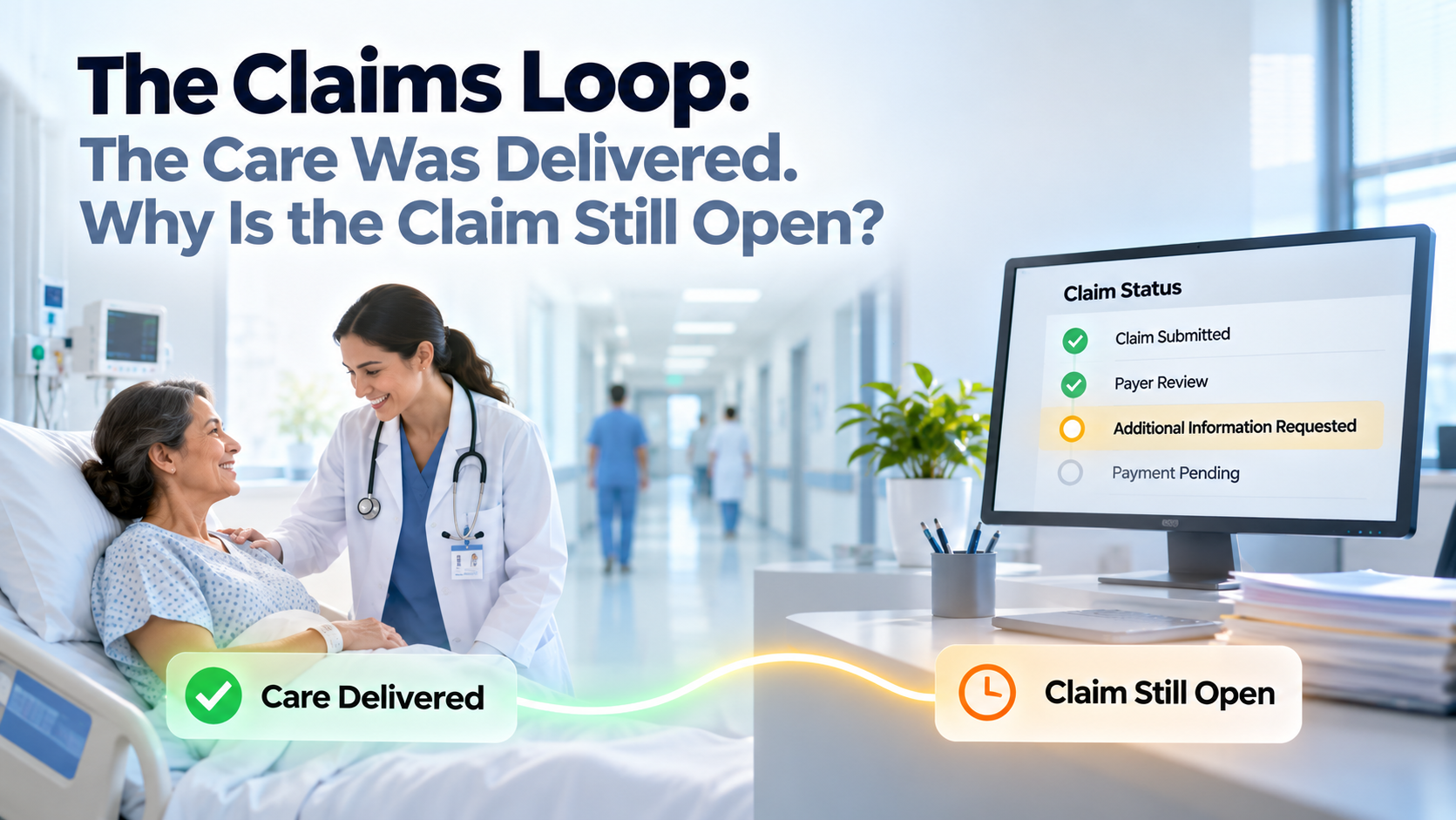
The Claims Loop: The Care Was Delivered. Why Is the Claim Still Open?
The patient had been discharged three weeks earlier.
She had arrived at the hospital with severe abdominal pain, undergone diagnostic tests, received treatment and returned home after her condition stabilized. Her physician had completed the clinical work, the nursing team had documented the care, and the hospital had recorded the encounter in its electronic health record.
From the patient's perspective, the most important outcome had been achieved. She had received the care she needed and was recovering.
But inside the hospital's revenue-cycle department, the same encounter was still an unfinished transaction.
The claim had been submitted to the health insurer, but payment had not arrived. A billing specialist eventually discovered that the payer required additional documentation to support one of the billed services.
The requested information existed in the patient's clinical record. Unfortunately, it had not reached the payer in the form required for claim adjudication.
The billing specialist contacted the coding team. Coding asked for clarification from the clinical documentation team, which needed to review the physician's notes. The physician, meanwhile, was attending to patients and had several other administrative requests awaiting attention.
Days passed before the necessary clarification was completed.
The claim was resubmitted, but the payer's next response identified another issue involving the original authorization record. The revenue-cycle team now had to investigate whether the authorization covered the specific services performed.
Another round of work began.
The hospital had delivered the care, documented the encounter, submitted a claim and responded to the payer's questions. Every participating department had performed work, and several different systems had recorded their activities.
Yet the financial outcome remained unresolved.
The patient's treatment was complete. The hospital's administrative process was still moving through a maze of disconnected actions, delayed responses and uncertain next steps.
This is an illustrative scenario, but the underlying problem is familiar throughout healthcare.
Hospitals have invested heavily in electronic health records, revenue-cycle management systems, clinical documentation tools, coding software, clearinghouses and increasingly sophisticated AI applications. These technologies have transformed how information is captured and processed.
But a hospital can possess all of those capabilities and still struggle to convert valid claims into timely, accurate reimbursement.
The problem is not always that the organization lacks information. Frequently, the information exists but is distributed across systems, departments and external organizations that do not operate as one continuous execution process.
This is the opportunity behind what we call the Claims Loop.
A Claims Loop is a closed business loop that continuously coordinates the documentation, validation, submission, adjudication, exception handling and financial reconciliation required to bring a healthcare claim to an accurate, authorized and verifiable resolution.
Its purpose is not to maximize reimbursement regardless of medical or contractual correctness. It is to ensure that valid claims move toward their rightful financial outcome without unnecessary delays, errors or repeated administrative effort.
That is a much more meaningful objective than simply processing claims faster.
1. Healthcare has digitized the records. The business process remains fragmented.
Walk through a modern hospital and the amount of technology supporting clinical and administrative operations is remarkable.
Physicians document patient encounters through electronic health records. Clinical coding systems help translate documented services into standardized codes, while billing platforms prepare claims for submission.
Clearinghouses validate and transmit electronic claims. Health plans receive those claims, apply their own administrative and coverage rules, and return acknowledgments, payment decisions or requests for additional information.
Revenue-cycle management systems track the financial process, while reporting platforms measure outstanding receivables, denials, payments and other operating indicators.
Each system addresses a legitimate requirement.
The EHR is designed around clinical care and documentation. The coding system supports accurate representation of services, and the billing system prepares transactions according to payer and regulatory requirements.
The payer's systems evaluate claims according to coverage, benefits, contractual arrangements and applicable rules.
Yet the financial journey crosses all of them.
A physician may correctly document a clinical encounter while the billing system still lacks a required administrative field. A claim may pass initial electronic validation but encounter a coverage-related denial during adjudication.
A payer may request supporting documentation that exists in the hospital's record but is not readily accessible to the team responsible for responding.
None of these conditions necessarily indicates that the underlying medical care was inappropriate.
They may simply reveal a gap between the clinical event, its administrative representation and the requirements of the organization responsible for payment.
The Centers for Medicare & Medicaid Services explains that electronic claims pass through multiple levels of editing, including basic format checks and subsequent coverage and payment-policy evaluation. A claim rejected during initial validation is not necessarily the same as one denied after payer adjudication.
That distinction matters because different problems require different actions.
A formatting rejection may need a corrected electronic submission. A documentation question may require additional evidence, while a coverage denial may require a qualified review of policy, medical necessity, contractual provisions and appeal rights.
The hospital needs to understand which situation actually exists before deciding what should happen next.
Its systems may record all these events correctly.
But recording a sequence of events is not the same as maintaining responsibility for resolving the underlying financial outcome.
That is where the administrative process can remain fragmented despite extensive digitization.
2. A submitted claim is not a completed financial transaction
Consider what happens when a hospital submits a claim.
The billing system creates an electronic transaction containing the required patient, provider, service, coding and other administrative information. The claim moves through the relevant processing channels toward the payer.
When the transmission is accepted, the hospital may reasonably consider the submission task complete.
But what has actually been achieved?
The claim has entered the payer's process.
It has not necessarily been adjudicated, approved or paid.
The payer may determine that some services are covered while others are not. Contractual adjustments may apply, additional information may be required, or responsibility for part of the amount may belong to another payer or the patient, subject to applicable laws and protections.
Even after adjudication, the hospital must reconcile the remittance information with the original claim and the payment actually received.
CMS describes the electronic remittance advice as the mechanism through which payment and adjustment information is communicated, including standardized reason and remark codes that explain why an adjudicated amount differs from what was billed.
This is important because a payment record is not simply a binary answer.
A claim can be paid in full, partially paid, denied, adjusted or resolved through another permitted financial disposition.
The amount originally billed may not equal the contractually allowable amount, and an unpaid balance does not automatically mean the hospital is entitled to additional reimbursement.
A properly engineered Claims Loop must understand those distinctions.
Its objective is accurate financial resolution, not indiscriminate collection.
Suppose a claim is valid and payable, but processing is delayed because the insurer needs information that the hospital already possesses.
That is an execution problem.
Now suppose a different claim has been denied because the service is not covered under the patient's plan, and the payer's decision is consistent with applicable terms and law.
That is a different situation.
The hospital may have a legitimate basis for appeal, or it may need to accept the contractual outcome. The loop should support the appropriate review rather than blindly pursuing payment.
This is why a claim should be understood as a changing business state rather than a task waiting to be completed.
Its condition evolves as documents are validated, coverage questions are answered, payer responses arrive and financial adjustments are reconciled.
Each change may create a new action requirement.
The critical question is whether the hospital has a system that recognizes those requirements and maintains continuity until the claim reaches a legitimate terminal state.
Without that continuity, sophisticated digital transactions can still become administrative waiting games.
3. The biggest revenue-cycle bottleneck may be the waiting between departments
Imagine a hospital receives a payer response requesting additional clinical information.
The request reaches the billing team on Tuesday morning. A billing specialist reviews it and determines that the coding department needs to clarify a detail in the original submission.
Coding receives the request later that day.
The coder examines the available documentation and identifies an ambiguity that requires clinical clarification. The request is forwarded to the appropriate physician or documentation specialist.
The physician is occupied with patient care and responds the following afternoon.
Coding updates the relevant information after review. Billing then prepares the corrected or supplemented submission, which reaches the payer several days after the original request arrived.
Each participating person may have spent only a few minutes on the actual task.
But the total elapsed time may have been several days.
This is the same Human Latency problem that appears in procurement, logistics, maintenance and collections.
The work itself is often not the principal source of delay.
The problem is the interval between one useful action and the next.
Healthcare makes this particularly challenging because the participants have very different responsibilities.
A physician's primary obligation is clinical care. A coder must represent documented services accurately, while a billing specialist must ensure that the claim complies with applicable administrative requirements.
A revenue-cycle leader may understand the financial consequences of delay but cannot independently alter clinical documentation or make judgments reserved for qualified professionals.
These boundaries are necessary.
The solution is not to remove them.
The solution is to engineer the execution process so that information moves efficiently and the appropriate person becomes involved only when their judgment or authority is genuinely required.
Consider a documentation request.
The system should be able to determine whether the requested information already exists, whether the relevant records can be retrieved through permitted access, and whether the issue requires genuine clinical clarification.
If the information is available and appropriately authorized for use, there may be no reason for the request to travel through several manual queues.
If clinical judgment is required, the responsible professional should receive a precise question with the necessary context rather than a vague administrative request.
Once the response is available, the process should continue without depending on someone remembering to reopen the case.
This is where AI becomes useful, but its role needs to be clearly defined.
AI can assist with document retrieval, classification, summarization, reconciliation and identifying missing information. It can help assemble context and recommend the next permitted action.
It should not invent clinical evidence, alter records to support unsupported billing or substitute its judgment for licensed professionals when clinical interpretation is required.
Those constraints are not obstacles to automation.
They are fundamental requirements for a trustworthy Claims Loop.
A healthcare organization should not have to choose between operational efficiency and clinical integrity.
The engineering challenge is to improve the former while protecting the latter.
4. The Claims Loop begins with the right definition of closure
Suppose a hospital decides to build a closed-loop system around its revenue cycle.
The first question should not be which AI agent to deploy or which claim-processing task to automate.
It should be what constitutes a successful outcome.
For a valid claim, the desired state may involve appropriate adjudication, accurate payment, posting of the remittance, resolution of permissible adjustments and completion of the financial record.
For a denied claim, the outcome may require review, correction where justified, appeal within the applicable rules or acceptance of a valid denial.
Some cases may involve coordination of benefits, secondary payer activity or patient responsibility.
The loop needs to understand which party is responsible for which portion of the transaction and what actions are legally and contractually appropriate.
This creates a more demanding architecture than a simple workflow.
A workflow might say that a claim was submitted, reviewed and completed.
A loop needs evidence that the intended financial state was actually reached.
Imagine a payer sends a remittance indicating that part of a claim has been paid.
The system must determine whether the payment corresponds to the appropriate contractual amount, whether any adjustments are valid and whether the remaining balance requires further action.
If the remittance and payment have been reconciled correctly, the relevant portion of the claim can move toward closure.
If a discrepancy remains, the loop should identify the issue and determine the next appropriate step.
That may involve requesting additional information, reviewing contract terms, engaging a qualified billing specialist or initiating a legitimate appeal.
The system should preserve what has already happened.
It should know which documents were submitted, what response was received, which deadlines apply and whether a prior intervention resolved part of the problem.
This prevents the same issue from repeatedly returning to the beginning of the process.
The architecture follows the ten primitives we established for Loop Engineering: Goal, State, Context, Constraints, Actions, Observation, Evaluation, Memory, Escalation and Learning.
In a healthcare claim, context includes clinical and administrative information, payer rules, contractual terms and the history of previous interactions.
Constraints are especially important.
Patient privacy, security, clinical documentation integrity, coding accuracy, payer requirements and applicable legal protections must govern every action.
Some decisions can be automated within tightly defined limits. Others require qualified human review or explicit authorization.
Once an action occurs, the system observes the result and determines whether the claim has moved toward an acceptable financial outcome.
The cycle continues through observation, understanding, decision, action, verification and adaptation.
The loop closes when its legitimate completion conditions have been met, not merely when the last automated task reports success.
This distinction is what separates outcome engineering from ordinary process automation.
5. Denials are not just exceptions. They are evidence about the operating system.
Healthcare revenue-cycle organizations devote considerable attention to denials.
Teams review payer responses, determine whether a claim can be corrected or appealed, gather supporting documentation and pursue appropriate reimbursement.
That work matters because a denied claim can represent a financial loss, an administrative error, a missing requirement or a legitimate coverage decision.
But imagine a hospital experiencing the same type of preventable denial repeatedly.
A particular payer frequently requests the same supporting document. Claims from one department regularly contain an avoidable coding inconsistency, or certain authorization details are not transferred reliably into the billing system.
The denials are processed individually.
A specialist reviews each one, identifies the missing information and resolves the issue where possible. The claim moves forward, and the team records the activity.
Next month, similar claims encounter the same problem.
The hospital is paying repeatedly to correct a defect in its operating process.
This is where the learning component of Loop Engineering becomes essential.
An effective Claims Loop should not merely become faster at correcting the same errors.
It should help the organization understand why those errors keep occurring.
Perhaps a required field is missing from a system integration. Perhaps the clinical documentation workflow needs clearer guidance, or perhaps a payer-specific requirement is not represented accurately in the claim-preparation process.
Some patterns may indicate a problem with the payer's processing rather than the provider's submission.
The appropriate improvement depends on the evidence.
A useful learning system can connect the denial reason, relevant documentation, payer response, successful remediation and subsequent outcome.
Over time, it can help identify which problems are preventable, which require policy clarification and which are legitimately outside the hospital's control.
The organization can then improve the upstream process.
An integration can be corrected. A validation rule can be added, and clinical documentation teams can receive appropriately designed guidance.
For recurring payer issues, the hospital may need to review contractual obligations or engage through established provider-relations and dispute channels.
These improvements should be tested rather than introduced simply because a model identifies a correlation.
Healthcare claims are complex, and a pattern that appears common may have different causes across patient populations, service lines or payer arrangements.
Still, the larger principle is powerful.
The best Claims Loop should eventually reduce the number of preventable exceptions that require intervention.
It should not become an endlessly expanding machine for processing denials.
That would automate the cost of poor execution without correcting the underlying problem.
A mature loop learns from resolution and uses that knowledge to improve future claim quality.
This is how the organization begins moving from reactive denial management toward a more reliable revenue-cycle operating model.
6. The financial opportunity is larger than reducing claim-processing labor
When healthcare organizations evaluate AI, administrative productivity is an obvious starting point.
How much time does a specialist spend reviewing a claim? How many records can be validated automatically, and how many manual steps can be removed from coding, submission or reconciliation?
These questions are useful because administrative effort carries a real cost.
But the larger economic opportunity may lie in what happens to the claim after the initial work has been performed.
Consider the effect of a legitimate claim remaining unresolved for weeks because supporting information did not move between departments promptly.
The hospital has already incurred the cost of delivering care. Clinical personnel have been paid, facilities have been operated, and supplies have been consumed.
Yet reimbursement remains uncertain or delayed.
If the claim ultimately qualifies for payment, unnecessary delay ties up working capital and makes financial forecasting less reliable.
The organization may need additional administrative effort to investigate, resubmit or appeal.
A meaningful improvement in the Claims Loop can therefore produce value through several mechanisms.
It may reduce avoidable rejections and preventable denials. It may shorten the time required to resolve documentation requests, improve the accuracy of payment posting or reduce the number of claims requiring repeated manual intervention.
It may also improve cash-flow predictability by making outstanding claims easier to understand and manage.
But these benefits need careful measurement.
The amount billed is not the same as collectible revenue. The total value of claims processed by AI is not equivalent to value created by AI.
A denied claim later paid after appeal does not automatically demonstrate that the loop caused the recovery. The payment may have occurred through the hospital's existing process.
A serious Loop Engineering program should establish a baseline and examine changes in appropriate metrics.
Those might include clean-claim rate, first-pass acceptance, preventable denial rate, denial overturn rate, claim resolution time, days in accounts receivable, cost to collect and the proportion of cases requiring human intervention.
The organization should also evaluate whether automation creates new errors or shifts administrative burden to clinicians, patients or payers.
One of the most important measures may be the time between a claim becoming actionable and the next useful action actually occurring.
That is the point where Human Latency becomes measurable.
The goal is not to make every claim instant. External payer review, clinical judgment and legitimate administrative requirements impose constraints that cannot simply be removed by software.
The goal is to eliminate avoidable inactivity and improve the correctness of actions taken within those constraints.
That is a much stronger financial argument than counting how many documents an AI system can read per minute.
7. The Revenue Cycle VDC is how the loop becomes operational
By now, the conceptual value of a Claims Loop may be clear.
The practical challenge is much harder.
Who connects the electronic health record with the coding system, billing platform, clearinghouse, payer responses and financial reconciliation processes?
Who determines which documentation can be accessed, which actions may be automated and when a qualified clinician or coding specialist must intervene?
Who builds the evaluation system needed to distinguish a correctly resolved claim from one that merely passed through an automated workflow?
And who maintains the solution when payer requirements, contracts, software integrations or hospital operations change?
These questions explain why enterprise AI projects often become more difficult after the demonstration succeeds.
A model may accurately identify missing claim information in a controlled environment. Making that capability work across thousands of real claims, multiple payer arrangements and several interconnected enterprise systems is another matter.
Hospitals cannot stop operating while these integrations are engineered.
Claims continue arriving. Clinicians continue treating patients, and revenue-cycle teams must keep the financial process functioning.
This requires an execution capability that can introduce new technology incrementally while preserving the reliability and integrity of the existing environment.
A Revenue Cycle Virtual Delivery Center, or Revenue Cycle VDC, offers a way to organize that capability.
The VDC brings together integration engineers, AI specialists, revenue-cycle domain experts, quality specialists and other relevant capabilities around a specific operational outcome.
Its responsibility is not simply to supply developers or deploy an AI agent.
It is to engineer, operate and improve the technology-enabled execution system required to produce a measurable result.
Consider a hospital that wants to reduce avoidable denials related to missing or inconsistent documentation.
A conventional AI project might begin by training a model to detect missing information in claims.
A Revenue Cycle VDC begins with the business process.
Which claims are affected? Where does the relevant documentation originate, and how does it move into the billing system?
Which payer requirements are consistently creating problems? When is a documentation issue an administrative omission, and when does it require clinical judgment?
The VDC maps these conditions and determines which parts of the process are suitable for automation.
Integration engineers connect the permitted systems and data sources. AI capabilities assist with identifying missing information, assembling context and preparing recommendations.
Revenue-cycle specialists define the business rules, while appropriately qualified clinical and coding personnel establish the boundaries for documentation and coding-related decisions.
Security and compliance requirements are built into the architecture.
Access to protected health information must be limited and governed. Automated processing must preserve auditability, data integrity and the ability to review how an action was determined.
The initial loop may operate in an advisory mode.
It identifies likely documentation issues before claim submission and provides the relevant information to authorized personnel.
The organization measures whether the recommendations are accurate and whether they actually reduce avoidable errors.
As confidence grows, selected administrative actions can become automated within approved limits.
The system may reconcile claim statuses, retrieve permitted records, prepare documentation requests or coordinate workflow steps that do not require independent clinical judgment.
Higher-consequence decisions remain under appropriate human authority.
Once the loop is operating, the VDC continues improving it.
The team investigates recurring exceptions, evaluates changes in payer responses, maintains integrations and refines the system as new evidence emerges.
Over time, the hospital may extend the capability into additional claim categories, departments or payer relationships.
Reusable integrations, governance methods and evaluation patterns can reduce the effort required to engineer subsequent loops.
This is where the VDC model becomes more than a project-delivery arrangement.
It provides ongoing execution capacity without requiring the hospital to build a new permanent technology organization around every potential AI use case.
At AiDOOS, this is how we see Virtual Delivery Centers and Loop Engineering reinforcing each other.
Loop Engineering defines the business outcome and the architecture required to pursue it. The VDC provides the coordinated people, AI, tools and engineering capacity to build, operate and improve the loop.
The hospital retains clinical, financial and regulatory accountability.
The VDC supplies execution capability. It does not replace the judgment of physicians, coders, compliance professionals or revenue-cycle leaders.
That division of responsibility is essential.
Healthcare needs more than intelligent automation. It needs trustworthy execution systems that understand when software can act and when a qualified person must decide.
8. Healthcare should not have to choose between caring for patients and getting paid correctly
Return to the patient from the beginning of our story.
Her care was completed several weeks ago, but the financial record remains unresolved because clinical documentation, billing and payer processes have not remained connected.
The hospital's revenue-cycle team is still investigating information that may have been available earlier. The physician has received administrative requests long after the clinical encounter, and the payer is waiting for the evidence necessary to make an appropriate determination.
Nobody benefits from unnecessary delay.
The hospital does not benefit from outstanding receivables and repeated administrative work. The payer does not benefit from incomplete information, and the patient may eventually encounter confusion if financial responsibility remains unresolved.
The clinicians certainly do not benefit from preventable interruptions to their work.
Now imagine a different operating model.
Before submission, the system checks the claim against the relevant requirements and identifies missing or inconsistent information that can be corrected legitimately.
Where clinical clarification is required, the appropriate professional receives a precise, contextual request.
Once the claim is submitted, the loop monitors its actual status and distinguishes administrative acknowledgment from adjudication.
If the payer requests more information, the system identifies the required evidence and helps coordinate an authorized response.
If a denial occurs, the loop supports a qualified review of the reason and determines whether correction, appeal or acceptance is appropriate.
When payment and remittance information become available, the system reconciles them against the expected financial outcome.
The process does not simply disappear when another department or external party must act.
The loop maintains continuity until the claim reaches a legitimate resolution, with clear ownership of any remaining exceptions.
And as the organization accumulates evidence, recurring problems begin to inform improvements upstream.
The next claim may be less likely to encounter the same preventable issue.
That is the real promise of the Claims Loop.
Not more aggressive billing. Not automated clinical documentation designed to extract the maximum possible payment, and certainly not removing human judgment from decisions where clinical integrity or patient rights are at stake.
The opportunity is to build a revenue-cycle operating system that respects those boundaries while reducing unnecessary administrative friction.
Hospitals have already invested heavily in the systems required to deliver and document care.
Increasingly, they are investing in AI infrastructure capable of understanding complex information, identifying patterns and supporting decisions.
The missing layer is often the engineered continuity between those capabilities and the financial outcome.
For healthcare executives, that distinction may become central to evaluating AI investments.
A model that identifies missing documentation is useful. An agent that prepares a claim is useful, and an automated system that posts remittances accurately can save considerable administrative effort.
But the more important question is whether those capabilities work together to produce a more reliable, timely and correct revenue cycle.
That requires persistent objectives, coordinated actions, verification and learning.
It requires engineering across clinical and financial systems.
And it requires an execution model that can bring the necessary specialists together without creating another disconnected technology project.
The hospital does not need its clinicians to become billing coordinators. It does not need its finance team to become integration engineers, or its IT department to manually maintain every cross-functional process.
It needs each professional to contribute their expertise where it matters, supported by an operating system that keeps legitimate business outcomes moving.
Healthcare will always involve uncertainty, complex decisions and obligations that cannot be reduced to simple automation.
The goal is not to remove that complexity by pretending it does not exist.
It is to ensure that avoidable administrative delays do not add unnecessary difficulty to an already demanding system.
The patient received the care she needed.
The hospital should be able to complete the corresponding financial process accurately, lawfully and without weeks of preventable coordination.
That is not merely a billing efficiency problem.
It is an execution problem.
And that is what the Claims Loop is designed to solve.