
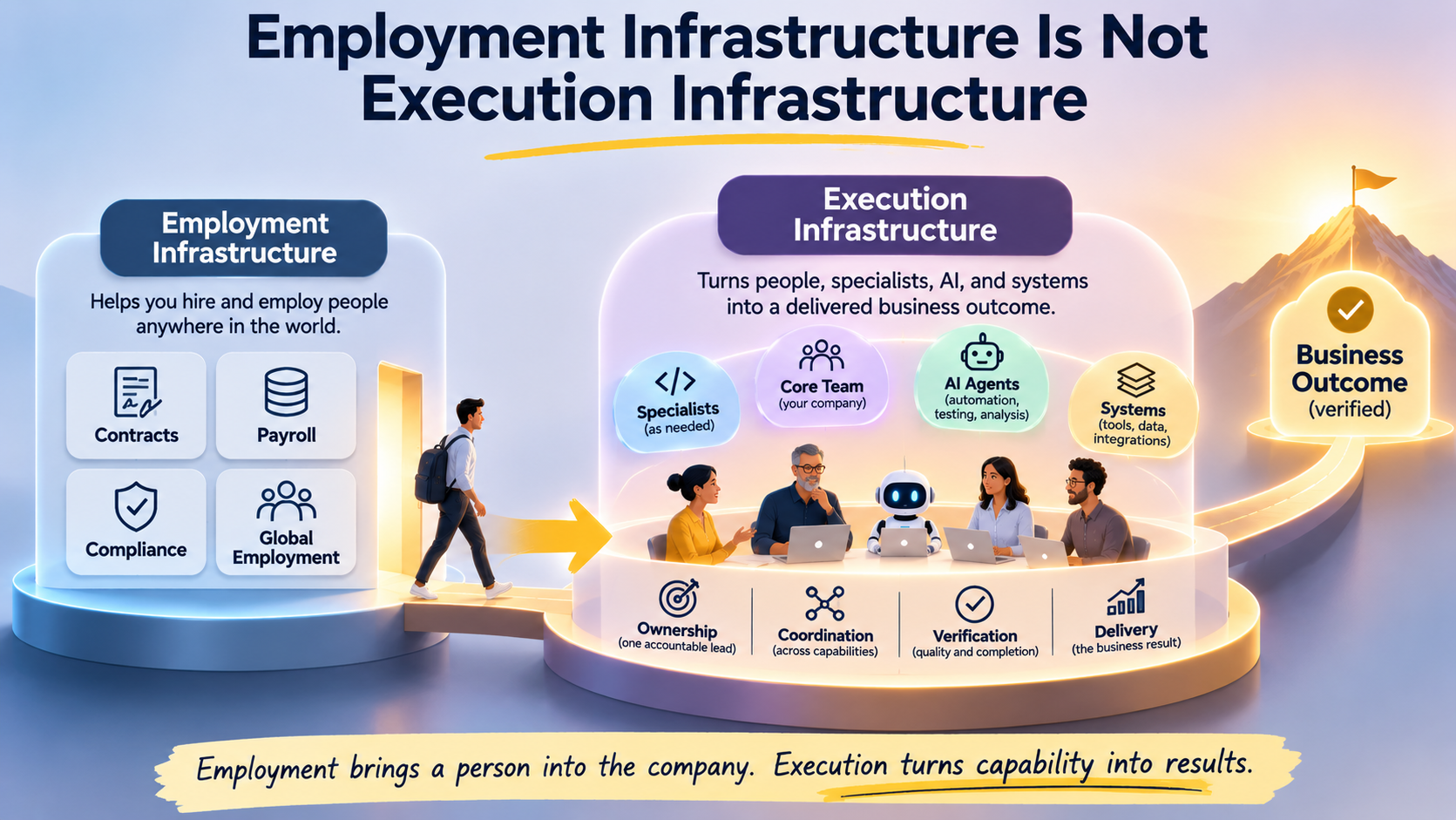
Employment Infrastructure Is Not Execution Infrastructure
Over the last decade, companies became much better at hiring people anywhere.
Platforms made it easier to employ someone in another country, handle payroll, manage compliance, issue contracts, and pay people correctly. Other platforms made it easier to find vetted engineers, designers, product people, finance professionals, and specialists without relying on a local network.
That was a big shift.
It removed friction from global hiring and talent access.
But there is another problem that these platforms do not really solve.
Once the person is hired, contracted, or introduced, the company still has to turn that person into an outcome.
That sounds obvious, but it is the gap between employment infrastructure and execution infrastructure.
The first helps you bring people into the company.
The second helps the company get important work done.
Those are not the same thing.
The global hiring problem was real
A few years ago, hiring someone in another country could become a serious operational headache.
You had to think about legal entities, payroll, tax, contracts, local employment law, benefits, currency, and compliance. For many companies, the administrative burden was enough to stop them from hiring globally.
Platforms such as Deel and Remote helped solve that problem.
They made it much easier for a company in one country to employ someone in another without building all the local infrastructure itself.
That is valuable.
If you know exactly who you want to hire, you want them to work for you long-term, and you are ready to manage them, these platforms are useful.
They solve an employment problem.
The mistake is assuming that solving employment automatically solves execution.
It does not.
Hiring someone is only the beginning
Suppose a company hires an excellent integration engineer through a global employment platform.
The contract is correct. Payroll works. Compliance is handled. The person starts on Monday.
Now the real work begins.
What should they work on first?
Which systems do they need access to?
Who explains the customer context?
Which architect makes decisions?
What happens when the integration depends on a data migration?
Who handles testing?
Who speaks to the customer when requirements change?
How do we know the integration is complete?
None of those questions are payroll questions.
They are execution questions.
The employment platform did its job.
Now the company has to do the rest.
Talent marketplaces solve a different part of the problem
The same distinction applies to talent platforms.
Platforms such as Toptal, Andela, Upwork, and others made it easier to find capable people outside the traditional hiring model.
That solved another important problem.
Finding good talent is hard.
Vetting people takes time. Searching across countries is difficult. Companies often do not know which specialists to trust.
A talent platform can reduce that friction.
But once again, finding the person does not mean the work is delivered.
The customer still needs to understand what capabilities are required, select the right person, explain the context, coordinate dependencies, manage the work, review the output, and deal with everything that falls between roles.
The platform helps you find capability.
The company still has to assemble execution.
A brilliant person can still fail inside a weak system
This is one of the things organizations underestimate.
We often assume that if we find better people, execution will improve automatically.
Sometimes it does.
But a brilliant engineer inside a confused organization can still spend days waiting for decisions. A great designer can still work on the wrong problem. A strong consultant can still produce excellent analysis that nobody implements.
The person may be good.
The system around them may be weak.
This is the same problem we explored in Why Execution Fails Despite Smart People. Individual intelligence cannot compensate forever for unclear ownership, slow decisions, missing dependencies, poor access, and weak coordination.
Talent matters.
But talent is only one part of execution.
The company is still the integrator
This is the hidden burden in most talent platforms.
The company becomes the integrator.
It decides which people are needed.
It brings them together.
It resolves conflicts between them.
It manages the project.
It fills capability gaps.
It decides who owns the outcome.
It verifies whether the work is complete.
That may be completely fine if the company already has strong delivery leadership.
A mature product organization may know exactly how to use external specialists. A strong engineering leader may be able to bring in one expert and get enormous value from them.
But many companies are not struggling because they cannot find one more good person.
They are struggling because they cannot assemble all the pieces around an outcome.
That is a different problem.
Most important work needs more than one capability
Consider something simple like moving a legacy customer workflow into a new platform.
At first, it sounds like an engineering problem.
Then you start looking closely.
You need someone who understands the current process. You may need data migration capability. You may need integration work. Security may need to review the design.
Testing has to happen.
Someone needs to understand the customer.
Training may be required.
There may be a compliance issue.
A single excellent contractor does not make those dependencies disappear.
The work still needs a system around it.
This is why many business problems should not begin with the question, “Who can we hire?”
They should begin with, “What needs to become true, and what capabilities are required to make that happen?”
That is a much better starting point.
Employment infrastructure starts with the person
Employment infrastructure naturally starts with an individual.
Who are we hiring?
Where do they live?
How do we employ them legally?
How do we pay them?
What benefits apply?
These are necessary questions.
But they assume that the company has already decided what person it needs.
Execution infrastructure starts somewhere else.
It starts with the outcome.
What must be delivered?
What capabilities are required?
Which parts must stay inside the company?
Which capabilities can come from outside?
Which tasks can be handled by AI?
Who owns the result?
How will completion be verified?
The person enters later.
That order matters.
A VDC begins with work, not with employment
This is one of the clearest differences between a Virtual Delivery Center and employment platforms.
A VDC does not begin by asking the company to select a person.
It begins by understanding the execution mandate.
Suppose the company says it needs to reduce enterprise customer onboarding from twelve weeks to four.
That is not a hiring request.
It is an execution problem.
The VDC can look at what is actually slowing onboarding. Maybe integration expertise is missing. Maybe security reviews take too long. Maybe data preparation is poor.
Maybe the company needs a small implementation pod, a specialist for part of the work, an AI agent for repetitive validation, and a better verification process.
The answer may involve people.
It may also involve systems, agents, or process changes.
That is the point.
The outcome drives the capability mix.
The VDC keeps one owner around the result
This matters more than it seems.
When work is assembled from several contractors or providers, accountability can become fuzzy.
The integration person owns integration.
The data person owns data.
The QA person owns testing.
The company project manager tries to connect everything.
If the overall outcome slips, everybody can still say they completed their piece.
That is not unusual.
It is one of the most common ways execution fails.
A VDC should have one accountable lead around the outcome.
That person may not perform all the work.
But they are responsible for making sure the pieces become one result.
This changes the conversation.
Instead of asking whether every contributor completed their tasks, the company can ask whether the outcome was actually delivered.
This is where Deel and Toptal stop being comparable
It is easy to put Deel, Remote, Toptal, Andela, and AiDOOS into the same broad category because they all touch global work.
But they solve different problems.
Deel and Remote help companies employ people globally.
Toptal and similar platforms help companies find vetted specialists.
Andela helps companies access distributed technical talent and teams.
A Virtual Delivery Center is trying to solve a different layer.
It is trying to convert an execution need into a governed capability system around an outcome.
That is why the comparison should not be framed as one platform being “better” than another.
If you want to hire a long-term employee in another country, an employment platform may be exactly what you need.
If you want one excellent specialist and you are ready to manage them, a talent platform may be ideal.
If the problem is that the work itself needs to be assembled, governed, delivered, and verified, then you are dealing with a different problem.
That is where execution infrastructure begins.
The distinction becomes more important with AI
AI makes this gap even clearer.
Employment platforms are built around humans.
Talent platforms are also mostly built around human capability.
Execution increasingly involves both people and machines.
A future customer implementation may include an internal owner, an external integration specialist, a data expert, a testing agent, a documentation agent, and the customer’s own systems.
Who employs the testing agent?
Nobody.
Who manages payroll for it?
Nobody.
But it still participates in the work.
This is why the operating model has to move beyond employment.
As we explored in How AI Agents Fit Inside a Virtual Delivery Center, agents need identity, purpose, permissions, ownership, and verification.
They belong inside an execution system.
Not inside an HR system.
The future company will use all of these models
This should not become an argument that one category replaces everything else.
Companies will still hire.
They will still use employment platforms.
They will still use freelancers, specialist networks, outsourcing firms, and consulting companies.
They will also use AI agents.
The interesting change is that these things can become components inside a larger execution architecture.
A VDC may include an employee hired through Deel.
It may include a specialist found through another network.
It may include an external delivery partner.
It may include AI agents.
The VDC does not have to replace those systems.
It can sit above them.
Its job is to make the collection behave like one execution environment.
That is a much more useful way to think about the market.
The missing layer is orchestration
The internet made talent global.
Marketplaces made talent searchable.
Employment platforms made global employment manageable.
AI is making machine capability abundant.
But somebody still has to orchestrate all of it.
Which capability is needed?
When should it enter?
What access does it need?
Who owns the decision?
What should stay internal?
What can be automated?
How will the work be verified?
What happens when the capability is no longer needed?
These questions are not solved by discovering talent.
They are not solved by paying talent.
They are not solved by employing talent.
They belong to execution.
This is why The New Labor Arbitrage Is Not Geography. It Is Orchestration. is such an important part of the VDC argument.
The advantage is moving from cheaper labor to better composition.
The buyer should first understand what problem they have
There is a simple way to decide.
If the problem is, “We have found the right person and want to employ them in another country,” use employment infrastructure.
If the problem is, “We need one capable specialist and know how to manage the work,” use a talent platform.
If the problem is, “We need a mature function transferred and run by somebody else,” outsourcing may be the right answer.
If the problem is, “We have an outcome that requires several changing capabilities, internal ownership, external specialists, AI, governance, and verification,” then a VDC becomes much more relevant.
These are different needs.
They should not be forced into one category.
The real product is not the worker
This may be the biggest conceptual shift.
For most of the history of work, the person was the unit.
Hire a person.
Contract a person.
Assign a person.
Bill a person.
Measure the person's time.
That model made sense when productive capability was mostly human.
It makes less sense when execution can combine humans, AI agents, software, platforms, and specialists in different proportions.
The real product starts moving away from the worker.
It moves toward the outcome.
The company no longer needs to ask only, “Who will do this?”
It can ask, “What execution system will get this done well?”
That is a much richer question.
Employment infrastructure is still important
None of this reduces the value of employment infrastructure.
Good global employment systems solved a painful problem.
They made international hiring much easier.
They also helped normalize the idea that talent does not need to sit in the same city as the company.
That was an important step in the evolution of work.
But employment infrastructure solves one part of the journey.
It helps you bring a person into the organization.
It does not decide what the organization should ask that person to do.
It does not assemble the surrounding capabilities.
It does not own the overall outcome.
It does not verify that the business result happened.
That is not a weakness.
It is simply a different job.
Execution infrastructure begins where hiring ends
Once the contract is signed, payroll is configured, and the person is ready to work, the company still faces the hardest part.
Something has to get done.
A customer has to go live.
A product has to ship.
A process has to improve.
A system has to migrate.
A regulatory problem has to be solved.
A business outcome has to move from intention to reality.
That requires more than employment.
It requires context, capability, ownership, access, decisions, coordination, verification, and memory.
That is execution infrastructure.
The future of work needs both.
We need systems that make it easy to employ people globally.
We also need systems that make it possible to combine people, specialists, AI, and software around work without rebuilding the company every time the work changes.
That second layer is still young.
But it is becoming more important every year.
The first wave of global work platforms helped companies hire anywhere.
The next wave has to help them execute anywhere.