
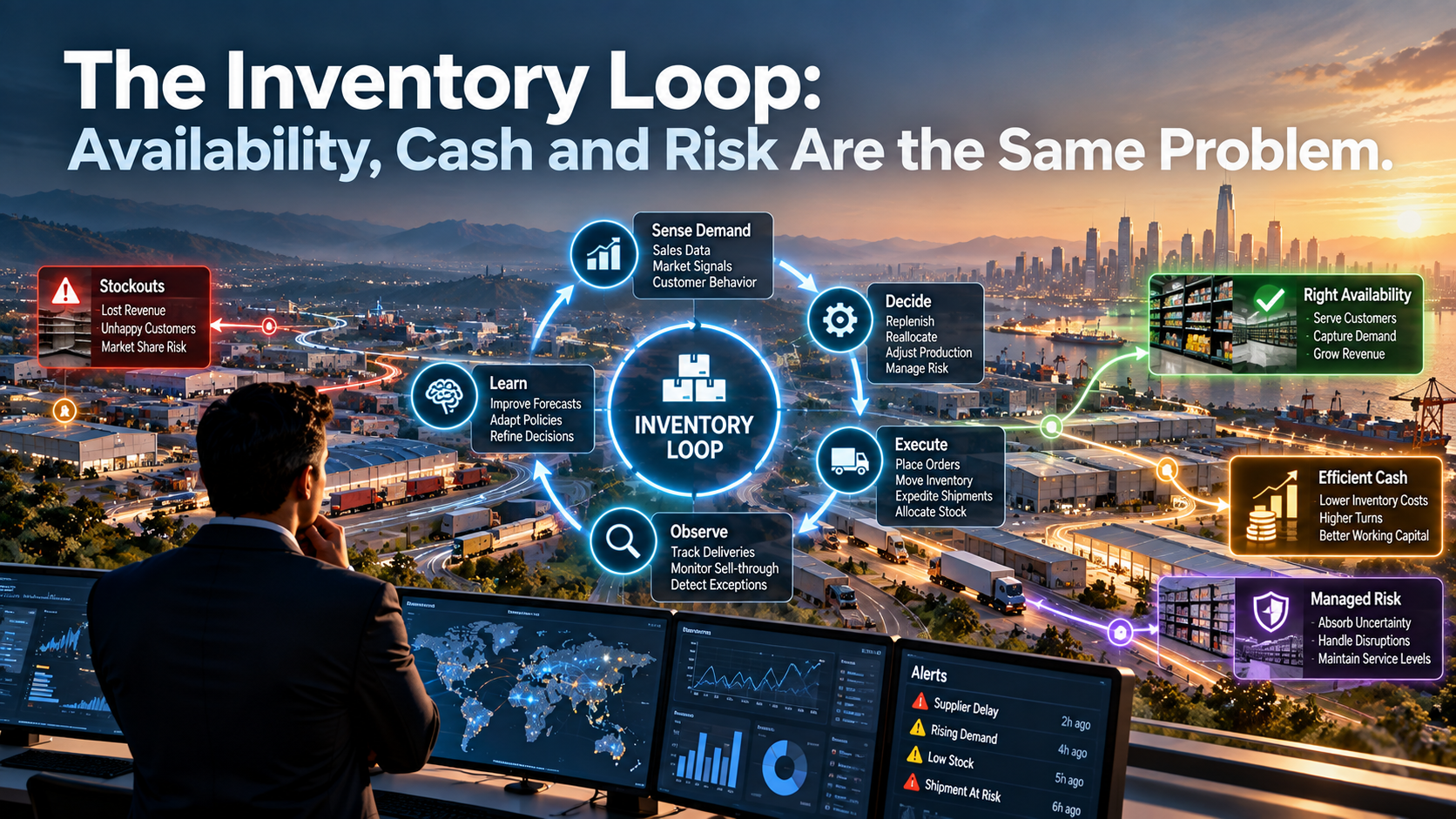
The Inventory Loop: Availability, Cash and Risk Are the Same Problem
Inventory looks deceptively simple.
You need enough product to satisfy demand, but not so much that cash gets trapped on shelves, in warehouses or somewhere in transit. Every retailer, distributor and manufacturer has lived with that tension for decades.
Too little inventory creates stockouts, missed revenue and unhappy customers. Too much inventory creates carrying cost, markdowns, obsolescence and working-capital pressure.
Most companies therefore treat inventory as a planning problem.
Forecast demand. Set safety stock. Place orders. Monitor replenishment. Review exceptions. Adjust periodically.
That sounds reasonable.
But inventory is not really a planning problem.
It is a continuously changing state.
Demand changes. Supplier performance changes. Lead times change. Promotions change. Weather changes. Customer behavior changes. Production changes. Logistics changes.
The inventory decision that was correct on Monday can be wrong by Wednesday.
This is why inventory may become one of the clearest examples of what a closed business loop can do.
The objective is not to predict demand perfectly.
The objective is to continuously keep availability, cash and risk inside an economically acceptable range.
That is the Inventory Loop.
1. Inventory is cash wearing a different uniform
Finance sees inventory as working capital.
Operations sees it as availability.
Sales sees it as something that must be there when the customer wants to buy.
Supply chain sees forecasts, replenishment plans, lead times and service levels.
These are different views of the same economic object.
A box sitting in a warehouse is not just a box.
It is cash that has been converted into stock.
If the product sells at the right time and at the right margin, that decision works.
If it sits too long, cash remains trapped.
If there is too little, the company loses demand it may never recover.
If there is too much, the business may eventually discount it, write it down or dispose of it.
That means the real inventory problem is not maximizing stock.
It is not minimizing stock either.
It is maintaining the right economic state.
Enough availability to capture demand.
Enough flexibility to absorb uncertainty.
But not so much that capital becomes inefficient.
That is a balancing problem, and balancing problems naturally want loops.
2. Forecasting is important, but forecasting is not closure
For decades, companies have invested heavily in forecasting.
And rightly so.
The better you understand future demand, the better you can plan production, procurement and replenishment.
AI improves that capability significantly.
Models can combine sales history, weather, promotions, location, seasonality, customer behavior, macroeconomic signals and many other variables.
But even a highly accurate forecast is still only a prediction.
The business outcome has not happened.
Suppose a model predicts that demand for a product will increase by 22 percent next week.
Useful.
What happens next?
Does the organization have enough inventory?
Can the supplier deliver?
Is production capacity available?
Will additional stock arrive before demand peaks?
Is there enough warehouse space?
Will moving inventory from another location be faster than ordering more?
What happens if the demand signal weakens tomorrow?
A forecast tells the business what may happen.
A loop determines what the business should continuously do about it.
This distinction matters.
Prediction without action becomes a dashboard.
Action without verification becomes automation.
A closed loop connects prediction, action and reality.
3. The inventory problem is really a conflict between three outcomes
Most inventory decisions are trying to optimize three things at once.
Availability. Cash. Risk.
Availability asks whether the product will be there when the customer wants it.
Cash asks how much capital must remain tied up in order to maintain that availability.
Risk asks what happens if the assumptions are wrong.
That third piece matters because inventory decisions are always made under uncertainty.
Demand may be higher than expected.
A supplier may miss a shipment.
A port may close.
A truck may arrive late.
A promotion may outperform.
A competitor may cut prices.
A product may suddenly lose relevance.
The company cannot eliminate uncertainty.
It can only decide how much exposure it wants.
That is why inventory policies differ.
A critical spare part may justify extremely high availability despite low turnover.
A fast-fashion item may require aggressive risk management because excess stock loses value quickly.
A high-margin product may justify more safety stock than a low-margin commodity.
There is no single correct inventory level.
There is only a correct inventory state relative to the business objective and the context.
That makes inventory a natural closed-loop problem.
4. Most inventory systems still operate periodically
This is where human latency enters.
Companies often have sophisticated inventory software.
They have forecasts, MRP, ERP, warehouse management, order management and supply-chain planning systems.
Yet many important decisions are still periodic.
Planners review exceptions in the morning.
Buyers analyze supplier shortages.
Teams meet weekly.
Regional managers review stock positions.
Warehouse teams escalate constraints.
Finance reviews working capital.
Each system knows something.
Each function knows something.
But nobody continuously owns the entire state.
This creates latency.
A demand signal changes today.
The forecast updates tonight.
The planner sees it tomorrow morning.
The planner determines that inventory is insufficient.
Procurement contacts the supplier.
The supplier responds the next day.
Logistics checks available capacity.
Someone approves expedited shipping.
Another day passes.
By the time the intervention is complete, the original demand condition may already have changed.
Again, very little of this delay is actual work.
Most of it is waiting between decisions.
The company may have real-time data but still operate with batch-time execution.
That is an increasingly strange mismatch.
5. The Inventory Loop should continuously ask one question
A useful way to think about inventory is to reduce the complexity to one persistent question:
Are we still inside the desired economic state?
That state might include target availability, acceptable working capital, margin thresholds, lead-time exposure and service-level commitments.
The exact definition will vary by product, location and business model.
But the loop continuously observes whether reality is drifting away from that state.
Suppose demand increases faster than expected.
The loop detects the change.
It evaluates current inventory, inbound stock, supplier capacity and transfer options.
Perhaps the correct action is to order more.
Perhaps it is to move inventory between locations.
Perhaps it is to expedite a shipment.
Perhaps it is to change allocation.
Perhaps the best action is to do nothing because the demand spike is unlikely to persist.
The important point is that the decision is not made in isolation.
It is made against the objective.
Then the system observes what happens next.
Did demand continue?
Did the supplier confirm?
Did the shipment arrive?
Did inventory recover?
Did the action create excess stock elsewhere?
The loop continues until the inventory state returns to an acceptable range.
6. A real Inventory Loop crosses organizational boundaries
This is where the architecture becomes important.
Inventory rarely belongs to one team.
Demand planning may sit in supply chain.
Procurement owns supplier actions.
Warehousing owns physical availability.
Logistics owns movement.
Finance owns working-capital pressure.
Commercial teams own promotions and pricing.
Store or field teams own local execution.
The loop crosses all of them.
That creates an organizational challenge.
If a product is likely to stock out, who owns the outcome?
The planner may detect it.
Procurement may need to act.
Logistics may need to expedite.
Finance may need to approve additional cost.
Sales may need to change allocation.
Today, many organizations handle that situation through escalation.
The problem moves from one person to another.
A closed loop should behave differently.
The objective remains persistent even while responsibility moves across functions.
If finance approval is needed, finance enters.
If a supplier response is required, procurement engages.
If a transfer is the best option, logistics executes it.
But the loop continues to own the outcome.
This prevents the business from confusing handoff with progress.
A request being sent is not progress.
A task being assigned is not progress.
The inventory state improving is progress.
7. The Inventory Loop is not about removing planners
There is a danger in describing autonomous inventory systems badly.
It can sound like planners disappear and AI starts buying stock on its own.
That is not the point.
Good planners do something extremely valuable.
They understand context that systems often miss.
They know that a customer is unusually sensitive to a particular product.
They know that a supplier's commitment is unreliable even when the system says otherwise.
They know that an upcoming promotion will behave differently from historical patterns.
They understand commercial tradeoffs.
They know when an unusual situation deserves intervention.
Those skills remain important.
What should disappear is the need for planners to continuously act as monitoring infrastructure.
They should not spend most of their day checking dashboards, refreshing reports, moving between systems and chasing responses.
The loop should do that.
The system should maintain awareness continuously.
It should know when the inventory state changes.
It should understand which responses are authorized.
It should act where action is safe.
And when the situation crosses a threshold where human judgment is required, it should bring the planner in with context already assembled.
The planner becomes more valuable because less of their time is spent maintaining continuity.
8. The economics become much more interesting when the loop learns
The first version of an Inventory Loop could simply execute known policies more continuously.
That alone has value.
But learning changes the opportunity.
Suppose the system notices that one supplier consistently misses promised delivery times during a particular season.
The immediate loop adapts by increasing lead-time assumptions.
The learning layer goes further.
It changes how future decisions treat that supplier.
Suppose a particular product repeatedly experiences demand spikes after a certain external signal.
The loop begins incorporating that signal earlier.
Suppose certain expedited shipments repeatedly cost more than the stockout they were intended to prevent.
The system learns that the intervention itself is economically irrational.
Over time, the loop becomes better at balancing availability, cash and risk.
This is where closed loops become more than automation.
Execution creates evidence.
Evidence creates learning.
Learning changes future execution.
The operating system improves because it operates.
That is an important difference.
9. The future of inventory may be less about planning and more about continuous balancing
Inventory planning will not disappear.
There will always be strategic decisions.
Network design.
Supplier selection.
Capacity planning.
Product lifecycle decisions.
Major promotions.
Long-term commitments.
But below that strategic layer, a large amount of inventory management may shift from periodic planning to continuous balancing.
That is a different operating model.
The business does not wait for the next planning cycle to react.
It does not rely on humans to notice every deviation.
It continuously maintains the state within defined boundaries.
That is the deeper promise of the Inventory Loop.
Not perfect forecasts.
Not infinite automation.
Not eliminating planners.
A business that can continuously sense when inventory is drifting away from its desired economic state and intelligently respond before the problem becomes expensive.
The goal is not more inventory.
The goal is not less inventory.
The goal is the right inventory, in the right place, at the right time, with the right amount of capital and risk behind it.
That is why availability, cash and risk are not three separate inventory problems.
They are one loop.