
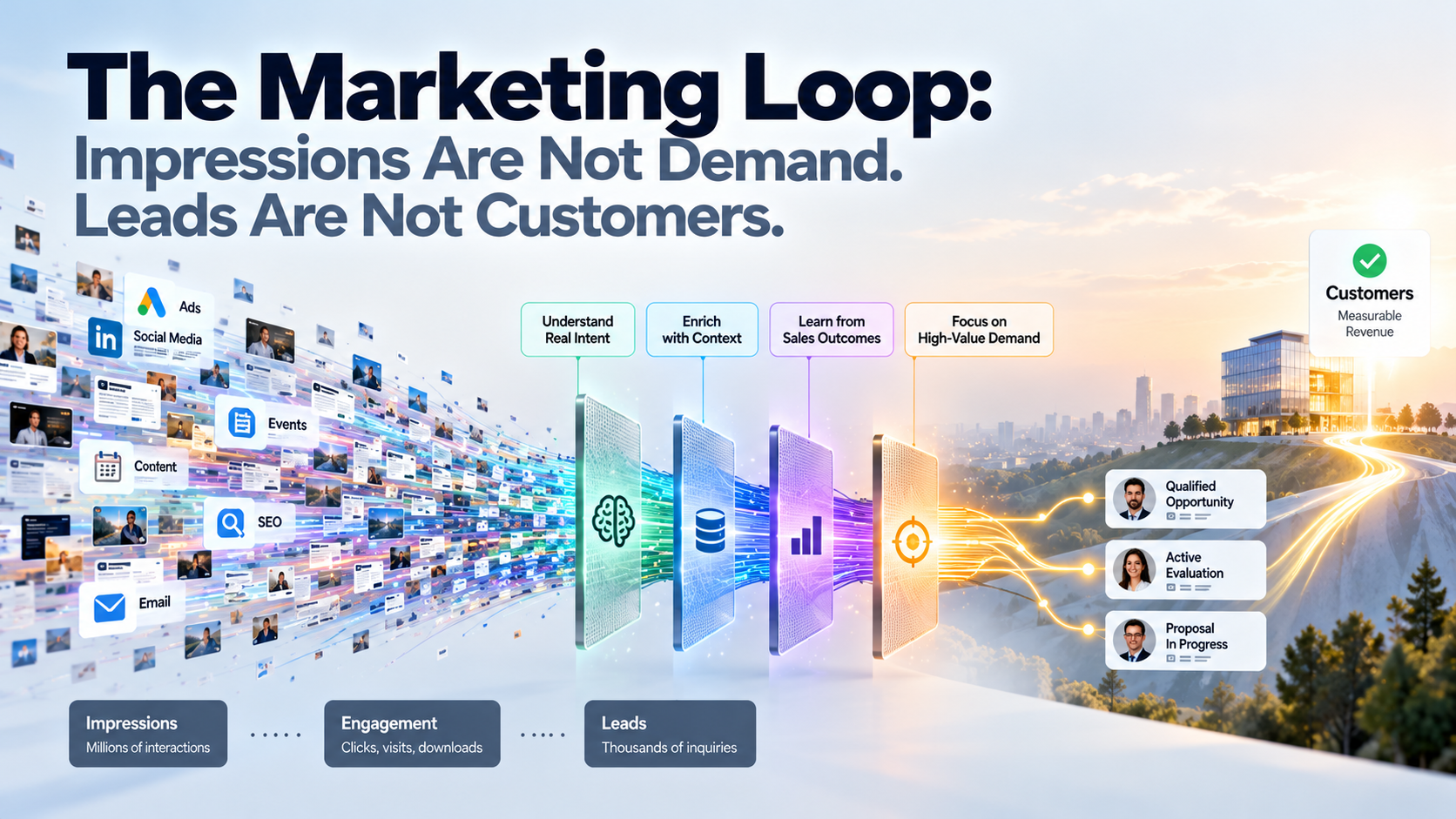
The Marketing Loop: Impressions Are Not Demand. Leads Are Not Customers.
The marketing team had every reason to celebrate.
Their latest campaign had generated 4,000 leads in six weeks. Cost per lead was down 35%, website traffic had increased, and engagement across LinkedIn, email and paid campaigns was comfortably above previous benchmarks. The dashboard was full of green indicators.
During the monthly business review, the marketing director presented the results with obvious satisfaction. The company had invested in better targeting, AI-generated content, automated campaigns and a new analytics platform. Everything appeared to be working.
Three months later, the CEO asked a different question.
How much business had those 4,000 leads generated?
The answer was uncomfortable. Sales had converted very few into meaningful opportunities, and hardly any had progressed far enough to suggest a realistic path to revenue.
Marketing argued that the leads had been delivered and the sales team had failed to follow up properly. Sales responded that most contacts were students, researchers, consultants, competitors or people who had downloaded something without any intention of buying.
Both teams could produce reports supporting their positions.
The marketing platform showed successful campaigns. The CRM showed thousands of new records. The sales engagement platform showed outreach activity, and the analytics system could trace visitors through landing pages, forms and email sequences.
Almost every system had performed its assigned function.
Yet the business had little to show for it.
This is not an unusual failure of marketing technology. It is a consequence of designing marketing around activities that are easy to measure rather than around the difficult question of whether the business is creating genuine demand.
Impressions are not demand, and leads are not customers.
That distinction is becoming more important as AI makes marketing activity cheaper, faster and easier to produce at enormous scale.
1. Marketing became measurable. Somewhere along the way, measurement became the objective.
For much of its history, marketing struggled to demonstrate its contribution to business performance.
A company could spend money on advertising, events, brand building and public relations without knowing precisely which activities influenced a customer. Marketing leaders had to rely on research, broad market indicators and sometimes a considerable amount of judgment.
Digital marketing changed that.
Suddenly, businesses could measure impressions, clicks, visits, downloads, form submissions, email opens and countless other interactions. Marketing automation connected many of those signals into increasingly sophisticated customer journeys.
This was genuine progress. Companies could understand audience behavior, experiment with creative approaches and measure many activities that had previously been difficult to observe.
But something else happened.
Because digital activity was easy to count, organizations began managing marketing around the numbers they could most conveniently collect.
Campaigns were judged by impressions. Content was judged by engagement. Demand generation was judged by leads, and teams were rewarded for reducing cost per lead.
These measurements were useful proxies, but proxies have a habit of becoming targets.
Consider a marketing team instructed to generate 5,000 leads within a quarter.
One approach is to identify a narrow group of companies facing an urgent business problem, understand their situation and create material that helps those buyers evaluate a meaningful solution.
Another approach is to publish a broadly appealing report, promote it aggressively and ask visitors to provide their contact information before downloading it.
The second approach may generate considerably more leads.
It may also create far less genuine buying interest.
The dashboard cannot always distinguish the two.
A person downloading a report about artificial intelligence may simply be curious. Someone attending a webinar may be learning about an industry. A company visiting a website may be researching competitors rather than evaluating a purchase.
Those interactions can be valuable, particularly when the objective is education or building awareness. The mistake is assuming they all represent the same commercial intent.
When marketing is measured primarily by activity, the organization can become exceptionally effective at producing activity.
And when AI enters that environment, it often amplifies the problem.
2. AI has made content abundant. It has not made attention abundant.
Imagine the work required to run a substantial marketing campaign just a few years ago.
Someone needed to research the audience, develop messaging, write copy, create images, design landing pages, prepare email sequences, build advertisements, analyze performance and develop variations for different customer segments.
That work required time and specialized capabilities.
Today, AI can assist with much of it.
A company can generate dozens of article variations, personalize thousands of emails, produce creative alternatives, analyze campaign results and build landing-page drafts in a fraction of the previous time.
That represents a major productivity improvement.
But there is a problem that cannot be solved simply by producing more content.
The people receiving that content have not acquired more hours in the day.
A CFO still has a business to run. A procurement leader still has suppliers to manage. A hospital executive still has patients, employees and operational pressures demanding attention.
AI can multiply the number of messages competing for their attention, but it cannot multiply the attention available to receive them.
In fact, as more organizations deploy AI-generated marketing, the average buyer may become more selective about what deserves consideration.
Think about the modern executive's inbox.
Messages are increasingly personalized. They mention recent company announcements, demonstrate familiarity with the recipient's role and make reasonably intelligent observations about business challenges.
Some are genuinely useful.
Many are simply better-written versions of the same unsolicited pitch.
The technology can produce an appearance of relevance without necessarily creating actual relevance.
This is where marketing faces a difficult transition.
For years, the challenge was producing enough material to reach the market. Increasingly, the challenge may be producing something that a particular customer finds worth paying attention to.
That requires more than language generation.
It requires understanding the customer's circumstances, identifying an important problem, developing a credible point of view and communicating something that changes how the buyer thinks.
AI can assist with all of those activities, but it cannot manufacture a business problem that does not exist.
A message is not valuable simply because it is personalized.
It is valuable when it connects with something the customer genuinely cares about.
That is why the next marketing advantage may come not from generating more content, but from understanding more precisely which conversations are worth creating.
3. The marketing problem does not end when a lead enters the CRM
Return to the company that generated 4,000 leads.
Suppose we examine what actually happened after the campaign.
Hundreds of contacts downloaded a report but never engaged again. Others responded to automated emails without showing any meaningful interest in the company's product.
A smaller group asked useful questions.
Some wanted to understand pricing. Others described specific operational problems. A few requested technical information or asked whether the solution could integrate with existing systems.
These interactions were not equal.
Yet the marketing dashboard largely treated them as variations of the same accomplishment: a lead had been generated and passed into the commercial process.
Sales then inherited the problem of determining which contacts represented a genuine opportunity.
An account executive might discover after several conversations that the prospect lacked a budget, had no immediate requirement or did not operate in the company's target market.
Another prospect might have a significant problem but require expertise that the sales team did not immediately possess.
A third might be interested but disappear after receiving a generic follow-up that failed to address the actual concern.
Eventually, some opportunities progressed and others did not.
What happened to that information?
In many organizations, surprisingly little of it returns to marketing in a form that can improve future decisions.
The CRM may record a lost opportunity. Perhaps the account executive selects a reason such as "No budget," "Not interested" or "Competitor selected."
Those labels provide some structure, but they often conceal the more valuable explanation.
Did the customer lack budget because the problem was not important enough? Was the product too expensive relative to the expected benefit? Did the prospect misunderstand what the company offered?
Was the competitor selected because of superior functionality, an established relationship or greater confidence in implementation?
Perhaps marketing had attracted the right customer but communicated the wrong value proposition.
Perhaps the campaign attracted the wrong audience entirely.
Those distinctions matter.
Without them, marketing continues optimizing the top of the funnel while sales continues discovering problems that should have changed the marketing strategy months earlier.
The organizations operate as separate systems with separate definitions of success.
Marketing generates leads. Sales works opportunities. Customer success later manages accounts, and finance measures revenue.
The customer moves through all of them, but the learning rarely travels back with the same continuity.
This is where a Marketing Loop becomes useful.
It connects market understanding, campaign execution, customer response, sales feedback and verified commercial outcomes into a system that can continuously improve what the organization says, to whom it says it and why.
4. A Marketing Loop should pursue qualified demand, not endless engagement
A genuine Marketing Loop needs a more meaningful objective than generating traffic or leads.
It might aim to increase the number of relevant organizations that recognize a problem the company can solve and demonstrate credible interest in evaluating a solution.
That is more difficult to measure than clicks.
It is also closer to what the business actually needs.
The loop begins with an understanding of the market. Who experiences the problem? Under what circumstances does it become important? Which organizations are likely to have the authority, resources and motivation to address it?
It then develops hypotheses about how those customers can be reached and what information might help them understand the opportunity.
Consider a software company targeting mid-sized logistics providers.
The initial hypothesis might be that these companies are interested in AI-based dispatch optimization. Marketing develops content around predictive routing, operational efficiency and the future of transportation technology.
The campaign produces respectable engagement.
But sales conversations reveal something unexpected.
Many prospects are not particularly interested in another dispatch optimization tool. Their immediate frustration concerns delivery documentation, customer discrepancies and the manual work required before completed shipments can be invoiced.
The original campaign was attracting attention around a broad technology theme.
The actual buying motivation was a much narrower operational problem.
A conventional marketing organization may eventually discover this during a quarterly review.
A well-designed Marketing Loop can identify the emerging pattern earlier, provided the feedback is reliable and sufficiently representative.
It can connect relevant sales conversations, customer questions, campaign engagement and commercial outcomes. The marketing team can then test whether more specific messaging around delivery-document reconciliation attracts a better-qualified audience.
The system observes what happens next.
Do the right companies engage? Are the conversations more substantive? Do prospects describe problems that the company can genuinely solve?
Do those conversations progress into credible opportunities, or does the revised campaign merely produce a different set of vanity metrics?
This is continuous learning in practice.
The loop does not optimize one campaign indefinitely. It revisits the underlying assumptions about the customer, the problem and the proposed value.
This is also where the broader Loop Engineering architecture provides useful discipline.
The goal describes the demand outcome. State and context describe the market and customer signals, while constraints define budgets, acceptable outreach practices, privacy requirements and brand standards.
Actions include research, content, campaigns, experiments and authorized commercial handoffs. Observation and evaluation determine what happened and whether it represented meaningful progress.
Memory preserves previous learning. Escalation brings in human judgment when evidence is ambiguous or decisions carry significant consequences, and learning improves future strategies rather than merely changing the next advertisement.
Underneath those capabilities runs the continuous cycle of observing, understanding, deciding, acting, verifying and adapting.
But an important boundary remains.
Marketing can influence and generate qualified demand. It cannot independently guarantee that a customer will buy, that sales will close the opportunity or that delivery will fulfill the promise.
Those outcomes belong to connected loops.
A well-engineered Marketing Loop should create a trustworthy handoff into the Sales Loop and learn from what happens afterward, without pretending to control every downstream result.
5. The biggest marketing breakthrough may be learning what not to do
Marketing teams are frequently encouraged to expand activity.
Publish more content. Test more channels. Reach more accounts. Increase campaign frequency and improve conversion rates.
AI makes many of these activities cheaper, which can make the pressure to do more even stronger.
But cheaper activity is not necessarily more productive activity.
Suppose a company spends $100,000 across several campaigns. One generates thousands of low-intent contacts, another creates modest engagement with a highly relevant audience, and a third produces very little response.
A conventional performance review may favor the first campaign because its cost per lead is lowest.
A more careful evaluation might reach a different conclusion.
The second campaign may have created meaningful conversations with customers facing a problem the company can solve. Its apparent cost per lead is higher, but the quality and eventual economic contribution may be substantially better.
The third campaign may reveal that the underlying market hypothesis was wrong.
That is useful information too.
A genuine feedback loop needs to know when to stop, not just when to accelerate.
It should help marketing teams recognize that a message is attracting the wrong audience, that a channel is not producing incremental value or that a segment lacks sufficient commercial interest.
It should also understand that attribution is imperfect.
A customer may encounter an article, speak with a peer, attend a conference, search independently and eventually request a demonstration. Assigning the entire value of that opportunity to the final click would distort what actually happened.
Conversely, a campaign may appear successful because it reaches customers who were already planning to buy.
These are not small measurement problems.
They affect how marketing budgets are allocated and how organizations interpret their own performance.
Closed-loop marketing therefore requires evidence that goes beyond platform-reported conversions. Where practical, teams should use controlled experiments, holdout groups, cohort analysis and appropriate measures of incremental lift.
They should compare not only the number of leads generated, but also whether the intervention changed meaningful customer behavior.
Sometimes the evidence will remain incomplete.
A responsible system should acknowledge uncertainty rather than manufacture a precise ROI figure from unreliable attribution.
This kind of learning can lead to a surprising outcome.
The best Marketing Loop may recommend producing fewer campaigns, targeting fewer accounts or abandoning channels that create noise without value.
That may feel uncomfortable in an industry accustomed to celebrating reach.
But if the objective is genuine demand, reducing unproductive activity can be just as valuable as increasing productive activity.
6. A Growth VDC makes continuous experimentation an operating capability
Designing a Marketing Loop is one challenge. Building and operating it inside a real company is another.
A marketing leader may understand the opportunity clearly but lack the coordinated execution capacity to pursue it.
The company has a CRM, marketing automation platform, analytics tools, content management system and perhaps several advertising accounts. Customer information lives across these systems, while sales feedback remains scattered through conversations, notes and commercial records.
Marketing strategists understand positioning. Creative specialists know how to communicate, data analysts understand measurement, engineers build integrations, and sales teams understand what customers say during actual evaluations.
But these people rarely operate as one continuously coordinated execution system.
A campaign requires design. The landing page requires development. Tracking needs implementation, the data requires cleaning, and sales feedback must be interpreted before the next experiment can be designed.
Even when AI assists with individual tasks, the overall process can remain slow.
This is where a Growth Virtual Delivery Center, or Growth VDC, becomes relevant.
A Growth VDC provides an on-demand execution capability that combines marketing expertise, data, engineering, creative production, AI agents and experimentation tools around measurable growth objectives.
Rather than organizing all the work around separate departmental tasks or agency retainers, the enterprise organizes execution around a defined business hypothesis and the outcomes it wants to test.
Consider the logistics software company from our earlier example.
The Growth VDC might begin with a narrow hypothesis: mid-sized carriers experiencing high manual effort in delivery-document reconciliation represent a more commercially relevant market than companies broadly interested in AI-based dispatch optimization.
A small team can research the target segment, examine existing customer evidence, develop clearer positioning and build a focused campaign around that problem.
Engineers connect the necessary analytics and CRM data. Content specialists develop material that helps buyers understand the issue, while AI tools assist with research, production and analysis.
The team launches the experiment and observes what happens.
But the work does not end when the campaign goes live.
The VDC helps connect the resulting engagement with what sales learns from actual customer conversations. It evaluates whether the campaign is attracting relevant organizations and whether those organizations demonstrate genuine interest.
If evidence supports the hypothesis, the company can increase investment.
If the evidence contradicts it, the VDC helps revise or retire the approach without creating another disconnected project.
The same execution capacity can improve landing pages, investigate conversion problems, integrate data, test messaging, build useful tools for prospects or produce technical content that addresses recurring buyer concerns.
Over time, the organization accumulates more than campaign assets.
It accumulates customer knowledge, reusable engineering, tested messages, measurement methods and an increasingly accurate understanding of where demand exists.
At AiDOOS, this is how we see the relationship between Loop Engineering and the Virtual Delivery Center model.
Loop Engineering defines the continuous business outcome and the system required to pursue it. The VDC provides the people, AI, tools and engineering capacity to build, operate and improve that system.
The Growth VDC should not be measured simply by how many articles, advertisements or landing pages it produces.
Its value should be evaluated through the quality of the experiments it executes, the credibility of the evidence it generates and its contribution to meaningful commercial outcomes.
That is a different relationship between marketing investment and execution.
The business is no longer buying an endless stream of marketing deliverables.
It is building a capability that continuously learns how to create relevant demand.
7. Marketing and Sales should behave like connected loops, not competing departments
There is a reason the debate between marketing and sales has lasted so long.
Both functions are essential, but they have historically been measured at different points in the customer journey.
Marketing is asked to generate interest. Sales is asked to convert that interest into revenue.
When results disappoint, each function can point to work completed by its own standards.
The Marketing Loop and Sales Loop offer a better way to organize their relationship.
Marketing should understand which customer problems deserve attention, develop useful ways to reach those customers and create conditions for meaningful commercial engagement.
Sales should help interested customers evaluate their needs, understand available solutions and reach informed decisions.
The two loops should exchange information continuously.
Marketing needs to learn which messages attract buyers with real problems. Sales needs to understand what initially attracted those buyers, what they expect and what has already been communicated.
When a deal is lost, the reason should inform future marketing where it reveals something generalizable about customer needs, positioning or market selection.
When an opportunity succeeds, the organization should understand what contributed to that success without assuming every correlation represents causation.
And when the customer becomes an active user, the next loop begins.
Customer success and retention can reveal whether the original marketing promise corresponded to the value the customer actually experienced.
That feedback may be more important than anything the campaign dashboard can report.
A company might be exceptionally good at attracting customers through a particular promise, only to discover that those customers rarely achieve the expected outcome.
Increasing campaign investment would amplify the underlying problem.
A connected execution system should recognize that mismatch and bring the evidence back to the people responsible for positioning, product and growth.
This is how the organization begins to learn across the entire customer lifecycle.
Marketing does not end at the lead. Sales does not exist independently of what was promised, and customer retention is not merely a separate function responsible for repairing relationships after the sale.
Each loop has a distinct objective, but all three contribute to the larger economic relationship between the company and its customers.
8. The future of marketing may be quieter, smaller and considerably more valuable
Return to the original marketing team with its 4,000 leads.
Imagine that six months later the company runs a different campaign.
This time, it reaches a much smaller audience. The content is focused on a problem the team understands deeply, and the message makes a specific argument that relevant customers can evaluate against their own experience.
The campaign produces only a few hundred responses.
The dashboard looks less impressive.
But the sales team recognizes the companies that respond. More of them describe genuine operational problems, and the conversations begin with a shared understanding of why the topic matters.
Technical questions are more relevant. Commercial discussions are more productive, and the company discovers fewer mismatches between customer expectations and what it can actually deliver.
The marketing director is no longer celebrating lead volume alone.
The team can explain what it learned about the market, which hypotheses were supported, which were rejected and how those insights changed the quality of commercial engagement.
That is a much more valuable conversation with the CEO.
Of course, marketing will continue to need awareness campaigns, brand building, education and long-term relationship development. Not every useful marketing activity produces an immediate buying signal.
A category-defining article, for example, may influence how executives think long before they have a budget or project ready.
The Marketing Loop should not abandon those activities simply because their short-term revenue contribution is difficult to measure.
It should give each activity a clear purpose, appropriate evidence and a sensible connection to the broader customer journey.
What should disappear is the confusion between easily measured activity and genuine business progress.
AI is going to make marketing content increasingly abundant. Companies will produce more articles, more campaigns, more advertisements and more personalized messages than ever before.
But customers will still have limited attention, specific problems and independent judgment.
The organizations that succeed may be those that understand these realities better than their competitors.
They will use AI to learn faster, not merely publish faster. They will use automation to remove unnecessary execution delays, not simply increase the frequency of messages.
And they will organize marketing around understanding customers and creating demand that the business can genuinely serve.
The question will no longer be how many people saw the campaign.
It will be whether the company understood something important about its market, reached the people for whom that understanding mattered and helped create the conditions for a valuable customer relationship.
A million impressions may create awareness.
Four thousand leads may create an impressive report.
But neither guarantees that a single customer has found a reason to buy.
The purpose of marketing is not to make the dashboard look successful. It is to make the business more relevant to the people it hopes to serve.
That is the promise of the Marketing Loop.