
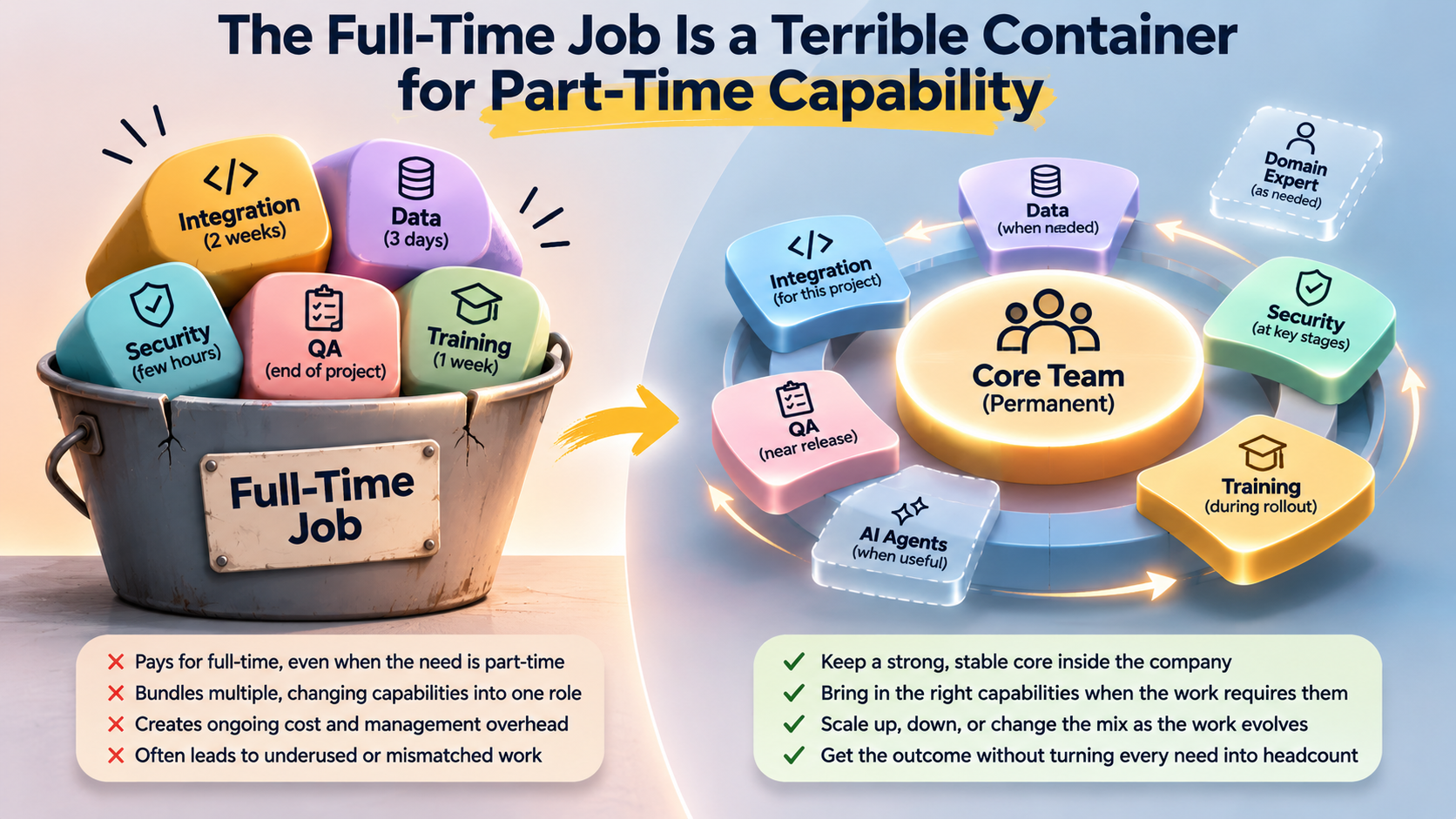
The Full-Time Job Is a Terrible Container for Part-Time Capability
There is a strange thing we do inside companies.
We see a need for a skill, and we immediately turn it into a job.
We need better integrations, so we hire an integration engineer. We need stronger data capability, so we hire a data engineer. We need more security depth, so we hire a security person.
The logic sounds reasonable because the capability is real.
The problem is that the capability may be real only part of the time.
A company may need deep integration expertise for two weeks during a customer implementation, then almost none for the next month. It may need a data specialist heavily during a migration and barely at all after that. It may need a security expert for a few critical decisions, not forty hours every week.
Yet employment is usually sold in one size.
Full-time.
That is where the mismatch begins.
Work rarely arrives in full-time shapes
If you look closely at most important projects, the work is not smooth.
It comes in bursts.
A product launch may need heavy design at the beginning, engineering in the middle, testing near the end, and legal review at a few specific moments.
A customer implementation may need integration, data, configuration, security, training, and support, but not all of them at the same time.
An AI initiative may need a domain expert for the problem definition, an engineer during build, a risk specialist before production, and someone else later to monitor the system.
The work keeps changing shape.
The job does not.
That is a bigger problem than it first appears.
The company pays for a stable unit of labor while the work itself is unstable.
We explored this tension in Work Is Episodic. Why Are Teams Permanent?. The issue is not that permanent teams are bad. The issue is that we use them for work that is not permanent.
A role is often several capabilities bundled together
Job descriptions make this easy to miss.
Take something like “Implementation Engineer.”
The title sounds like one capability.
In reality, that person may be expected to handle APIs, configuration, data mapping, troubleshooting, customer communication, testing, documentation, and sometimes even project management.
That is already several jobs hiding inside one title.
The reverse also happens.
A company may open several roles because it assumes each capability needs a full-time person. One person for data. Another for integration. Another for QA. Another for security.
But the actual workload may not justify full-time demand for any of them.
This is why the idea from Roles Are Fiction. Capabilities Are Real. matters so much.
The work needs capabilities.
The organization turns those capabilities into roles because roles are easy to hire, budget, manage, and put on an org chart.
That convenience can become expensive.
The full-time job is a very large unit
A full-time employee gives the company a lot.
They give time, context, availability, continuity, and often emotional commitment.
That is valuable.
But it is also a large unit of capacity.
If the business needs ten hours of a capability every week, hiring forty hours of it is a poor fit.
If the business needs a capability only during certain phases, the mismatch gets worse.
This is not a criticism of the person.
It is a design problem.
The company is buying a bigger unit than the work requires.
That would be obvious in almost any other part of business.
If a factory needs a machine for two days a month, it would at least consider renting it.
If a company needs cloud infrastructure only during peak periods, it does not necessarily buy enough servers for the maximum possible load and leave them idle the rest of the year.
But with knowledge work, we still do this all the time.
We buy permanent capacity for temporary need.
The hidden cost is not just salary
When people hear this argument, they often reduce it to cost.
That misses part of the point.
Yes, salary matters.
But the bigger issue is everything that comes with permanent employment.
The company has to recruit the person, onboard them, manage them, develop them, provide benefits, create meaningful work, think about progression, and keep the role useful after the original need changes.
Those are not bad obligations.
They are what make employment valuable when the relationship is right.
But they are also reasons not to use employment casually.
If the capability is not truly permanent, the company creates a long-term commitment around a short-term problem.
That is how teams become bloated without anyone making a foolish decision.
Each individual hiring decision may have looked reasonable at the time.
The accumulation is what creates the problem.
This is why companies end up with strange jobs
One of the things I have noticed over the years is how often companies create roles that are really collections of leftover work.
The original reason for the hire disappears.
The person is good, so the company finds other things for them to do.
A year later, the job has become a mix of responsibilities that would never have been designed together from scratch.
Again, this is not because anyone did something stupid.
It is because employment is sticky.
Once the person is inside, the company tries to preserve the relationship.
That is human and often the right thing to do.
The real mistake happened earlier.
The company treated temporary capability as permanent capacity.
The better question is not “Do we need this person?”
The better question is:
“How much of this capability do we actually need?”
That sounds simple, but it changes the discussion.
A manager may say, “We need a security architect.”
Fine.
Do we need one full-time?
Every week?
For the next three years?
Or do we need senior security judgment at specific points in the delivery cycle?
That is a different problem.
The same question applies to data, AI, integration, design, legal, compliance, finance, and dozens of other specialist areas.
Once you ask about the quantity and timing of capability, the job title stops being the only answer.
Some capabilities should absolutely be full-time
There is an important caveat.
Not every capability should be fractional.
Some work benefits enormously from permanence.
A product leader needs deep context. A principal architect may need years of accumulated knowledge. A customer executive may need long-term relationships and trust.
Some capabilities are used every day.
Some are too important to depend on availability outside the company.
Some are part of the company’s identity.
Those belong inside.
This is why I like the principle from the previous article, Hire the Core. Virtualize the Rest..
Hire the capabilities that need to compound.
Do not automatically hire every capability that appears.
Fractional capability is not the same as freelancing
This distinction matters.
If the answer were simply “use freelancers,” companies would already have solved this problem.
They have not.
A freelancer gives you access to a person.
You still need to know exactly who you need, find them, vet them, onboard them, manage them, connect them to the work, and make sure all the other dependencies are covered.
That can work very well for simple tasks or when the company already knows what it is doing.
It becomes harder when the outcome needs several capabilities working together.
The problem is not access to talent.
The problem is orchestration.
That is why a Virtual Delivery Center is different.
The VDC can hold the outcome, the governance, the context, and the execution structure while different capabilities come in and out.
The company is not assembling the whole thing from scratch every time.
The team should be stable where stability matters
This is where people sometimes misunderstand flexibility.
A flexible execution model does not mean a different team every morning.
That would be chaos.
Some relationships should stay stable.
The internal owner should stay close to the outcome.
The people who carry product context should remain.
A specialist who repeatedly performs well should come back.
A delivery pod that understands the customer should not be replaced just because another provider is slightly cheaper.
The point is not maximum fluidity.
The point is to stop turning every temporary need into a permanent role.
That is a much narrower and more useful idea.
AI makes the mismatch even more obvious
AI is going to make this issue harder to ignore.
Suppose a company hires a five-person team around a workflow.
A year later, agents can handle a large part of the routine production, testing, and documentation.
What happens to the old staffing model?
The work still matters.
The human capability may still matter too.
But the amount of human time required may drop sharply.
If the company designed the function around permanent headcount, it now has a difficult adjustment.
If the function was already designed around a smaller permanent core with flexible capability around it, the transition is easier.
This is one reason How AI Agents Fit Inside a Virtual Delivery Center matters.
AI does not simply automate tasks.
It changes how much human capacity the company needs, and when.
That makes the full-time job an even more awkward unit for some kinds of work.
Part-time capability can be more senior
There is another benefit that does not get enough attention.
When a company hires full-time, budget often forces a compromise.
Maybe the business really needs a very senior expert, but cannot justify the salary for a permanent role.
So it hires someone more junior and hopes they can grow into it.
That may work.
But sometimes the company would be better off using a truly excellent expert for a smaller amount of time.
Twenty hours of the right person can be worth more than two months of someone learning the problem.
This is especially true when the work involves high judgment.
Architecture.
Security.
Regulation.
Complex integration.
Commercial strategy.
The company does not always need more time.
Sometimes it needs better judgment for less time.
A fractional model makes that possible.
Cheap full-time capacity can be expensive
This is where rate comparisons become misleading.
A manager may say that a specialist is too expensive because their hourly rate is high.
But the better question is what the work costs in total.
Suppose one expert charges three times as much per hour but solves the problem in one quarter of the time.
They may still be cheaper.
They may also reduce rework, coordination, and risk.
The same logic applies inside organizations.
A full-time employee may appear cheaper per hour than a specialist.
But if the company only needs a fraction of that person’s capability, the comparison is wrong.
The unused capacity has a cost too.
It is just harder to see.
Idle capability creates management work
Unused capacity is not truly idle.
Managers still have to manage it.
They find work.
They create projects.
They move people between priorities.
They worry about utilization.
Sometimes this leads to a subtle form of organizational busywork.
A team exists, so the company creates work for the team.
That is the wrong direction.
The work should create the need for capability.
The capability should not create the need for work.
This sounds obvious.
In practice, it is one of the hardest habits to change.
A VDC lets the capability appear when the work appears
This is the practical advantage of a VDC.
Imagine a company with a persistent Product Engineering VDC.
The internal product leader and core architecture team remain stable.
During one quarter, the company needs heavy frontend capability.
Later, that demand drops and security becomes more important.
A few months after that, the company needs a data specialist and an AI engineer for a new feature.
The VDC can change the mix without rebuilding the whole team.
The mandate remains Product Engineering.
The capability composition changes with the roadmap.
That is much closer to how the work actually behaves.
The company is not constantly laying people off and rehiring.
It is not constantly starting new outsourcing contracts either.
It has a persistent execution environment with variable capability.
That is the difference.
The same logic applies outside technology
This is not just a software problem.
A finance function may need heavy transaction support at month-end and more strategic analysis during planning cycles.
A legal function may need specialist regulatory expertise only when entering a new market.
A supply chain team may need forecasting support during a disruption and less of it later.
A growth function may need launch specialists, content, analytics, and campaign operations in different proportions throughout the year.
The shape changes.
The traditional job assumes the shape is stable.
That mismatch appears across the enterprise.
This is why How to Virtualize a Business Function Without Breaking It is really about more than workforce flexibility.
It is about building functions around the way capability is actually consumed.
People may prefer this model too
There is also a human side.
Not every experienced professional wants another full-time job.
Some people want to work deeply on interesting problems without joining a new company for five years.
A senior expert may prefer to work with several organizations.
A parent may want more control over time.
A specialist may value variety.
A professional may want to build reputation across outcomes rather than climb one internal hierarchy.
That does not mean everyone wants freelancing.
Freelancing can be unstable, transactional, and lonely.
A better model could give professionals recurring relationships, strong reputation, meaningful work, and access to structured execution environments without requiring one employer to own their entire economic life.
That connects back to From Loyalty to Leverage: The New Compact Between Talent and Enterprise.
The future does not have to be permanent employment on one side and gig work on the other.
There is a large space in between.
The real problem is that HR thinks in jobs
This is not a criticism of HR.
The systems are built that way.
Workforce planning uses positions.
Budgets use headcount.
Compensation uses salary bands.
Recruiting begins with job descriptions.
Performance systems follow roles.
So when a business leader says, “I need more capability,” the organization naturally turns that need into a position.
The machinery is already there.
What is missing is another path.
A way to say, “I need this capability for this outcome, at this intensity, for this period.”
That is a different kind of workforce request.
It is closer to capacity engineering than traditional hiring.
CFOs should care about this more than anyone
Finance leaders often get blamed for headcount controls.
But they are reacting to a real problem.
Permanent cost accumulates quickly.
Once the economy turns, companies suddenly discover how little flexibility they have.
This is why the debate should not be reduced to “finance wants fewer people.”
The better conversation is about cost architecture.
Which capabilities should be fixed?
Which should be variable?
Which need to be available continuously?
Which appear only when certain work appears?
A company that answers these questions well is not simply cheaper.
It is more resilient.
It can grow without becoming bloated.
It can slow down without immediately hurting people.
That is a much better outcome than cycling between aggressive hiring and painful layoffs.
Managers should care because it changes what leadership means
A manager in this model cannot define success by the number of people reporting to them.
They need to understand the capability system.
They need to know what is missing, what can be activated, what should stay internal, and what no longer needs a person at all.
They also need to protect continuity.
If a specialist leaves, does the knowledge stay?
If an agent takes over repetitive work, does the team understand how it works?
If a capability becomes permanent, should it now be hired into the core?
These are better management questions.
They are also harder.
But they get closer to the real job of leadership.
Some fractional work will become permanent, and that is fine
A flexible model does not mean the company should resist hiring forever.
Sometimes the evidence becomes obvious.
A capability that started as occasional becomes central.
Demand stays high.
Context begins to matter more.
The same specialist is being brought back every month.
At that point, hiring may be the right next step.
This is actually one of the strengths of starting flexibly.
The company can learn before committing.
It can see what the work really requires.
It can make the hiring decision based on evidence rather than forecast.
The VDC can become a bridge into permanent capability when permanence is earned.
Start by looking at the jobs you are about to open
There is a simple exercise every leadership team can do.
Take the next ten open roles.
Ignore the titles for a moment.
Ask what capability each role is supposed to provide.
Then ask how often that capability is actually needed.
Every day?
A few days each month?
Only during certain projects?
Only because one existing employee is overloaded?
Then ask whether one person is truly the right unit.
Maybe it is.
But some of those ten roles will probably look different after the conversation.
Perhaps two should be permanent.
Three could be provided through existing teams.
Two may be better handled by specialists.
One may be mostly automatable.
Two may belong inside a VDC.
Now workforce planning becomes more thoughtful.
The job should fit the work
This is the simplest way I can put it.
If the work is permanent, a permanent job can be a beautiful structure.
It gives the company continuity and gives the person stability, belonging, development, and the chance to build something over time.
But if the work is temporary, irregular, or fragmented across several specialist capabilities, the full-time job can be a poor container.
We should not force work into that container simply because it is familiar.
The company needs another option.
A strong internal core surrounded by flexible, governed capability gives it one.
That capability can come from people, specialists, agents, partners, or software.
It can expand when the work expands.
It can contract when the work contracts.
It can change when the nature of the work changes.
The company still hires.
It just becomes more careful about what deserves to become a job.
That may sound like a small change.
It is not.
Once we stop assuming that every capability need must become a full-time role, the entire architecture of work begins to open up.