
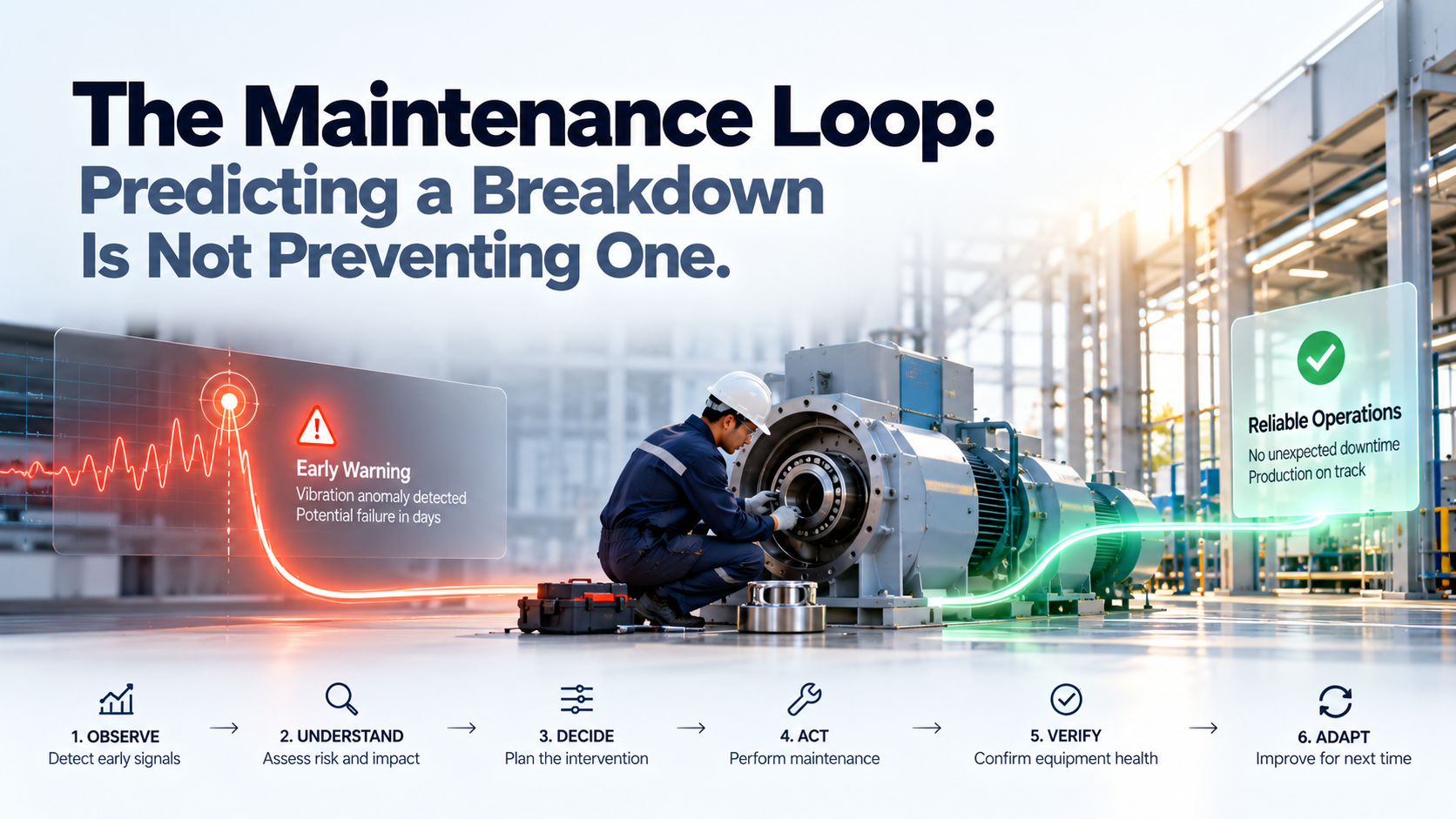
The Maintenance Loop: Predicting a Breakdown Is Not Preventing One
The maintenance engineer noticed something unusual on Tuesday morning.
A vibration sensor attached to a critical production machine had detected a change in its operating pattern. The company's predictive maintenance system analyzed the signal and warned that a bearing was deteriorating. If the condition continued, the equipment could fail within days.
The warning was accurate. The machine was still running, but the underlying mechanical problem was real.
The engineer reviewed the alert and created a maintenance work order. The computerized maintenance management system recorded the issue, assigned a priority and placed the work in the maintenance queue.
The plant had recently invested in industrial sensors, data infrastructure and AI-based condition monitoring. The technology was performing exactly as intended, providing visibility into equipment health before an actual breakdown occurred.
On Friday afternoon, the machine failed.
Production stopped for most of the shift. An urgent repair crew was assembled, the required replacement part had to be sourced, and the production manager began reorganizing orders to minimize the impact on customer commitments.
During the subsequent review, management asked why the predictive maintenance system had failed.
It hadn't.
The prediction was correct. The alert was delivered, and the work order was created. The problem was that the organization never converted the warning into a completed intervention.
The maintenance team had been occupied with another equipment problem. The required spare part was not readily available, and the production supervisor had been reluctant to release the machine because several important orders were scheduled.
Each delay had a reasonable explanation. Together, they produced the very breakdown the AI system had warned about.
This is an illustrative scenario, but it captures a fundamental weakness in how many enterprises approach AI.
We have become increasingly capable of predicting what may happen. We are not necessarily becoming equally capable of ensuring that the right action happens before it is too late.
In manufacturing, the difference is measured in downtime, production losses, emergency repairs, quality problems and missed customer commitments.
A prediction has value only when the organization can use it to make a better decision.
And a decision becomes economically meaningful only when the required intervention is carried out and its result is verified.
That is where the Maintenance Loop begins.
1. We have invested heavily in knowing when machines might fail
Industrial maintenance has undergone several important transitions.
For much of manufacturing history, equipment was repaired when something broke. A motor failed, a conveyor stopped, or a pump developed a serious problem, and maintenance personnel responded.
This reactive approach made maintenance relatively straightforward to organize, but unexpected failures could create expensive operational disruptions.
Preventive maintenance introduced a different philosophy. Instead of waiting for equipment to break, organizations began inspecting, servicing and replacing components according to defined schedules or usage intervals.
That reduced dependence on failure-driven intervention, although scheduled maintenance could sometimes result in unnecessary work or fail to detect deterioration occurring between inspections.
Condition monitoring and predictive maintenance introduced another level of sophistication.
Sensors can observe vibration, temperature, pressure, electrical behavior and other characteristics of operating equipment. Analytical systems can recognize patterns associated with deterioration, while machine-learning models can help estimate future equipment conditions.
The promise is compelling.
Instead of replacing a component because six months have passed, a manufacturer can consider its actual condition and the risk of failure.
Instead of discovering a problem only when production stops, the organization may receive enough warning to intervene during a planned maintenance window.
These capabilities are already part of established industrial reliability practice. The US Department of Energy distinguishes reactive, preventive, predictive and reliability-centered maintenance, while NIST has researched the monitoring, diagnosis and prognosis of manufacturing equipment.
The challenge is no longer simply whether organizations can detect abnormal equipment behavior.
It is what happens after detection.
A machine does not repair itself because a model predicts failure. A replacement bearing does not appear because an alert was generated, and a production schedule does not automatically accommodate a maintenance window because an algorithm recommends intervention.
Somebody must determine whether the prediction is trustworthy, evaluate the consequences, secure the necessary parts, coordinate with production and arrange the actual repair.
Once the work is completed, somebody must establish whether the equipment has returned to an acceptable operating condition.
Between the prediction and that verified recovery lies an execution process that can involve several departments, systems, suppliers and people.
That process is where much of the economic value of predictive maintenance is either realized or lost.
2. A maintenance work order is another promise, not an outcome
The work order occupies an important place in industrial maintenance.
It records what needs attention, where the problem exists, who has responsibility and which activities must be performed. A good maintenance management system also preserves equipment history, parts usage, repair records and other information that helps the organization operate reliably.
But creating a work order does not mean that maintenance will happen at the right time.
Consider the deteriorating bearing from our opening story.
The predictive system recommends inspection and possible replacement. The maintenance engineer creates a work order, and the system assigns it a priority based on the reported condition.
At that moment, the machine is still running.
The production manager has a scheduled order that must be completed before Thursday. Stopping the equipment immediately would disrupt the plan, and the engineer cannot guarantee exactly when the bearing will fail.
The replacement component is also uncertain.
The inventory system indicates that a bearing is available, but someone needs to confirm that it is the correct specification. The maintenance team must determine whether additional tools or contractor support will be required.
Each of these details influences whether the intervention can be performed.
The work order has not solved them.
Perhaps the maintenance supervisor plans to review the task later that afternoon. The inventory team promises to confirm the spare part, and production asks whether the intervention can wait until the weekend.
By Wednesday, the machine continues operating, which creates a false sense of comfort.
The original warning is still visible in the maintenance system, but nothing about its existence guarantees that the organization will reach a decision in time.
This is the same execution gap we have examined in Collections, Procurement and Logistics.
A collections system records that an invoice is overdue, but the money does not arrive merely because a reminder was sent. A procurement system records a confirmed purchase order, but the component does not become available simply because the supplier acknowledged the request.
And a maintenance system records a work order without ensuring that the equipment receives the appropriate intervention.
The administrative process and the business outcome are different things.
An engineered Maintenance Loop must preserve responsibility for that difference.
It should understand that the objective is not to generate a warning or complete a maintenance task. The objective is to maintain equipment in an acceptable operating state while balancing safety, reliability, production requirements and economic cost.
That requires much more than a ticketing workflow.
3. The hardest maintenance decisions are economic decisions disguised as technical ones
Imagine a factory with two machines showing similar signs of mechanical deterioration.
One machine is operating below capacity and can be stopped without affecting immediate production commitments. The other is supporting an urgent customer order, and stopping it now would cause substantial disruption.
From a condition-monitoring perspective, the machines may have similar risk indicators.
From the business perspective, the decisions are very different.
The maintenance team must understand the likelihood and consequences of failure, the cost of intervention, the availability of alternatives and the risks associated with continued operation.
In some circumstances, immediate intervention is essential.
In others, a short period of carefully controlled operation may be justified while parts, personnel and a safe maintenance window are arranged.
These decisions cannot be made responsibly from a vibration reading alone.
They require a broader understanding of the asset and the business that depends on it.
This is why a Maintenance Loop must connect equipment health with production schedules, inventory, workforce availability, supplier commitments and operational constraints.
A warning that appears relatively minor in the sensor data may be economically significant if the equipment supports a critical production process with no available backup.
Another warning may deserve monitoring rather than immediate shutdown if the condition is stable, the consequences are limited and the approved maintenance strategy supports continued operation.
The objective is not to prevent every possible breakdown at any cost.
That would be an expensive and, in many cases, impractical operating philosophy.
The objective is to make appropriate reliability decisions under known constraints and uncertainty.
This distinction is central to established asset-management thinking. ISO 55000:2024 frames asset management around realizing value from assets while balancing performance, cost and risk.
Loop Engineering does not replace those principles.
It provides a way to connect them to continuous observation, decision support, coordinated execution and verification.
A well-designed Maintenance Loop should know the difference between an economically desirable intervention and a technically possible one.
It should also understand that some constraints are non-negotiable.
Personnel safety, required isolation procedures, regulatory obligations and equipment operating limits cannot be compromised simply because continuing production appears financially attractive.
This is why the loop needs both intelligence and authority boundaries.
AI may help evaluate available options. Qualified people and approved control systems remain responsible for decisions that require technical certification, safety judgment or operational authorization.
The strongest maintenance architecture is not the one that gives AI the greatest freedom to act.
It is the one that makes good decisions easier to reach, execute and verify without weakening human accountability.
4. The Maintenance Loop connects prediction with physical intervention
Suppose the factory wants to engineer a closed loop around a critical industrial motor.
The business objective is to maintain the motor's required operating capability, minimize avoidable unplanned downtime and manage maintenance expenditure within acceptable boundaries.
The loop begins by observing the equipment's condition.
Sensors provide operating data, and analytical systems identify changes that may indicate deterioration. Maintenance records provide historical context, while production systems indicate how heavily the equipment is expected to be used.
When abnormal behavior appears, the loop evaluates the condition in relation to the asset's operating requirements.
Is the signal reliable? Does it indicate a known failure mode? Has the equipment behaved similarly before? Are additional measurements needed before the organization can make a responsible decision?
These questions matter because predictive models are not infallible.
Industrial data can be noisy. Sensors can malfunction, operating conditions can change, and patterns that resemble deterioration may have harmless explanations.
A good loop should not treat every model output as an unquestionable instruction.
It should use the prediction as evidence.
Now suppose the available evidence indicates that intervention is warranted.
The loop examines the actions available.
Can the machine be inspected during a scheduled production pause? Is the required component available? Does a qualified technician have the necessary capacity? Would an alternative production plan reduce the cost of intervention?
If the decision requires authorization, the system should assemble the relevant information and bring the responsible person into the process.
The plant manager should not receive a vague message saying that the equipment may fail.
The manager should receive a clear explanation of the condition, the uncertainty involved, the operational consequences and the available courses of action.
Once an intervention is approved, the loop maintains continuity.
The spare part must be confirmed. The technician must be scheduled, the equipment must be safely released, and the maintenance work must be performed according to approved procedures.
But even that does not complete the loop.
The work order may show that the bearing was replaced. The technician may have completed the repair, and the machine may have restarted successfully.
The remaining question is whether the equipment has actually returned to the desired state.
The loop needs evidence.
Has vibration returned to an acceptable range under appropriate operating conditions? Is the temperature stable? Has the repair introduced another abnormal condition? Is the equipment performing reliably under the required production load?
Only when the defined verification conditions are satisfied should the intervention be considered successfully closed.
Where the condition remains abnormal, the system should preserve the evidence and support further investigation.
The seven-stage execution cycle remains consistent with our broader Loop Engineering architecture: Observe, Understand, Decide, Act, Verify, Adapt and Repeat.
In maintenance, however, those stages operate across both digital and physical environments.
That is what makes the engineering challenge particularly demanding.
The model can identify the problem in software. The intervention must happen in the physical world, and the evidence of recovery must come from reality rather than from the completion status of a digital task.
5. Human latency becomes expensive when equipment continues deteriorating
We previously explored the concept of Human Latency: the time businesses lose between useful actions because execution depends on human attention, coordination and follow-through.
Maintenance provides an especially important illustration.
Suppose a predictive system identifies a developing problem on Monday morning. The engineering analysis takes only a few minutes, but arranging the intervention requires several separate decisions.
A maintenance supervisor reviews the alert later that day. Inventory confirms the correct component on Tuesday, while production determines a possible shutdown window on Wednesday.
A qualified technician is finally scheduled for Friday.
The organization may have spent less than an hour on the actual coordination work, yet several days have elapsed.
During those days, the equipment continues operating under a deteriorating condition.
The risk does not remain stationary while the organization waits.
This makes maintenance different from many administrative processes.
An overdue invoice may become more difficult to collect as time passes, but a deteriorating mechanical component can move from a manageable condition into a failure that damages other equipment or creates a safety hazard.
Delay changes the problem itself.
That is why the value of prediction depends partly on how much useful intervention time remains.
A warning received ten days before a probable failure may allow planned maintenance. The same warning discovered only hours before failure may leave very few safe or economical recovery options.
An organization can have sophisticated real-time condition monitoring and still operate through weekly maintenance planning cycles.
The information moves at machine speed.
The decisions move at organizational speed.
A Maintenance Loop helps reduce that mismatch.
It does not eliminate the physical time required to inspect, repair or replace equipment. Nor should it bypass approvals or safety procedures simply to improve response speed.
Instead, it identifies what can be coordinated earlier.
Parts availability can be checked automatically. Relevant production constraints can be gathered before the maintenance review, and possible intervention windows can be evaluated while the equipment remains operational.
The system can recognize when a commitment has not been fulfilled and bring the issue back to the responsible person before the available intervention window disappears.
In many cases, this continuous coordination may be more valuable than shaving a few additional seconds from the prediction model's response time.
The objective is not instantaneous maintenance.
It is timely, informed and verified intervention.
6. Building the Maintenance Loop requires expertise across systems that rarely speak the same language
A modern manufacturing plant may already possess much of the technology needed for intelligent maintenance.
Industrial sensors monitor equipment conditions. Operational technology platforms capture machine data, while historians preserve time-series information.
A computerized maintenance management system records work orders and repair histories. An ERP manages inventory and procurement, and a production planning system maintains the manufacturing schedule.
The plant may also have invested in cloud or on-premise AI infrastructure capable of running advanced analytical models.
These investments provide valuable capabilities.
What they do not automatically provide is a coordinated execution system responsible for moving from predicted equipment risk to verified operational recovery.
Someone must engineer the connections.
The predictive model may identify a deteriorating component, but the asset identifiers used by the monitoring platform may not match those in the maintenance system.
The spare-parts database may contain several similar components without a reliable connection to the precise equipment configuration.
Production schedules may change without the maintenance planning process receiving timely updates.
The technician's repair notes may contain important diagnostic information in unstructured text that never returns to the predictive model.
Each of these gaps affects the loop's ability to operate.
Some are integration problems. Others are data-quality problems, domain-modeling problems or organizational authority problems.
There are also industrial cybersecurity and safety considerations.
An AI-enabled maintenance application may need read access to operational data without requiring direct control over machinery. Any permitted interaction with industrial control systems must respect the site's established safety and security architecture.
The organization must distinguish between recommending an intervention, issuing an approved maintenance instruction and directly controlling physical equipment.
Those are very different levels of authority.
This complexity helps explain why a predictive maintenance pilot can demonstrate impressive analytical capability without becoming a reliable enterprise operating system.
The model may have been trained successfully. The dashboard may be accurate, and the technology team may have completed its assigned project.
But the business still needs someone to integrate the remaining systems, establish the operating rules, validate interventions and maintain the complete execution process.
That is where the Virtual Delivery Center becomes relevant.
7. A Reliability VDC provides the execution capacity behind the loop
Consider a manufacturer operating several facilities with hundreds of critical assets.
The company wants to improve equipment reliability through AI but does not want to create a large permanent engineering team for every machine category, production line and maintenance use case.
It already has maintenance engineers, plant managers, technicians and operational technology specialists.
What it lacks is coordinated capacity to engineer, integrate, validate and continuously improve the digital execution layer around those existing capabilities.
A Reliability Virtual Delivery Center, or Reliability VDC, provides a different way to organize that work.
The VDC brings together the required integration engineers, data specialists, AI engineers, domain experts, verification specialists and delivery capabilities around a clearly defined reliability outcome.
Its responsibility is not simply to build a predictive model or install another dashboard.
It is to help the organization create and operate a working Maintenance Loop.
A practical starting point may be one production line with a small group of critical motors, pumps or compressors.
The enterprise identifies the equipment where unexpected downtime creates meaningful operational consequences, and the VDC begins by understanding how failures are currently detected and handled.
Where does condition data originate? How reliable is it? Which failure modes are relevant, and how does the maintenance team determine whether intervention is necessary?
The VDC then examines the surrounding execution process.
How are work orders created? Where are spare parts recorded? Who authorizes downtime? Which systems contain production requirements, and how is successful repair verified?
These questions establish the engineering scope.
The first version of the loop may operate primarily in an advisory mode.
It observes equipment conditions, correlates relevant data and prepares maintenance recommendations supported by evidence. Engineers and maintenance personnel evaluate those recommendations before any operational action occurs.
As the system demonstrates reliability, the organization may authorize more routine activities to happen automatically.
The loop could prepare a work order, check parts availability, assemble an intervention plan or notify the relevant maintenance coordinator.
Higher-consequence decisions remain with qualified personnel.
The VDC also establishes a verification process.
It is not enough to demonstrate that work orders were generated more quickly. The company needs evidence that the interventions were appropriate, maintenance coordination improved and equipment returned to acceptable operating conditions.
Over time, the team can examine whether the loop reduces avoidable maintenance latency, improves planned intervention readiness and helps the plant manage reliability more effectively.
The distinction between measurement and attribution matters here.
If unplanned downtime falls during a pilot, the improvement may reflect better maintenance, lower production demand, changed equipment utilization or other factors.
The program should therefore establish sensible baselines and assess outcomes without automatically attributing every improvement to AI.
This is how the VDC creates something more valuable than a successful proof of concept.
It establishes an engineering capability that can improve the operating system around equipment reliability.
The same team can later extend the approach to additional assets and facilities, reusing verified integrations, data models, governance methods and recovery patterns.
At AiDOOS, this is how we see Loop Engineering and Virtual Delivery Centers working together.
Loop Engineering defines the system that continuously pursues a verified business outcome. The VDC supplies the people, AI, tools and engineering capacity to build, operate and improve that system.
The plant retains operational authority. Maintenance personnel remain responsible for safe physical intervention, and the VDC provides the execution capacity needed to connect intelligence with the systems and processes that make intervention possible.
The enterprise does not need a separate permanent AI team for every asset category.
It needs a repeatable method of creating reliable execution capabilities around economically meaningful outcomes.
8. The most valuable maintenance system may be the one that learns why its own warnings were ignored
Return to the machine from the beginning of our story.
The predictive system correctly identified a deteriorating bearing. The maintenance work order was created, but the intervention never happened before failure.
A conventional project review might focus on improving the predictive model.
Could it provide an earlier warning? Could the model estimate remaining useful life more accurately? Could another sensor improve confidence?
Those are legitimate questions.
But suppose the model had already provided enough warning.
The real failure occurred after the prediction.
The maintenance team lacked an available intervention window. The spare part was not ready, and production management did not have a clear understanding of the consequences of delay.
Improving model accuracy alone may not solve any of those problems.
A Maintenance Loop should learn from the complete execution history.
When did the condition first become concerning? When was the warning reviewed? Which dependencies delayed action, and which alternative interventions might have been available?
Did the organization misunderstand the urgency? Was the required part missing? Did the approval process introduce unnecessary latency?
Perhaps the prediction was accurate but poorly communicated. Perhaps the model generated so many low-quality warnings that engineers had become reluctant to trust it.
These are different failure modes.
Each suggests a different improvement.
The loop's memory should preserve the relationship between equipment signals, human decisions, intervention actions and verified outcomes.
Over time, the organization can understand not only which equipment tends to fail, but also why certain warnings fail to produce timely maintenance.
This opens an opportunity that goes beyond predictive maintenance.
A company may begin redesigning the way it organizes spare parts, maintenance windows, escalation thresholds and coordination between production and engineering.
The learning is no longer confined to the model.
It improves the operating system around the model.
This is particularly important because maintenance is an established engineering discipline with decades of accumulated knowledge. AI should not displace that experience or ignore proven reliability practices.
Its contribution is to help organizations connect evidence, decisions and execution more continuously.
A well-designed Maintenance Loop should make experienced engineers more effective, not reduce them to passive approvers of machine-generated recommendations.
It should preserve their judgment, make the relevant information easier to access and ensure that their decisions translate into action before the opportunity to intervene is lost.
There is a larger economic consequence too.
When equipment reliability improves, a manufacturer gains more than lower repair expenditure. It may improve production predictability, reduce disruption to customer commitments, use spare-parts inventory more intelligently and avoid unnecessary emergency interventions.
These benefits can affect several parts of the enterprise.
The Maintenance Loop can therefore connect naturally with the Inventory, Procurement and Supply Chain Loops.
A deteriorating asset may require a replacement component. Procurement can help obtain it, inventory can assess availability, and production planning can determine the operational consequences of different intervention windows.
But each loop should preserve a clear responsibility.
Maintenance is accountable for the equipment's defined recovery and reliability conditions. Procurement is accountable for the relevant supply outcome, and inventory maintains the required stock conditions.
The value emerges when these capabilities exchange context and coordinate actions without losing their separate objectives.
This is how an enterprise gradually becomes more than a collection of intelligent applications.
It begins developing an execution architecture in which important business states are continuously observed, acted upon and verified.
For a manufacturer, that could mean fewer situations where the business knew something was going wrong but failed to intervene while there was still time.
Consider how different the Friday afternoon in our opening story could have been.
The system notices the bearing deterioration on Tuesday and establishes that the risk warrants intervention. It checks the required part, identifies an acceptable maintenance window and gives the plant manager enough context to authorize the work.
The replacement is carried out safely before the equipment reaches an unacceptable condition. The motor returns to production, and the loop verifies that the relevant operating measurements are within their approved limits.
There is no emergency shutdown, no frantic search for parts and no urgent rearrangement of customer orders.
The predictive model may be exactly the same one that generated the original warning.
What changed was the system around it.
The organization stopped treating the prediction as the end of an AI task and began treating it as the beginning of an execution responsibility.
That is the real opportunity in Loop Engineering.
For years, manufacturers have invested in systems that help them understand what might happen to their equipment.
The next phase should help them ensure that appropriate action happens while there is still time to change the outcome.
Because a machine does not care how accurate the prediction was.
It either keeps operating within acceptable conditions, receives the intervention it needs, or eventually fails.
The value of intelligence is not what it predicts. It is what the business manages to prevent, preserve or improve because of that prediction.
That is what the Maintenance Loop is designed to achieve.
Industry References: The National Institute of Standards and Technology's work on manufacturing diagnostics and prognostics, the US Department of Energy's maintenance approaches, and ISO 55000:2024 on asset management.