
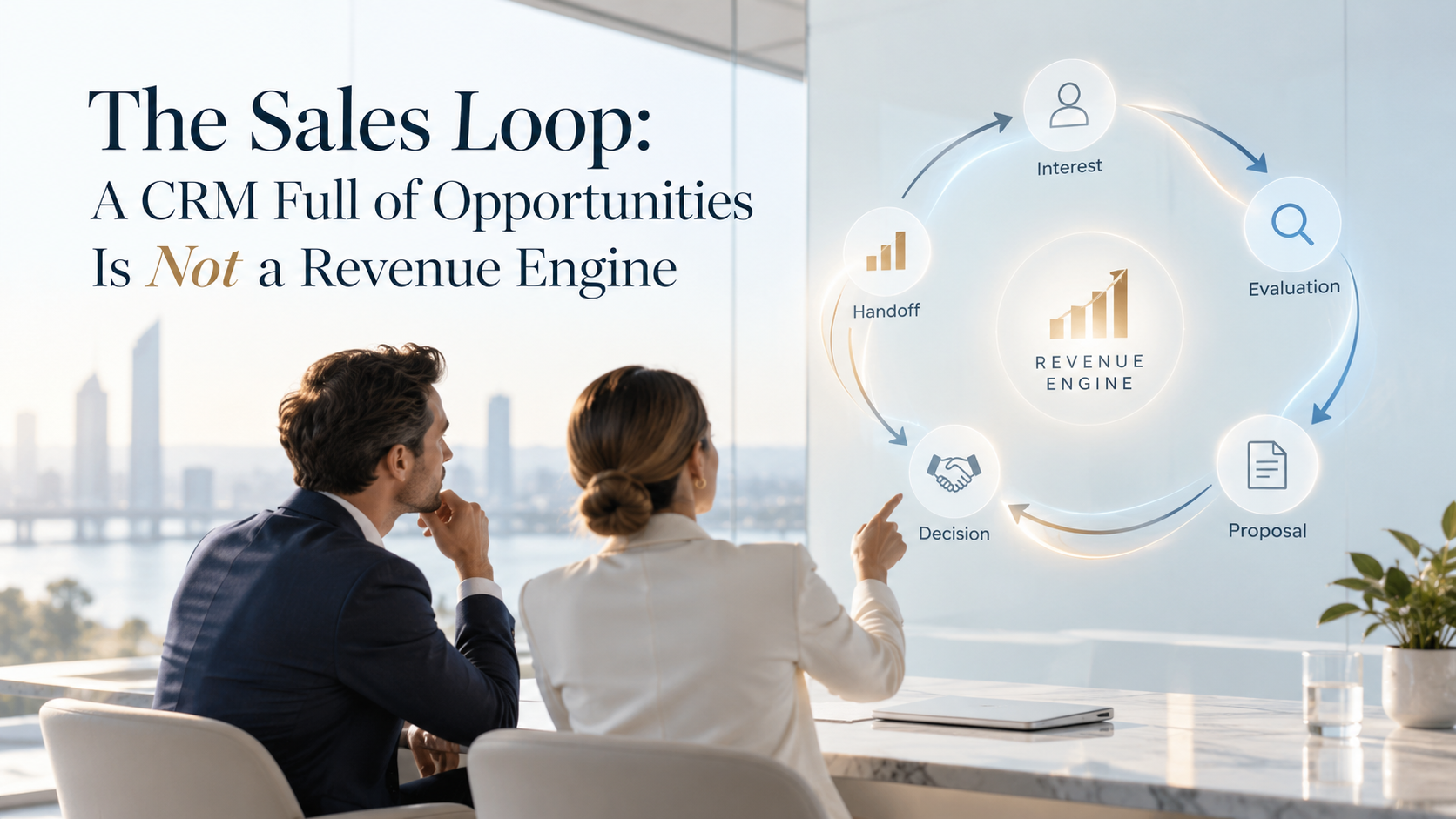
The Sales Loop: A CRM Full of Opportunities Is Not a Revenue Engine
It is Monday morning, and the sales leadership team is reviewing the pipeline.
The CRM looks encouraging. There are 86 active opportunities, several large deals approaching their expected close dates, and a healthy-looking pipeline that comfortably exceeds the quarterly target. The dashboards are colorful, the forecasts are carefully categorized, and the activity reports show that the sales team has been busy.
Yet the CEO is concerned because revenue is not growing at the rate the pipeline suggests it should.
One opportunity has been in negotiation for six weeks. Another customer attended a successful demonstration but has not moved forward. A third requested a technical clarification two weeks ago, and the response is still being assembled by the product team.
The sales manager asks what is happening with these deals. Account executives explain that customers are evaluating internally, procurement is reviewing contracts, technical teams are checking integrations, and decision-makers are occupied with other priorities.
Everyone has a reasonable explanation. Nobody appears to be neglecting their responsibilities, and the CRM contains detailed notes documenting the journey.
Still, the deals are not closing.
The organization has invested in Salesforce or another capable CRM, sales engagement tools, forecasting platforms, marketing automation, conversation intelligence and, increasingly, AI agents. It knows more about its pipeline than ever before.
But knowing everything about an opportunity is not the same as moving it toward a decision.
This is the uncomfortable reality of modern sales technology. We have become exceptionally good at recording selling activity while the actual process of converting customer interest into business value remains surprisingly dependent on individual attention, memory and follow-through.
The CRM is full of opportunities, but the business needs revenue.
That difference is where the Sales Loop begins.
1. Sales software knows what happened. Does it know what needs to happen?
Think about the typical B2B sales journey.
A prospect expresses interest, attends a discovery call, watches a demonstration, discusses requirements and requests a proposal. The salesperson updates the CRM, creates tasks, schedules meetings and coordinates the next conversation.
As the opportunity progresses, more people become involved. A technical specialist answers integration questions, finance prepares commercial terms, legal reviews contractual language, and a senior executive may be asked to participate in the final negotiation.
Every step can be recorded. Modern sales platforms can capture conversations, identify engagement patterns, generate follow-up emails and recommend actions based on previous deals.
But none of these capabilities guarantees that the opportunity is progressing.
Suppose a prospect asks whether the proposed solution integrates with its existing ERP. The account executive sends the question to the internal technical team and updates the opportunity with a note saying that technical clarification is pending.
The CRM is accurate. The salesperson has done what the process requires, and the task has been assigned to the appropriate person.
Three days later, the technical team responds with a detailed answer.
Unfortunately, the salesperson is occupied with other prospects and does not immediately notice the response. Another day passes before the clarification reaches the customer.
By then, the customer's internal evaluation meeting has already taken place.
The response was technically correct, but it arrived after the moment when it could have influenced the decision.
Nobody needed a better CRM dashboard to prevent that outcome. The organization needed a mechanism that understood the importance of the customer's question, maintained responsibility for answering it and recognized the consequences of delay.
The opportunity did not lose momentum because the salesperson lacked intelligence. It lost momentum because the execution system stopped moving between steps.
This is precisely the kind of gap that Loop Engineering seeks to address.
2. A pipeline stage is not a business state
Most sales organizations manage opportunities through stages.
Qualification, discovery, demonstration, proposal, negotiation and closed won or lost are familiar examples. The exact labels differ, but the underlying approach is similar across companies.
These stages provide structure. They help leaders understand how opportunities move through the sales process, assign probabilities and forecast potential revenue.
But the stage often describes what the seller has done rather than what is actually happening inside the buyer's organization.
An opportunity might be marked as "Proposal Sent," but that tells us very little about its true condition.
Has the customer read the proposal? Does the proposed solution address the real problem? Is there an approved budget? Has the economic buyer accepted the business case? Does procurement have concerns about commercial terms?
Perhaps the technical team is enthusiastic while finance remains unconvinced. Perhaps the original sponsor has changed roles, or the customer's priorities have shifted since the first conversation.
Two opportunities can occupy the same CRM stage while having entirely different probabilities of reaching a commercial decision.
That is why a Sales Loop needs a richer understanding of state.
The relevant state is not merely the latest activity recorded in the CRM. It includes what the customer is trying to accomplish, what has been agreed, what remains uncertain, which stakeholders matter, what commitments are outstanding and what conditions must change before the customer can make a decision.
This information rarely lives in one application.
Some of it appears in emails. Some sits inside meeting notes or proposal documents. Some belongs to technical discussions, procurement records or conversations that the account executive has not yet entered into the CRM.
And some of it is unknown because the customer has not shared it.
That last point is important. AI does not eliminate uncertainty about another organization's intentions, and a well-engineered Sales Loop must distinguish observed facts from assumptions.
A customer downloading a proposal is evidence of engagement, not proof of purchase intent. A positive demonstration is encouraging, but it does not establish that a budget exists or that the buying committee agrees.
The system becomes more useful when it recognizes these distinctions instead of pretending every digital signal predicts what the customer will do.
The Sales Loop must understand the real state of the buying journey, not simply the administrative state of the selling process.
That requires a shift from recording activity to understanding what is preventing a legitimate commercial decision.
3. The biggest sales problem may be the time between meaningful conversations
Consider a company selling a technology solution worth $250,000 annually.
The prospect has a genuine business problem, the proposed solution appears suitable, and the technical evaluation has been positive. The buyer wants to move forward but needs several internal stakeholders to agree.
What follows can be painfully familiar.
The customer requests a security questionnaire. The account executive sends it to the security team, which returns the completed document four days later. The customer's security team then requests clarification about data retention.
Another internal discussion begins.
Two days later, the customer asks for a revised commercial proposal covering a smaller initial deployment. Finance needs to validate the pricing, while the solution architect must adjust the proposed scope.
The revised proposal is ready by Friday but reaches the customer on Monday. The original executive sponsor has meanwhile left for a business trip, and the next review meeting moves to the following week.
None of these activities is especially unusual. Security reviews matter, commercial terms deserve scrutiny, and important buying decisions should not be rushed.
The problem is the unnecessary waiting around them.
The actual work may require a few hours spread across multiple specialists. The overall process can consume weeks because each step depends on another person's attention before anything moves again.
Our earlier article on Human Latency explored this contradiction. AI can compress work time dramatically while business processes remain limited by the speed at which people notice, coordinate and restart the next action.
Sales is especially vulnerable because momentum matters.
Customers have competing priorities. The problem that felt urgent during the first meeting may no longer dominate their attention a month later. Internal sponsors may struggle to maintain enthusiasm when the evaluation becomes fragmented.
A salesperson can do everything reasonably well and still lose an opportunity because the surrounding organization responded too slowly.
Now imagine a system that maintains continuity around the customer's actual decision requirements.
When the security questionnaire arrives, it identifies the relevant internal capabilities and helps assemble accurate, approved responses. When an integration question is raised, it routes the issue with the necessary technical context and tracks it until the customer receives a satisfactory answer.
If the proposal needs revision, the system coordinates the scope, pricing and approval process rather than leaving the account executive to manage a collection of disconnected tasks.
The purpose is not to pressure the customer into deciding faster. It is to ensure that the seller does not introduce unnecessary friction into a buying journey that is already complicated enough.
There is an important economic distinction here.
Reducing the time needed to generate a proposal is useful. Reducing the time between a customer's question and a trustworthy answer may be far more valuable.
The first improves productivity. The second can improve the customer's experience and preserve the conditions under which revenue becomes possible.
4. A Sales Loop should help the customer reach a decision, not chase the customer endlessly
This is where the concept of closed loops needs careful interpretation.
A collections loop has a relatively clear financial outcome. A logistics loop can verify whether goods were delivered under agreed conditions, and an inventory loop can evaluate availability against an operating target.
Sales is more complicated because the desired outcome depends on a customer's independent decision.
The customer may decide to buy. The customer may decide not to buy, postpone the investment, select another supplier or abandon the project entirely.
These are legitimate possibilities.
A Sales Loop cannot be engineered as though every opportunity must eventually become revenue. That would confuse autonomous execution with automated persistence, and customers would quickly experience the difference.
Imagine an AI system that notices a prospect has not replied for five days. It sends a reminder, waits another three days, sends a different message and continues experimenting with increasingly personalized communication until someone responds.
Technically, the system is executing a loop.
Commercially, it may be damaging the relationship.
A useful Sales Loop must understand when further action is appropriate, when a buyer has requested time, when a concern remains unresolved and when continued outreach is no longer justified.
The goal should be to help qualified opportunities progress toward a clear, informed commercial decision while respecting the customer's preferences and the seller's operating constraints.
That means closure does not always mean a sale.
An opportunity can close because a contract was signed. It can also close because the customer explicitly rejected the proposal, the business need disappeared, or the parties determined that the solution was not a suitable fit.
Those outcomes should be recorded accurately rather than disguised as continued pipeline potential.
For successful opportunities, the Sales Loop might terminate at an authorized commercial agreement and a verified handoff into onboarding or delivery. The subsequent fulfillment and collection of cash belong to connected but distinct business loops.
This distinction prevents an execution architecture from becoming an enormous, vaguely defined process that claims responsibility for everything.
A well-designed Sales Loop knows where its own outcome begins and ends, while ensuring that the next loop receives the information and commitments needed to operate.
There is also a human dimension that no amount of automation should obscure.
Buying a significant product or service is often an act of trust. Customers are exposing budgets, operational problems, organizational priorities and sometimes their own professional credibility.
The salesperson's role is not merely to transmit information. It is to understand the buyer, exercise judgment, establish confidence and help people navigate uncertainty.
AI can make those activities better supported. It should not turn them into mechanical behavior that leaves the customer feeling managed by a machine.
5. The strongest Sales Loop may begin before the first meeting
Many companies think of sales automation as a way to produce more outreach.
Find more prospects, personalize more emails, make more calls and schedule more demonstrations. The assumption is that greater activity will eventually produce greater revenue.
Sometimes that works, but it can also create more noise without improving the underlying quality of commercial engagement.
The more interesting opportunity is connecting market understanding, customer context and sales execution into a continuous system.
Suppose a mid-sized manufacturer has recently expanded into two new markets. The expansion creates potential demand for integration, logistics, workforce and operational technology capabilities.
A conventional sales organization may discover the opportunity through a news article, a referral, a salesperson's research or a marketing campaign.
An intelligent loop could continuously identify relevant business changes and evaluate whether they create a genuine reason for engagement.
But it should not stop at detecting the event.
It needs to determine what the development means for the customer. Does the expansion create a problem the seller can credibly solve? Is the customer likely to have the required budget or authority? Does the seller possess relevant experience or capabilities?
If those conditions are not present, contacting the company may add little value.
If they are present, the system can help formulate a useful approach grounded in the customer's actual situation.
Once the relationship begins, the loop maintains context.
A conversation with the operations team may reveal an integration problem. A later discussion with finance may show that the larger concern is working-capital exposure. The proposed solution may need to change because the true economic problem is different from the one initially presented.
This is where the Sales Loop becomes more than an outreach system.
It continually improves the organization's understanding of the customer's desired outcome and coordinates the work needed to help the customer evaluate a credible response.
Marketing, sales, solution engineering, pricing, legal and delivery readiness become part of a connected commercial journey.
The system should also recognize when the best next action is not another sales message. It may be a technical clarification, a working demonstration, a more realistic commercial proposal or an introduction to a specialist who understands the customer's problem.
For many complex B2B purchases, these actions create far more value than simply increasing contact frequency.
The future revenue engine may therefore be less about automating the salesperson's activity and more about continuously removing the obstacles between a real business need and a confident buying decision.
6. The hardest part of the Sales Loop is often inside the selling organization
There is a familiar assumption that deals stall because customers are slow.
Customers certainly have their own decision processes, but sellers frequently contribute more delay than they realize.
An account executive needs technical information, but the solution architect is busy with another opportunity. Pricing requires approval, but finance has not received enough information to evaluate the request.
Legal is waiting for a revised commercial scope. The proposal team is waiting for input from delivery, while delivery cannot confirm its commitments until somebody clarifies the customer's requirements.
The customer sees only fragments of this internal activity.
From their perspective, the seller is taking too long to answer straightforward questions.
This is particularly common when companies sell complex solutions requiring several specialized capabilities.
A technology company may have excellent engineers, an experienced security team and knowledgeable commercial specialists. Yet those capabilities are organized around functions rather than around the specific opportunity trying to reach a decision.
The account executive becomes the coordinator.
They assemble information, schedule meetings, chase approvals, relay questions and ensure that nothing important is forgotten.
Much of that coordination is necessary today, but it does not represent the highest-value contribution of a capable salesperson.
A salesperson should spend more time understanding customer priorities, identifying commercial possibilities, navigating relationships and helping buyers make informed decisions.
The surrounding execution work needs an operating mechanism of its own.
Consider a prospect who wants a demonstration of a capability that does not yet exist in the exact form requested.
The sales team may need to involve engineering, product, solution architecture and potentially outside specialists. Somebody must determine whether the request is feasible, how much effort it requires and whether it is commercially sensible.
The quality and speed of that response can materially influence the customer's decision.
This is where connecting Sales Loops with Virtual Delivery Centers creates an interesting possibility.
Instead of treating the opportunity as a sales record that occasionally needs help from other departments, the enterprise can organize the necessary execution capacity around the commercial outcome itself.
That does not mean building custom software for every prospect. It means having a coordinated delivery mechanism capable of producing the right technical, commercial and operational evidence when it is genuinely required.
7. A Virtual Delivery Center can turn commercial promises into credible execution
One of the most damaging things a sales organization can do is win business that the company is not properly prepared to deliver.
The proposal looks attractive, the customer signs, and the opportunity moves to "Closed Won." Then the delivery team discovers that important assumptions were never validated.
An integration turns out to be more complicated than expected. A specialist skill is unavailable. The implementation timeline depends on a customer system that cannot be accessed, or the proposed solution requires engineering that nobody has planned.
The CRM records a victory while the next business loop begins with a problem.
This is why the Sales Loop should not be completely disconnected from execution capacity.
A Virtual Delivery Center, or VDC, provides an on-demand mechanism for bringing together the necessary specialists, engineering capabilities, AI agents and tools around a defined outcome.
In a sales context, the VDC may serve two related purposes.
First, it can help engineer and operate the Sales Loop itself. That means integrating CRM, communication systems, proposal generation, technical validation, approvals and other relevant applications into a more continuous execution environment.
Second, it can provide delivery capacity when the buying journey requires evidence that goes beyond ordinary sales material.
Imagine a consulting company pursuing a large transformation opportunity. The customer wants to know whether a proposed integration is feasible, how the implementation would be structured, what risks exist and how the outcome will be verified.
The traditional process may involve several internal departments and external specialists. Coordinating them can take weeks, particularly if the company does not have all the required expertise permanently available.
A VDC offers a different approach.
The company can assemble a small execution capability around that specific requirement. Integration specialists inspect the relevant interfaces, domain experts examine business constraints, and AI-assisted engineering tools help prepare architecture, estimates and implementation options.
The resulting proposal can be based on actual technical evaluation rather than optimistic assumptions.
If a proof of concept is commercially justified and authorized, the same capability can help create it. If the customer moves forward, the knowledge accumulated during pre-sales can transfer into the delivery process.
That continuity is important.
Traditional sales and delivery handoffs often lose information because the people who understood the original business problem are no longer involved when execution begins.
A VDC can preserve relevant context, reusable assets, verification criteria and engineering decisions across that transition.
At AiDOOS, this is one of the ways we see Closed Loops and Virtual Delivery Centers reinforcing each other.
The Sales Loop maintains continuity around the customer's decision journey. The VDC supplies execution capacity when technical validation, engineering, integration or specialized expertise is required to move the opportunity forward credibly.
The same VDC model can also engineer the Sales Loop's underlying integrations and automation, operating with the enterprise's existing CRM and commercial systems rather than requiring wholesale replacement.
The objective is not to replace salespeople with agents or turn every opportunity into an engineering project.
It is to remove unnecessary friction between a genuine customer requirement and the organization's ability to respond with a trustworthy solution.
And when the customer decides to proceed, the delivery organization should inherit a clear understanding of what was promised, why it matters and how success will be measured.
This is a much stronger foundation for revenue than simply generating more proposals.
8. The future revenue engine should learn from decisions, not just count activities
Most sales organizations have accumulated enormous amounts of historical data.
Opportunities, conversations, proposals, objections, demonstrations, losses, wins, pricing decisions, sales cycles and customer interactions are recorded across multiple systems.
Yet surprisingly little of that experience necessarily changes how the organization sells.
A company may lose several opportunities because its security review takes too long, but the next account executive still encounters the same delay.
Another company may repeatedly discount deals that would have closed at the original price, simply because the sales process treats a request for a discount as evidence that a discount is necessary.
A third may produce elaborate proposals for prospects who lack a funded project or a clear internal owner.
The lessons exist, but they are scattered across individual experience and post-deal reviews.
A well-engineered Sales Loop should become better because it operates.
It should understand which interventions actually help customers make decisions, which activities create unnecessary friction and which signals are consistently misleading.
Suppose the system discovers that complex deals involving a particular integration frequently stall during technical evaluation.
Adaptation may help the current opportunity by bringing in the appropriate technical specialist earlier.
Learning goes further. It may justify changing the company's standard qualification process, introducing a reusable demonstration environment or creating a more effective technical validation procedure for similar opportunities.
The same principle applies to commercial approvals.
If pricing reviews repeatedly delay relatively routine deals, the organization may discover that its authority thresholds, information requirements or approval processes need redesign.
The learning belongs to the operating system, not merely to the individual salesperson.
This is where Loop Engineering can create compounding value.
Every closed opportunity produces evidence. That evidence helps the company understand what customers actually needed, where execution struggled and which interventions produced a credible improvement.
Not every apparent pattern should automatically become a new policy. Sales data is noisy, deals differ, and customers make decisions for reasons that may never be completely visible.
A serious learning system needs evaluation, appropriate human oversight and care in distinguishing correlation from genuine impact.
But even with those limitations, the opportunity is substantial.
The enterprise can move beyond counting emails, calls, meetings and proposals toward understanding what makes commercial decisions progress.
Leadership can measure stage latency, unresolved buyer requirements, response time to substantive questions, technical validation cycles, decision quality, conversion, commercial margin and the reliability of handoffs into delivery.
Revenue remains the ultimate commercial concern, but it is not the only useful signal.
A well-qualified loss may be healthier than a poorly understood opportunity that remains in the forecast for months. A decision to disqualify a prospect can release valuable execution capacity for customers who genuinely need what the organization offers.
This is why a Sales Loop must be designed around progress toward a legitimate decision, not around maximizing activity or maintaining an artificially impressive pipeline.
9. A revenue engine is not a database. It is an organization that can keep its promises.
Return to the sales leadership meeting from the beginning of this story.
The CRM still contains opportunities, forecasts and activity records. Salespeople still build relationships, understand customers and help organizations evaluate important decisions.
But imagine that the business can now see something much more useful than a collection of pipeline stages.
It knows which opportunities are waiting for a customer decision and which are waiting because the seller has not completed an internal commitment.
It knows when a technical question is unresolved, when a proposal is based on unverified assumptions and when a buying process has genuinely lost momentum.
The appropriate people receive the context and authority they need to act. Routine coordination no longer depends entirely on individual memory, and the system continues monitoring what happened after each intervention.
Leaders can distinguish productive commercial progress from administrative activity.
The company also becomes more honest about its pipeline. Opportunities that are not viable are closed or requalified, while serious customer requirements receive the attention and execution capacity they deserve.
The sales organization does not become less human.
If anything, the most valuable parts of selling become more human because people spend less time carrying information between disconnected systems and more time understanding the customers they serve.
The role of AI is to maintain context, reduce avoidable latency, support better decisions and coordinate permitted actions. The role of Loop Engineering is to ensure those capabilities remain connected to a persistent, verifiable objective.
The role of the Virtual Delivery Center is to provide the engineering and execution capacity required to build, operate and improve that system, while helping the enterprise translate credible commercial commitments into delivery readiness.
This changes the relationship between sales technology and revenue.
A CRM tells the organization what it knows about its opportunities. An AI agent can help perform many of the activities needed to pursue them.
A Sales Loop continuously helps the organization move legitimate opportunities toward an informed decision, while ensuring that important commitments do not disappear between departments, systems and people.
And a VDC makes it possible to engineer that execution capability without requiring every business to assemble a new permanent team for every commercial problem.
The great sales organizations of the future may not be the ones sending the most personalized emails, deploying the most agents or maintaining the largest pipelines.
They may be the ones that understand customers most deeply, respond to meaningful needs most reliably and turn genuine buying interest into outcomes that both sides are confident they can deliver.
For decades, CRM systems have helped companies remember their customers.
The next step is building companies that do not forget what their customers are waiting for.
That is when a pipeline begins to behave like a revenue engine.