The Point of No Return
On UA16, the red-eye from Newark to London, a woman who has crossed this ocean six hundred times watches a young colleague take her first-ever transatlantic flight, and does the math on a life spent living in the middle of the sea.

On the little map on the seatback in front of her, the aeroplane has almost reached the middle of the ocean, and Claire is watching for the moment it can no longer turn back.
There is such a moment. Most passengers never think about it, but it is real, and it has a name. On a long crossing over water the crew calculate a point, somewhere out past the last land, beyond which there is not enough fuel to return to where you came from. Before it, if something goes wrong, you go back. After it, whatever happens, you are committed. You are going on to the far side. There is no returning.
The point of no return. Claire has watched for it, without ever quite admitting she was watching, on something like six hundred crossings.
She knows this flight the way other people know their commute, because it is her commute. UA16, Newark to London, the eastbound red-eye, wheels up at half past eight in the evening and down at Heathrow just as London is starting its day. She knows which seat. She knows the lounge with the good showers. She knows two of the crew tonight by name, and one of them, seeing her board, said welcome back, Claire, the way you greet a regular, because she is one.
She is fifty-two years old, and for twenty-five years she has held two halves of a company together across three thousand miles of ocean, using nothing but her own body, flown back and forth, back and forth, until the crossing stopped being a journey she took and became, though she has never said this out loud to a living soul, the place she actually lives.
Any leader who flies this ocean knows the arithmetic she lives inside.
You are never in one time zone. You are always six hours from the other half of your life, and the six hours are a wall you spend your whole day climbing over. You are on a call at six in the morning to catch London before they leave, and a call at ten at night to catch New York before they do, and in between you are supposed to also be a person. Your body is on one clock and your calendar is on another and the two of them are at war every single day, and the war has no end, because the ocean does not move and the meetings do not stop.
You lose the night. That is the particular cruelty of going east. The westbound flight gives you a long lazy afternoon that never ends, but the red-eye going home to Europe steals your night clean out of your life. You board in the dark and you chase the sunrise the whole way and the night gets crushed down to four fake hours behind a plastic blind, and then it is morning, someone else's morning, and you have not slept, and there is a car, and a day.
Claire has had six hundred of these stolen nights. She sometimes thinks that if you added them all up, the hours the ocean has taken from her, there would be years of it. Years of her life spent at thirty-eight thousand feet in the dark, awake, suspended over black water, belonging to no country at all.
Three seats away, across the aisle, there is a young woman who cannot stop smiling.
Claire noticed her in the lounge. Twenty-six, twenty-seven, in a suit she has clearly bought for the occasion, photographing the flat seat when she thought no one was looking, turning the little amenity kit over in her hands like it was made of gold. Her first one. Her first time turning left. Her first crossing on the company's money, flying to London for something that must feel, tonight, like the beginning of the whole rest of her life.
Emma, her name badge said in the lounge. Claire has not spoken to her. But she has not been able to stop watching her, because watching Emma is like watching a home movie of a person she used to be.
She was Emma once. Exactly her. Twenty-seven and thrilled, in a suit she could not really afford, on this exact flight, certain that the crossing was the door to everything.
And it was. That is the thing. It was the door to everything. She walked through it and she got everything. The bigger job and the bigger one after that, the two beautiful apartments, one on each side of the ocean, the seat they book without asking, the crew who know her name.
She just did not understand, at twenty-seven, that the door would never close behind her. That she would spend the next twenty-five years standing in the doorway, in the draught, on the threshold between two lives, fully inside neither one.
Somewhere over the ocean, in the stolen night, Claire lets herself count the cost, which she does not usually allow, because it is not a productive thing to do at six hundred crossings in.
Her marriage ended out here. Not dramatically. It just could not survive a wife who was always six hours away and a stolen night from home. He was patient for a long time, longer than she deserved, and then one day he was not, and she could not entirely blame him, because you cannot build a life with a person who lives on an ocean.
Her son is grown now, and kind, and polite to her in the specific way of a child who long ago stopped expecting a parent to actually be there, and learned not to mind, which is worse than minding. She was in the air for a great many of the things. She always meant to be there for the next one. There was always a crossing.
She has two homes and lives in neither. She has an apartment in London where the plants are plastic and an apartment in New York where the fridge holds condiments and wine, and her actual home, the place she has spent more waking hours than any other on earth, is seat 4K on a Boeing 767 over the middle of the Atlantic, which is to say, nowhere. A country in the middle of the ocean that does not exist, with a population of one.
She thinks about the pilot who used to fly this route, the story that went around, a man who crossed to New York nine hundred times and never once saw the city. She had laughed when she heard it. She is not laughing now, because she is the passenger version of him, and she has spent twenty-five years being unreachable for seven hours at a stretch, six hundred times, and somewhere in all that unreachable dark over the water she lost the thread of her own life without ever noticing the moment it happened.
The map updates. The little aeroplane creeps another few miles east. And Claire understands, with the terrible clarity that only comes at three in the morning over the ocean, what has actually been bothering her tonight, watching Emma smile.
She thinks she passed her own point of no return a long time ago.
Some crossing, years back, the trip stopped being the thing she did to get to her life and quietly became her life, and she flew right past the point where she could have turned around and gone back to being a person who lived somewhere, and she never even saw it go by. She was working. She was always working. And now, she has been telling herself, it is too late, the fuel is gone, there is no returning, you are committed, you go on.
And then, watching the little plane on the map, she catches the lie in it. The beautiful, convenient, twenty-five-year lie.
A plane over the ocean has a point of no return because a plane has a fixed amount of fuel and the physics do not care what you want.
A life does not.
That is the thing the crossing has been whispering to her for years, and it is not true. There is no point in a human life past which you are physically forbidden to choose a shore. There is only the story you tell yourself so you do not have to. The for now that becomes forever. The one more year. The it is too late to change it now. Emma, three seats over, believes the crossing is the beginning of everything. Claire has spent twenty-five years letting it be the middle of everything, the permanent middle, the in-between with no end, and she has called that being committed when it was really just being afraid to land.
She is not out of fuel. That was never true. She just stopped looking for a shore.
She does not sleep. She is not going to pretend she sleeps. But somewhere past the middle of the ocean she makes the first real decision she has made in years, and it is not about a quarter or a number, it is about a shore.
She is going to stop being the bridge. She is going to build it so that the two halves of that company are held together by something other than one exhausted woman's body flying back and forth across the water until it kills her, because that was never a strategy, it was just her, sacrificing her one life six hours at a time, and calling it dedication. She is going to choose a coast. An actual one, with an actual home on it, where the plants are real, before the ocean takes whatever is left.
And there is one more thing, and it is the only thing she does tonight that costs her anything.
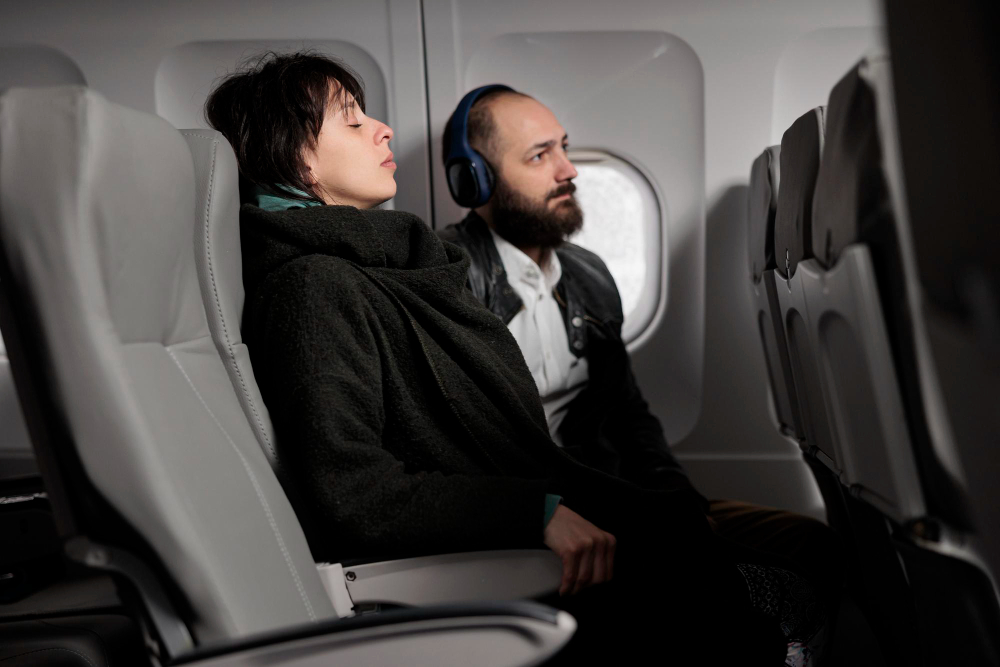
When the cabin starts to wake for the descent, and the light comes grey and then gold around the blinds, and Emma across the aisle lifts her window shade and gasps a little at the sight of a whole country coming up out of the dawn, Claire is going to lean across and talk to her.
She is not going to frighten her. She is not going to pour twenty-five years of stolen nights onto a thrilled young woman on the best morning of her career.
She is just going to say one true thing. That the crossing is wonderful, and it is, and she should enjoy every minute of it. And that it will try, very gently, over years, to become her whole life, and to convince her there is a point past which she cannot turn back. And that this is the only lie the ocean tells, and she should not believe it, and she should choose a shore while she is still young enough to build a life on it, and not find out at fifty-two, at thirty-eight thousand feet, that the in-between was where she lived the whole time.
Below, the map shows the little aeroplane crossing the last of the water, past the calculated point, committed now to the far shore, no returning.
But Claire, for the first time in a very long time, is not.
The wheels touch at Heathrow in the gold morning. There is a car waiting, and a day. She will do the day.
And then she is going to go and find a shore, and stand on it, and stay.
The North Atlantic Briefing is for the people who live on this ocean, held together across three thousand miles by their own bodies and their own stolen nights, and have started to wonder when the crossing became the life. A company should not be bridged by one exhausted person flying back and forth until there is nothing left of them. A VDC Readiness Memo is a small, honest look at how to hold two sides of an ocean together without asking a person to live in the middle of it.
Related crossings:
- The Man Who Never Rounded Anyone Off the captain who flew this ocean nine hundred times and never saw the far shore.
- The Woman Who Knew What Time It Was Everywhere another life lived across the clocks, holding a whole team together over the water.
- The Eleven Hours She Could Not Be Reached the seven hours over the ocean when the world cannot find you.
Next crossing: two executives who have taken the same two seats on this same red-eye every other Tuesday for three years, nodded a thousand times, and never once spoken, each quietly certain the other has it all figured out.
Was this useful?
A quick reaction helps us shape the next issue.Thanks for the reaction —
More from the briefing

You'd Have Done the Same
When a storm shuts New York, a hard, successful man flying to the deal of his life is ordered down to a small town in Newfoundland called Gander, and taken in by strangers who want nothing at all.
Cabin Pressure
On AC856, the every-other-Tuesday red-eye from Toronto to London, two frequent flyers who have shared the same cabin for three years and never spoken finally do, and each discovers the composed stranger they envied was drowning too.

The Man Who Swept These Floors
On AZ611 from New York to Rome, a man flies home at the front of the plane for the first time in his life, to buy the ceramics factory whose floors he swept as a boy, and to face the brother who stayed while he became someone else.