Cabin Pressure
On AC856, the every-other-Tuesday red-eye from Toronto to London, two frequent flyers who have shared the same cabin for three years and never spoken finally do, and each discovers the composed stranger they envied was drowning too.
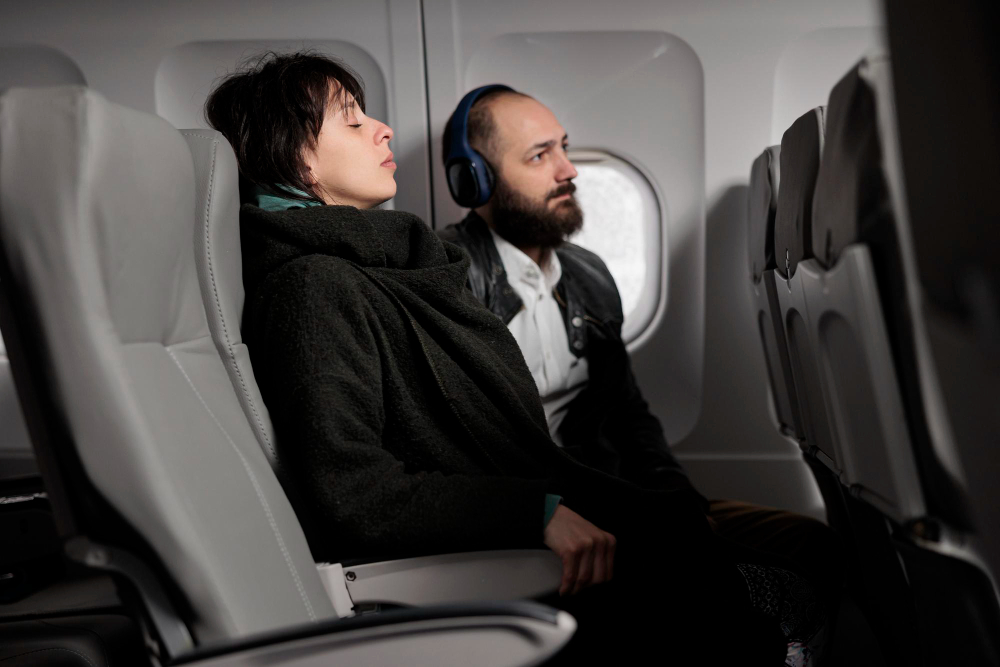
Every other Tuesday, at a quarter past nine at night, the same two strangers take almost the same two seats on the same aeroplane, and for three years they have not said a single word to each other.
They have a choreography, though. That is the strange thing about the regulars on a route like this. You do not speak, but you learn each other completely.
She knows he always asks for still water, never sparkling, and that he reads real newspapers, folded the old careful way, and that he is asleep before they clear the Canadian coast, which she has always taken as a sign of a man with a clear conscience and nothing keeping him up.
He knows she works until the exact moment they dim the cabin lights and then stops, cleanly, like a machine switching off, and that she reads actual paper books, and that she is kind to the crew in a way that most people up front are not.
They nod. That is the whole of their relationship. A nod boarding. A small tilt of the head over the shoulder if they reach the overhead bin at the same time. A nod at the far end, in the jet bridge fog of the London morning, going their separate ways into the same city. A thousand nods, give or take, over three years.
And each of them has built, out of these small pieces, a complete and confident portrait of the other, and both portraits are wrong.
She thinks he has it figured out.
Henry, though she does not know his name, is to her the picture of a man who has arrived. Calm. Unhurried. The still water, the folded paper, the easy sleep. She watches him some nights and thinks, that is a person who is not afraid of anything, a person who has done all this long enough that it costs him nothing, and she wishes, quietly, that she could be more like him, because she is forty-one and it costs her everything.
He thinks she has it figured out.
Anna, though he does not know her name, is to him the future. Sharp, composed, effortless. She works with a focus he envies and switches it off without a struggle and is decent to everyone, and he watches her some nights and thinks, that is what it looks like to be at the top of your game with your whole life still ahead of you, and he feels, without resenting her for it, very old and very tired by comparison.
Tonight, over the black middle of the ocean, both of these portraits are going to come apart, because tonight one of them is crying.
It is Anna.
She is not making a sound. She has years of practice at this, the silent kind, the kind you can do in a meeting or a bathroom or a window seat with your face turned to the black glass. But the cabin is dark and quiet and Henry is not asleep tonight, and out of the side of his eye he can see her shoulders, and the small helpless movement of a person trying very hard to be still.
Anna is crying because she left her daughter four hours ago.
Eighteen months old. She said her name properly for the first time last week, the whole thing, Mumma, and Anna was on this aeroplane when she did it and heard about it from a video her partner sent that she watched in this seat with her hand over her mouth. Tonight, at the door, the baby had clung and screamed in the particular way that eighteen months old scream, and Anna had handed her over and walked to the car and she has not stopped, quietly, since.
She does this every other Tuesday. She flies away from her child, across an ocean, for a job in a city three thousand miles from where her daughter is learning to talk. She has told herself, for two years, that it is temporary, that it is for the family, that the money and the title are worth it, that she is not the first woman to do this. And every other Tuesday the aeroplane lifts off and takes her away and she cries in the dark for about an hour and then she puts herself back together and lands and does the job, and no one at the office in London has the faintest idea, because she is composed, because she is sharp, because she has it figured out.
She thinks she is the only one on this whole aeroplane falling apart. She is surrounded, she is certain, by people like the calm man across the aisle, people who have it sorted, and she is the fraud crying in 2A.
Henry watches her for a while. And then he does a thing he has not done in three years.
He reaches into the little amenity pocket, and he takes out the small packet of tissues they give you, unopened, and he leans across the aisle, and he holds it out to her, and he says, very quietly, the first words he has ever said to her.
He says, it does not get easier, but you do get stronger. I promise.
Anna takes the tissues. She is mortified, and grateful, and something in the gentleness of it, the specific been-there gentleness, undoes her a little more before it puts her back together.
And she says, because it is the middle of the night over the ocean and the normal rules do not apply out here, she says, is it that obvious.
And Henry says, only to another regular.
And that is how, after three years and a thousand nods, they finally begin to talk.
She tells him. She does not mean to, but it comes out, the way it does at altitude in the dark to a stranger you will never really have to see. The baby. The word she missed. The every-other-Tuesday. The feeling of being torn exactly in half and failing, in her own eyes, at both halves. The performance of having it together that she keeps up all day so that no one will see the woman who cries over the ocean.
And Henry listens, the way you can tell within ten seconds whether a person actually knows how to do, and he does.
And then he tells her his.
The calm she has envied for three years. The still water and the easy sleep and the man who is afraid of nothing.
His wife is in London. She is very ill. She has been ill for a long time, and the best person to treat the particular thing she has is at a hospital there, and so two years ago she went to be near it, to be near her sister too, and Henry stayed in Toronto because that is where the work is and the work is what pays for all of it, and every other Tuesday he flies across the ocean to sit beside his wife for four days and then he flies back and works and flies out again.
The easy sleep, he tells her, is not a clear conscience. It is exhaustion. It is the sleep of a man who has learned to switch off the instant he sits down because it is the only place left in his life where nobody needs him to be strong for four hours.
And tonight, he says, and his voice changes, tonight is not a normal Tuesday, because the doctors called on Sunday, and he is not entirely sure what he is flying toward, and he has been sitting here in the dark not sleeping for the first time in three years, which is why, he supposes, he finally noticed her.
They sit with that, the two of them, in the dark, over the deepest part of the ocean.
Two people who have spent three years each believing they were the only one in the cabin who was drowning, and each believing the other was the one who had it figured out. And the truth is that she was flying away from the person she most wanted to be with, and he was flying toward the person he was most afraid to lose, and they had been doing it side by side, in silence, the whole time, three feet apart, nodding.
This is the thing about the cabin, the thing Anna understands for the first time tonight, somewhere past the point where there is no land in any direction.
It is pressurized. That is what keeps them all alive up here, the pressure, the invisible thing holding the cabin against the thin dead air outside. Without it, at this height, you would not last a minute.
And every single person in it is holding a pressure of their own, exactly as invisible, exactly as load-bearing, and exactly as unmentioned. The whole cabin full of important-looking people in the dark, each one certain they are the only one straining against something, each one performing the smooth calm face at all the others, and every one of those smooth calm faces is a person holding a cabin of their own together by sheer will, three feet from someone doing exactly the same thing.
They are, all of them, having it figured out at each other, and the performance is the loneliest part, because it is the thing that keeps them from ever finding out that no one, not one single person up here, actually does.
Anna and Henry talk almost all the way across. They talk about his wife, and about her daughter, and about the strange life of the regular, the lived on this ocean</a>, back and forth, every other Tuesday, belonging fully to neither shore. They talk the way you can only talk to someone who is inside the exact same thing, which they have been, for three years, without knowing it.
And when the light begins to come up grey and then gold around the blinds, and the crew start to wake the aeroplane, Henry says the thing that he has been circling.
He says, do not do what I did. He says, I told myself for years that it was temporary, that it was for the family, and I meant it, and it was true, and now my wife is in a hospital in a city we never lived in together and I have missed two years of ordinary Tuesdays that I would give anything to have back. He says, the ocean will let you call it temporary for as long as you like. It will never once tell you the time is up.
And Anna, who came onto this aeroplane certain she was alone and a fraud, looks at this tired kind man who is flying toward the worst news of his life, and she feels something she has not felt in two years of these crossings, which is not fixed exactly, nothing is fixed, but seen, which is the thing she did not know she was starving for.
The wheels touch at Heathrow in the gold morning.
And in the jet bridge, in the fog of arrival, where for three years they have given each other one last nod and walked away into the same city, they stop.
And Anna puts out her hand, and she says, I'm Anna.
And he takes it, and he says, Henry.
Three years, a thousand nods, one ocean, and finally their names.
Anna is going to call Toronto the second she is through the doors, and hear her daughter, and cry again, differently. Henry is going to get in a car and go to a hospital and find out what he is facing, and he is not going to face it as alone as he was yesterday, because there is a person in this city now who knows.
They are going to look for each other, every other Tuesday, from now on. The nod is over. The seat across the aisle will not be a stranger anymore.
And the crossing that was, for three years, the loneliest place either of them knew, the pressurized dark over the middle of the ocean where they each held themselves together in silence, turns out to have had, the whole time, three feet away, the one thing that would have made it bearable.
They just had to say a word.
The North Atlantic Briefing is for everyone in the cabin holding an invisible pressure of their own, three feet from someone doing exactly the same thing, all of them performing the smooth calm face at each other in the dark. Nobody up there has it figured out. Not one. The isolation of the people who cross this ocean to hold their working lives together is real, and it is heavier than any of them lets the others see. A VDC Readiness Memo will not fix a life. But some of the crossings, and some of the pressure, a company genuinely does not have to ask its people to carry alone.
Related crossings:
- The Point of No Return another life lived on this ocean, every other Tuesday, belonging to neither shore.
- The Show Must Go On a man performing that everything is fine, for an audience that already knows it is not.
- The Eleven Hours She Could Not Be Reached a parent torn in half by the ocean, unreachable while it happens.
Next crossing: the night the weather closes in over the Atlantic and the red-eye is ordered down to a small town in Newfoundland it was never meant to land in, where a cabin full of important people are about to find out what they are worth without any of it.
Was this useful?
A quick reaction helps us shape the next issue.Thanks for the reaction —
More from the briefing

You'd Have Done the Same
When a storm shuts New York, a hard, successful man flying to the deal of his life is ordered down to a small town in Newfoundland called Gander, and taken in by strangers who want nothing at all.

The Point of No Return
On UA16, the red-eye from Newark to London, a woman who has crossed this ocean six hundred times watches a young colleague take her first-ever transatlantic flight, and does the math on a life spent living in the middle of the sea.

The Man Who Swept These Floors
On AZ611 from New York to Rome, a man flies home at the front of the plane for the first time in his life, to buy the ceramics factory whose floors he swept as a boy, and to face the brother who stayed while he became someone else.