
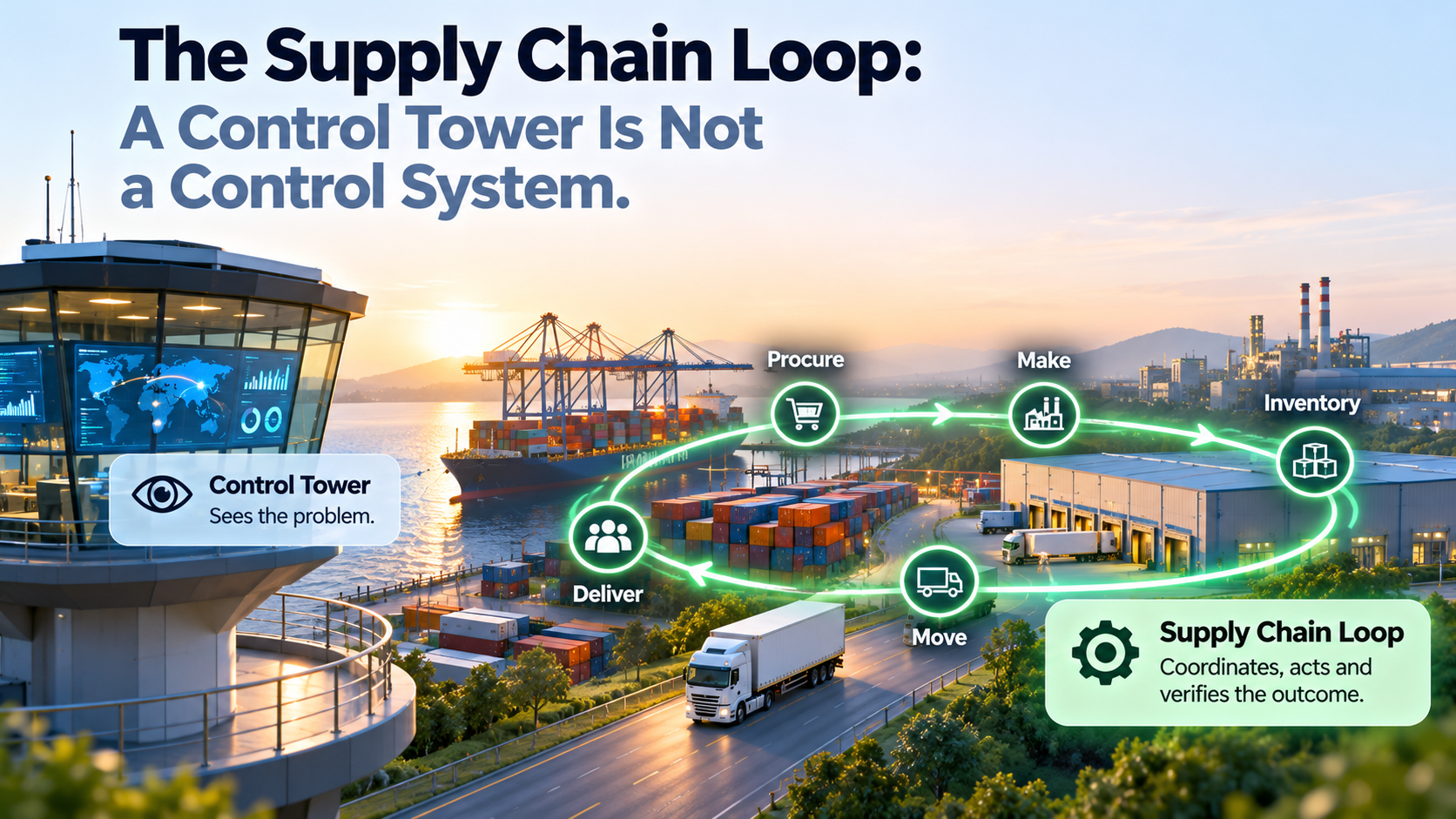
The Supply Chain Loop: A Control Tower Is Not a Control System
Imagine a consumer goods manufacturer preparing for one of its largest retail promotions of the year.
Production is scheduled, the distribution centers have reserved capacity, transportation providers have confirmed their commitments, and thousands of stores are expecting products before the promotion begins.
On Monday morning, the company's supply chain control tower detects something unusual. A packaging supplier has missed an important production milestone, putting a scheduled delivery at risk.
The system works exactly as designed. The supplier's status changes from green to amber, the estimated arrival date moves by two days, and an alert appears on the procurement team's dashboard.
The problem is visible.
But nothing changes.
The buyer contacts the supplier for an updated commitment. The supplier says it is investigating the delay and promises a response later that afternoon. Meanwhile, the production planning team continues working from the original schedule because nobody has formally confirmed that the material will be late.
By Tuesday morning, the supplier confirms the delay. Production planning now realizes that one manufacturing line may run out of packaging materials before the next shipment arrives.
The planning team asks another facility whether it has surplus stock. That facility does have some material available, but transferring it would require transportation capacity and approval because the stock was reserved for a different customer order.
Logistics investigates the transfer. Finance questions the additional freight cost, and sales wants to know whether the original retail commitment can still be met.
By Wednesday, the company has a workable recovery plan.
Unfortunately, it is now too late to execute that plan without disrupting the manufacturing schedule. The alternative transportation capacity is no longer available, and the inventory that could have been transferred has been allocated to another order.
The company eventually misses part of its delivery commitment. The retail promotion proceeds, but some stores receive insufficient stock, and the manufacturer spends the following weeks examining the financial and operational consequences.
During the review, the supply chain leadership team asks a familiar question.
Why didn't we see this coming?
The uncomfortable answer is that they did.
The control tower detected the problem on Monday morning. The data was available, the alert was accurate, and the risk was visible to the relevant teams.
What the organization lacked was a system that could continuously connect the warning with the decisions, actions and verification required to preserve the business outcome.
The company had visibility into the disruption. It did not have continuous control over the response.
That distinction sits at the heart of the next phase of supply chain transformation.
1. We have spent years learning to see the supply chain
Supply chain visibility has been a major enterprise technology priority for decades.
Manufacturers, retailers and logistics providers have invested heavily in ERP systems, warehouse management, transportation platforms, supplier portals, planning applications, IoT infrastructure and increasingly sophisticated analytics.
The objective has been understandable.
A global supply chain contains thousands of moving parts. Raw materials come from suppliers, products move through manufacturing facilities, inventory sits across distribution networks, and transportation providers connect businesses with customers.
Every activity creates information, but that information rarely originates in one system.
A purchase order may exist in SAP or Oracle. Supplier commitments may arrive through EDI, email or a supplier portal, while transportation status comes from a carrier or logistics platform.
Inventory exists in warehouse systems, production requirements live in planning applications, and customer orders follow another set of processes.
Getting a coherent view of this environment is genuinely difficult.
Supply chain control towers emerged to address that problem. They bring together information from multiple sources, helping organizations understand the state of their operations and recognize exceptions that might otherwise remain hidden.
This was a major advancement.
A company no longer needed to wait for a customer complaint to discover that a shipment was late. It could identify the risk earlier, understand which orders might be affected and investigate possible responses.
Modern control towers can go considerably further.
As the Association for Supply Chain Management has discussed, AI-enabled control towers are evolving from traditional visualization environments toward more intelligent systems capable of supporting coordinated operational responses.
Some platforms already provide optimization, scenario analysis, automated decisions and execution capabilities.
That progress should not be dismissed.
But the term control tower has also become broad enough to describe very different levels of maturity.
For some organizations, it means an integrated dashboard showing inventory, supplier commitments and transportation movements. For others, it is a sophisticated operating capability that combines information, decision rights and coordinated actions across the supply chain.
A February 2026 article in Supply Chain Management Review makes this distinction clear: a serious control tower is an operating model involving people, technology and decision authority, not merely a software dashboard.
The important question is therefore not whether a company has purchased something called a control tower.
It is what the control tower can actually do.
Can it recognize a problem? Can it understand the business consequence? Can it determine an appropriate intervention, initiate the necessary actions and verify whether the outcome improved?
Those are progressively different capabilities.
And the distance between seeing a problem and correcting it is where much of the supply chain's economic value remains trapped.
2. A control tower observes the network. A control system changes its behavior.
The distinction becomes clearer when we borrow an idea from control engineering.
A control system does not exist merely to report the condition of something.
It exists to maintain or move that condition toward a desired state.
Think about a temperature control system.
A sensor measures the current temperature. The controller compares that measurement against the desired temperature, determines whether intervention is needed and activates the heating or cooling equipment.
After the intervention, the system measures the temperature again.
If the desired state has not been reached, the controller continues adjusting its actions within the limits of the system.
The feedback is essential.
A temperature sensor that accurately reports an overheating room is useful. But a report is not temperature control.
Control requires a connection between observation, decision, action and the resulting change in reality.
Supply chains are far more complex than temperature regulation, but the underlying principle is relevant.
Suppose an inventory system identifies that a product is likely to stock out.
The observation is valuable.
An AI model might then recommend transferring inventory from another distribution center. That recommendation is more useful, but the business state has not yet changed.
Someone still needs to authorize the transfer, determine whether transportation is available, execute the movement and verify that the product reaches the required location before the stockout occurs.
If the transfer fails, the organization needs another response.
A genuine control capability maintains responsibility through that entire sequence.
This is where Loop Engineering enters the picture.
A Supply Chain Loop is a closed business loop that continuously observes the state of the supply network, evaluates deviations from defined business objectives, coordinates permitted corrective actions and verifies whether those actions restored an acceptable operating condition.
The objective might involve customer availability, production continuity, service reliability, cost, working capital or a combination of these outcomes.
The loop does not necessarily execute every action autonomously.
Some interventions require human judgment, supplier participation, customer approval or operational authority that software should not possess.
But the process remains active while those decisions occur.
The system remembers what is unresolved, understands what is expected next and observes whether the required action actually happened.
That is the difference between a network that can see its problems and one that can continuously work toward resolving them.
3. The supply chain is not one process. It is a collection of interconnected loops.
Over the last several articles, we have explored individual business loops in considerable detail.
The Inventory Loop continuously balances availability, working capital and risk. The Procurement Loop seeks to ensure that supplier commitments become usable supply rather than merely confirmed purchase orders.
The Logistics Loop maintains responsibility for verified delivery rather than stopping when a vehicle reaches its destination. The Maintenance Loop connects equipment-health predictions with actual physical interventions and verified operational recovery.
Each loop has its own objective.
But inside a real enterprise, those objectives are connected.
Return to the packaging supplier from our opening story.
The procurement team is concerned that the supplier cannot meet the promised delivery date. The inventory team knows that available packaging stock may be insufficient to support the original production plan.
Manufacturing needs to understand which production orders will be affected. Logistics needs to determine whether alternate transportation or inventory transfers are feasible.
Sales is concerned about the retailer's promotional commitment, while finance wants to understand the cost of possible recovery actions.
Each team can make a locally reasonable decision.
The buyer might choose a cheaper substitute supplier. Inventory might preserve stock for a different product, while logistics might recommend an expedited shipment.
Manufacturing may want to avoid changing its schedule. Finance may resist additional transportation costs, and sales may insist that the retailer's original commitment must be protected.
These decisions are not necessarily compatible.
A cheaper supplier could introduce a quality risk. Protecting one production line might starve another, while an expensive transfer could preserve delivery performance but destroy the margin on the order.
The supply chain is full of these tradeoffs.
That is why optimizing each function independently does not guarantee an optimal enterprise outcome.
A Supply Chain Loop must understand how a change in one part of the network affects the others.
If a supplier misses a commitment, the system needs to understand the inventory consequence. If inventory becomes insufficient, it needs to understand the production consequence.
If production changes, logistics commitments may need to change. If customer delivery becomes uncertain, commercial decisions may become necessary.
Every intervention changes the state of something else.
The loop therefore needs to evaluate the consequences of its actions across the relevant business network.
This does not mean creating one enormous AI agent responsible for the entire company.
That would introduce its own problems of complexity, authority and reliability.
A more practical architecture is a network of specialized loops that exchange context and coordinate their actions around clearly defined objectives.
The Procurement Loop owns the supplier commitment. The Inventory Loop maintains the required stock state, and the Logistics Loop handles the relevant transportation outcome.
Above these, a broader Supply Chain Loop can coordinate decisions involving multiple functions when a local intervention affects the larger business.
The architecture resembles a living network of execution responsibilities rather than a single centralized workflow.
That is important because no individual department possesses complete control over a modern supply chain.
The business outcome is produced through their coordination.
4. The greatest disruption is often caused by decisions that arrived too late
Supply chain leaders spend considerable effort understanding disruption.
They monitor supplier risk, transportation delays, inventory shortages, production constraints, geopolitical developments and changes in customer demand.
These risks are real, and no amount of AI can eliminate them.
A supplier may still miss a shipment. A port may close, a production line may fail, and demand may change unexpectedly.
But the consequences of disruption depend heavily on when the organization responds.
Imagine that a manufacturer learns on Monday that a material delivery will be delayed until Thursday.
At that moment, several recovery options may be available.
Another facility may have usable inventory. An alternative supplier might be able to provide a partial shipment, or production could be rescheduled before the original material is exhausted.
By Wednesday, some of those options may have disappeared.
The available inventory may have been consumed. Alternative transportation capacity may have been booked, and production commitments may be too close to change without significant cost.
The same disruption becomes more expensive as the intervention window closes.
This is where Human Latency becomes particularly damaging.
The supplier's update waits for the buyer. The buyer waits for planning, planning waits for logistics, and logistics waits for finance.
Everyone is performing a legitimate function, but the recovery opportunity is shrinking while the organization coordinates its response.
The problem is not simply that people are working slowly.
Supply chain decisions are spread across teams with different responsibilities, systems and operating priorities. People need to understand context, seek approvals and consider consequences before acting.
The enterprise was designed around those constraints.
But AI allows us to reconsider how much of the coordination must depend on human attention.
When a supplier commitment changes, an intelligent execution system can immediately gather the relevant inventory, production and logistics context.
It can estimate which customer commitments may be affected and identify available interventions.
It can distinguish actions that fall within approved policies from those requiring explicit authority.
If human approval is necessary, the responsible person can receive a clear decision rather than a vague notification.
Once that decision is made, the system can coordinate permitted execution and observe what happens afterward.
The value lies in shortening the time between recognizing a problem and taking a useful action.
A control tower may help a company discover a disruption earlier.
A closed loop helps the company use that early warning while recovery options still exist.
This is where supply chain responsiveness becomes a competitive advantage.
Two manufacturers might face the same supplier disruption and have access to essentially the same information.
One spends three days coordinating a response.
The other identifies a workable intervention within hours and begins executing it before the alternatives disappear.
The difference may have very little to do with the accuracy of their forecasting systems.
It may have everything to do with how their organizations execute.
5. A Supply Chain Loop needs reliable state, authority and feedback
The architecture of a genuine Supply Chain Loop is demanding because the system must operate across information and decisions that do not always agree.
Consider the supplier delay again.
The supplier portal says the shipment has been dispatched. The transportation provider has not recorded a pickup, while the manufacturer's ERP still shows the original expected delivery date.
Which state is correct?
The answer matters because the system may recommend different actions depending on whether the material is still at the supplier's facility, moving through the transportation network or already waiting at a distribution center.
This is why data quality is not merely a technical concern.
It determines whether the loop understands reality well enough to act.
A supply chain system needs to distinguish confirmed events from estimates, commitments from actual fulfillment, and missing information from evidence that something did not happen.
A supplier promising shipment is not equivalent to a carrier confirming pickup. A carrier confirming delivery is not necessarily proof that the receiving facility accepted the correct quantity and quality.
The system must understand those differences.
It also needs a clear definition of the desired business state.
For the promotional campaign in our opening story, the objective might be to preserve the agreed customer delivery commitment while operating within approved cost, quality, safety and service constraints.
That objective cannot be reduced to one metric.
The cheapest intervention might cause a stockout. The fastest intervention might be unnecessarily expensive, and an alternative material might be available but fail an important quality requirement.
The loop must evaluate tradeoffs.
This is where the ten primitives of Loop Engineering become useful.
Goal defines the desired outcome. State describes what is currently true, and Context explains the relevant demand, inventory, production, supplier and customer conditions.
Constraints establish acceptable operating boundaries, while Actions define the changes that the system is actually authorized to initiate.
Observation determines what happened after an intervention, and Evaluation assesses whether the business moved toward its desired state.
Memory preserves previous decisions and their consequences. Escalation brings qualified people or other systems into decisions that exceed the loop's authority, while Learning identifies what should improve in future execution.
These are architectural capabilities, not ten tasks performed in a rigid sequence.
Inside the architecture, the continuous cycle remains familiar: Observe, Understand, Decide, Act, Verify, Adapt and Repeat.
But the supply chain adds an important complication.
Many of the actions required to change the outcome belong to external organizations.
A manufacturer cannot simply instruct a supplier to increase production without agreement. It cannot force a logistics provider to accept an uncontracted shipment, and it cannot assume that a customer's receiving facility will accommodate an unexpected delivery.
The loop therefore needs to understand the difference between controlling an internal system and coordinating with an external partner.
Some actions can be executed directly through authorized enterprise applications.
Others require a request, negotiation, confirmation or explicit commitment from another organization.
The loop must treat those external responses as new observations rather than assuming that sending an instruction guarantees compliance.
That is what makes supply chain control fundamentally different from controlling a machine inside one facility.
The system operates across organizational and commercial boundaries.
And its effectiveness depends on maintaining accurate feedback across those boundaries.
6. More autonomy is not automatically better control
There is a danger in describing the future of supply chains as fully autonomous.
The phrase sounds attractive because it suggests that systems will recognize disruptions and correct them without requiring human involvement.
In some carefully defined situations, that may be possible and economically valuable.
But autonomy is not the objective.
Reliable business outcomes are.
Suppose an AI system identifies that a component will arrive late. It decides to preserve production continuity by ordering replacement material from another supplier and arranging expedited air freight.
The intervention works.
The material arrives on time, and the production line continues operating.
But the alternative supplier charges a substantial premium, the freight cost is far higher than expected, and the recovered production order generates almost no contribution margin.
Did the system succeed?
Operationally, it preserved availability.
Economically, the intervention may have been irrational.
Now consider a different situation.
A manufacturer uses an alternative component that appears technically compatible but has not completed the required quality approval process.
The system might preserve production temporarily while creating a much larger reliability or compliance problem.
These examples show why control requires constraints.
The loop must understand not only what it is trying to achieve, but also what it must not do while pursuing that outcome.
Financial limits, contractual commitments, quality approvals, safety requirements, regulatory obligations and customer relationships all influence the appropriate decision.
Some decisions can be governed through predefined policies.
Others require human judgment because the consequences are significant, uncertain or difficult to reverse.
The system should know the difference.
A supply chain leader should be able to define which interventions the loop can execute automatically, which require approval and which are prohibited.
For example, the system might automatically request updated supplier commitments, reconcile shipment milestones or initiate an approved inventory inquiry.
It may be permitted to propose stock transfers and prepare alternative transportation options.
But changing a strategic supplier, approving an expensive expedited shipment or altering an important customer commitment may require explicit authority.
This approach does not make the system less intelligent.
It makes the system more trustworthy.
Good control engineering is not about maximizing the number of actions a controller can perform.
It is about keeping the system within acceptable operating conditions while moving it toward the desired state.
The same principle applies to enterprise execution.
A mature Supply Chain Loop should become more capable over time, but its growing autonomy must be supported by evidence, governance and clear responsibility.
Human judgment remains part of the architecture.
The difference is that humans no longer need to serve as the default coordination mechanism for every ordinary event.
7. The Supply Chain VDC: Engineering the system that connects the loops
By now, the strategic opportunity is clear.
The difficult question is how an enterprise actually builds this capability.
Consider a manufacturer that already has an ERP, planning software, supplier portals, warehouse systems, transportation applications and AI infrastructure.
The company has invested heavily in technology.
Yet connecting those investments into a continuously operating execution system requires work that does not fit neatly inside any one application.
Someone needs to understand the supply chain objective, connect the relevant systems and determine which information represents the authoritative business state.
Someone needs to engineer the decision logic, establish constraints, build reliable integrations and define how actions will be executed and verified.
And somebody needs to maintain the system as suppliers, facilities, customer requirements and enterprise applications change.
This is not simply an AI model deployment.
It is an ongoing engineering responsibility.
A Supply Chain Virtual Delivery Center, or Supply Chain VDC, provides a way to organize the required execution capability.
The VDC brings together the appropriate domain specialists, integration engineers, AI engineers, data specialists, verification capabilities and operational tools around a defined business outcome.
Rather than assembling a permanent internal team for every new supply chain initiative, the enterprise can mobilize execution capacity around the loops it wants to engineer and operate.
The starting point should be narrow enough to produce credible evidence.
Imagine the manufacturer from our opening story deciding to focus initially on one material category supporting one important production line.
The objective might be to reduce avoidable production disruptions caused by late supplier commitments.
The VDC begins by understanding the current execution process.
Where do supplier commitments originate? How are changes reported, and which systems contain the relevant inventory, production and transportation information?
When a delivery becomes uncertain, who currently evaluates the consequence? Which alternative actions are possible, and who has authority to approve them?
The team examines where the process loses time and where an earlier intervention might actually change the outcome.
From there, it engineers the first loop.
Integration specialists connect the supplier, inventory and production information. AI capabilities help interpret relevant signals, identify inconsistencies and evaluate the possible consequences of delays.
Domain specialists define the operating constraints, while the engineering team establishes the actions that can be performed through existing systems.
The initial deployment may operate primarily in an advisory mode.
When a supplier milestone is missed, the system gathers the relevant context and proposes appropriate interventions. The responsible planners evaluate those recommendations before any operational change occurs.
This allows the organization to test whether the loop understands the business correctly.
As evidence accumulates, selected routine actions can become automated within approved limits.
The system might request revised delivery commitments, check alternative inventory availability or prepare transfer options.
More consequential interventions remain subject to human authority.
The important difference from a conventional project is what happens after deployment.
The VDC does not declare success simply because the AI model is running or an integration has gone live.
It helps verify whether the system actually reduces avoidable latency, improves intervention readiness and preserves the relevant production or delivery outcomes.
When the loop encounters failures, the engineering team investigates them.
Was a supplier update misinterpreted? Was inventory information stale? Did an approval arrive too late, or did the recommended recovery action create an unexpected downstream problem?
Each observation becomes evidence for improving the loop.
Once the first capability is reliable, the VDC can extend the architecture into related materials, production lines, facilities or customer commitments.
Reusable integrations, evaluation methods, governance controls and decision patterns reduce the need to recreate the same engineering work repeatedly.
Eventually, the enterprise begins building an interconnected network of loops.
Procurement, Inventory, Manufacturing and Logistics can exchange relevant information and coordinate permitted actions while maintaining distinct responsibilities.
This is where the VDC model becomes especially valuable.
The organization does not need to turn every planner into an AI engineer or every IT team into a permanent supply chain transformation department.
It needs a repeatable mechanism for assembling the right execution capabilities around outcomes that justify the investment.
At AiDOOS, this is how we see the relationship between Loop Engineering and Virtual Delivery Centers.
Loop Engineering defines the business outcomes, feedback architecture and operating discipline. The VDC provides the coordinated capacity to engineer, operate and continuously improve those loops.
The enterprise retains ownership of its systems, decisions, data and commercial commitments.
The VDC supplies the execution capability required to make those investments work together.
The objective is not to replace the existing control tower, ERP or planning systems.
It is to help ensure that the business can move from knowing what is happening to continuously doing what is necessary about it.
8. The next supply chain advantage will be measured in outcomes, not alerts
Return once more to the manufacturer's delayed packaging shipment.
The supplier still encounters a production problem. AI has not eliminated manufacturing variability, and the global supply chain has not become immune to disruption.
The difference is what happens after the problem appears.
On Monday morning, the supplier commitment changes.
The Supply Chain Loop recognizes that the updated delivery date may affect a scheduled production order. It examines available inventory, production requirements and feasible recovery alternatives.
The system identifies surplus material at another facility and determines that an early transfer could preserve the manufacturing schedule within the relevant operating constraints.
The responsible planner receives the recommendation with the necessary context. The transfer is approved, and the system initiates the permitted execution steps.
The loop then observes whether the inventory was actually released, transported and received.
If the transfer encounters a delay, the system recognizes the new condition and reevaluates the available options.
By Wednesday, the material is available for production.
The retail promotion proceeds without the original disruption reaching the customer.
The company may have used the same supplier portal, inventory system, TMS and planning software it possessed before.
It may even have used the same predictive model.
What changed was the execution architecture connecting those capabilities.
Instead of a warning triggering a chain of disconnected human activities, the business maintained continuous responsibility for protecting a defined outcome.
That difference should eventually change how supply chain leaders measure performance.
A control tower can report how many exceptions were detected and how quickly information became visible.
A Supply Chain Loop should also be evaluated by what happened afterward.
How long did it take to recognize the business consequence of a disruption? How quickly was an appropriate response initiated, and how many avoidable handoffs occurred before the intervention began?
Did the action preserve the customer commitment? Was the recovery economically justified, and did it introduce additional risks elsewhere in the network?
How frequently did the system require human intervention? Where did those interventions add genuine judgment, and where were people simply moving information between applications?
Most importantly, did the supply chain become better at handling similar problems over time?
These questions connect AI performance with operational economics.
A company may process millions of supply chain events and produce thousands of intelligent alerts. Those numbers demonstrate technological capability, but they do not establish business value.
A more meaningful measure is whether the organization can maintain customer availability, protect production continuity, reduce unnecessary expediting, improve working-capital efficiency and respond to disruption without creating new problems elsewhere.
The value of a closed loop must also be measured carefully.
Avoiding a disruption is not always easy to prove because the company cannot observe the exact alternative future that would have occurred without the intervention.
Credible measurement therefore requires baselines, appropriate comparisons and an honest understanding of uncertainty.
But the direction is clear.
The enterprise should increasingly judge its supply chain intelligence by the business conditions that intelligence helps preserve or improve.
There is also a larger implication.
For decades, organizations have tried to make supply chains more visible.
They built information systems, integrated partners, created dashboards and developed increasingly sophisticated forecasting and planning capabilities.
Those investments were necessary because a business cannot respond intelligently to conditions it does not understand.
But visibility was never the final objective.
A customer does not care how many supply chain events the manufacturer can monitor. The customer cares whether the product arrives when promised and performs as expected.
A factory manager does not care how beautifully the system visualizes a supplier shortage if the production line still stops.
And a CFO does not measure success by the sophistication of the network dashboard while working capital remains trapped in the wrong inventory.
The real question is whether the enterprise can use what it knows to change what happens next.
That requires more than observation.
It requires decisions, authority, coordinated execution, feedback and learning.
The most advanced supply chain will not necessarily be the one with the greatest number of sensors, the most detailed digital twin or the most sophisticated control tower interface.
It may be the one that keeps important business outcomes moving even when conditions change unexpectedly.
This is where our broader Loop Engineering thesis comes together.
Procurement, Inventory, Logistics and Maintenance are not merely separate functions to be automated. They are interconnected operating capabilities that must continuously coordinate around the enterprise's commitments.
Virtual Delivery Centers provide a practical way to engineer and maintain that capability across the existing technology estate.
And the Supply Chain Loop provides the feedback architecture through which intelligence becomes execution.
The next generation of supply chains will still need visibility. They will still need experienced planners, capable suppliers, reliable infrastructure and good operational judgment.
But they should no longer depend on someone repeatedly discovering that an important outcome has stopped moving.
A control tower can tell the business that something is going wrong.
A true control system helps the business change what happens next, verifies whether the intervention worked and learns how to respond better the next time.
The supply chain was never meant to be watched. It was meant to deliver.
That is the difference between seeing the network and engineering the outcome.