RAMP for Procurement Professionals: When AI Stops Comparing Vendors and Starts Closing the Procurement Loop
Vikram's team has a spreadsheet with 147 suppliers.
Every row contains something important. Contract value, renewal date, payment terms, performance score, category, risk rating, last negotiation, and the name of the internal owner are all there.
The sheet is maintained carefully. It is also already out of date.
One supplier increased lead times three weeks ago. Another missed a quality threshold last month, while a third quietly changed payment terms in its latest proposal.
A fourth supplier looks healthy on every scorecard but has recently become much more dependent on one manufacturing region. A fifth is due for renewal in sixty days, yet nobody has started the negotiation.
Vikram knows all of this because his team spends an enormous amount of time assembling the story behind every supplier.
They read emails, check ERP records, ask operations what happened, review contracts, compare market prices, chase business owners, and update procurement systems after decisions have already been made elsewhere.
Then AI arrives.
It can summarize contracts.
It can compare bids.
It can extract pricing.
It can draft supplier emails, analyze spend, identify unusual clauses, classify risk, prepare negotiation points, and generate a supplier scorecard in minutes.
The productivity gain is immediate.
But six months later, Vikram notices something frustrating.
The procurement team is faster at understanding suppliers.
The company is not necessarily faster at changing supplier outcomes.
A late supplier is still late.
A poor contract still waits for someone to renegotiate it.
A renewal still drifts toward the deadline until several people suddenly realize they have two weeks left to make a decision.
The AI is analyzing the procurement process.
Humans are still carrying the process forward.
That is where RAMP and Closed Loops become more interesting.
The opportunity is not simply to give procurement better intelligence.
It is to build systems that continuously observe supplier reality, act within business boundaries, verify what happened, and adapt until the commercial outcome improves.
1. Procurement has always been a control system disguised as a department
Vikram starts by looking at one supplier responsible for a critical component.
The company expects delivery within fourteen days.
The supplier's average lead time has gradually moved from twelve days to seventeen, then nineteen, and now twenty-two.
Nobody decided to accept twenty-two days.
The process simply drifted there.
Operations adapted.
Planners ordered earlier. Warehouses held more safety stock, and finance absorbed the additional working capital.
The supplier scorecard still shows amber.
That small example reveals something important.
Procurement is not merely a function that buys things.
It is constantly trying to maintain business states.
Price should remain within an acceptable range.
Supply should remain reliable.
Quality should stay above a threshold.
Risk should remain tolerable.
Contracts should protect the business.
Inventory should not grow simply because suppliers are becoming less dependable.
When reality moves away from those desired states, somebody has to intervene.
That is already a loop.
The company observes supplier performance, compares it with expectations, decides what to do, acts, and then observes again.
The problem is that humans are often the only thing holding the loop together.
One person notices the lead-time drift.
Another person asks operations whether it matters.
Someone prepares the data.
Someone contacts the supplier.
Someone waits.
Someone negotiates a corrective plan.
Three weeks later, someone remembers to check whether the supplier actually improved.
The procurement system records parts of this activity.
It rarely owns the outcome.
That is the opportunity for Closed Loops.
2. Retrieval means knowing the supplier beyond the contract
Vikram's team decides to redesign the supplier-performance process around one strategic category.
The first instinct is to connect AI to the contract database.
That helps, but the contract tells only part of the story.
A supplier relationship has a much richer state.
The system may need purchase-order history, actual lead times, defect rates, dispute history, invoices, payment terms, previous negotiations, current demand, inventory exposure, alternative suppliers, supplier communications, customer impact, and contractual obligations.
It may also need information outside procurement.
Operations knows where delays hurt.
Finance knows whether the payment terms are creating cash pressure.
Quality knows whether defect rates are becoming operationally dangerous.
Sales may know that a particular customer commitment makes one component unusually important this quarter.
This is Retrieval in RAMP.
For procurement professionals, Retrieval is not simply document search.
It is assembling the context required to understand the commercial and operational state of a supplier before deciding what should happen next.
Vikram sees the effect immediately.
One supplier looks expensive when compared only on unit price.
Once logistics cost, defect rates, payment terms, and emergency-expedite expenses are included, a supposedly cheaper competitor looks much worse.
Another supplier appears to be missing service levels, but the company's own forecasting errors caused a large portion of the instability.
The relationship looks different when the context is complete.
This is why procurement AI cannot begin with “find the cheapest vendor.”
That is not procurement intelligence.
It is price sorting.
The real work is understanding the economics, risk, reliability, and strategic importance surrounding the decision.
AI can retrieve that context much faster than a human team.
But the procurement professional still needs to understand what belongs in the context.
3. Agents change procurement when they can do more than draft the email
Once Vikram's team has a reliable view of supplier state, agents become much more useful.
The obvious application is communication.
An agent can prepare a supplier email, summarize a performance issue, request information, and schedule a follow-up.
That is convenient.
It is not yet transformative.
The more interesting question is what actions the loop should be allowed to take.
Suppose lead time exceeds the agreed threshold.
The system might automatically request a corrective plan.
It could ask for an updated delivery commitment, notify internal planning, compare alternative suppliers, calculate the cost of delay, and prepare a recommendation for partial reallocation.
Some actions can happen with little human involvement.
Others should not.
Can the agent shift ten percent of volume to another supplier?
Can it initiate a sourcing event?
Can it negotiate payment terms?
Can it accept a price increase?
Can it trigger a contractual penalty?
These are authority questions.
That is what Agents means in RAMP when applied to procurement.
The procurement professional needs to design an action space.
Routine and reversible actions can become highly automated.
The system can request missing documents, chase late acknowledgements, gather updated lead times, compare approved alternatives, and remind stakeholders about expiring contracts.
More consequential actions need stronger boundaries.
A change in supplier allocation may affect operations.
A negotiation decision may affect long-term economics.
A contract change may create legal exposure.
The agent can prepare the decision.
Humans may still own the approval.
This is not a weakness in the loop.
It is good loop design.
The goal is not maximum autonomy.
The goal is the right autonomy for the consequence.
4. Models can optimize price and still make procurement worse
Vikram's team introduces a model that recommends the lowest-cost supplier mix.
The output is impressive.
It identifies a way to reduce annual spend by nearly eight percent.
Finance is interested.
Operations is less enthusiastic.
The model proposes moving more volume to a supplier with lower prices but much higher lead-time variability.
That supplier also has a poorer record during seasonal peaks.
The savings are real.
So is the operational risk.
This is the Models capability in RAMP.
A model can optimize whatever objective it is given.
That does not mean the objective captures the whole business.
Procurement has always lived with tradeoffs.
Price matters.
So do reliability, quality, resilience, switching cost, working capital, supplier concentration, innovation, regulatory exposure, geography, and strategic flexibility.
A powerful model does not remove these tradeoffs.
It makes the organization's priorities more explicit.
If the system is told to minimize unit cost, it may do exactly that.
If the business cares about total landed cost and supply continuity, the objective must reflect those realities.
This is why AI-native procurement is not about choosing the smartest model.
It is about defining the right decision system.
Some parts may use predictive models.
Others may use language models to reason across contracts or supplier communications.
A deterministic rule may be better where the policy is clear.
A strategic sourcing decision may still require experienced human judgment.
The mature procurement function does not ask, “Where can we insert AI?”
It asks, “What intelligence belongs at this point in the loop, and what business outcome are we actually optimizing?”
5. Proof begins after the negotiation is over
Vikram's team renegotiates a supplier contract.
The headline result looks excellent.
The supplier agrees to a lower price, better payment terms, and a stronger service commitment.
Everyone congratulates the negotiation team.
Three months later, Vikram checks what actually happened.
The unit price decreased.
Emergency freight increased.
The supplier missed several promised dates, and the operations team quietly increased buffer inventory.
The negotiated saving still exists on paper.
The business outcome is much weaker.
This is Proof.
Procurement often celebrates the action.
The sourcing event completed.
The supplier agreed.
The contract was signed.
The savings were recorded.
A Closed Loop asks whether the promised outcome materialized in reality.
Did the supplier actually deliver on time?
Did quality improve?
Did the price reduction survive once logistics and operational costs were included?
Did working capital improve?
Did supplier risk decrease?
This is where the loop starts learning.
A supplier that repeatedly agrees to corrective plans but fails to improve should not be treated the same way during the next intervention.
A negotiation tactic that produces short-term price concessions but damages reliability should be reconsidered.
An alternative supplier that initially looks expensive may become more attractive after real performance evidence accumulates.
Proof turns procurement from a sequence of commercial events into a continuously improving operating system.
The organization no longer asks only what it negotiated.
It asks what the negotiation changed.
6. The procurement loop becomes something the business can design deliberately
Vikram's team maps the supplier-performance process using the seven-step Closed Loop framework.
The State includes supplier performance, current pricing, quality, lead times, contractual commitments, demand exposure, inventory position, alternative supply, and relevant business context.
The Objective might be to maintain reliable supply within an acceptable total cost and risk range.
That definition is important.
If the objective were simply “reduce spend,” the system could make decisions that damage operations.
Then come Constraints.
Certain suppliers may be mandated for regulatory reasons.
A critical customer program may require approved materials.
Volume cannot be shifted beyond a limit without qualification, and some contract changes require legal approval.
The loop then defines Actions.
Request a corrective plan.
Reforecast demand.
Change an order.
Move a portion of volume.
Start a sourcing event.
Renegotiate terms.
Escalate to leadership.
Qualify an alternative supplier.
Pause further allocation.
After each action comes Observation.
Did lead time improve?
Did quality recover?
Did the supplier meet the new commitment?
Did costs move elsewhere?
Did operations experience fewer disruptions?
Then comes Evaluation.
Was the business actually better off?
The answer may not be obvious immediately.
A lower price could be worse if it creates more inventory.
A supplier diversification effort could increase short-term cost while materially improving resilience.
Finally comes Adaptation.
The next action changes based on what the loop learned.
A supplier that responded well may require less intervention.
A supplier that repeatedly misses commitments may trigger volume reallocation.
A category where alternatives are weak may require supplier-development work rather than aggressive negotiation.
The sequence remains familiar:
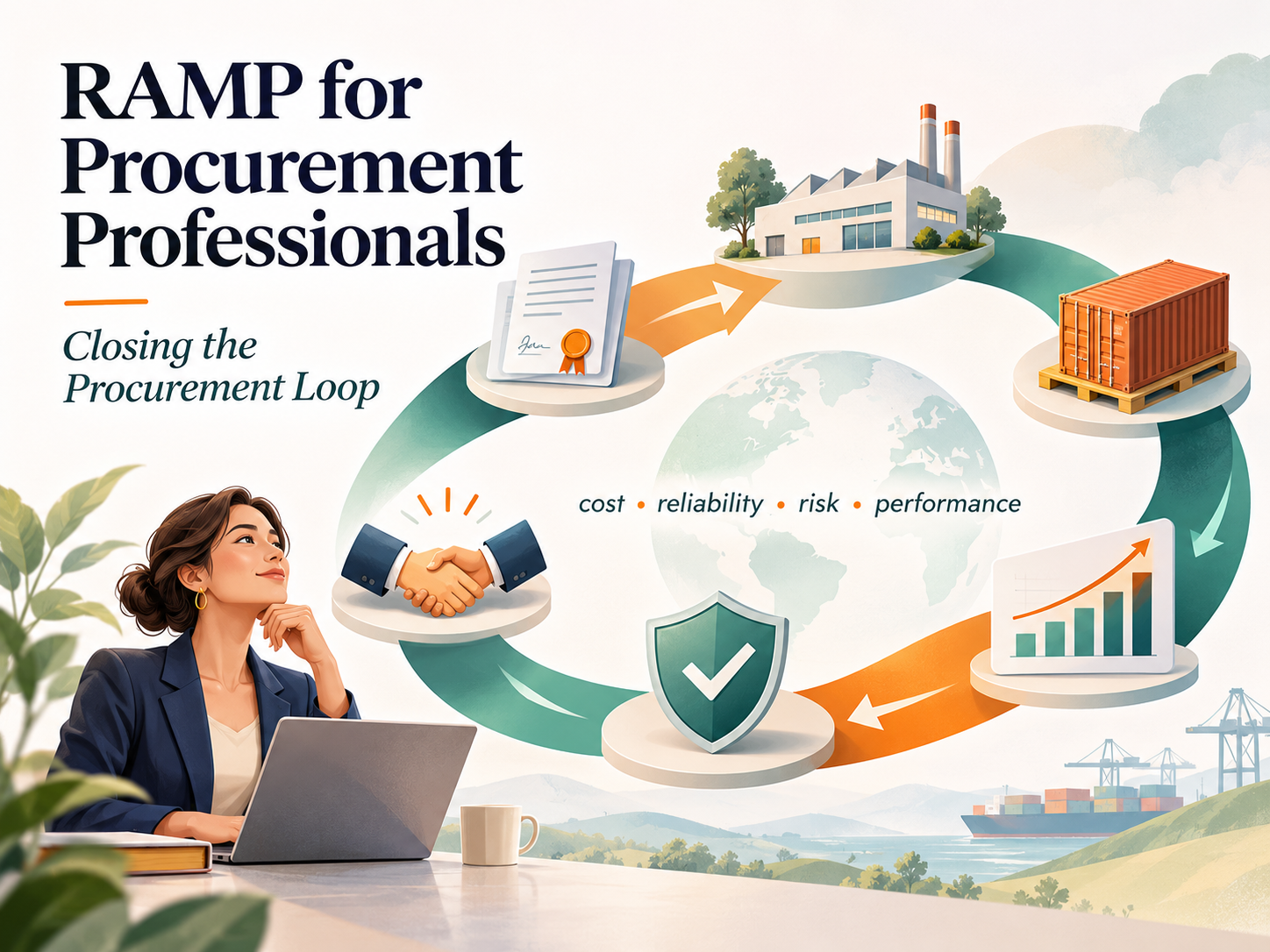
State → Objective → Constraints → Actions → Observation → Evaluation → Adaptation
RAMP powers the loop.
Retrieval establishes the commercial and operational context.
Models help interpret the state and evaluate options.
Agents perform bounded actions.
Proof establishes whether supplier and business outcomes actually changed.
Then the loop adapts.
That is much more powerful than an AI system that merely recommends which supplier appears cheapest.
7. Human procurement professionals move toward decisions that shape the business
A year later, Vikram's team still negotiates.
It still manages suppliers.
Contracts still matter, sourcing events still happen, and people still talk to people.
What changes is the amount of human attention consumed by routine coordination.
Agents monitor renewal dates.
They chase missing responses.
They collect updated supplier data, prepare performance summaries, surface deviations, and keep ordinary follow-up moving.
The procurement professionals see fewer administrative exceptions.
The exceptions they do see matter more.
A strategic supplier is deteriorating financially.
A critical component now has only one credible source.
A new supplier offers better economics but introduces geopolitical risk.
A business unit wants to bypass procurement because speed matters more than process.
A supplier with mediocre pricing is offering access to a technology that could materially improve the company's product.
These are not spreadsheet problems.
They require judgment.
This is humans by exception in procurement.
AI absorbs enough of the mechanical work that experienced procurement professionals can spend more time understanding markets, building supplier strategy, negotiating difficult tradeoffs, managing resilience, and shaping the economics of the business.
The profession becomes less about purchasing administration and more about commercial system design.
That is a much stronger role.
8. RAMP turns procurement from buying things into managing business outcomes
Vikram eventually stops looking at procurement primarily through categories and contracts.
He starts seeing loops.
Supplier reliability is a loop.
Cost optimization is a loop.
Contract renewal is a loop.
Quality improvement is a loop.
Risk management is a loop.
Inventory exposure is a loop.
Supplier development is a loop.
Every one of them involves observing a state, choosing an action, seeing what happened, and adjusting again.
The old organization made humans carry much of that cycle manually.
RAMP changes what is possible.
Retrieval helps procurement understand the true state of the supplier and the business around it.
Agents allow routine commercial and operational actions to happen continuously within appropriate boundaries.
Models contribute intelligence around pricing, risk, alternatives, contracts, demand, and possible interventions.
Proof makes sure the organization is measuring the outcome rather than merely congratulating itself for completing the procurement activity.
Closed Loops connect those capabilities to something the business actually cares about.
Reliable supply.
Better economics.
Lower risk.
More flexibility.
Stronger supplier performance.
Vikram still has 147 suppliers.
The difference is that his team no longer needs to wait until a quarterly review to discover that one relationship has been deteriorating for three months.
The system can see the change earlier, understand the context, take appropriate first actions, observe the response, and keep moving until the supplier returns to an acceptable state or the situation needs human judgment.
That is a different procurement model.
It is not procurement with a chatbot.
It is procurement with intelligence embedded inside the operating cycle.
And once professionals begin thinking this way, the question stops being whether AI can compare vendors faster.
The more interesting question becomes whether procurement can continuously move cost, reliability, risk, and supplier performance toward better business states.
That is when AI stops helping procurement analyze suppliers and starts helping close the procurement loop.