RAMP for Customer Success Professionals: When AI Stops Predicting Churn and Starts Closing the Retention Loop
Ananya starts her Monday with a list of twelve accounts marked red.
The customer-success platform calls them “at risk.” Product usage has fallen, support activity has increased, two renewal dates are approaching, and one account has stopped attending the monthly review call.
The system is doing exactly what the company bought it to do.
It is telling Ananya which customers may leave.
What it cannot tell her, at least not reliably, is why.
One customer has reduced usage because the team using the product reorganized. Another has a technical issue that has quietly made one workflow unusable, while a third actually loves the product but is under company-wide cost pressure.
The fourth account is different again.
Usage looks healthy.
Support tickets are low.
The executive sponsor has been positive in every meeting.
Yet the account is probably the most dangerous one on the list because the product has never become important enough to the customer's business. They like it, but they could remove it tomorrow and very little would change.
Ananya knows this because she has spent two years with the account.
The health score does not.
This is the uncomfortable truth behind much of customer success technology.
We have become very good at identifying signals.
We are much less systematic about turning those signals into actions that continue until the customer's state actually improves.
AI can make the health score smarter.
It can summarize every customer conversation, predict churn more accurately, draft the perfect follow-up email, and prepare an executive business review in minutes.
All of that is useful.
But a customer does not renew because the company became excellent at predicting that they might not.
The business outcome is retention, expansion, and ultimately customer value.
That is where RAMP and Closed Loops become much more interesting.
1. A churn prediction is useful, but it is still only an observation
Customer success has spent years becoming increasingly data-driven.
Teams track adoption, engagement, support cases, NPS, contract value, renewal dates, product usage, stakeholder participation, feature adoption, and dozens of other signals.
Those signals help CSMs see problems earlier.
That is real progress.
But imagine Ananya receives an AI-generated alert saying an account has a 74% probability of churning.
What should she do with that number?
Should she call the executive sponsor?
Ask product to investigate?
Send training material?
Offer a discount?
Escalate internally?
Wait?
The prediction does not answer that.
Even if the model is perfectly accurate, the company has not yet changed the outcome.
This distinction matters because organizations can easily confuse intelligence with intervention.
A better churn model can tell you more precisely which customers are in trouble. A Closed Loop asks what happens after the organization knows that.
What state is the customer actually in?
What outcome do we want?
What intervention makes sense?
What happened after the intervention?
Did customer behavior change?
If not, what should happen next?
That is a very different system.
It turns customer success from monitoring accounts into continuously managing customer outcomes.
2. Retrieval means understanding the customer beyond the health score
Ananya opens the first red account.
The system shows a 38% decline in usage over six weeks.
That looks serious.
Then she asks AI to retrieve the surrounding context.
The product team shipped a new workflow two months earlier. The customer's users tried it, encountered repeated errors, opened three support cases, and gradually moved back to an old manual process.
One support case is still technically open.
The CSM notes mention frustration, but nobody connected that frustration to the usage decline.
Now the problem looks very different.
The customer is not disengaged.
The product is failing them.
This is Retrieval inside RAMP.
For customer success, Retrieval should not mean simply pulling more data into a dashboard.
It means assembling enough context to understand the customer's current state.
That context can include product usage, support history, onboarding progress, contractual commitments, meeting transcripts, renewal conversations, unresolved product requests, stakeholder changes, previous promises, invoice disputes, executive sentiment, and even public changes inside the customer's business.
A health score compresses all of that complexity into one number.
Sometimes that is useful.
Sometimes compression hides the very thing the CSM needs to know.
Ananya's job is not to become better at reading the score.
It is to understand the reality underneath it.
AI can help enormously because the relevant evidence may be scattered across ten systems and months of conversations.
A model can retrieve the support issue, connect it with the usage drop, summarize the customer's recent comments, and surface the relationship.
But the professional still needs to ask whether the context is sufficient.
Perhaps the most important information never entered a system.
The executive sponsor might have moved to another role.
A new CFO may be reviewing every vendor.
The customer's internal champion may have lost political influence.
Customer success has always depended on these realities.
RAMP makes them more visible because machine intelligence is only as useful as the context surrounding it.
3. Agents can intervene continuously, but intervention needs boundaries
Once Ananya understands why the customer is struggling, the next question is what the system should do.
An agent can prepare the obvious steps.
It can alert the product owner, summarize the support history, request an update on the unresolved issue, prepare a message for the customer, schedule follow-up, and monitor whether usage recovers after the fix.
That already removes a substantial amount of coordination.
But customer success quickly becomes more complicated.
Suppose another customer has low adoption because only half the intended users completed onboarding.
An agent could identify the inactive users, send training material, offer office hours, monitor attendance, and adjust communication based on which users respond.
That feels reasonable.
Now imagine a strategic customer has complained about missing functionality.
Should the agent promise a roadmap date?
Should it offer service credits?
Should it contact the customer's executive sponsor automatically?
Should it escalate directly to the CEO?
The answer cannot simply be “AI decides.”
This is the Agents capability in RAMP.
The organization needs to define what the machine is permitted to do around the customer relationship.
Low-risk actions can become highly autonomous.
An agent can schedule training, send documentation, request feedback, remind internal owners about commitments, or follow up on an unresolved support item.
Commercial actions need stronger boundaries.
Discounting, contractual commitments, executive escalation, roadmap promises, and sensitive customer communication may require human review.
The exact line will differ by company.
What matters is that the line exists.
A Closed Loop cannot operate if it has no actions.
But a customer relationship should not become an uncontrolled sequence of machine-generated interventions either.
The CSM increasingly becomes the person who designs where autonomy belongs.
That is a more important responsibility than writing another follow-up email.
4. The most intelligent model can still optimize the wrong version of success
A few months later, Ananya's company introduces a model that recommends the “next best action” for every account.
The model is impressive.
For one customer it recommends additional training. For another it recommends executive engagement, while another receives a suggestion to introduce an unused feature that correlates strongly with long-term retention.
At first, the recommendations look sensible.
Then Ananya notices something.
The model frequently recommends actions that increase product engagement.
That makes sense because engagement is strongly correlated with retention.
But one of her largest accounts does not need more engagement.
The customer has integrated the product deeply into a back-office process. Only a small group of employees use it, but the system performs an important job every day.
Usage volume looks mediocre.
Business dependency is high.
Trying to increase engagement could create activity without creating value.
This is the Models problem.
A model can optimize what the organization measures.
That does not guarantee the organization measured the right thing.
Customer success teams often use proxies because the true outcome is difficult to observe.
Logins.
Feature adoption.
Meeting attendance.
Training completion.
NPS.
Support activity.
All can be useful.
None automatically means the customer is receiving business value.
This is why the RAMP-ready CSM needs to understand what state the loop is actually trying to maintain.
The objective is not “make health score green.”
It is not even necessarily “maximize usage.”
The objective is to keep the customer receiving enough meaningful value that continuing the relationship makes business sense.
That may look very different across accounts.
For one customer, success means employee adoption.
For another, it means reduced processing time.
For another, it means fewer errors.
A fourth may care almost entirely about revenue generated through the product.
The stronger the model becomes, the more important it is to give it the right objective.
Otherwise AI simply becomes exceptionally good at optimizing the proxy.
5. Proof begins where customer success dashboards usually stop
Ananya's team fixes the technical issue for the first at-risk account.
The support ticket is closed.
The customer receives an apology and an update.
Everyone is relieved.
The customer-success system records the intervention as complete.
Ananya does not.
She asks the team to monitor what happens next.
Do users return?
Does the previously broken workflow get used?
Does usage stabilize?
Does the customer mention the issue again?
A few weeks later, the answer is disappointing.
The problem was technically fixed, but the users do not come back.
They have already created a workaround outside the product.
This is Proof.
The support problem was resolved.
The customer outcome was not.
So the loop continues.
The next intervention is different.
Instead of another email saying the issue has been fixed, Ananya's team offers a short working session with the actual users. They show the corrected workflow, help migrate the workaround back into the system, and watch where users still hesitate.
Two weeks later, the usage pattern changes.
Now the loop has evidence that the customer's state actually improved.
That distinction is fundamental.
A Closed Loop does not ask only whether the company completed its action.
It asks whether the action changed the outcome.
The email was sent.
The call happened.
Training was delivered.
The support issue was closed.
The QBR was completed.
Those are activities.
Customer success needs evidence of something else.
Did adoption improve?
Did the customer achieve the expected value?
Did the unresolved friction disappear?
Did the relationship strengthen?
Did renewal risk actually decline?
This is where Proof changes the profession.
The CSM stops measuring success by how diligently the team performed customer-success activities and starts measuring whether the customer's business state changed.
6. The retention loop makes customer success much more concrete
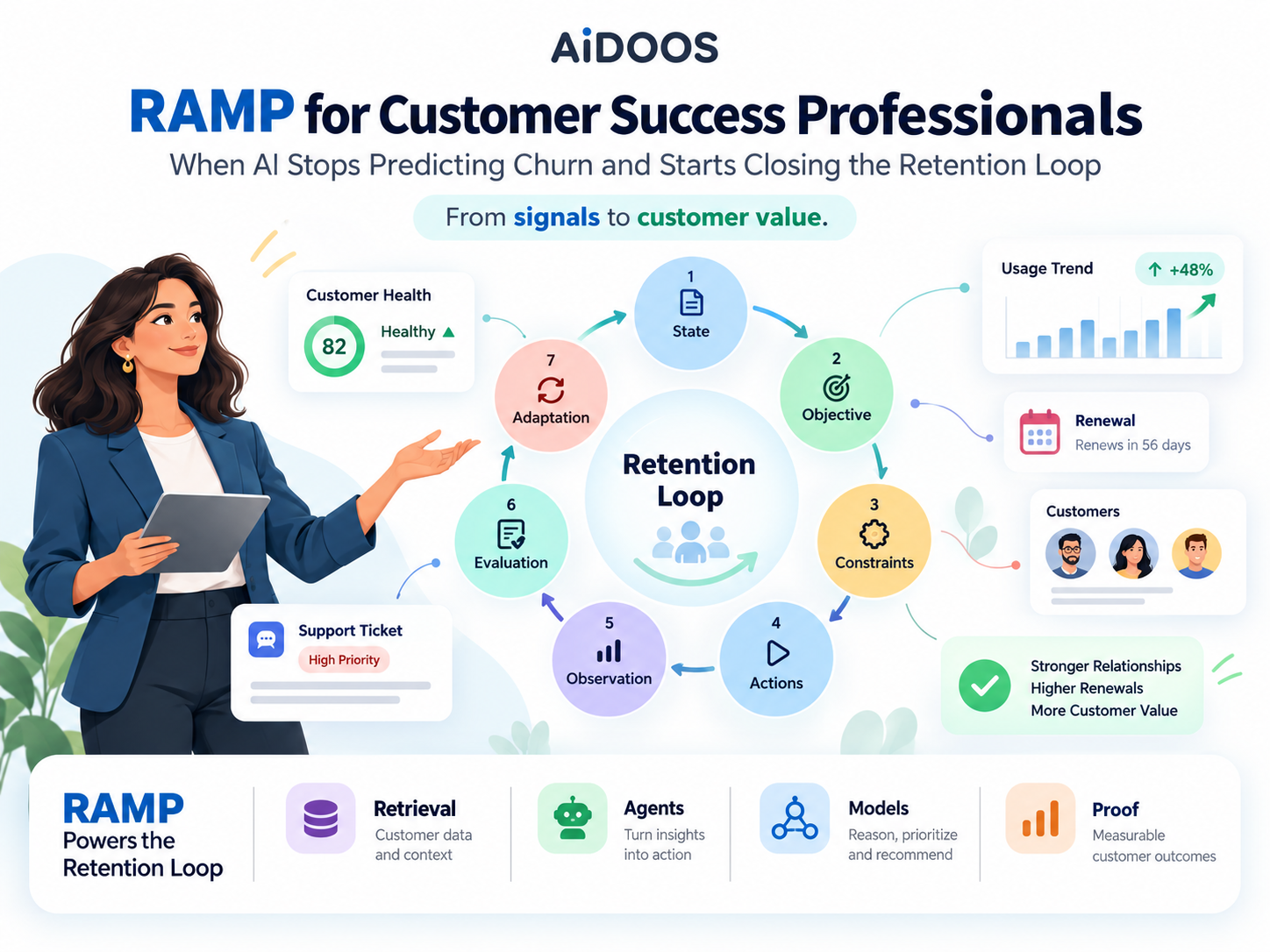
Ananya's team eventually maps one account through the seven-step Closed Loop framework.
The State is the customer's actual current condition.
Usage has fallen, two important users are inactive, one workflow has been abandoned, the executive sponsor remains engaged, and renewal is five months away.
The Objective is not simply “renew the customer.”
That is too late and too transactional.
The objective is to restore meaningful value before the renewal becomes a negotiation about price.
The team defines Constraints.
Do not make unsupported product commitments.
Do not overwhelm the customer with automated communication.
Do not offer commercial concessions before understanding whether price is actually the problem.
Do not bypass the account owner for sensitive executive engagement.
Then come Actions.
Resolve the product issue.
Contact affected users.
Offer a working session.
Introduce an alternative workflow.
Escalate a strategic blocker.
Provide evidence of value already created.
Bring in an executive sponsor when the situation genuinely warrants one.
The loop then Observes what happens.
Did users return?
Did the customer's team adopt the workflow?
Did support activity decline?
Did sentiment improve?
Did the executive sponsor re-engage?
Then it Evaluates whether the account moved closer to the desired state.
If yes, perhaps intervention can reduce.
If not, the system Adapts.
The next action changes.
Maybe the problem was misdiagnosed.
Maybe the product issue was only one symptom.
Perhaps the true problem is that the customer never changed its internal process enough to receive the promised value.
The sequence remains:
State → Objective → Constraints → Actions → Observation → Evaluation → Adaptation
RAMP powers what happens inside that sequence.
Retrieval gives the loop customer context.
Models interpret the state and help determine possible actions.
Agents carry out bounded interventions, while Proof establishes whether customer value actually improved.
That is the retention loop.
It is much more meaningful than another churn dashboard.
7. Customer Success may become smaller in activity and larger in responsibility
A year later, Ananya's Monday morning looks different.
There are still accounts that need attention.
But she no longer begins with twelve red customers and manually asks what happened in each one.
The system has already been working.
Routine onboarding gaps have triggered the appropriate actions.
Training loops have followed inactive users.
Support-related adoption problems have been connected to unresolved cases.
Promised follow-ups have not disappeared into somebody's inbox.
Accounts that recovered have moved out of intervention automatically.
The remaining accounts are difficult for reasons the system cannot safely resolve alone.
One customer is considering consolidating vendors after an acquisition.
Another loves the product but has lost its executive sponsor.
A third is getting value but believes the price has grown faster than that value.
These are not cases where another automated nurture sequence will help.
They require people.
Experienced people.
This is humans by exception in customer success.
The machine absorbs much of the coordination surrounding the relationship.
The human concentrates on ambiguity, trust, politics, negotiation, judgment, and the moments where a customer needs another human being to understand what is actually happening.
That changes the economics of the function.
A CSM may be able to responsibly cover a larger portfolio because the system is continuously observing accounts rather than waiting for the CSM to check every one manually.
But the point should not simply be larger account ratios.
That would repeat the old productivity mistake.
The more interesting outcome is that CSMs can spend more of their time where human attention changes the result.
Less chasing.
Less reporting.
Less remembering.
More understanding.
More intervention.
More value creation.
8. RAMP turns Customer Success from a renewal function into a value system
There is a reason many customer-success teams struggle to explain their economic value.
They are responsible for something enormously important, but the work often appears as a collection of activities.
Onboarding.
Check-ins.
QBRs.
Health scores.
Training.
Escalations.
Renewal preparation.
AI can automate many of those activities.
That should not frighten strong customer-success professionals.
It should force the profession to become clearer about what it actually exists to accomplish.
The customer did not buy a QBR.
They bought an outcome.
They did not buy onboarding.
They bought the ability to use the product successfully.
They do not care whether the account health score is green.
They care whether the product remains valuable enough to deserve another year of budget and attention.
This is why Closed Loops fit customer success so naturally.
Customer value is not a one-time event.
The customer's state changes continuously.
Their people change.
Their priorities change.
Your product changes.
Their business changes.
What worked six months ago may no longer create the same value today.
The relationship itself is a loop.
RAMP gives customer-success professionals the capabilities to operate that loop with far more leverage.
Retrieval helps them understand what is actually happening across the customer relationship.
Agents allow appropriate interventions and follow-up to happen continuously rather than only when a CSM remembers.
Models help interpret risk, opportunity, sentiment, behavior, and possible next actions.
Proof forces everyone to look beyond activity and ask whether customer value genuinely changed.
Closed Loops connect those capabilities around the outcome.
Ananya still cares about churn prediction.
Knowing that a customer is becoming risky early is useful.
But the prediction is no longer the destination.
It is the beginning of the work.
The real question is what happens after the system sees the risk.
Can it understand why?
Can it act appropriately?
Can it observe what happened?
Can it learn whether the intervention worked?
Can it adapt until the customer returns to a healthy state or the situation genuinely requires human judgment?
When the answer becomes yes, customer success stops being a team that watches customers and reacts when something turns red.
It becomes a system that continuously works to keep customers receiving value.
That is a much stronger definition of the profession.
And it may be what customer success was supposed to become all along.