
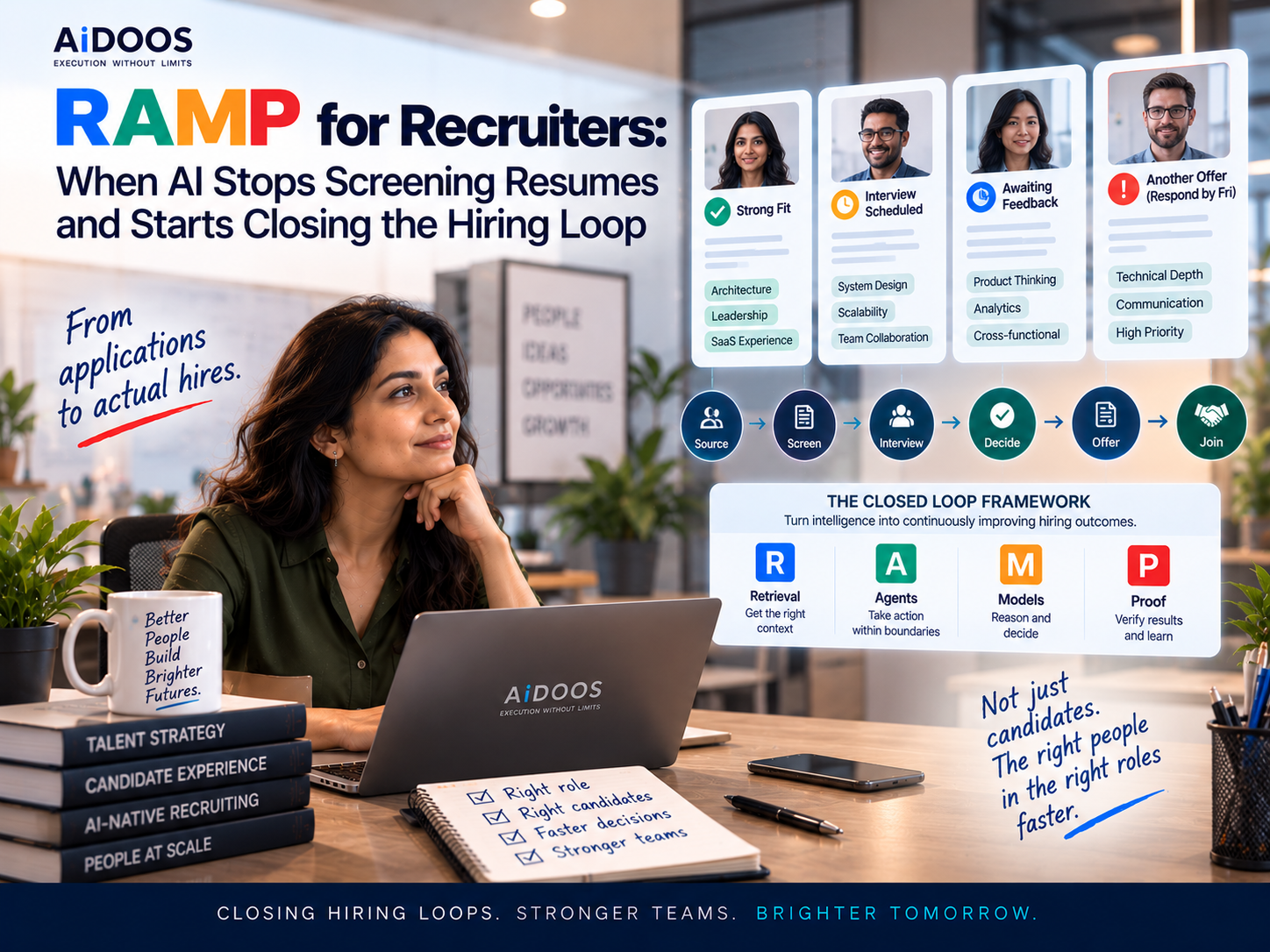
RAMP for Recruiters: When AI Stops Screening Resumes and Starts Closing the Hiring Loop
Rhea has 312 applications for one role, and that would have sounded like a good problem fifteen years ago. More candidates meant more choice, and more choice should have meant a better hire.
It does not feel that way now. Many of the resumes are beautifully written, some look almost uncannily perfect for the job, and every keyword from the job description appears in exactly the right place.
Rhea knows why. Candidates are using AI too, so resumes are easier to optimize, cover letters easier to generate, and interview preparation dramatically easier.
At the same time, her recruiting system shows another problem. Twenty-seven candidates are waiting for review, six have completed first-round interviews, and three interviewers still have not submitted feedback.
One strong candidate has another offer and needs an answer by Friday. The hiring manager is traveling, and another candidate has been sitting in “Interview Scheduled” for nine days because one panel member keeps moving the meeting.
Rhea has an AI assistant that can summarize resumes, rank candidates, draft outreach, generate interview questions, write rejection emails, and create a polished job description in seconds. All of that helps, but Friday afternoon still arrives and the strongest candidate accepts another offer.
The AI was fast, while the hiring process was not. That distinction matters.
Recruiting has spent the first phase of AI adoption asking how machines can help recruiters perform individual tasks faster. The more interesting question is whether intelligence can help the organization close the hiring loop itself.
That is where RAMP becomes much more than a recruiting productivity framework.
1. Recruiting looks like a funnel, but it behaves like a loop
The classic recruiting process is usually drawn as a funnel. Candidates enter at the top, some are screened out, some move to interviews, a smaller number reach final rounds, and somebody eventually receives and accepts an offer.
The picture makes the process look linear. Rhea's day tells a different story.
The hiring manager rejects the first shortlist because the role was not defined clearly enough, so recruiting goes back to sourcing. A strong candidate interviews well but wants compensation outside the approved range, which pulls finance into the process.
Another candidate looks weak on paper but is recommended by an employee who has worked with them before. Rhea reopens the profile and sends it back into consideration.
Then an interviewer identifies a skill requirement nobody mentioned when the job was created. The team changes what it is looking for halfway through the search, while another candidate accepts an offer and then receives a counteroffer from their current employer.
This is not a simple funnel. It is a loop containing smaller loops, with the organization continuously observing what is happening, making decisions, taking actions, learning something new, and adjusting the next move.
Humans are currently holding most of those loops together. Rhea remembers who needs to respond, notices when a candidate has been waiting too long, nudges the hiring manager, asks compensation for an exception, reschedules the interviewer, and reconnects with the candidate before silence turns into withdrawal.
The recruiting system contains the stages, but Rhea carries the state. That is precisely the kind of work AI can begin to change.
Not because the organization no longer needs a recruiter, but because the recruiter should not have to act as the human integration layer between every person and system involved in hiring.
2. Retrieval becomes more important when resumes become less trustworthy
Rhea starts with the 312 applications. An AI model can compare them against the job description in seconds, which seems like the obvious first use case.
It is also where things can go wrong quickly. Suppose the job description says the company needs eight years of experience, Kubernetes knowledge, enterprise SaaS experience, and previous management responsibility.
The AI can find those things. The harder question is why they are required.
Perhaps “eight years” was copied from an earlier job description, Kubernetes is useful but not truly important, and management experience was added because the previous person had direct reports even though the company now expects the role to be an individual contributor.
If the requirement is wrong, AI simply screens the wrong people more efficiently.
This is why Retrieval has to happen before ranking. For recruiters, Retrieval means understanding the real context of the role rather than treating the job description as the truth.
What outcome does this person need to create? What has made people successful or unsuccessful in similar roles, and which capabilities are genuinely essential rather than merely familiar?
Rhea speaks with the hiring manager and discovers that the team is not actually struggling with Kubernetes. Its biggest problem is architecture.
The product grew quickly, and the company needs someone who can make difficult system-level decisions while mentoring several capable engineers. That changes the search immediately.
A candidate who matches the original keywords perfectly may now be less relevant than someone whose background demonstrates strong architectural judgment. The model becomes more useful because Rhea gave it a better reality to work with.
This is an important principle for AI-native recruiting. The quality of candidate matching cannot exceed the quality of the organization's understanding of the role.
AI can retrieve resumes, but a strong recruiter retrieves the real requirement.
3. Agents should remove hiring latency, not merely send more outreach
Once the role is properly understood, Rhea turns to the next problem: waiting. Recruiting contains extraordinary amounts of waiting that nobody intentionally designed.
Teams wait for a hiring manager to review profiles, for candidates to send availability, for interviewers to submit feedback, for compensation approval, for someone to decide whether another round is really necessary, and for an offer letter to be prepared.
Every delay creates risk because strong candidates do not experience your hiring process in isolation. They are talking to other companies while your organization is deciding what to do next.
This is where Agents can create much more value than automated sourcing alone.
An agent can continuously monitor the state of every active candidate and understand the service level expected at each stage. If feedback is missing, it can follow up, while a strong profile sitting unreviewed can be escalated appropriately.
If a candidate has another deadline, the system can recognize that the urgency of the loop has changed. If interview feedback reveals disagreement, the agent can summarize the disagreement instead of allowing five scorecards to sit independently in the ATS.
The agent does not need authority over everything. It might schedule routine interviews autonomously, request missing feedback, send approved information, update candidate records, and keep the process moving.
More consequential actions require boundaries. Rejecting a candidate, changing compensation, skipping a critical interview stage, making commitments about remote work, or issuing an offer all carry more weight and may require human accountability.
These questions move recruiting from AI automation into delegation design. The goal is not to automate the recruiter, but to remove unnecessary human latency from the hiring process while preserving human judgment where it actually matters.
4. Models can rank candidates, but hiring is not a ranking problem
Rhea's company introduces a candidate-scoring model. Every applicant receives a score, and leadership likes the apparent consistency because the top candidates rise immediately.
Rhea looks at several profiles manually and notices something uncomfortable. One candidate has an unusually low score even though her experience appears strong.
She has never worked for a large enterprise software company. She spent five years at a small startup where her title remained “Software Engineer,” even though she eventually became responsible for most of the architecture.
The model sees a weaker title history. Rhea sees scope.
Another candidate receives an excellent score because he has worked at several impressive companies, holds the right titles, and matches nearly every technical requirement. During the interview, however, he struggles to explain decisions he supposedly owned.
The ranking looked precise, while the underlying reality was not.
This is the Models capability in RAMP. Models can help recruiters reason across large amounts of evidence, identify patterns, compare experience, surface unusual candidates, summarize interviews, and challenge inconsistent evaluations.
They can also inherit every weakness in the evidence they receive. If historical hiring favored one type of background, a model trained against previous “successful” hires may reproduce that preference.
Job titles also differ enormously across industries and countries, while interviewers themselves may evaluate people inconsistently. Summarizing weak evidence does not magically create strong evidence.
A RAMP-ready recruiter therefore treats model output as intelligence rather than truth. The question is not whether AI can score candidates, because it obviously can.
The better question is what evidence the model is using, what the score actually means, and which important dimensions may be absent from the representation.
Hiring is ultimately a prediction about future performance made from incomplete evidence. AI can help improve the prediction, but it should not make uncertainty invisible.
5. Proof changes recruiting when everyone can present perfectly
Rhea interviews a candidate whose resume is exceptional. The person communicates beautifully, and their answers are structured, articulate, and almost perfectly aligned with the role.
Five years ago, that performance would have been a strong positive signal. Now Rhea has another question: what does the candidate actually know how to do?
AI has changed the surface layer of professional presentation. Candidates can improve resumes, prepare likely questions, rehearse interviews, study a company's product, generate examples, and receive coaching before speaking with anyone.
None of that is inherently bad, and a well-prepared candidate should not be penalized for using available tools. It does, however, weaken the relationship between polished presentation and underlying capability.
This is where Proof becomes especially important in recruiting.
Proof does not mean forcing candidates into artificial tests designed to catch them using AI. The future workplace will use AI anyway.
It means evaluating whether the candidate can create the outcomes the role requires with whatever legitimate tools are available.
For an engineer, Rhea might give the candidate an unfamiliar architecture problem and allow AI. The interesting evidence is no longer whether they remember every technical detail.
It is how they frame the problem, what context they seek, which assumptions they challenge, how they use the machine, and whether they can recognize when its recommendation is weak.
For a marketer, the test may not be “write a campaign without AI.” It might be to review five AI-generated campaigns and explain which one should never reach the customer and why.
For a financial analyst, the candidate could receive a polished AI-generated analysis containing subtle mistakes and be asked to challenge it.
That is Proof of a different kind. The candidate is not proving that they can outperform AI at mechanical production.
They are proving that they understand the work deeply enough to use, direct, and challenge intelligence.
6. The hiring loop becomes something the organization can actually design
Rhea's team chooses one difficult engineering role and maps the process using the seven-step Closed Loop framework. The exercise quickly exposes where the process is genuinely designed and where it is simply inherited habit.
The State includes the current candidate pool, role requirements, interview progress, outstanding decisions, candidate interest, competing deadlines, compensation position, and unresolved concerns.
The Objective is not simply “fill the role.” The company wants a capable person to accept and successfully join within a reasonable period, without lowering the evidence standard simply because the position has been open too long.
Then come Constraints. Compensation boundaries, hiring policies, fairness, human accountability, candidate consent, and the limits of what agents may promise all matter.
The loop then defines available Actions. It can retrieve new candidates, ask for additional evidence, schedule interviews, request feedback, escalate internal delays, send information, arrange another conversation, prepare an offer for approval, or close the process when the evidence says the fit is poor.
After each action comes Observation. Did the candidate respond, did the interview happen, did feedback arrive, and did new evidence increase or reduce confidence?
The organization then Evaluates whether the process genuinely moved closer to the objective. A completed interview is not necessarily progress if it provided no new evidence.
Finally comes Adaptation. The next action changes with the new state, so a candidate who needs more technical evidence may require a focused discussion rather than another generic interview.
A candidate who has become highly convincing may not need the fifth stage originally drawn on the process map. A hiring manager who repeatedly delays feedback may need escalation because internal latency is now the largest threat to the outcome.
The sequence remains:
State → Objective → Constraints → Actions → Observation → Evaluation → Adaptation
RAMP supplies capability inside the loop. Retrieval brings together role and candidate context, Models interpret evidence, Agents move routine work forward, and Proof ensures the organization is making decisions based on demonstrated capability rather than polished surfaces.
That is much more powerful than adding an AI resume screener to the old hiring funnel.
7. Human judgment becomes more important when the administrative layer disappears
Six months later, Rhea manages more open roles than before, yet she spends less of her day checking calendars and chasing people for feedback.
Agents handle routine coordination, candidate records are updated automatically, and hiring managers receive structured context instead of folders full of resumes. Interview evidence is summarized, contradictions are surfaced, and stalled processes do not remain invisible for a week.
Rhea sees fewer administrative exceptions, but the exceptions she sees are harder.
A candidate has the strongest technical evidence but wants a role the organization cannot offer. Another person has an unusual background that the model struggles to compare against conventional candidates.
A hiring manager wants to reject someone because they “didn't feel senior enough,” while the interview evidence suggests the candidate solved harder problems than several people already on the team.
A final candidate has two offers and wants to know what their career could look like three years from now. None of these are scheduling problems.
They require people.
This is humans by exception in recruiting. AI removes more of the machinery surrounding hiring and concentrates human attention around ambiguity, persuasion, judgment, fairness, and consequential decisions.
That raises the bar for recruiters.
If someone's primary value is moving candidates through an ATS, AI will absorb a large part of the job. If their value lies in understanding talent, challenging weak requirements, recognizing unconventional capability, reading motivation, advising hiring managers, and closing difficult candidates, machine leverage can make them much more powerful.
The recruiter becomes less of a process administrator and more of a talent decision architect.
That is a healthier direction for the profession.
8. RAMP turns recruiting from filling seats into building capability
Rhea eventually stops thinking about the 312 applications as the starting point. The role is the starting point, and more precisely, the business outcome behind the role is.
What is the company trying to accomplish, what capability is missing, and does that capability really require a permanent hire? Could someone already inside the organization do it, could the work be redesigned, or could AI remove enough repetitive execution that the role itself should change?
Those questions become more important in an AI-native economy. Recruiting cannot remain separate from the changing architecture of work.
A company may discover that the job it planned to hire three people for now requires one highly capable professional operating with agents. Another role may become more valuable because AI expands its scope dramatically.
Some jobs will disappear, while new combinations will emerge. The recruiter needs to understand these shifts because talent acquisition begins before sourcing.
It begins with defining what capability the organization actually needs.
This is where RAMP becomes relevant beyond the recruiting process itself.
A RAMP-ready recruiter understands that future candidates will increasingly be evaluated on how well they combine domain expertise with Retrieval, Agents, Models, and Proof.
They can help hiring managers distinguish between someone who merely uses AI and someone who can own larger outcomes because of it.
Closed Loops take the idea one step further.
The recruiter can apply the same thinking to their own work. The hiring process itself becomes a loop that continuously observes its state, acts, gathers evidence, and adapts until the organization either secures the right capability or learns that its original requirement was wrong.
Rhea still has applications to review, people still interview people, and candidates still need to trust the organization enough to join it.
What changes is the amount of human energy wasted carrying information between steps that machines can already connect.
The future of recruiting is not a robot choosing employees from a pile of AI-generated resumes. That would be a remarkably unimaginative outcome.
The better future is one where machines handle enough of the search, coordination, context assembly, and routine execution that recruiters can spend far more time answering the questions that actually matter.
What capability does this business need? What evidence tells us this person has it, what are we missing because their background does not look conventional, and what does this candidate need to believe before they will join us?
Those are the questions that define great recruiting.
When AI helps the organization answer them faster, while also removing the waiting and friction between decisions, it stops merely screening resumes.
It starts helping close the hiring loop.