
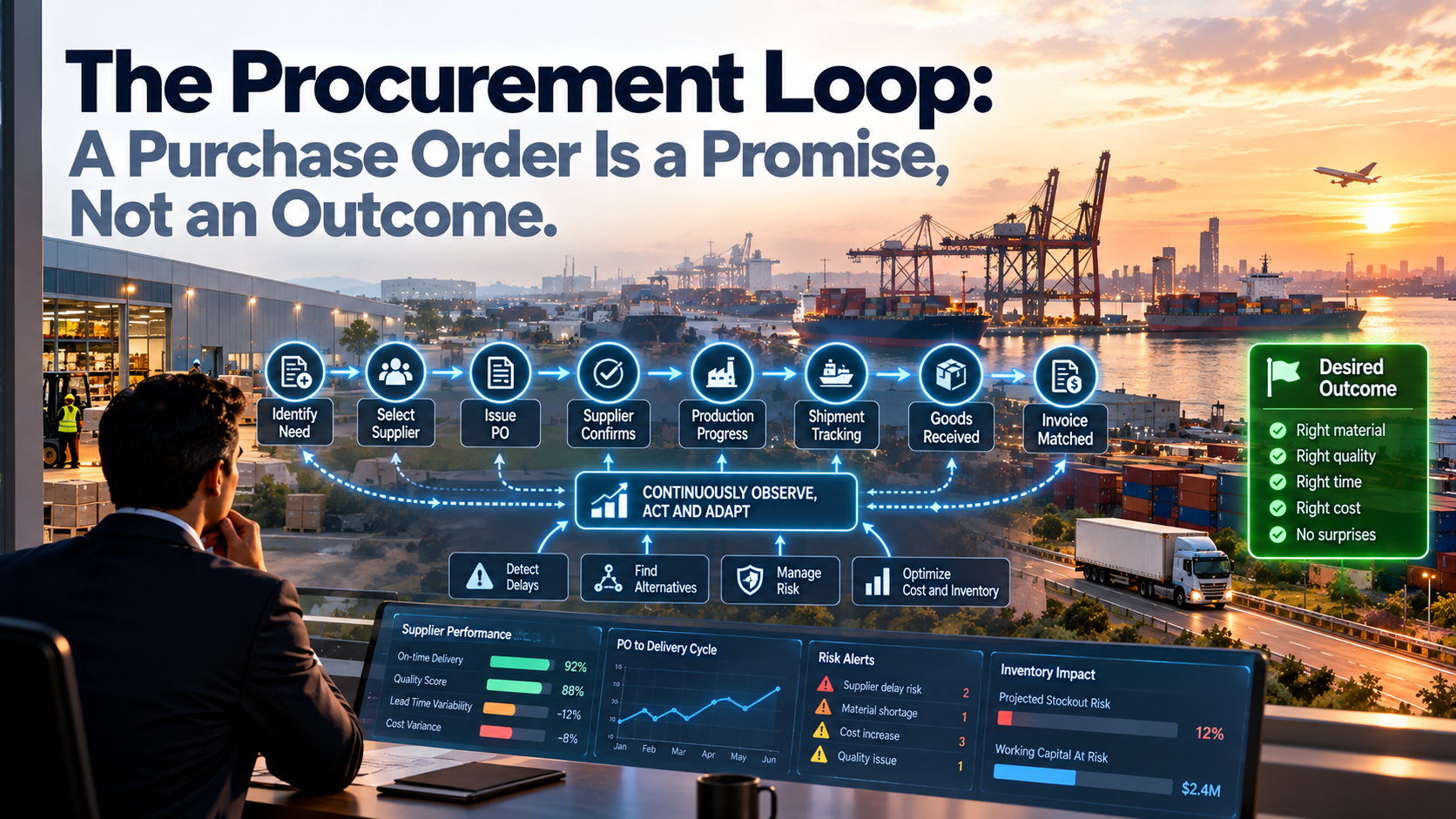
Picture a manufacturing plant on a Wednesday morning. A production supervisor discovers that a critical component expected the previous evening has not arrived. The assembly line has enough material to continue for another four hours, after which production will have to stop.
The procurement team is surprised. The purchase order was issued on time, the supplier acknowledged it, and the ERP shows the order as confirmed. Nobody violated the purchasing process, and every internal approval was completed correctly.
Yet the component is missing, and the business is about to lose production capacity.
Someone calls the supplier. The supplier explains that a production issue delayed the shipment, but nobody communicated the change because the revised delivery date had not been finalized. Procurement contacts logistics, logistics checks alternative transportation, and the plant manager asks whether material can be borrowed from another facility.
Within an hour, half a dozen people are working on the problem. Emails are flying, calls are being made, and everyone is trying to establish what should have been known much earlier.
The strange part is that the problem did not begin that morning. It probably began two or three days earlier, when the supplier first realized that the original commitment was at risk.
The information existed somewhere. The consequences were predictable. Several possible interventions may have been available. But the organization did not connect those pieces until the production line was already in danger.
The purchase order was processed successfully. The business outcome was not.
That difference is the starting point for what we call the Procurement Loop.
1. Procurement has spent decades getting better at buying
Enterprise procurement has become remarkably sophisticated. Organizations have invested in ERP systems, supplier management platforms, electronic sourcing, contract repositories, automated approvals, purchase-order processing, supplier portals and spend analytics.
These systems have solved important problems. Companies can enforce purchasing policies, improve transparency, negotiate at scale, reduce unauthorized spending and maintain far better records of supplier commitments.
Yet much of this technology still revolves around the transaction. A requirement becomes a requisition, the requisition becomes an approved purchase order, and the purchase order becomes a supplier commitment.
After that, the process enters a less predictable world.
A supplier may promise delivery by Friday but discover on Tuesday that a machine has failed. A shipment may leave the factory on schedule and then spend three days waiting for clearance. A component may arrive at the warehouse but fail quality inspection. Materials may be physically available yet unusable because the required documentation is missing.
From the purchasing system's perspective, these are exceptions to the process. From the business's perspective, they are often the very things that determine whether procurement succeeded.
The organization did not create procurement to issue purchase orders. It created procurement to ensure that the business has access to the goods and services it needs, under commercially and operationally acceptable conditions.
That is a much larger responsibility.
A purchase order records an intention and a commercial commitment. It does not guarantee that the right material will become available at the right location, in acceptable condition, at the moment the business needs it.
We have built excellent systems for recording promises. The next challenge is building systems that continuously help the enterprise turn those promises into reality.
2. The real procurement outcome is not the purchase
Imagine an automotive manufacturer buying a component for one of its assembly lines. The purchase order specifies quantity, price, delivery date and contractual conditions.
The supplier accepts the order, and the procurement dashboard shows the transaction progressing normally. On paper, the company has secured its requirement.
But the business needs more than supplier acceptance.
It needs the correct component, manufactured to the required specification, delivered to the appropriate facility, accepted by quality control and available when production is scheduled to consume it.
Every one of those conditions matters.
A component delivered a week early may create unnecessary inventory and consume working capital. The same component delivered two days late may stop production. A cheaper component that repeatedly fails inspection may cost far more than a reliable alternative with a higher purchase price.
This is why procurement cannot be optimized only around purchase price or transaction efficiency. Its real economics include availability, quality, supplier reliability, working capital, disruption risk and the consequences of failure.
The best purchasing decision is not always the cheapest offer. Sometimes paying more for reliability protects a much larger economic outcome. Sometimes waiting is preferable to expediting because the additional transportation cost exceeds the likely impact of the delay.
These decisions depend on context, and that context changes continuously.
A supplier delay affecting a low-priority spare part may require no immediate action. The same delay affecting a component required for tomorrow's production schedule may justify an entirely different response.
The Procurement Loop must understand that distinction.
Its goal is not simply to complete procurement transactions. Its goal is to continuously preserve the required supply outcome within acceptable cost, quality, timing and risk boundaries.
That sounds like something procurement teams already try to do, and they do. The difference lies in how responsibility is maintained between decisions.
Today, people frequently hold that responsibility together through experience, communication, vigilance and follow-up. A closed loop gives the organization a system that can maintain awareness and coordinate permitted actions continuously, while bringing people into decisions that genuinely require their judgment.
3. The expensive part is often what happens after everyone has done their job
Think about how a supplier delay typically moves through an organization.
A supplier notices that production is behind schedule. Someone needs to update the delivery commitment, but the account manager is waiting for confirmation from the factory. Meanwhile, the purchasing organization continues to operate against the original date.
Eventually an update arrives.
A buyer sees it and asks the planning team whether the delay is critical. Planning checks available inventory and realizes that a production order may be affected. The issue reaches logistics, where someone investigates whether alternative transportation is available.
Finance may need to approve the additional cost. Another facility may have excess stock, but transferring it requires coordination between warehouse teams and plant management.
All of this is reasonable work. Each person is making decisions within their area of responsibility.
The problem is the time between those decisions.
In our earlier article on Human Latency, we explored the difference between work time and elapsed time. The same principle is especially visible in procurement because a seemingly minor delay in one department can quickly become a major operational problem somewhere else.
The buyer may need five minutes to recognize the issue. The planner may need another ten minutes to calculate the production impact. Logistics may need fifteen minutes to identify an alternative. Finance may need another five minutes to authorize the additional cost.
But those thirty-five minutes of actual work can be scattered across several days.
The supplier update waits for attention. The buyer waits for planning. Planning waits for logistics. Logistics waits for approval. By the time the company acts, the alternatives may be fewer and more expensive.
This is the hidden cost of an open Procurement Loop.
The enterprise often has the required intelligence, but it is distributed across people and applications. There is no persistent execution mechanism responsible for connecting that intelligence and keeping the outcome moving.
That is why simply adding another AI assistant to the procurement team may not be enough.
An assistant can summarize supplier communications, compare quotations and draft follow-ups. These capabilities improve individual productivity, but the process can still become dormant between actions.
The larger opportunity is to engineer a system that remains attentive to the supply commitment itself.
It should notice when the delivery risk changes, understand the operational consequences, determine whether intervention is justified, initiate permitted actions and observe whether the intervention worked.
The purpose is not to make the buyer type faster. It is to prevent a supplier problem from becoming a production problem simply because nobody connected the signals in time.
4. What would a real Procurement Loop look like?
Suppose a supplier has committed to delivering 5,000 components next Thursday. The order is important because production needs those components the following Monday.
A conventional workflow might track order confirmation, expected shipment date, transportation milestones and receipt. If something changes, an alert or exception enters a queue for someone to investigate.
A closed loop begins with the business objective.
The components must be available for production, in the required condition, before consumption begins. The business also has constraints around procurement cost, approved suppliers, inventory policies, quality standards and the authority to make changes.
Now imagine that the supplier's production system reports a delay.
The loop does not automatically send a generic escalation email. It first needs to understand what the delay means.
Perhaps the plant has enough inventory for another week, making the problem relatively minor. Perhaps another inbound shipment will arrive earlier. Or perhaps the delayed components are essential to a major customer order with substantial financial consequences.
The same supplier event can have very different implications.
The system examines current inventory, inbound material, production schedules, alternative suppliers, available transfers and transportation options. It identifies which actions are possible and evaluates them against the objective.
One option may be to expedite the delayed shipment. Another may be to transfer inventory from a nearby plant. A third may be to reschedule production within permissible limits.
The cheapest option is not automatically the best. The fastest option is not automatically the best either.
The right decision depends on the overall business consequence.
Suppose transferring components from another facility is the preferred approach. The loop can initiate an authorized transfer, notify the relevant systems and begin monitoring the movement.
But issuing the transfer request does not close the loop.
The system must observe whether the material was picked, dispatched, received, inspected where required and made available to the production line. If the transfer encounters another problem, the loop must evaluate the new condition and determine whether further action is necessary.
This is the difference between a sequence of automated tasks and continuous responsibility for an outcome.
The loop does not assume success because an action was executed. It looks for evidence that the business actually reached the required state.
Not every situation needs to run without human intervention. A costly expedition, supplier substitution or production rescheduling decision may require explicit authorization.
The important change is that the system can maintain continuity around the decision. Once the authorized person responds, execution resumes without the process disappearing into another inbox.
5. The loop is only as good as its connection to reality
This is where the idea becomes more difficult, and also more interesting.
A procurement loop needs to operate across systems that were rarely designed to function as one continuous control system.
The purchase order may live in SAP or Oracle. Supplier commitments may arrive through a portal, EDI integration or email. Transportation milestones may sit inside a logistics provider's platform. Inventory may be recorded in a warehouse management system, while production requirements live in a manufacturing execution or planning application.
Quality inspection adds another layer. Finance contributes cost and approval constraints, while contracts define supplier obligations and permissible remedies.
These systems may disagree.
The ERP may show that material is in transit while the transportation system has no confirmed pickup. A warehouse may record receipt even though quality acceptance is pending. A supplier may update its portal without the change reaching the purchasing organization.
This is not a minor integration detail. It is fundamental to whether the loop can make trustworthy decisions.
Before a system can act intelligently, it needs a reliable understanding of what is true.
That requires reconciling information, identifying conflicting signals, understanding which systems are authoritative and preserving the distinction between confirmed facts, estimates and assumptions.
A supplier's promise is not the same as proof of dispatch. Proof of dispatch is not the same as delivery. Delivery is not the same as acceptance, and acceptance is not necessarily the same as usable availability.
Each transition needs appropriate evidence.
The canonical Loop Engineering model helps organize this complexity. An Outcome Loop has ten primitives: Goal, State, Context, Constraints, Actions, Observation, Evaluation, Memory, Escalation and Learning.
Those primitives are architectural requirements rather than ten sequential tasks. Together, they establish what the loop is trying to achieve, what it knows, what it may do, how it checks the result and how it improves.
Inside that architecture, the operating cycle remains consistent: Observe → Understand → Decide → Act → Verify → Adapt → Repeat.
The Procurement Loop applies this cycle to supply commitments, but the underlying discipline is reusable. The same structure can support collections, inventory, customer retention, maintenance and other business outcomes.
What changes is the domain knowledge, available actions, business constraints and definition of successful closure.
There is also a distinction between adaptation and learning that matters in procurement.
If a supplier misses a delivery, adaptation helps the loop find a better response to that particular situation. If the supplier repeatedly misses commitments under similar conditions, learning may justify changing future lead-time assumptions, supplier-risk scoring or recommended sourcing policies.
Those longer-term changes should be governed and tested, especially when they affect contracts, commercial relationships or safety-critical materials.
A system that repeatedly handles exceptions is useful. A system that helps the organization become less vulnerable to those exceptions is more valuable.
6. Building the loop is an engineering responsibility, not a software configuration exercise
At this point, a procurement leader may reasonably agree with the concept but ask a difficult question.
Who is going to build all of this?
The ERP vendor understands its procurement module. The supplier portal vendor understands its application. The logistics provider understands shipment tracking. The internal IT team understands enterprise integrations and security.
Procurement understands the business.
But a genuine closed loop crosses every one of those boundaries.
Somebody needs to map the end-to-end outcome, identify the relevant state transitions, connect the systems, design decision logic, establish permissions, engineer the agents, implement verification and make sure the loop performs reliably under real operating conditions.
And that is only the initial build.
Supplier behavior changes. Contracts change. Applications are upgraded. New facilities come online. Business policies evolve. The organization discovers that an intervention which appeared beneficial does not consistently improve the economic outcome.
Someone has to maintain and improve the loop.
This is where many promising enterprise AI ideas run into the same organizational problem. Building an impressive proof of concept is relatively easy compared with operating a cross-functional business capability in production.
The AI agent might work perfectly in a demonstration.
But who handles the ERP change that breaks its integration? Who investigates a supplier acknowledgment that arrived in an unexpected format? Who validates whether the system's intervention actually prevented a stockout?
Who changes the loop when procurement modifies its approval policy? Who investigates cases where the system made the technically correct decision but created an unexpected operational consequence?
These are not one-time implementation questions. They are part of owning a living execution system.
The traditional response is to create another internal project team, hire specialists, engage consultants or assemble an outsourcing arrangement.
That may solve the initial resource problem, but it does not always create a sustainable way to engineer and operate many different loops.
Enterprises need an execution capability that can form around an outcome, connect the required systems, put the loop into production and continue improving it as conditions change.
This is where the Virtual Delivery Center becomes relevant.
7. The Virtual Delivery Center is how the loop gets engineered and operated
A Virtual Delivery Center, or VDC, provides an on-demand execution capability that brings together the necessary people, AI capabilities, tools and engineering disciplines around a defined business objective.
The distinction from conventional staffing is important.
The enterprise is not simply hiring a developer, integration engineer or AI specialist. It is forming an execution capability responsible for delivering and maintaining a working business solution.
Consider an enterprise that decides its first priority is reducing production disruptions caused by late supplier deliveries.
It does not need to transform the entire procurement organization immediately. A better starting point may be one manufacturing facility, one critical material category and a clearly defined set of supplier commitments.
A VDC can begin by understanding how those commitments move through the business.
Where do orders originate? Which system contains the authoritative delivery commitment? How does the supplier communicate changes? Which inventory records can be trusted? When does a delay become economically significant?
The team maps the current process, but not merely to document it. It needs to identify the points where an important business state changes, where human latency appears and where intervention can alter the outcome.
From there, the VDC engineers the first loop.
Integration specialists connect the relevant systems. Domain experts define the business conditions and allowable interventions. AI engineers introduce reasoning or agent capabilities where they are genuinely useful. Security and quality specialists establish permissions, safeguards, tests and verification requirements.
The loop should work with the enterprise's existing technology estate wherever practical. Its purpose is not to replace the ERP, supplier management platform or logistics software, but to make those investments participate in a more complete execution system.
This is especially important for companies that have already invested heavily in AI infrastructure. The compute, models and data platforms may be available; what is missing is the engineered path from those capabilities to a measurable business outcome.
The first deployment should be deliberately narrow.
Perhaps the system begins by observing supplier commitments and identifying situations that human buyers would otherwise discover too late. It operates in an advisory mode while the organization evaluates its accuracy, data quality and recommendations.
As confidence grows, carefully selected actions can become automated.
The system may request an updated delivery estimate, reconcile a shipment milestone or initiate an approved internal notification. Higher-risk actions, such as switching suppliers, changing contractual commitments or authorizing expensive transportation, remain subject to explicit authority.
Every intervention should leave an evidence trail.
What condition triggered the decision? Which information was used? What action was taken? Who approved it? What happened afterward? Did the business outcome improve?
That evidence is how the enterprise learns whether the loop is producing value rather than simply generating additional activity.
Once the first loop is reliable, the VDC continues operating and improving it. The same execution capability can then expand into additional suppliers, facilities, material categories or related loops.
Over time, reusable integrations, evaluation methods, governance controls and engineering patterns can reduce the effort required to build subsequent loops.
This is a major part of the VDC proposition.
The enterprise does not need to assemble a new permanent department for every promising AI opportunity. It can establish execution capacity around the outcomes that matter, scale that capacity as needs change and retain governance over the business systems and decisions.
At AiDOOS, this is how we see Virtual Delivery Centers and Loop Engineering coming together.
Loop Engineering defines what must be built and how it should behave. The VDC supplies the coordinated execution capacity to build, operate, verify and improve it.
The loop is the business capability. The VDC is the delivery model that helps bring that capability into existence and keep it useful.
Neither concept replaces the other.
8. The next procurement advantage may have little to do with purchasing faster
Procurement leaders are under constant pressure to reduce cost.
Negotiate better prices. Consolidate suppliers. Improve contract compliance. Reduce administrative effort. Automate more transactions.
These remain important responsibilities, but they represent only part of procurement's economic influence.
A purchasing organization can achieve an excellent negotiated price and still impose enormous costs on the business through unreliable supply, unnecessary inventory, late interventions, quality problems and disruption.
A more intelligent procurement function must understand those tradeoffs across the full lifecycle of supply.
That creates the opportunity for a different set of performance measures.
Alongside negotiated savings and purchase-order processing efficiency, leadership can measure whether critical materials were actually available when needed, how quickly supply risks were resolved, how often intervention prevented disruption and what those interventions cost.
Supplier performance becomes more than a periodic scorecard. The organization can observe whether commitments are being met and whether changing conditions require action.
Working capital becomes part of the same conversation. So do production continuity, accepted quality, total landed cost and the reliability of customer commitments.
Not every improvement can be attributed entirely to AI. Demand may change, suppliers may recover independently, and many external factors influence procurement outcomes.
A serious Loop Engineering program must therefore establish baselines and measure results carefully. It should distinguish actions completed from outcomes observed, and observed improvements from improvements credibly attributable to the intervention.
That discipline is important because the objective is not to produce another impressive AI dashboard.
It is to change how the business operates.
Imagine returning to the manufacturing plant from the beginning of this story.
The supplier still encounters a production problem on Monday. AI has not made machines infallible, shipments instantaneous or global supply chains immune to disruption.
But this time, the enterprise recognizes the risk while alternatives are still available.
The system identifies the exposed production requirement, evaluates available inventory and recovery options, and brings the right decision to the right person. The approved intervention begins immediately, and its progress remains visible until the required material is safely available for use.
The production supervisor arrives on Wednesday morning and finds the components ready.
There is no emergency meeting, no frantic search through emails and no urgent effort to reconstruct what happened over the previous two days.
The people involved may have performed some of the same work. The difference is that the work happened when it mattered, supported by a system that maintained continuity between decisions.
That is what a well-engineered Procurement Loop can make possible.
For decades, procurement systems have become increasingly effective at recording transactions, enforcing policies and managing commercial commitments. The next step is connecting those capabilities to a continuously operating system that takes responsibility for moving important supply outcomes toward closure.
It will require intelligent software, reliable integrations, domain expertise, careful governance and ongoing engineering. It will also require a different approach to organizing the capacity that builds and operates those systems.
Closed Loops give enterprises a clearer definition of what successful execution means. Virtual Delivery Centers offer a way to mobilize the people, AI and tools required to make that execution real.
The future of procurement should not be measured only by how efficiently a company places orders.
It should be measured by how reliably those orders become what the business actually needs.
A purchase order is a promise. The real achievement is keeping it.