Does an LLM output that looks grammatically "correct" mean it's linguistically sound? Often, no.
One of Turkish's most fundamental yet most overlooked mechanisms is vowel harmony and LLMs break it systematically specially with foreign proper nouns, abbreviations, and long inflectional chains.
To document this i put together a new case study: Vowel Harmony Breakdown and Morphological Well-Formedness as a Helpful-Criterion Failure.
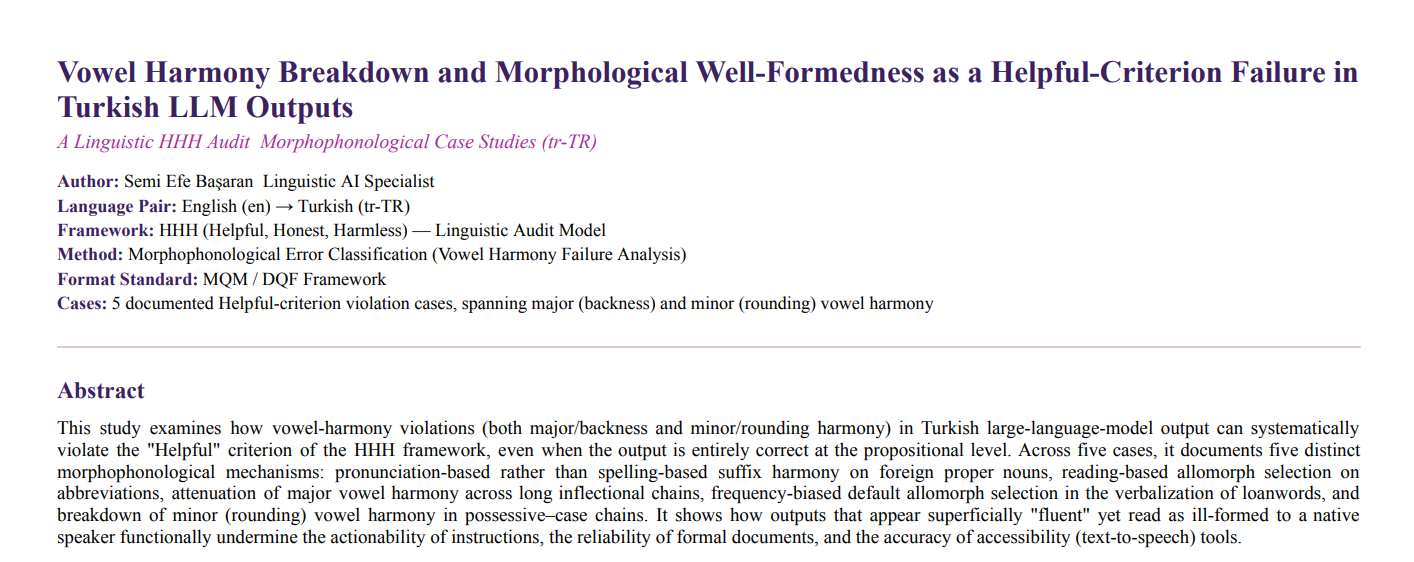
The core claim is even when not a single word is technically "wrong," broken vowel harmony can directly violate the "Helpful" criterion of the HHH (Helpful, Honest, Harmless) framework because even accurate propositional content can fail to be usable, undermine trust in a formal document, or misfire in text-to-speech tools.
Five cases are examined:
Pronunciation-based (not spelling-based) suffix harmony on foreign proper nouns Reading-based allomorph selection on abbreviations Harmony attenuation across long inflectional chains Frequency-biased default allomorph selection on loanwords Breakdown of minor (rounding) vowel harmony in possessive-case chains
Full document is attached. Feedback and discussion is welcome from anyone.


Does an LLM output that looks grammatically "correct" mean it's linguistically sound? Often, no.
One of Turkish's most fundamental yet most overlooked mechanisms is vowel harmony and LLMs break it systematically specially with foreign proper nouns, abbreviations, and long inflectional chains.
To document this i put together a new case study: Vowel Harmony Breakdown and Morphological Well-Formedness as a Helpful-Criterion Failure.
The core claim is even when not a single word is technically "wrong," broken vowel harmony can directly violate the "Helpful" criterion of the HHH (Helpful, Honest, Harmless) framework because even accurate propositional content can fail to be usable, undermine trust in a formal document, or misfire in text-to-speech tools.
Five cases are examined:
Pronunciation-based (not spelling-based) suffix harmony on foreign proper nouns Reading-based allomorph selection on abbreviations Harmony attenuation across long inflectional chains Frequency-biased default allomorph selection on loanwords Breakdown of minor (rounding) vowel harmony in possessive-case chains
Full document is attached. Feedback and discussion is welcome from anyone.
Does an LLM output that looks grammatically "correct" mean it's linguistically sound? Often, no.
One of Turkish's most fundamental yet most overlooked mechanisms is vowel harmony and LLMs break it systematically specially with foreign proper nouns, abbreviations, and long inflectional chains.
To document this i put together a new case study: Vowel Harmony Breakdown and Morphological Well-Formedness as a Helpful-Criterion Failure.
The core claim is even when not a single word is technically "wrong," broken vowel harmony can directly violate the "Helpful" criterion of the HHH (Helpful, Honest, Harmless) framework because even accurate propositional content can fail to be usable, undermine trust in a formal document, or misfire in text-to-speech tools.
Five cases are examined:
Pronunciation-based (not spelling-based) suffix harmony on foreign proper nouns Reading-based allomorph selection on abbreviations Harmony attenuation across long inflectional chains Frequency-biased default allomorph selection on loanwords Breakdown of minor (rounding) vowel harmony in possessive-case chains
Full document is attached. Feedback and discussion is welcome from anyone.