RAMP for Cybersecurity Professionals: When the Agent Can Lock the Account
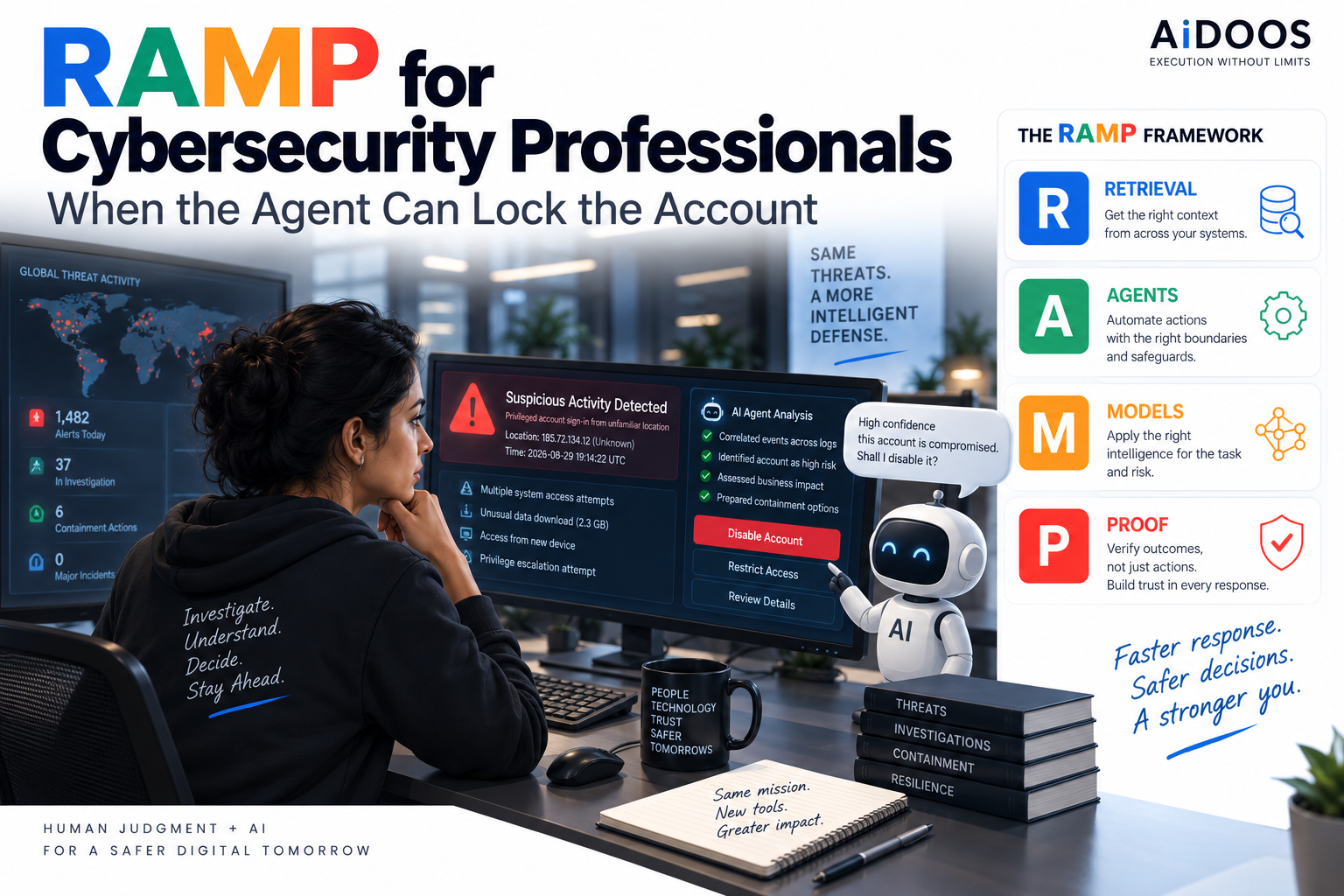
Asha is halfway through dinner when her phone lights up with a security alert. A privileged account has signed in from an unfamiliar location, attempted to access several systems, and started downloading an unusual amount of data.
By the time she opens the incident console, an AI agent has already investigated the activity. It has correlated the sign-in with recent access events, identified the account as high risk, and prepared a containment action.
The recommendation is simple: disable the account immediately.
Asha's finger hovers over the approval button. The account belongs to an automation process that supports the company's overnight order reconciliation, and disabling it could interrupt a business-critical workflow.
The agent may be right that the account is compromised. It may also be right that disabling it would stop the suspicious activity, but those two facts do not automatically make the proposed action the best response.
This is the moment when AI changes cybersecurity from an investigation problem into an authority problem. The machine can find the threat, recommend the action, and increasingly execute it, but someone still has to decide what the system is allowed to do when security and business continuity collide.
That is why the RAMP framework is especially relevant to cybersecurity professionals. Retrieval, Agents, Models and Proof describe the capabilities needed to turn machine intelligence into a trustworthy security response, rather than simply a faster one.
The alert is not the incident
Asha has learned that the first alert is rarely the whole story. A suspicious sign-in might indicate a stolen credential, but it could also reflect a legitimate employee traveling, a corporate VPN, a newly introduced automation, or an identity provider recording a familiar activity in an unfamiliar way.
The security team cannot investigate every alert as though it were a confirmed breach. At the same time, it cannot dismiss unusual activity merely because there is a plausible innocent explanation.
The difficult part is assembling enough context to distinguish the two.
Asha asks the agent to show her why it considers the account high risk. The agent returns the sign-in history, the systems accessed, the unusual download pattern, and a recent change in the account's permissions.
That is useful, but Asha asks another question: what does this account normally do?
The answer is not obvious from the security console. The account was created years ago, its original owner has left the company, and its name does not clearly identify the application that depends on it.
Asha asks the agent to search the configuration repository, recent change records, and the service's operational documentation. It finds a dependency on the reconciliation process and a maintenance ticket from the previous week.
Now the incident looks different.
The security concern remains, but the team can see the operational consequences of containment. They can also investigate whether the suspicious activity is connected to the recent maintenance rather than treating the account as an isolated identity.
This is Retrieval in cybersecurity.
It is not simply collecting more logs. It is understanding which information is necessary to make a defensible security decision.
The relevant context may include identity history, endpoint telemetry, network activity, asset ownership, application dependencies, recent changes, known vulnerabilities, threat intelligence, and the business importance of affected systems. Some of that information lives in security tools, while some lives in engineering systems, business applications, or the memory of people who understand the environment.
AI can retrieve and correlate this information much faster than a human analyst. But the quality of the investigation still depends on whether the organization has made its systems understandable.
A security agent cannot reliably assess the impact of disabling an account if nobody knows what the account is connected to. It cannot distinguish an unusual but authorized change from a suspicious one if the change was never recorded anywhere it can access.
This creates an important connection between cybersecurity and organizational hygiene. Asset inventories, service ownership, access records, and operational documentation are not merely compliance artifacts; they become part of the context intelligent security systems need to act responsibly.
The better the context, the more useful the intelligence becomes. A powerful model operating against an incomplete picture can still make a very confident mistake.
Containment is a decision, not just a command
Asha's team confirms that the activity is suspicious enough to justify containment. The question now is how to contain it without creating unnecessary damage.
The agent recommends disabling the account. Asha asks it to compare that option with other available containment measures and explain the operational consequences of each.
The team considers whether it can revoke active sessions or credentials, restrict the account's access, isolate a particular workload, or temporarily block the suspicious activity while preserving the legitimate process. The appropriate choice depends on what the investigation has established and what the environment can safely support.
This is where Agents becomes more than a technical feature.
An agent can perform actions, but cybersecurity professionals need to decide which actions belong within its authority. The difference between recommending containment and executing containment is not merely a user-interface detail.
Imagine an agent that automatically disables every account associated with a high-confidence alert. In many cases, that could stop an attacker quickly and reduce the time available for further damage.
In other cases, the same behavior could disable a critical service account, interrupt a production deployment, or lock out the person needed to resolve the incident. A security control that protects one part of the organization can create risk somewhere else.
The answer is not to require human approval for every action. That would make automation too slow for many situations and could leave analysts approving hundreds of routine decisions without meaningful review.
The better approach is to define authority around risk and consequence.
An agent might be allowed to perform narrowly scoped, reversible containment actions under clearly established conditions. More consequential actions could require additional evidence, a second control, or human authorization.
The important point is that autonomy should be designed deliberately.
What is the agent trying to achieve? Which systems can it access, what actions can it take, and what must cause it to stop or escalate?
Those questions are familiar to security professionals because cybersecurity has always involved permissions, boundaries, and trust. AI agents introduce another kind of actor into that environment.
The same principle applies to human contributors. When an organization brings in external delivery capacity through a Virtual Delivery Center, access should be appropriate to the work being performed rather than broad simply because someone is participating in a project.
Agents make that principle even more important because they can act at machine speed. A poorly scoped permission can turn a small misunderstanding into a large operational event before a human notices.
Asha's team eventually approves a containment action that addresses the suspicious activity while preserving the legitimate business process. The agent executes it and records what changed, but the incident is not considered resolved merely because the command succeeded.
That distinction leads to the next problem.
The most dangerous answer may be the one that sounds certain
The agent's investigation report is impressively clear. It describes the suspicious activity, identifies a likely compromise, and recommends a sequence of actions.
Asha appreciates the speed, but she notices that one part of the report is more confident than the evidence supports. The agent says the attacker “used the account to exfiltrate customer data,” while the available telemetry establishes only that an unusual download occurred.
That difference matters.
The download may indeed be malicious. It may also involve data that was already available to the account, a legitimate batch process, or an incomplete interpretation of the logs.
The security team needs to investigate further before making a claim that could trigger legal, regulatory, or customer-notification consequences.
This is where the Models capability becomes important.
Cybersecurity professionals do not need to memorize every model release. They do need to understand what different kinds of intelligence can and cannot establish.
A model may be excellent at summarizing logs, correlating events, or proposing hypotheses. That does not mean its explanation is evidence of what actually happened.
A language model can generate a plausible incident narrative from incomplete information. It may connect events that are related, but it may also connect events that merely happened close together.
The model's usefulness lies in helping the analyst investigate. Its danger lies in making an uncertain interpretation sound like a completed investigation.
Asha asks the agent to separate observed facts from hypotheses and identify which claims still require verification. The revised report is less dramatic, but much more useful.
It distinguishes what the telemetry shows from what the team suspects. It also identifies the evidence that would help confirm or reject the leading explanation.
That is a better use of intelligence.
The same judgment applies when choosing models for different security tasks. A lightweight model may be sufficient for routine classification, while a stronger reasoning model may help investigate a complex incident involving several systems.
Some decisions may be better handled by deterministic controls rather than generative AI. If a security policy requires a particular approval before a privileged change, the system should enforce that rule rather than ask a model whether approval seems necessary.
The mature question is not “How much AI can we put into security operations?” It is “What kind of intelligence belongs in this part of the security workflow, and what should remain a hard control?”
That distinction becomes more important as agents gain authority. A model error inside an analyst's draft is one thing, while the same error inside an autonomous containment workflow can have immediate consequences.
A successful containment action is not a successful security response
The agent reports that the suspicious sessions have been revoked and the account's access has been restricted. The immediate activity has stopped, and the incident dashboard begins returning to normal.
Asha does not close the incident.
She wants to know whether the containment actually achieved the intended outcome, whether the legitimate reconciliation process is still functioning, and whether the attacker may have another path into the environment.
This is Proof, the fourth capability in RAMP.
Security teams have always worked with evidence, but AI makes the distinction between action and outcome especially important. An agent can execute a command successfully without resolving the underlying problem.
Disabling an account may stop one suspicious session while leaving another compromised credential active. Isolating an endpoint may interrupt visible activity while the attacker retains access elsewhere.
A patch may install successfully while the vulnerable service remains exposed because the deployment did not affect the running workload. A security tool may report that a threat was removed while the underlying misconfiguration remains.
The question is not simply whether the action completed. It is whether the security objective was achieved.
Asha's team verifies the containment against independent evidence. They examine whether the suspicious activity has stopped, whether related identities or systems show signs of compromise, and whether the affected business process is operating as expected.
They also preserve the evidence needed to understand what happened. The goal is not merely to make the dashboard green, but to establish a defensible account of the incident.
This is where AI can make security operations substantially stronger.
Agents can collect evidence, compare events across systems, identify gaps in the investigation, and help analysts test competing explanations. They can perform routine verification continuously rather than waiting for someone to remember a checklist.
But the verification itself needs a standard.
What evidence is sufficient to declare containment successful? What must be checked before recovery is complete, and what uncertainty remains?
The answers depend on the incident and its consequences. A low-risk endpoint event does not require the same level of assurance as a compromise involving privileged access or sensitive customer information.
Proof therefore needs to be calibrated.
The purpose is not to slow every response down. It is to make sure the organization knows when it has enough confidence to act, recover, and eventually close the incident.
The SOC can become faster without becoming more effective
A few months later, Asha's security operations center has adopted several agents. They summarize alerts, enrich investigations, prepare incident timelines, and recommend containment actions.
The analysts are undeniably faster.
A task that once required fifteen minutes of switching between tools may now take two. The team can examine more alerts, investigate more anomalies, and prepare reports with much less manual effort.
Leadership is pleased, but Asha notices a new problem.
The agents are producing more findings than the team can meaningfully evaluate.
Some are important. Others are technically interesting but operationally insignificant, while a few are based on weak correlations that would not survive closer examination.
The SOC has more output than ever.
That does not automatically mean it has more security.
This is the same productivity trap appearing across many professions. AI makes production cheap, but the organization still needs to determine which outputs deserve attention and what action should follow.
In cybersecurity, the cost of getting that wrong can be substantial.
An analyst who spends the day reviewing low-value AI findings may miss a genuinely important signal. A team that measures success by the number of alerts processed may become very efficient at processing alerts without improving its ability to prevent or contain incidents.
Asha begins changing the way the team evaluates its AI workflows.
Instead of asking only how many alerts the agents handled, she asks whether they helped the team identify meaningful threats earlier, reduce unnecessary investigation, improve containment decisions, and preserve the evidence needed for reliable recovery.
She also wants to know when the agents were wrong.
Which recommendations were rejected? Which alerts were escalated unnecessarily, and which important signals were missed?
Those questions are uncomfortable because they expose the limitations of the system. They are also what make the system better.
A security organization that cannot examine its own AI failures will struggle to improve its AI capability.
The goal is not to create a SOC where machines are always confident. It is to create one where uncertainty is visible, mistakes can be investigated, and the system becomes more dependable over time.
The junior analyst still needs to learn how to investigate
Asha has another concern that does not appear on the productivity dashboard.
Her junior analysts are becoming extremely good at operating AI-assisted security tools. They can produce incident summaries, explain alerts, and prepare containment recommendations much faster than previous cohorts.
But she is not always sure they understand the investigation underneath the answer.
One afternoon, she gives a junior analyst a historical incident and asks them to explain why the team's original conclusion was wrong. The analyst immediately asks the AI system for a summary.
Asha stops them, not because using AI is forbidden, but because she wants to know whether they can recognize the mistake themselves.
The exercise reveals a problem.
The analyst can describe the incident beautifully. They struggle to explain which evidence supports the conclusion and which details are merely assumptions.
This is the apprenticeship challenge AI creates for cybersecurity.
Junior analysts historically learned by investigating alerts, reading logs, following suspicious activity, making mistakes, and having experienced colleagues explain what they missed. Much of that work can now be accelerated or automated.
That is good for operations, but it can remove the experiences through which judgment develops.
The answer is not to preserve manual toil. It is to redesign learning around the capabilities that matter.
Asha begins using AI-generated and historical scenarios to teach investigation. Analysts are asked to challenge the model's explanation, identify missing context, compare alternative hypotheses, and decide what evidence would justify containment.
They also practice recognizing when the safest action is not the most aggressive one. A security professional needs to understand business consequences, not merely technical indicators.
This is where RAMP becomes a useful learning framework.
Retrieval teaches the analyst to establish context. Agents teach them to understand delegation and authority, while Models help them recognize the strengths and limitations of machine intelligence.
Proof teaches them to distinguish a plausible security story from a defensible conclusion.
The goal is not to produce analysts who can operate AI tools. It is to produce analysts who can use AI without surrendering their own judgment.
The security professional becomes a governor of machine action
A year later, Asha's SOC looks different.
Agents perform much of the routine enrichment and investigation. They correlate information across systems, prepare evidence, and execute certain containment actions within carefully defined boundaries.
The team is faster, but the most important change is not speed.
Asha and her colleagues spend more time designing the conditions under which machine action can be trusted.
They examine which context agents need, which permissions they should have, and which decisions require human involvement. They evaluate models against the kinds of security work they actually perform, rather than assuming that a generally capable model is appropriate for every task.
They also build Proof into the workflow.
An incident is not closed because an agent says it is resolved. A containment action is not successful merely because a command completed, and a confident explanation is not treated as fact simply because it sounds convincing.
The security professional's role is moving toward the governance of intelligent execution.
That does not mean every cybersecurity worker becomes a manager or an AI engineer. It means more professionals will be responsible for understanding what machines are doing, why they are doing it, and whether the resulting outcome is safe enough to trust.
The work remains deeply technical.
Identity, networks, endpoints, applications, cloud infrastructure, threat behavior, and incident response still matter. AI does not remove the need for that knowledge; it gives the knowledge a larger field in which to operate.
Asha may eventually supervise far more security activity than she could have investigated manually. Her value will not come from personally reading every log or clicking every containment button.
It will come from understanding the environment well enough to direct intelligence, recognize uncertainty, set appropriate boundaries, and remain accountable for the response.
That is what RAMP means for cybersecurity professionals.
Retrieval provides the context needed to understand the threat. Agents expand the capacity to investigate and act, while Models contribute intelligence where it is useful and Proof establishes whether the response achieved the intended result.
The four capabilities work together because security is not merely about detecting bad things. It is about making good decisions under uncertainty, often when the consequences of being wrong are immediate.
The agent may lock the account.
The security professional still needs to know whether it should, what else might break, and how to prove that the organization is safer afterward.
That is not a smaller role for cybersecurity.
It is a more consequential one.