Virtual Delivery Centers: The Org Chart Can’t Keep Up With the Work
Daniel runs operations for a manufacturing company.
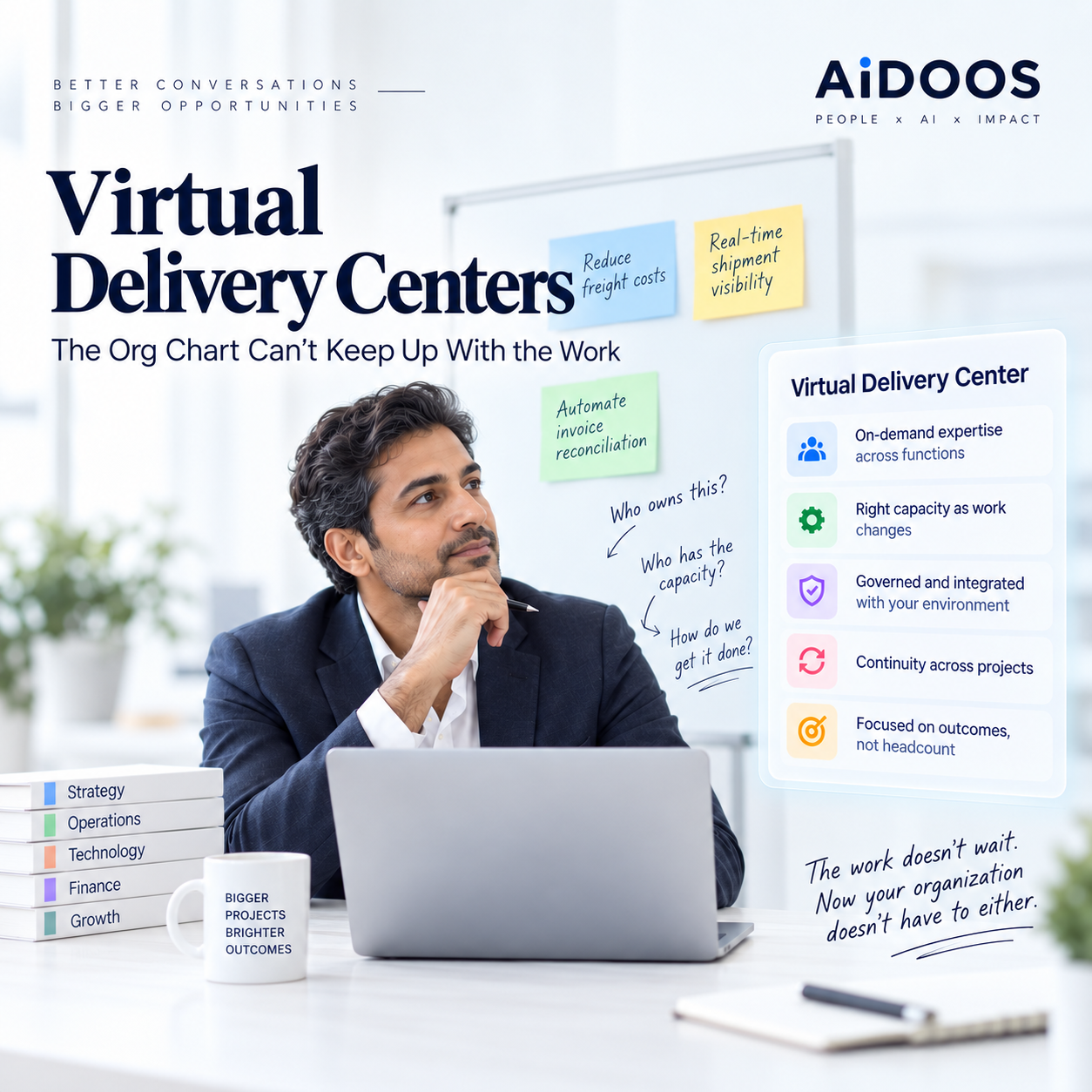
On Monday, the CEO asks him to reduce freight costs across three regions. On Wednesday, a major customer requests real-time shipment visibility. By Friday, finance wants a better way to reconcile carrier invoices because the existing process is consuming hundreds of hours every month.
None of these requests is unreasonable.
The problem is that Daniel does not have a “freight optimization team,” a “shipment visibility team,” and an “invoice reconciliation team” sitting idle waiting for work.
He has an operations organization.
It was designed around the work the company does continuously.
People run warehouses, manage transportation, handle suppliers, support customers, solve exceptions, and keep the business moving.
The new problems cut across that structure.
Freight optimization needs data expertise, logistics knowledge, software capability, and perhaps optimization modeling. Shipment visibility involves integrations, carrier systems, customer experience, and engineering.
Invoice reconciliation touches finance, operations, documents, workflow automation, and exception handling.
Daniel looks at the org chart.
The work does not fit anywhere.
So he does what leaders have done for decades.
He asks who can take it.
That question may be one of the reasons execution moves so slowly inside large organizations.
We keep trying to fit new work into permanent structures that were designed for yesterday's recurring responsibilities.
The work is becoming episodic.
The org chart remains permanent.
That mismatch is what Virtual Delivery Centers are ultimately trying to solve.
1. Organizations are designed around ownership, but work arrives around outcomes
Daniel's transportation director owns freight operations.
That sounds like the obvious place to put the optimization initiative.
The director agrees that the problem matters, but his team is already handling carrier performance, daily exceptions, contract renewals, capacity issues, and the operational problems that appear every morning whether a transformation project exists or not.
The freight project is important.
It is not the team's only responsibility.
Daniel could assign the project anyway.
That is what organizations usually do.
A transformation initiative gets attached to an existing leader, who adds it to the responsibilities of people already carrying permanent work.
The project begins slowly.
Meetings are scheduled around operational emergencies. Analysis happens when someone finds time, and the initiative remains strategically important while being practically secondary to the work that keeps the business alive today.
This is not a motivation problem.
It is a capacity problem.
The org chart tells the company who owns functions.
It does not guarantee that those functions have spare capacity for every new outcome leadership wants to create.
This distinction becomes increasingly important as business change accelerates.
A company may need an AI initiative for six months, a supply-chain optimization project for four, and a customer-data program for nine. The skill combinations required by those initiatives may have little relationship to the permanent departmental structure.
Yet the default organizational response is still to ask which department owns the work.
Perhaps the better question is who should own the outcome and what execution capacity should form around that leader until the outcome is achieved.
That is a different organizational principle.
2. Hiring solves one kind of problem very well
Daniel considers building a permanent analytics team inside operations.
There is a reasonable argument for it.
If the company will continuously need data science, optimization, and operational analytics for years, hiring people and building internal capability may be exactly the right decision.
Permanent work deserves permanent capability.
The difficulty begins when the organization cannot confidently predict the shape or duration of demand.
The freight initiative may need an optimization specialist intensely for twelve weeks and occasionally afterward. The visibility project may require several integration engineers during implementation, but much less capacity once the connections are stable.
The reconciliation project may benefit from document intelligence and workflow expertise that the company has no reason to retain as a full-time internal team after the problem is solved.
Hiring converts these temporary peaks into permanent organizational structure.
That is sometimes worthwhile.
It should not be automatic.
Daniel also discovers that hiring has another characteristic leaders often forget while planning projects.
It takes time.
The business can identify a problem in a Monday leadership meeting. It may take weeks or months to define roles, obtain approvals, recruit candidates, interview them, negotiate offers, wait through notice periods, and onboard the successful hires.
By the time the organization is ready, the problem may have changed.
This is not an argument that companies should stop hiring.
It is an argument that hiring and execution operate on different clocks.
The org chart moves deliberately because permanent commitments should move deliberately.
Business opportunities do not always wait.
An enterprise therefore needs more than one mechanism for obtaining capability.
3. Staff augmentation gives you people; it does not automatically give you a delivery center
Daniel's next option is familiar.
Bring in contractors.
This can work well when the organization knows exactly which skill it needs and already has the structure to manage the work.
If Daniel has a functioning engineering team that simply needs two additional developers for several months, staff augmentation may be perfectly sensible.
But his freight-optimization problem does not arrive as four empty seats.
It arrives as ambiguity.
Which data is usable?
How should freight performance be measured?
Which lanes have enough volume to optimize?
Do contractual constraints limit carrier changes?
Could a model improve planning, or would simple operational changes create most of the value?
What systems need integration?
What should be built, and what already exists?
Giving Daniel four resumes does not answer these questions.
It gives him four additional people whose work someone must structure.
This is where the distinction between capacity and delivery structure matters.
A Virtual Delivery Center should not merely provide individuals. It should give the leader a structured environment through which capability can be assembled around outcomes as those outcomes change.
Daniel should still own the business objective.
He knows what the organization needs.
But he should not need to become a recruiting manager, vendor coordinator, technical project manager, and specialist evaluator every time a new initiative crosses functional boundaries.
That is what makes the Virtual Delivery Center different in principle from simply buying labor.
The center provides continuity and governance.
The work flowing through it can change.
One quarter, Daniel may need supply-chain analytics.
The next, he may need automation capability.
Later, a regulatory change might require completely different expertise.
The delivery center remains connected to the leader and the organization while the capability around the work changes.
That is the idea worth paying attention to.
4. Perhaps every leader needs a delivery center before they need another department
A few weeks later, Daniel tries a different mental model.
Instead of asking where the freight initiative belongs on the org chart, he imagines having a delivery center attached to his function.
Not a permanent team of fifty people.
A mechanism.
Daniel could define an outcome, establish the business context, and bring appropriate capability around it.
For the freight problem, that might involve a logistics specialist, data engineer, optimization expert, and someone responsible for coordinating execution.
When the initiative moves from analysis to implementation, the mix changes.
Perhaps the optimization specialist becomes less important while integration and operational rollout capability increases.
When the outcome is stable, capacity contracts again.
The customer-visibility initiative can move through the same center with a different configuration.
This begins to resemble how computing changed when cloud infrastructure became available.
Companies once had to purchase hardware before knowing exactly how much capacity future applications would require.
Cloud did not eliminate infrastructure.
It changed the relationship between demand and capacity.
Execution may be approaching a similar transition.
Permanent organizations will remain essential.
But leaders may increasingly expect access to execution capacity that can expand, contract, and reconfigure around work without requiring a corresponding reorganization every time.
That is what “a delivery center for every leader” means at its most interesting.
It does not mean every executive gets a shadow department.
It means every leader can access structured capability around outcomes without rebuilding the machinery of execution each time.
The org chart continues to represent ownership.
The delivery center becomes a way of expressing capacity.
Separating those two concepts could have significant consequences.
5. AI makes the org chart mismatch harder to ignore
There is another reason this idea matters now.
AI is changing the amount and composition of work required to produce outcomes.
Suppose Daniel's reconciliation project would once have required several people manually examining documents, matching records, and managing exceptions.
AI can automate substantial portions of that process.
That reduces the amount of human capacity required.
It does not necessarily eliminate the need for people.
Someone still needs to understand the workflow, integrate systems, define exceptions, verify accuracy, and decide how the process should behave when evidence is ambiguous.
The mix of capability changes.
This makes permanent role design more difficult.
Should Daniel hire a document-processing specialist because one six-month initiative needs that skill?
Perhaps not.
Should he have access to someone with that expertise when required?
Absolutely.
The RAMP framework describes how professionals themselves become more capable in this environment through Retrieval, Agents, Models, and Proof.
That affects enterprise delivery too.
A RAMP-ready specialist can potentially operate with significantly more leverage because agents and models perform parts of the surrounding execution.
The implication is subtle but important.
The enterprise may need fewer permanently defined roles and more fluid access to capabilities.
An initiative is no longer necessarily a fixed equation where a certain amount of work translates directly into a certain number of people for a predictable duration.
Some pieces can be automated heavily.
Others require deep human judgment.
The ratio changes as the work progresses.
A delivery model designed around fixed staffing assumptions struggles with that reality.
A Virtual Delivery Center can adapt more naturally because the unit being organized is the outcome rather than the seat.
6. The organization still needs boundaries, or flexibility turns into chaos
Daniel likes the idea of variable capacity.
His CIO immediately asks the right question.
“How do we stop this becoming a free-for-all?”
If every leader can activate external capability whenever work appears, the company could end up with duplicated projects, uncontrolled access, inconsistent architecture, and a landscape nobody understands.
This is why VDC cannot simply mean “people on demand.”
The delivery center needs governance.
Daniel should be able to activate capability quickly, but not invisibly.
The organization needs clarity about what work is being performed, which systems contributors can access, who owns decisions, and what happens to access when the relevant work ends.
Architecture still matters.
Security still matters.
Procurement and finance still matter.
The enterprise does not become less governed because capacity becomes more fluid.
In fact, fluid execution requires better governance because permanent organizational boundaries are no longer doing as much of the controlling automatically.
A well-designed VDC therefore needs to coexist with the company's existing systems and controls.
For AiDOOS, the intended model is for work to occur inside the customer's tools wherever practical, with access constrained to the role, task, and period required.
That matters because leaders should gain capacity without creating another disconnected operating universe.
Daniel's freight initiative may use the company's existing repositories, data environment, issue tracking, communication channels, and operational systems.
The VDC brings capability into that environment.
The company retains ownership.
This is what prevents flexibility from becoming organizational fragmentation.
The goal is not to bypass the enterprise.
It is to make the enterprise easier to execute within.
7. The org chart does not disappear; it stops carrying a burden it was never designed to carry
Six months later, Daniel's organization still looks recognizable.
The transportation director still owns transportation.
Finance still owns financial control.
IT still owns architecture and critical systems.
The company has not dissolved into temporary teams.
What has changed is the way new work enters the organization.
When leadership identifies an outcome, the first question is no longer automatically, “Who on the org chart has capacity?”
Sometimes the answer is still an internal team.
Sometimes the company decides the capability is strategic enough to hire permanently.
In other cases, the leader activates capacity through the VDC and builds the appropriate execution configuration around the work.
That flexibility changes conversations.
The transportation team no longer needs to pretend it can absorb a major optimization program while running daily operations.
The CIO does not need to create a permanent integration team because three projects happen to need integrations this year.
Daniel does not need to decide today what exact skill mix his function will require eighteen months from now.
The organization can preserve permanent ownership while making execution more fluid.
That may become increasingly important because the pace of business is moving in the opposite direction from organizational design.
Products change faster.
AI capabilities change faster.
Customer expectations move faster.
Entire workflows can be redesigned in months.
Yet companies still reorganize as though each structure needs to survive for several years.
Maybe that is because we have been asking the org chart to do two jobs.
It tells us who owns the business.
Then we also expect it to contain all the capacity required to change the business.
Those are not the same thing.
The first requires continuity.
The second increasingly requires flexibility.
Virtual Delivery Centers create a way to separate them.
Daniel still needs a strong permanent organization. He may need it more than ever, because someone must understand the business, hold institutional knowledge, make long-term decisions, and remain accountable when individual initiatives end.
What he no longer needs is a permanent department for every temporary configuration of work.
That is the shift.
The org chart tells Daniel who owns the outcome.
The VDC gives him a place to assemble the capability needed to achieve it.
When those two things stop being confused, leaders gain another way to respond to work that arrives faster than organizations can redraw themselves.
The work does not care whether the org chart is ready.
Perhaps execution should not have to wait for it.