
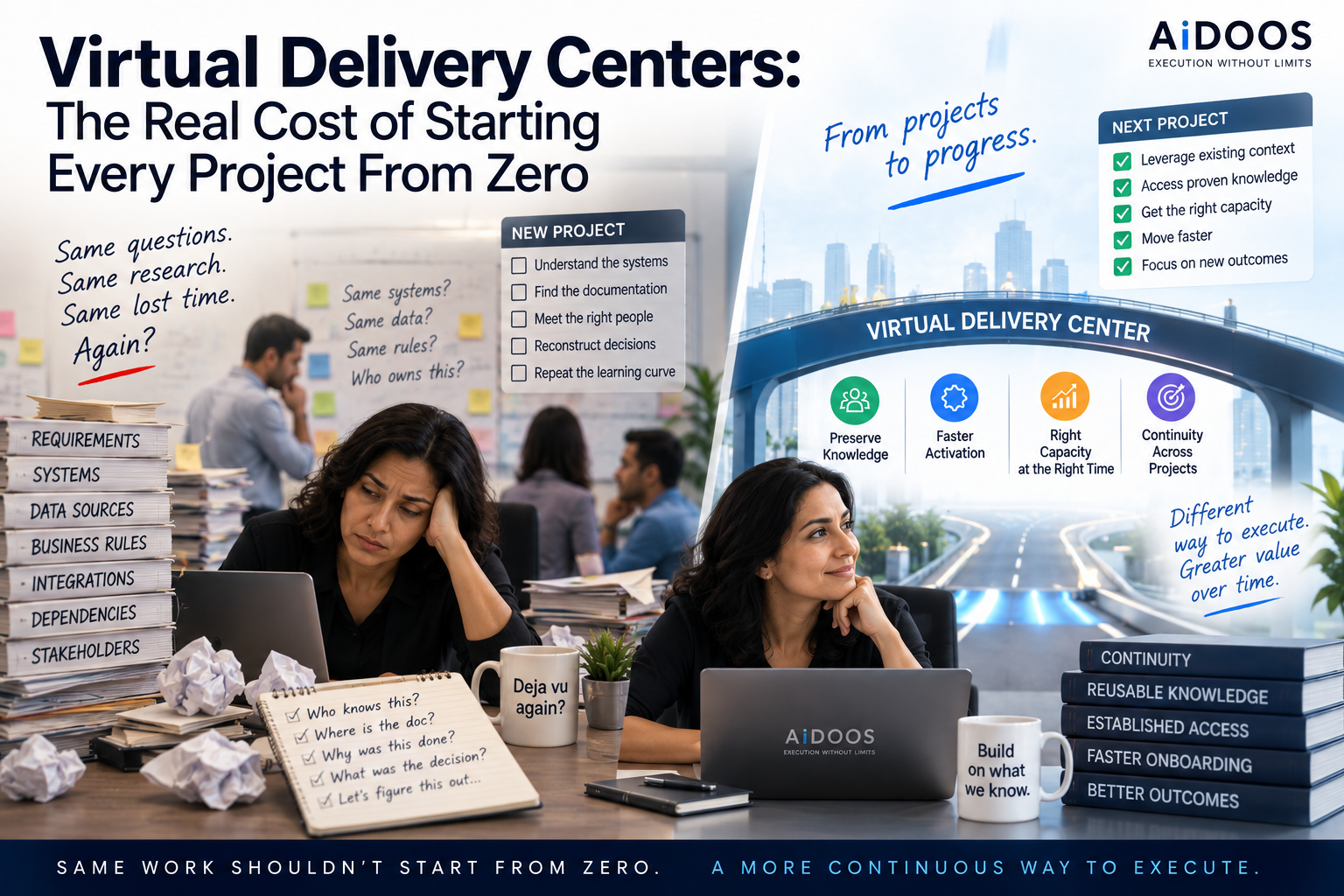
Virtual Delivery Centers: The Real Cost of Starting Every Project From Zero
Leena's finance integration has finally gone live.
The project took longer than anyone wanted, but the result is working. Finance has stopped moving data between two systems manually, the reconciliation process is more reliable, and the technology team has survived the final weeks without another major incident.
At the closing meeting, everyone is relieved. The external contributors have completed their assignments, the project manager is preparing the final report, and Leena is already thinking about the next initiative.
Three months later, the business asks for a new customer-reporting capability.
It sounds straightforward. The reporting system needs information from the same finance platform, some of the same customer records, and a few of the same integration points the previous project touched.
Leena assumes this one should be easier.
Then the questions begin.
Which service owns the customer identifier? Why does the finance system use a different account number? Was the reconciliation rule implemented in the application or the integration layer? Who knows why the API behaves differently for a small group of legacy customers?
The answers exist somewhere.
Some are in the repository. Some are in old tickets, while others are buried in meeting notes or the memory of people who have since moved to different work.
The new team spends its first two weeks reconstructing what the previous team already knew.
Nobody calls this a failure.
It is simply how projects have always worked.
But Leena starts wondering whether the organization has developed a habit of paying for the same understanding repeatedly.
That is the hidden cost of starting every project from zero.
The project is finished, but the learning has nowhere to go
At the end of a project, organizations usually preserve the obvious artifacts.
The code remains in the repository. The documentation is uploaded, the final presentation is stored, and the project manager closes the remaining administrative tasks.
On paper, the knowledge has been handed over.
In practice, something more complicated has happened.
The people who delivered the work have accumulated an understanding of the system that is difficult to capture completely. They know which documentation is reliable, which dependency is fragile, and which apparently simple change tends to create problems elsewhere.
They also know the history behind decisions.
Why did the team choose one integration approach over another? Why was a particular business rule implemented in an unusual way? Which alternative was rejected, and what would have to change before it became viable?
Some of this can be documented.
Some of it is difficult to recognize as important until the next project asks exactly the right question.
Leena remembers a conversation from the finance integration. One engineer had warned that a particular customer-account mapping should not be reused for reporting without additional validation.
The warning made sense at the time, but it never became a formal architectural decision. It was discussed in a meeting, resolved for the immediate project, and then disappeared into the background.
Now the reporting team is about to make the same mistake.
This is not primarily a documentation problem.
It is a continuity problem.
Documentation is one way of preserving knowledge, but continuity also involves knowing where the knowledge lives, who understands it, and how it should influence the next piece of work.
A project can be completed successfully while leaving the organization poorly prepared for the next project.
That distinction is easy to miss because project budgets usually end at delivery.
The cost of rediscovery appears later, inside somebody else's budget.
Every new team pays an invisible entry fee
Leena asks the new delivery lead why the reporting project needs so much discovery time.
The answer is reasonable.
The team needs to understand the existing architecture, confirm the data sources, review the business rules, establish access, inspect previous integrations, and identify the people who can answer questions.
None of that is wasted work.
The problem is that much of it has already been done.
The company is paying an entry fee to its own systems.
This happens across industries.
A manufacturer brings in a team to modernize a production application. Six months later, another team begins an analytics project and spends weeks understanding the same equipment interfaces, data definitions, and operational constraints.
A bank completes one compliance integration, then starts another initiative that requires a new group of specialists to rediscover the same approval processes and system dependencies.
A retailer builds a customer-data capability, then commissions a loyalty project that needs much of the same context.
The work is different.
The underlying organization is not.
Yet project-based delivery often treats each engagement as though it were entering a new environment.
That creates costs that are rarely visible in the headline estimate.
There is the time spent onboarding people and explaining systems. There is the time internal employees spend answering questions they have answered before, and there is the delay while the new team learns which assumptions are safe.
There is also the cost of mistakes.
A team that does not know the history may repeat an abandoned approach, misunderstand a business rule, or make a change that creates an unexpected dependency elsewhere.
These costs do not necessarily mean the previous project was poorly delivered.
They may simply mean the delivery model was designed to complete projects rather than preserve execution capability between them.
That is a different problem.
And it requires a different kind of solution.
Continuity does not mean keeping everyone permanently assigned
Leena's first thought is to retain the entire previous team.
That would certainly preserve some knowledge.
It would also recreate the very problem she is trying to avoid.
The finance integration required a concentrated period of engineering, testing, and coordination. The reporting project needs a different combination of skills, while the next initiative may require something else entirely.
Keeping the same people permanently assigned would preserve capacity whether or not the company had enough work for them.
That may be sensible for a stable, ongoing function.
It is less attractive when demand changes from project to project.
The important distinction is between continuity of capability and permanence of headcount.
An organization may need continuing access to knowledge, delivery context, and a reliable way to assemble capacity without needing the same individuals working full-time every month.
This is where a Virtual Delivery Center becomes interesting.
The idea is not simply to create another permanent external team.
It is to establish an enduring delivery environment through which the enterprise can access capability as work arises, while preserving useful context and governance between engagements.
The capacity can change.
The relationship does not have to begin from zero every time.
That distinction matters because a VDC should not be judged only by how quickly it can find people for the next project.
If every engagement requires a completely new search, a completely new onboarding process, and a completely new effort to understand the customer's environment, the model has preserved very little.
The value comes from making future execution easier to activate.
That may involve continuity in delivery leadership, reusable system knowledge, established access processes, shared architectural understanding, and a clearer record of what previous work taught the organization.
It does not require pretending that every contributor will always be available.
A good model should be honest about that.
People change assignments. Specialists move between engagements, and some capabilities are needed only occasionally.
The goal is not to eliminate change.
It is to prevent every change from forcing the organization to relearn everything.
The internal team should own the knowledge, not become its only storage location
Leena's internal team has another concern.
They do not want the company to become dependent on an external delivery provider for understanding its own systems.
That concern is legitimate.
A delivery model that preserves knowledge only inside the provider's organization can create a different form of lock-in. The customer may gain short-term continuity while becoming less capable of changing providers or bringing work back internally.
That is not the kind of continuity Leena wants.
She wants the company to retain ownership of its systems, priorities, and important technical decisions. External delivery capacity should strengthen that ownership rather than replace it.
This means continuity has to be designed into the working relationship.
The company should know where important decisions are recorded, how system knowledge is maintained, and what happens when contributors change. It should be able to inspect the work, understand the architecture, and retain access to the artifacts needed to operate and evolve the system.
The delivery environment should also fit into the customer's existing tools wherever practical.
For AiDOOS, the intended VDC model is to connect delivery capacity into the customer's repositories, issue trackers, communication channels, and other relevant systems rather than require the company to move all of its work into a separate proprietary project-management environment.
That matters for continuity.
If the work happens inside the customer's environment, the history remains closer to the systems and people who will need it later.
A decision recorded in the customer's issue tracker can be discovered by the next internal engineer. A test added to the repository remains useful after the engagement ends, while a clear architecture note can inform the next project without requiring the original contributor to be present.
Of course, merely storing information in the right place is not enough.
Someone still has to maintain it.
A repository full of outdated documents can be almost as misleading as no documentation at all. The useful question is whether the delivery process leaves behind knowledge that the next person can actually use.
That is a higher standard than “documentation completed.”
It asks whether the organization is becoming easier to work with over time.
AI makes organizational memory more valuable
A few months later, Leena's team begins using AI more extensively.
Coding agents can inspect repositories. Models can summarize incident histories, explain unfamiliar services, and help engineers understand how different parts of the system fit together.
This should make the next project easier.
Sometimes it does.
But the team discovers that AI is only as useful as the context it can retrieve.
The model can explain what the code does.
It cannot always explain why the company chose that implementation, which business constraint shaped it, or what happened the last time somebody tried to change it.
Those details may exist in old tickets or meeting notes, but they are not necessarily connected to the code the agent is examining.
This is where organizational memory becomes a practical AI capability.
The RAMP framework describes Retrieval as one of the four capabilities professionals need for AI-native work. In an enterprise delivery environment, that same principle has an organizational dimension: useful intelligence depends on useful context.
A company that repeatedly loses delivery knowledge will also make it harder for AI systems to work effectively inside its environment.
The model may be powerful.
The context may still be weak.
A VDC can help address that problem when continuity is treated as part of the delivery model rather than an administrative afterthought.
Previous work can leave behind reusable knowledge, tests, architectural decisions, and clearer understanding of the customer's systems. Future contributors, whether human or machine, can begin from that accumulated context.
This does not mean AI can replace the people who understand the organization.
It means their knowledge can become more useful when it is captured and connected to the work.
An experienced engineer who explains why a particular integration behaves strangely is not merely helping today's project. They may be creating context that prevents several future teams, and several future agents, from making the same mistake.
That is a different way of thinking about documentation.
It stops being something the team does at the end.
It becomes part of the organization's execution infrastructure.
The economics of continuity are easy to underestimate
Leena returns to finance with a different argument.
She is not asking the company to retain external capacity simply because another project might appear someday. She is asking whether the organization can reduce the repeated cost of activating delivery.
The CFO wants to understand what that means in practice.
Leena begins with the previous two projects.
How much time did the second team spend understanding systems the first team had already examined? How much internal engineering time was consumed by repeated onboarding and explanations, and which delays came from rediscovering information rather than performing new work?
The answers are not perfectly measurable.
Some discovery would have been necessary even with continuity, because the new project had different requirements. Some knowledge from the previous engagement may no longer have been relevant.
That is important to acknowledge.
Continuity does not eliminate discovery.
It reduces the portion of discovery that exists only because useful knowledge was lost or became difficult to access.
The economic question is therefore not whether a VDC can make every future project start instantly.
It cannot.
The question is whether maintaining a continuing delivery environment costs less than repeatedly rebuilding the same context, relationships, and operating arrangements.
For some organizations, the answer may be yes.
For others, particularly those with infrequent or highly unrelated projects, the economics may be less compelling.
A company that needs one isolated specialist engagement every few years may not benefit much from maintaining a continuing delivery structure.
A company with a steady stream of changing technology, operations, or transformation work may have a very different calculation.
This is where the VDC model becomes more interesting than a simple project-price comparison.
The value is not only in the cost of the current engagement.
It may also be in the reduced friction of the next one.
That includes the ability to activate capacity more quickly, preserve useful context, avoid repeated onboarding, and maintain a clearer relationship between the customer's internal team and the external capability it uses.
Those benefits should be evaluated rather than assumed.
A good delivery model ought to make them visible.
The next project should begin further ahead
Leena's reporting project eventually begins.
This time, the team does not start with a blank page.
The previous integration's architecture is available. The important business rules have been recorded, the relevant repositories and systems are already understood at a useful level, and the delivery lead knows which internal stakeholders need to be involved.
There is still discovery to do.
The reporting requirements are different, and some assumptions need to be challenged. The team still has to understand the new outcome rather than blindly reuse the previous solution.
But the first conversation is different.
Instead of spending two weeks asking, “How does this company work?” the team can spend more time asking, “What does this new outcome require?”
That is the difference continuity is supposed to create.
The organization is not paying to preserve people for the sake of preserving people.
It is preserving the ability to execute without repeatedly losing its starting position.
This is also why a VDC should not be confused with a collection of freelancers waiting for assignments.
The value is not merely access to individual skills.
It is the structure around those skills: the context, governance, continuity, and ability to assemble the right capacity for the work.
A company may still use permanent employees for capabilities it needs continuously. It may still engage consulting firms for particular kinds of expertise, and it may still use individual contractors when that is the simplest answer.
The VDC becomes useful when the organization needs a continuing mechanism for accessing execution capacity without rebuilding the entire delivery relationship for every new initiative.
That is a different proposition.
It is not about replacing every other way of working.
It is about solving a recurring problem that traditional project-by-project delivery often leaves behind.
The real asset is the organization's ability to execute again
At the end of the reporting project, Leena asks a question that would not have appeared in the original project plan.
“What will the next team know because we did this?”
The delivery lead talks through the new data definitions, the reusable components, the tests, and the decisions that should be preserved. They also identify a few areas where the documentation is still weak and where the internal team needs to retain particular knowledge.
It is not a glamorous closing conversation.
But it changes the meaning of completion.
The project is not finished only when the requested capability works.
It is finished more completely when the organization is also better prepared for the work that comes next.
That does not mean every project needs a permanent team attached to it.
It means the organization should stop treating delivery knowledge as disposable simply because a particular engagement has ended.
This is the deeper opportunity behind Virtual Delivery Centers.
Companies have spent decades organizing work into projects, departments, contracts, and staffing assignments. Those structures are useful, but they can also create artificial boundaries around knowledge that the organization will need again.
A VDC can provide a more continuous way to access execution capacity while allowing the amount and type of capacity to change.
The enterprise retains its priorities and ownership.
The delivery environment preserves useful context.
The work determines which capabilities are needed next.
And AI can increasingly help make that accumulated knowledge available to the people and agents performing the work.
The result is not that every project becomes easy.
It is that the organization has a better chance of becoming easier to execute within.
That may be one of the most underrated forms of productivity.
Not how quickly the current team can finish.
But how much less the next team has to relearn.
Leena's first finance integration was successful because it delivered the requested outcome.
The reporting project can be successful for another reason too.
It can leave the organization with more capability than it had before.
That is the difference between buying another project and building a continuing execution capacity.
And it is why the real cost of starting from zero is not merely the money spent rediscovering old knowledge.
It is the opportunity lost when the organization never gets to build on what it already learned.