The Lounge Where Everyone Was Demoted
An executive observes hierarchy in an airport VIP lounge - team members orbiting a boss, a boss adjusting to a senior leader, officials bowing to a President, and finally everyone surrendering to the real VVIP: a child with a cookie.
I had three hours to kill.
That is how most airport stories begin.
Not with destiny. Not with revelation. Not with a dramatic announcement from the universe.
Just a boarding pass, a delayed connection, and too much time in a place where chairs look comfortable until you sit on them.
I was in the VIP lounge of an international airport whose name I will not mention because airports, like people, become sensitive when described accurately.
It was one of those lounges that tried very hard to look calm.
Soft lighting.
Expensive coffee machine.
Quiet carpets.
Chrome lamps.
Overconfident sandwiches.
A dessert counter that looked better than it tasted.
Staff who walked fast but never appeared to be rushing.
Large glass windows through which you could see aircraft moving slowly, like whales with landing gear.
I had a connecting flight to catch, but not for another three hours.
Usually, this is when I would open my laptop and pretend to be productive.
Or scroll through messages.
Or read three lines of an article, get distracted, and then blame the internet for ruining attention spans.
But that day I decided not to do any of it.
I am a lifelong student of psychology.
Not formally. No degree, no certificate, no framed evidence.
Just the dangerous kind of student: someone who observes people and silently develops theories with no supervision.
Airport lounges are excellent laboratories.
Everyone is performing.
The business traveler performs calm.
The consultant performs urgency.
The politician performs accessibility.
The celebrity performs invisibility.
The family performs togetherness.
The startup founder performs being on an important call.
The retired couple performs indifference to the buffet while slowly conquering it.
And in a VIP lounge, the performances become even better.
Because everyone in a VIP lounge knows they are important.
That is the price of admission.
Some are actually important. Some have paid to feel important. Some have borrowed importance from status, position, loyalty points, a government badge, or a relative with better access.
But the room has a shared understanding:
We are not like the crowd outside.
This is already funny.
Because nothing makes humans more ridiculous than a room full of people quietly agreeing that they are above other humans while eating reheated pasta from small plates.
I took a seat near the far side of the lounge, with a clear view of the room.
Perfect observation point.
To my left, two men in suits were discussing something in whispers so intense that it could only have been either a merger or a family property dispute.
Near the window, a woman in a cream blazer was on a video call, nodding in a way that suggested she disagreed with every word but had mastered corporate facial yoga.
At the buffet, a man with a diplomatic passport was inspecting fruit as if national interest depended on melon quality.
A group of three young executives sat together near the coffee machine. One was speaking. Two were laughing a little too hard. The speaker was clearly the senior one. Not because he looked older, but because the others had adjusted their bodies toward him the way sunflowers turn toward light.
Then I saw him.
One of the directors of my company.
Let us call him Rajiv.
He was sitting a few meters away, half-turned toward a small group of team members.
He had not seen me.
This immediately improved the afternoon.
There are few pleasures in corporate life as pure as seeing someone behave naturally before they realize senior leadership is nearby.
Rajiv is a capable leader. Smart, disciplined, politically aware, and usually composed. He has the expression of a man who reads meeting agendas before meetings and silently judges those who do not.
Around him sat four of his team members.
I could not hear everything they were saying, but I did not need to.
Body language is often louder than sound.
One leaned forward every time Rajiv spoke, as if receiving scripture.
Another laughed before Rajiv had fully completed a sentence, which is always risky because occasionally the boss is not joking.
A third kept nodding in a rhythm that suggested his neck had entered performance mode.
The fourth had placed his laptop open but was not really using it. This is a classic office technique: appear operationally occupied while remaining available for approval.
Every few seconds, one of them would say something and then glance quickly at Rajiv’s face to see whether the statement had survived.
I watched with professional curiosity and personal amusement.
There it was: the little solar system of hierarchy.
Rajiv at the center.
Four moons in orbit.
Each moon pretending its orbit was voluntary.
I wondered how all four had entered this lounge. Perhaps Rajiv had brought them as guests. Perhaps they had status. Perhaps the airline had made a mistake and accidentally created democracy.
Whatever the reason, they were there.
And they were behaving exactly as humans behave near power.
Not badly.
Humanly.
We adjust.
We soften disagreement.
We sharpen agreement.
We laugh earlier.
We sit straighter.
We choose words more carefully.
We perform competence.
We hide irritation.
We offer ideas as if placing flowers at a shrine.
This is not only corporate behavior.
It is mammalian.
Put a senior person in a room, and the nervous systems reorganize.
I watched for another minute, then decided to walk over.
It would have been rude not to.
Also, I am not above small experiments.
“Rajiv,” I said.
He turned.
For half a second, his face did something magnificent.
Surprise first.
Then recognition.
Then calculation.
Then warmth.
All in one smooth executive sequence.
“Sir!” he said, standing up quickly.
His team members turned toward me as if someone had changed the lighting in the room.
“Please, please,” I said. “Sit. I just saw you here.”
Too late.
Everyone was already adjusting.
The little solar system had discovered a larger planet.
Rajiv’s posture changed first.
Not dramatically. He is too experienced for drama.
But enough.
His shoulders squared. His smile became more careful. His voice shifted half a tone downward into respect. The easy authority he had carried with his team became attentive deference.
His team members noticed.
Of course they noticed.
Human beings detect hierarchy faster than Wi-Fi detects networks.
The same body language I had just seen in them toward Rajiv now appeared, in a more refined form, in Rajiv toward me.
I nearly laughed.
Not at him.
At the system.
Power had not disappeared.
It had simply moved one level up.
The moons had discovered their planet was also a moon.
We spoke for a while.
Flights. Meetings. Customers. Delays. The usual airport conversation disguised as leadership discussion.
His team members stayed mostly quiet, now performing a different kind of attentiveness. Earlier, they had been trying to impress Rajiv. Now they were trying not to embarrass Rajiv in front of me.
This is an underrated corporate skill.
Many careers are protected not by brilliance, but by knowing when to stop contributing.
I asked one of them where he was headed.
He answered with the concentration of a man defusing a bomb.
“Frankfurt first, sir, then Toronto.”
“Long route.”
“Yes, sir.”
Poor fellow. I had asked about travel. He replied as if I had asked for quarterly guidance.
I smiled to make him comfortable.
It did not help much.
Then the lounge changed.
At first, it was just a movement near the entrance.
Two security personnel entered.
Then three more.
Then someone from airport management.
Then two people wearing earpieces who looked like they had never smiled in a professional setting.
The staff became alert.
Not panicked.
Alert.
There is a difference.
In a well-run airport lounge, panic is never visible until it is too late. Before panic comes choreography.
People began speaking into radios.
The reception desk suddenly had more people than necessary.
A lounge manager walked quickly toward the inner seating area, then turned, then walked back, then spoke to someone who looked even more important.
Everyone in the lounge noticed.
Of course we did.
VIPs are extremely sensitive to the arrival of a bigger VIP.
It is one of their survival traits.
Rajiv looked toward the entrance.
His team members followed.
I followed too.
Then they entered.
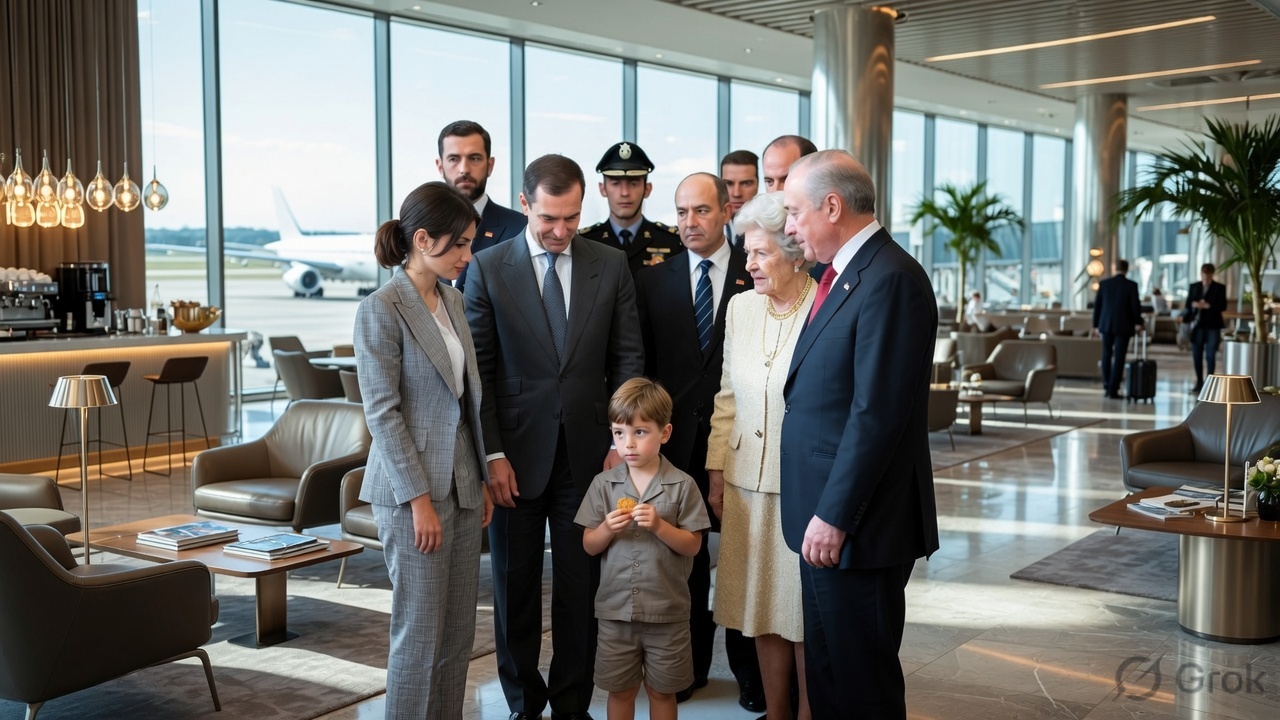
Four men in dark suits first.
Security.
Then two officials.
Then a small cluster of people whose clothing, posture, and quiet seriousness suggested government.
And then the President of a nearby country walked into the lounge.
I will not name the country.
Let us preserve diplomatic peace and my future visa options.
But we all recognized him.
Not instantly, perhaps, but quickly enough.
Phones moved slightly.
Heads turned.
Conversations dropped.
The room inhaled.
A few minutes earlier, everyone in this lounge had been important.
Now we had all been demoted.
Not officially.
Worse.
Socially.
There is no announcement for this kind of demotion.
No email from HR.
No “Dear valued passenger, your importance has been recalibrated due to the arrival of a head of state.”
It just happens.
One moment, you are a VIP.
Next moment, you are furniture with boarding rights.
The President entered with three or four senior people around him: a minister, a bureaucrat, someone who might have been national security, and another person with the expression of a man responsible for logistics nobody appreciated.
Behind them came the real surprise.
His family.
His wife.
His daughter.
His son-in-law.
And a little boy, perhaps four years old, holding a small backpack shaped like a dinosaur.
The President’s grandson.
The plot had arrived.
We later gathered, through lounge whispers and staff fragments, that their aircraft had developed some technical issue and had been rerouted. They had to spend a couple of hours at this airport. Naturally, they had been brought to the best lounge available.
This lounge.
Our lounge.
Formerly.
The airport staff moved into action.
A polite woman approached a table near the central seating area.
She bent slightly.
Spoke softly.
The passengers stood, gathered their things, and moved away with the dazed expressions of people who had just discovered that elite access has terms and conditions.
Another staff member approached the sofa section.
Then the window seats.
Then the quiet corner.
One by one, the VIPs were relocated.
Not thrown out.
Never that.
They were “requested.”
They were “guided.”
They were “accommodated elsewhere.”
Language is wonderful. It can turn eviction into hospitality.
A man near the buffet looked offended in three languages.
A woman in a red scarf asked, “But my flight is in forty minutes.”
The staff smiled with professional sorrow.
A young executive whispered, “Do they know who he is?” while pointing to someone whose importance had clearly expired.
I watched the whole thing with growing delight.
The social order was being updated in real time.
Rajiv leaned toward me and whispered, “Looks like we may be asked to move.”
“Looks like it.”
His team members looked worried. Not because they cared deeply about the seat, but because displacement in front of hierarchy is awkward.
A few minutes earlier, Rajiv had been the sun.
Then I had arrived, and he had become a planet.
Now a President had arrived, and all of us had become space dust.
But then came the twist.
The President did not sit where everyone expected.
The staff had arranged a large seating area for him. Beautiful chairs. Privacy screens. Bottled water. A fruit platter that had suddenly become more ambitious.
The minister stood beside him, slightly bent forward, speaking urgently.
The senior bureaucrat held a folder.
Another official was explaining something with both hands.
But the President was not really listening.
Neither was his wife.
They were both focused entirely on the little boy with the dinosaur backpack.
The child had discovered the dessert counter.
This was now the national priority.
The President’s wife walked with him to the counter.
The President followed.
The minister followed the President.
The bureaucrat followed the minister.
Security followed everyone.
A chocolate mousse was selected.
Then rejected.
A strawberry tart was inspected.
A cookie was accepted.
Then dropped.
An entire security apparatus paused around a cookie.
I have seen enterprise transformation programs with less attention.
The little boy looked at the fallen cookie.
Then looked at his grandfather.
The President of a sovereign nation bent down, picked it up, and said something that made the child laugh.
That was it.
That was the moment.
The most powerful person in the room was no longer the President.
It was the child.
The President controlled ministers.
The ministers controlled departments.
The departments controlled budgets.
The security controlled the lounge.
The lounge staff controlled us.
But the child controlled the President.
And the cookie controlled the child.
Therefore, by the ancient laws of practical power, the cookie was briefly the supreme authority in the room.
I could not stop laughing.
Quietly at first.
Then not so quietly.
Rajiv looked at me.
“What happened?”
I said, “We are watching geopolitics become childcare.”
He smiled, then saw it too.
The minister was still trying to speak to the President, who was now holding a napkin while the boy negotiated for juice.
The bureaucrat stood with the folder open, waiting for a signature that was clearly less urgent than apple juice.
The security men, who had entered like the final scene of a political thriller, were now forming a protective ring around a small person trying to open a packet of biscuits.
The President’s daughter was adjusting the child’s collar.
The son-in-law looked like every son-in-law in every culture near powerful in-laws: present, respectful, strategically silent.
The wife said something to the President.
The President immediately moved.
That was another hierarchy.
State power is one thing.
Marriage is older.
Rajiv whispered, “Sir, this is too good.”
I said, “Careful. Your team is watching you laugh.”
He straightened a little.
Then relaxed.
For once, the hierarchy was too absurd to maintain.
One of his team members smiled.
Then another.
Soon all of us were watching the same scene with the same human recognition.
The lounge had become a theater of power.
First, the team had orbited Rajiv.
Then Rajiv had adjusted around me.
Then all of us had adjusted around the President.
Then the President had adjusted around his wife.
Then both had adjusted around the grandson.
Then the grandson had adjusted around a cookie.
And the cookie, being free of ambition, had simply fallen on the floor.
This is why I love observing people.
No leadership book can compete with one good airport lounge.
A staff member finally reached our area.
“Excuse me, gentlemen,” she said, with the grave kindness of someone about to reduce our status. “We are very sorry, but due to a special delegation, we need to request that this section be cleared. We have arranged seating in the adjoining lounge.”
“Of course,” I said.
Rajiv also stood quickly.
His team members sprang up as if the chair had become illegal.
We gathered our bags.
Adjoining lounge.
What a phrase.
It means: you were important ten minutes ago.
We walked out together.
As we left, I looked back.
The President was now seated, but sideways, not in the grand chair prepared for him. His grandson was on his lap, holding the dinosaur backpack and half a cookie.
The minister stood nearby, still waiting.
The bureaucrat still held the folder.
The security still watched the room.
But the President was making a face at the child.
A silly face.
The kind of face no campaign poster would ever approve.
The child laughed.
And for those few seconds, the man who could move armies, budgets, laws, borders, ministers, and markets had become a grandfather trying to keep a child happy in an airport lounge.
It was beautiful.
Ridiculous.
And deeply educational.
In the adjoining lounge, which was perfectly fine but socially inferior by recent standards, we found seats near the back.
Rajiv’s team members were quieter now, but in a more relaxed way.
Something had shifted.
Not dramatically.
Nobody became enlightened.
No one resigned from hierarchy.
No one declared the end of corporate politics.
But after watching all of us get demoted by a child with a cookie, it became harder to take our own importance too seriously.
Rajiv sat beside me.
“Sir,” he said, “that was a lesson.”
“Yes.”
“In power?”
“In relativity.”
He laughed.
One of his team members asked, carefully, “Relativity, sir?”
I said, “Not Einstein’s. Airport lounge relativity.”
They smiled.
I continued.
“Everyone is powerful until someone more powerful walks in. And the most powerful person in the room is often controlled by someone who does not even know what power is.”
The team laughed now.
Properly.
Rajiv too.
Good.
Laughter is one of the few things that can flatten a room without humiliating anyone.
We ordered coffee.
Not great coffee.
But after demotion, one must accept what remains.
I thought about the corporate world.
How much of leadership is performance around invisible rank?
Who gets the chair at the head of the table.
Who speaks first.
Who waits.
Who laughs.
Who interrupts.
Who is allowed to be casual.
Who must be precise.
Who can be late and call it unavoidable.
Who must be early and call it professionalism.
Who receives updates.
Who asks questions.
Who absorbs consequences.
Power is everywhere.
But power is not fixed.
It moves.
It moves with context.
In one room, you are the boss.
In another, you are a passenger.
In another, you are a citizen.
In another, a patient.
In another, a parent.
In another, a child.
In another, a customer.
In another, simply a person waiting for someone else to open the door.
The mistake leaders make is thinking the version of themselves that receives deference is the real version.
It is not.
It is a version created by structure.
Remove the structure and see what remains.
That is the person.
The President had not become less powerful when he made faces at his grandson.
If anything, he became more human.
Rajiv had not become less capable when he adjusted his posture in front of me.
His team had not become foolish because they wanted to impress him.
All of us were simply responding to the invisible architecture of status.
The danger is not that humans do this.
The danger is forgetting we do this.
Because when leaders forget, they start believing the room is honest with them.
It rarely is.
Rooms bend around power.
People edit themselves near power.
They laugh at half-jokes.
They soften bad news.
They hide confusion.
They package disagreement.
They call fear alignment.
They call silence agreement.
They call performance culture.
A good leader must remember:
The room changes when you enter.
That is not a compliment.
It is a warning.
Your presence may reduce truth.
Your title may increase politeness.
Your authority may create theater.
Your team may be orbiting you so carefully that you mistake movement for honesty.
And above you, there is always another orbit.
A board.
A regulator.
A market.
A president.
A spouse.
A child.
A cookie.
The universe has a sense of humor.
Our boarding announcement came eventually.
Rajiv’s flight was different from mine, so we stood to part ways.
His team members shook my hand with renewed confidence, or perhaps relief that I was leaving.
Rajiv said, “Good to see you, sir.”
“Good to see you too.”
Then I said, “Rajiv?”
“Yes?”
“Remember the lounge.”
He paused.
Then nodded.
“I will.”
I think he understood.
Or at least, I hope he did.
When I boarded my flight later, I kept thinking about the little boy.
He had no idea what he had done.
He had not conquered the lounge.
He had not challenged hierarchy.
He had not disrupted protocol.
He had simply wanted a cookie.
And yet he had revealed the whole machinery.
That is the beauty of children.
They do not respect the theater because they cannot yet see it.
They remind us that beneath titles, countries, companies, status, access cards, boarding groups, lounge tiers, cabinet ranks, board seats, and executive presence, humans are still humans.
Hungry.
Tired.
Eager to be seen.
Afraid to be ignored.
Trying to impress someone.
Trying to please someone.
Trying to matter.
Trying to get through the next hour without embarrassment.
I settled into my seat.
The aircraft pushed back.
As we turned toward the runway, my phone buzzed one last time before airplane mode.
A message from Rajiv.
Sir, my team is still laughing about the cookie.
I smiled.
Then typed back:
Good. Every leadership team needs a cookie moment.
I put the phone away.
Outside the window, the airport lights stretched into the distance.
Somewhere behind us, in the best lounge in the terminal, a President may still have been waiting for his aircraft.
His ministers may still have been waiting for him.
The airport staff may still have been waiting for the delegation to leave.
The security may still have been watching everyone.
And the little boy may have been asleep by then, completely unaware that for a few glorious minutes, he had been the most important person in the airport.
Power had shifted.
Then shifted again.
As it always does.
That is the lesson.
Do not take the lounge too seriously.
You are only VIP until someone’s grandchild wants a cookie.
Was this useful?
A quick reaction helps us shape the next issue.Thanks for the reaction —
More from the briefing

You'd Have Done the Same
When a storm shuts New York, a hard, successful man flying to the deal of his life is ordered down to a small town in Newfoundland called Gander, and taken in by strangers who want nothing at all.
Cabin Pressure
On AC856, the every-other-Tuesday red-eye from Toronto to London, two frequent flyers who have shared the same cabin for three years and never spoken finally do, and each discovers the composed stranger they envied was drowning too.

The Point of No Return
On UA16, the red-eye from Newark to London, a woman who has crossed this ocean six hundred times watches a young colleague take her first-ever transatlantic flight, and does the math on a life spent living in the middle of the sea.