
Enterprise AI is moving quickly from assistants to agents.
That is a meaningful step forward. Instead of merely answering questions or generating content, agents can now retrieve information, use tools, call APIs, update systems, trigger workflows, communicate with employees and coordinate with other agents.
This feels much closer to real work.
But there is a problem hiding inside all that activity.
An agent can complete its task while the business outcome still fails.
A collections agent can send the perfect reminder and the invoice can remain unpaid. A retail agent can detect an empty shelf and the shelf can stay empty. A healthcare agent can identify a documentation issue and the claim can still be denied.
The agent acted.
The business did not necessarily change.
That distinction may become one of the most important ideas in the next phase of enterprise AI.
1. Task completion is not outcome completion
Most software has historically been built around tasks.
Create a ticket. Approve an invoice. Send an email. Update a record. Assign a technician. Generate a report.
AI agents inherit much of that structure.
We give an agent a goal, tools and permissions. It reasons about what to do, takes an action and reports that the work is complete.
From the agent's perspective, that may be correct.
From the business perspective, it may be nowhere near complete.
Consider collections.
An accounts receivable agent sees that an invoice is overdue. It checks the customer's payment history, drafts an appropriate message and sends it to the customer.
The agent has successfully completed its task.
But finance did not need an email sent.
Finance needed the money.
If the customer ignores the message, disputes the invoice, requests another copy, says the purchase order is incorrect or promises payment and then fails to pay, the business problem remains unresolved.
The real objective was never:
Send an intelligent collections email.
The real objective was:
Convert an overdue receivable into cash within acceptable commercial constraints.
That is a very different system to engineer.
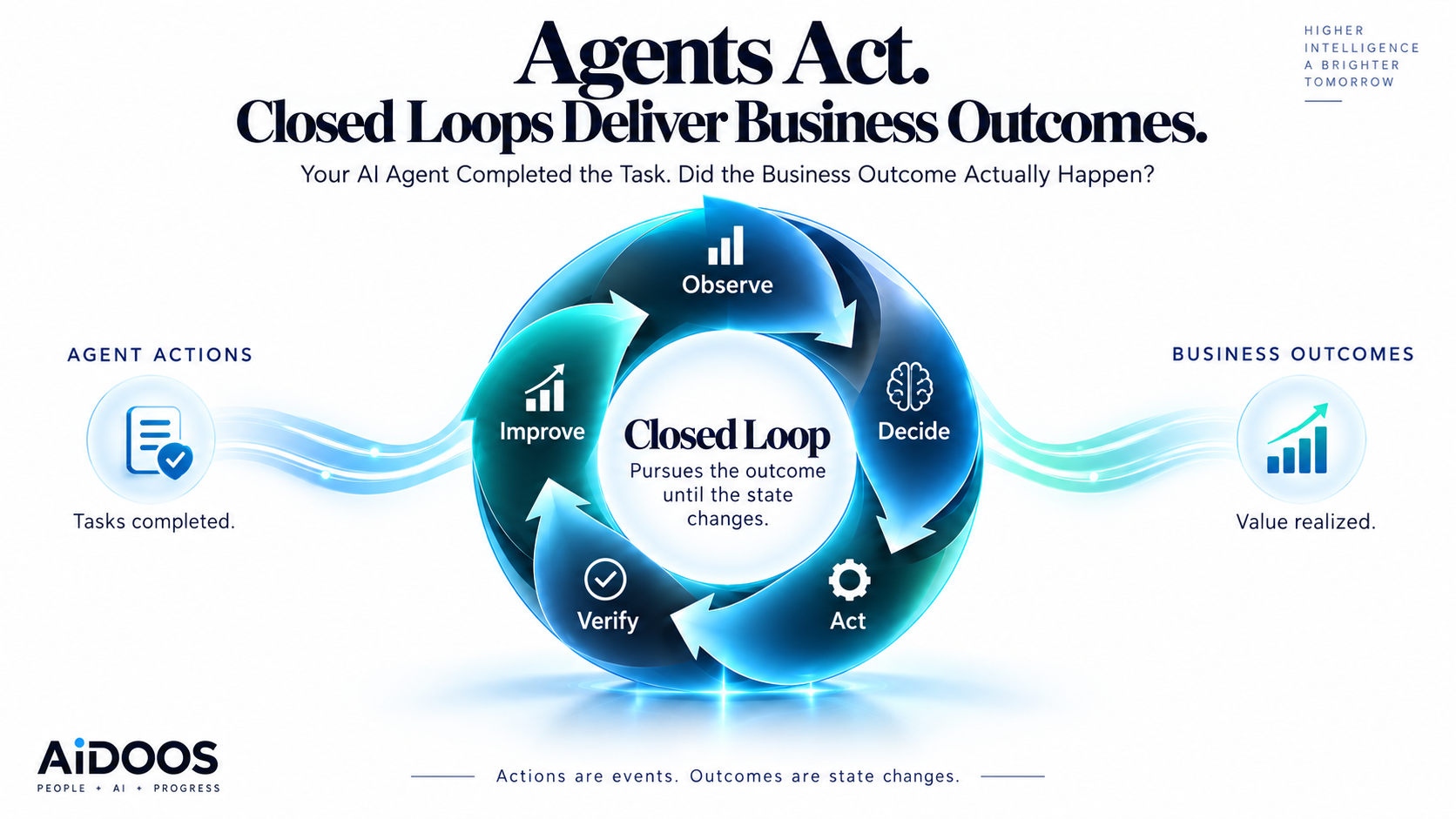
It must observe what happened after the message was sent. It must understand the customer's response, determine whether another action is required, decide whether a dispute exists, involve another person if necessary and continue until the receivable reaches an acceptable state.
The agent performs an action.
The loop owns the outcome.
2. The same gap appears across almost every industry
Take retail.
A computer vision system identifies that a product is missing from a shelf. An AI agent checks inventory and confirms that stock exists in the back room.
It creates a replenishment task.
Everything worked.
Yet the shelf can remain empty for another twenty minutes because the employee is busy, the task was missed, the product could not be located or the inventory record was wrong.
The actual objective was not to identify the gap.
It was to restore on-shelf availability.
That requires the system to observe whether replenishment actually happened. If it did not, the system needs to determine why and decide what should happen next.
Now consider healthcare.
An AI agent reviews a claim and identifies incomplete documentation. It flags the issue and asks for additional information.
Useful work has happened.
But the economic outcome has not happened.
The claim still needs to be corrected, coded appropriately, submitted, adjudicated and ultimately paid. If it is denied, the system needs to understand the reason, determine whether the denial is legitimate, choose the next action and continue.
The outcome is not documentation correction.
The outcome is a valid claim reaching cash.
Manufacturing has the same problem.
A predictive maintenance agent notices abnormal vibration in a machine and determines that a bearing is likely to fail. It creates a work order.
Technically, the system has done its job.
Operationally, nothing is solved until the correct part is available, maintenance occurs and subsequent telemetry confirms that the equipment is healthy again.
Logistics follows the same pattern.
An agent detects that a truck is likely to miss a delivery appointment and recommends an alternative route.
That recommendation has no business value by itself.
The route may need to be changed. A driver may need to be notified. A dock appointment may need to move. A customer may need to approve a different time.
Even after all of that, the system needs to know whether the shipment actually returned to the desired trajectory.
Across all of these examples, the same pattern emerges.
An action is an event. An outcome is a state change.
Agents are very good at creating events.
Businesses get paid for state changes.
3. Why agentic workflows still leave the loop open
The obvious response is to connect agents together.
One agent analyzes the situation. Another decides what to do. Another takes an action. Another evaluates the result.
Now we have a multi-agent system.
That is powerful, but it still does not guarantee a business outcome.
The question is not how many agents are involved.
The question is whether the system remains responsible for the objective after each action.
Many agentic workflows are still fundamentally chains.
Agent A performs a task and passes something to Agent B. Agent B performs another task and passes the result to Agent C.
Eventually the chain ends.
A closed loop behaves differently.
After an action occurs, the system observes reality again.
Did the condition improve?
Did something unexpected happen?
Has the target state been reached?
Should the same action continue, should another action be attempted, or should a human intervene?
The system does not stop merely because the planned sequence has been executed.
It stops when the outcome reaches an acceptable state.
That is the difference between an agentic workflow and an engineered business loop.
A workflow asks:
What should happen next?
A loop asks:
Are we there yet?
And if the answer is no, the system continues.
4. A business loop needs more than an agent
This is why we believe Loop Engineering needs a more complete architecture.
A business loop can be described through ten core primitives.
Goal defines the state the system is trying to reach. Without a persistent goal, there is nothing against which actions can be evaluated.
State describes what is currently true. The loop needs an accurate view of the business before deciding what to do.
Context explains why the current situation exists. Two identical states may require completely different actions depending on the customer, contract, location, history or operating conditions.
Constraints define what must never be violated. Financial limits, compliance rules, safety requirements, permissions and commercial boundaries all belong here.
Actions define what the system can actually change. Those actions may be executed by agents, APIs, enterprise applications, machines or people.
Observation captures what happened after the action. Without this, the system cannot distinguish attempted execution from real-world change.
Evaluation determines whether the action moved the business toward the goal.
Memory allows the system to understand what happened in previous iterations and similar situations.
Escalation defines when the system should bring in a human, another system or a higher authority.
Learning determines what should permanently change because of what the system has experienced.
These ten primitives form the architecture of a business loop.
Inside that architecture runs a continuous execution cycle:
Observe → Understand → Decide → Act → Verify → Adapt → Repeat
The distinction matters.
The ten primitives describe what the loop must contain.
The seven-stage cycle describes what the loop repeatedly does.
An AI agent can participate in several parts of this system. It may help understand the current state, decide between possible actions, communicate with a customer or evaluate a result.
But the agent is not necessarily the loop.
The loop is the persistent system that keeps driving toward the business outcome.
5. Adaptation is useful. Learning is more important.
There is another distinction worth making.
Many autonomous systems can already adapt.
If one action fails, the agent tries another. If a tool call returns an error, it changes its approach. If the customer does not respond, it sends another message.
That is valuable.
But adaptation is still mostly about the current situation.
Learning is different.
Learning asks whether the system itself should improve because of repeated experience.
Suppose a collections loop learns that customers in a particular segment consistently respond poorly to email but respond quickly to another channel.
Adaptation says:
Try another channel for this customer.
Learning says:
Change the default strategy for future customers with similar characteristics.
Suppose a maintenance loop learns that a particular sensor pattern repeatedly predicts failure twenty hours earlier than expected.
Adaptation changes what the system does this time.
Learning changes how the loop operates next time.
That distinction matters because the long-term promise of autonomous enterprise systems is not simply that they can repeat human workflows more quickly.
It is that the operating system of the business can improve through execution.
The loop becomes better at closing itself.
That is fundamentally different from automation.
6. Closed loops change how AI ROI is measured
This shift also changes the economics of AI.
Today, many enterprise AI programs are measured through technical activity.
How many employees use the copilot?
How many agents were deployed?
How many tasks were automated?
How many tokens were consumed?
How many hours were saved?
Those metrics can be useful, but they remain one step removed from the business.
Closed loops allow organizations to measure something closer to economic reality.
A collections loop can be measured by cash recovered, reduction in overdue receivables and improvement in Days Sales Outstanding.
A claim loop can be measured by denial reduction, payment recovery and time to cash.
A shelf loop can be measured by availability, replenishment time and lost-sales reduction.
A maintenance loop can be measured by downtime avoided, equipment availability and maintenance cost.
A logistics loop can be measured by on-time delivery, empty miles, cost per shipment and service performance.
Now the enterprise has a very different way to think about AI investments.
Instead of asking how much AI it owns, it can ask how many economically meaningful loops it has closed.
That moves the conversation away from technology deployment and toward operating performance.
It also gives CFOs, CEOs and operating leaders a much clearer language for AI.
The question becomes:
What business outcome is this system continuously responsible for?
That is a harder question than asking whether an agent works.
It is also a far more valuable one.
7. Agents may become abundant. Closed loops may become the real asset.
The agent ecosystem will likely grow enormously.
Enterprises will have thousands of specialized agents capable of research, analysis, communication, coding, operations and decision support.
Many of those capabilities may eventually become interchangeable.
Models will improve. Agent platforms will mature. Tool calling will become standardized. Enterprise applications will expose more actions to AI systems.
The scarce layer may move upward.
The hard problem will no longer be simply getting intelligence to act.
The harder problem will be designing systems that continuously coordinate intelligence, software, machines and people around an outcome.
That is where Loop Engineering enters.
An agent may write the message.
Another may analyze the customer.
Another may update the CRM.
A human may approve a commercial exception.
A payment system may process the transaction.
None of those components individually owns the outcome.
The loop does.
And that may become a useful way to think about the next generation of enterprise AI.
Agents will increasingly become the actors.
Closed loops will become the machinery through which those actors create measurable business value.
The enterprise AI race may therefore move beyond a simple question:
How many agents have you deployed?
Toward a much more consequential one:
How many important business loops have you actually closed?