
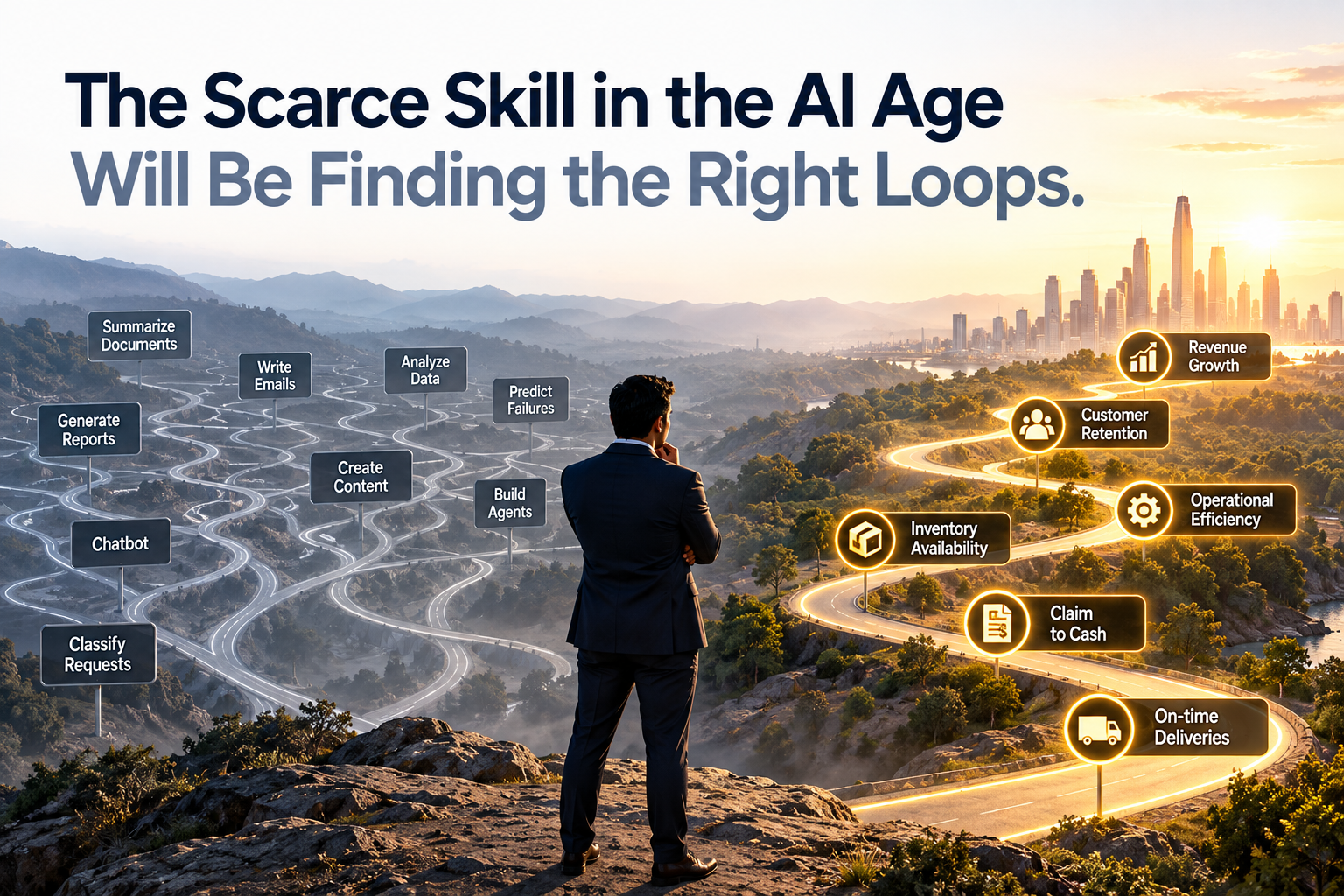
The Scarce Skill in the AI Age Will Be Finding the Right Loops
For most of the AI era so far, scarcity has been easy to identify. Models were scarce. Compute was scarce. AI talent was scarce. Access to high-quality infrastructure was scarce.
Even knowing how to prompt these systems well felt like an advantage. That world is already changing.
Models are multiplying. Compute is expanding. Agents are becoming easier to build. Every major software platform is adding intelligence.
Capabilities that looked extraordinary eighteen months ago are rapidly becoming standard features. Intelligence is becoming abundant.
Whenever something important becomes abundant, value moves somewhere else. The internet made information abundant, so finding the right information became valuable.
Cloud made computing abundant, so designing the right products and business models became more important. Generative AI is making reasoning, analysis and increasingly action abundant.
The next scarcity may therefore not be intelligence. It may be knowing what intelligence should continuously work on.
Which problem deserves a closed loop? Which business state is valuable enough to observe continuously? Which outcome should the system keep pursuing?
Where does eliminating human latency actually change economics? Where should autonomy stop? And perhaps most importantly, who is prepared to put their name against the result?
The companies that answer those questions well may create enormous value from AI. The ones that do not may end up with thousands of agents doing increasingly impressive things without materially changing the business.
1. We are about to have far more AI capability than we know what to do with
Imagine walking into a large company a few years from now. Every employee has access to powerful AI. Every major application contains agents.
Models can reason over company information, operate software, generate code, communicate with customers and coordinate actions across systems. The question will no longer be whether AI can do something.
In many cases, it probably can.
That creates a strange new problem. When capability is scarce, selecting what to automate is relatively easy. You deploy technology only where the value is obviously high enough to justify the cost.
When capability becomes abundant, almost everything begins to look automatable. Marketing can create more content. Sales can send more outreach. Finance can analyze more transactions.
Engineering can produce more code. Operations can generate more alerts. Customer service can answer more questions.
Activity explodes. But activity is not necessarily value.
A company could deploy ten thousand agents and still have slow collections, excess inventory, poor customer retention, missed deliveries and declining margins. The agents may all be functioning correctly.
They may simply be working on the wrong things.
This is why the strategic question changes. The first generation of enterprise AI asked, “What can AI do?” The next generation will have to ask, “What should the business continuously get better at doing?”
Those questions sound similar, but they are not. One starts with technology. The other starts with economics.
2. A use case is not necessarily a loop
Enterprise AI programs are full of use cases. Summarize this document. Generate that report. Classify this request. Predict this failure. Recommend this product. Draft this response.
Each can produce value. But a collection of use cases does not automatically produce a better company.
A loop begins somewhere deeper. It begins with a state the business cares about.
Suppose a retailer deploys computer vision to identify empty shelves. That is a useful AI use case.
But the retailer does not economically care whether an image was successfully classified. It cares whether customers can buy the products they came for.
So the stronger question is not whether AI can detect an empty shelf. It is whether the retailer can maintain on-shelf availability.
Now the design changes. Detection becomes one component. Inventory becomes another. Store operations become another.
Replenishment becomes another. Verification becomes another.
The system needs to observe whether the shelf was actually restored. If it was not, something else must happen.
The AI use case has become a business loop.
The same distinction appears in finance. Predicting which invoices will pay late is a use case. Reducing receivable age and converting valid invoices into cash is a loop.
Predicting customer churn is a use case. Keeping valuable customers in a healthy relationship is a loop.
Predicting machine failure is a use case. Maintaining asset availability within an acceptable economic and safety envelope is a loop.
Generating a proposal is a use case. Moving a qualified opportunity toward a commercial decision is a loop.
This shift is subtle, but strategically important. A use case asks what AI can do. A loop asks what the business wants to become true.
3. The best loops sit where economics, latency and agency meet
Not every business process needs to become a closed loop. That would be as misguided as trying to automate everything simply because automation is possible.
The most valuable loops tend to appear where three conditions overlap. There is a meaningful economic outcome. There is significant latency or friction preventing the business from reaching that outcome.
And there are actions available that can actually change the state.
Consider collections. The economics are obvious: cash.
The latency is obvious too. Invoices wait. Customers delay. Disputes sit unresolved. Payment commitments are forgotten.
Follow-ups happen later than they should.
There are also many possible actions. Contact the customer. Resolve the documentation problem. Correct the invoice. Escalate the dispute.
Change the channel. Involve the account owner. Offer an approved commercial path.
That makes collections a promising loop.
Now consider a dashboard that reports quarterly employee satisfaction. The information may be valuable, but there may not be a sufficiently clear action path from each signal to an outcome.
The result might require leadership judgment, cultural change and long-term human intervention. That may not be a good candidate for autonomous closure.
This distinction matters because the AI industry is currently biased toward what is technically easy to demonstrate. Generating content is easy to demonstrate. Summarizing documents is easy to demonstrate.
Building a chatbot is easy to demonstrate.
Closing a business loop is harder. It requires integration, context, authority, governance, observation, evaluation, exception handling and persistent responsibility.
But difficulty is not a reason to avoid it. Difficulty may be where the value is hiding.
If everyone can build the same agent in an afternoon, that agent is unlikely to remain a durable source of competitive advantage.
If closing an important business loop requires understanding a company’s economics, systems, operating constraints and organizational reality, the capability is much harder to copy.
The difficult loop may be the valuable loop.
4. Finding the right loop is a leadership problem
It is tempting to assume that identifying loops should be the responsibility of the AI team. That would be a mistake.
The AI team understands technology. It may not own the business number.
The best loops usually begin with someone who does. A CFO understands where cash gets trapped. A COO understands where execution breaks.
A chief supply chain officer knows where volatility creates expensive intervention. A sales leader knows where opportunities lose momentum.
A revenue-cycle leader knows where claims stall. A plant leader knows which forms of downtime actually hurt production.
These leaders may not know how to build agents. They do not need to.
Their critical knowledge is different. They know where the organization repeatedly fails to move from one valuable state to another.
That is the raw material of Loop Engineering.
This may eventually change how companies think about AI strategy. Instead of asking every function to submit “AI use cases,” leadership could ask each function to identify its most valuable open loops.
Where does value get stuck? Where does the organization repeatedly wait?
Where do employees spend time chasing rather than deciding? Which outcome requires constant intervention?
Which process generates endless exceptions? Where does management repeatedly ask, “Why hasn’t this happened yet?”
Those questions are far more revealing than asking where employees would like a copilot. They expose the operating system of the business.
5. The most valuable loop may be hiding between departments
There is another challenge. Organizations are designed vertically. Business outcomes travel horizontally.
That means the most important loops often have no natural owner.
Take an order that needs to become cash. Sales may own the customer. Operations may own delivery.
Finance may own invoicing. Collections may own overdue payment. Customer success may own the ongoing relationship.
Each function optimizes its portion. Nobody necessarily owns the entire loop.
This is where enterprise value leaks away. A sales team may celebrate a signed deal while implementation waits.
Operations may complete delivery while billing data remains incomplete. Finance may issue the invoice while a customer dispute sits with another team.
Collections may repeatedly chase the customer for something the company itself has not resolved.
Every department can hit its internal metrics while the total business outcome remains poor.
Closed loops expose that problem. The loop does not care which department owns the step. It cares whether the desired state was achieved.
This may force enterprises to confront something technology alone cannot solve. Someone has to own the number.
If the goal of the loop is reducing Days Sales Outstanding, who has authority to change the actions that influence it?
If the objective is maintaining shelf availability, who can coordinate inventory, replenishment and store operations?
If the objective is reducing claim-to-cash time, who can change behavior across clinical documentation, coding, billing and denial management?
The hardest part of Loop Engineering may therefore not be intelligence. It may be accountability.
AI can recommend. Agents can act. Systems can observe.
But somebody still has to decide what outcome matters enough to be owned.
That is a leadership decision.
6. The advantage will come from discovering loops others do not see
There is another reason loop discovery can become strategically important. Eventually every competitor will have AI.
Every competitor will have agents. Every competitor will have access to models capable of understanding documents, reasoning about data and operating software.
If everyone has similar intelligence, intelligence alone cannot be the advantage.
The advantage comes from what the organization teaches that intelligence to pursue.
Two retailers may use the same model. One uses it to answer employee questions.
The other discovers that a persistent loop connecting shelf observation, inventory, store labor and replenishment can materially improve product availability.
Same underlying intelligence. Different economic outcome.
Two manufacturers may use the same predictive model. One creates maintenance alerts.
The other connects prediction with production schedules, spare-part availability, supplier lead times and intervention economics to create a continuously operating asset-health loop.
Same prediction. Very different operating system.
Two banks may use similar AI. One deploys assistants across departments.
Another identifies a set of loops around fraud resolution, customer onboarding, collections and service recovery that materially change operating performance.
The difference is not model access. The difference is imagination combined with operational understanding.
This is why the next great AI skill may resemble product thinking more than prompt engineering. Someone needs to look at a business and see a loop where everyone else sees a department.
They need to see an outcome where everyone else sees a workflow. They need to see latency where everyone else sees normal process time.
They need to see a feedback system where everyone else sees a sequence of tasks.
That ability will be difficult to automate because it requires understanding what the organization values.
And value is contextual.
7. When intelligence becomes abundant, accountability becomes scarce
There is an even deeper scarcity underneath loop discovery: responsibility.
AI makes it easier to generate recommendations. Soon it will make it easy to generate actions.
But organizations do not ultimately survive on recommendations or actions. They survive on results.
Revenue. Cash. Margin. Availability. Retention. Quality. Safety. Throughput. Growth.
Someone has to stand behind those numbers.
This is where many AI initiatives become strangely vague. The model produced a useful analysis. The agent completed the workflow.
The pilot demonstrated efficiency. The team saved time.
All of those statements may be true. But did the business number move?
If it did not, who owns the gap?
Closed loops make that question uncomfortable because they expose the difference between technological success and economic success.
That discomfort is useful.
A real loop needs an objective precise enough that the organization can determine whether it closed. It needs a person or governing function capable of defining acceptable outcomes and constraints.
It needs authority. It needs measurement.
Eventually, it needs somebody willing to say, “I own this number.”
That may become one of the most valuable forms of leadership in an AI-native enterprise. Not managing every action, but defining the outcome and standing behind it.
The machines can increasingly handle the motion in between.
8. The future may belong to organizations that see their business as a portfolio of loops
Imagine an executive team several years from now. They still review revenue, margin, cash, customer growth and operational performance.
But beneath those metrics sits another view of the company: a portfolio of business loops.
Some are mature and highly autonomous. Some require frequent human intervention.
Some are expensive to operate. Some create extraordinary economic value.
Some close quickly. Others repeatedly stall at the same point.
Some should probably be redesigned. Others should be retired.
New loops are continuously discovered. Every loop has an objective, economics, operating constraints, telemetry and an accountable owner.
Leadership can see where human latency remains high. They can see where agents act successfully but outcomes still fail.
They can see which loops are learning. They can see which interventions repeatedly work.
They can see where the business itself is becoming faster and where it remains dependent on manual continuity.
That organization does not think of AI as another technology layer. AI has become part of its execution architecture.
At that point, the strategic question is no longer how many AI projects the company has. It is how intelligently the company has chosen the outcomes around which to organize autonomous execution.
That may be the defining skill of the next phase.
The world is not going to suffer from a shortage of intelligence. We are about to have more models, more agents, more compute and more automated capability than most organizations know how to absorb.
The scarce resource moves upward. It becomes judgment about where to apply that intelligence.
It becomes understanding which states matter. Seeing the loops others overlook. Designing the right constraints.
It becomes knowing when humans should enter, measuring whether reality actually changed, and being willing to own the outcome.
The companies that master those things will not necessarily have more AI than everyone else. They may simply know what to make it do.
And when intelligence becomes abundant, that may be the advantage that matters.