
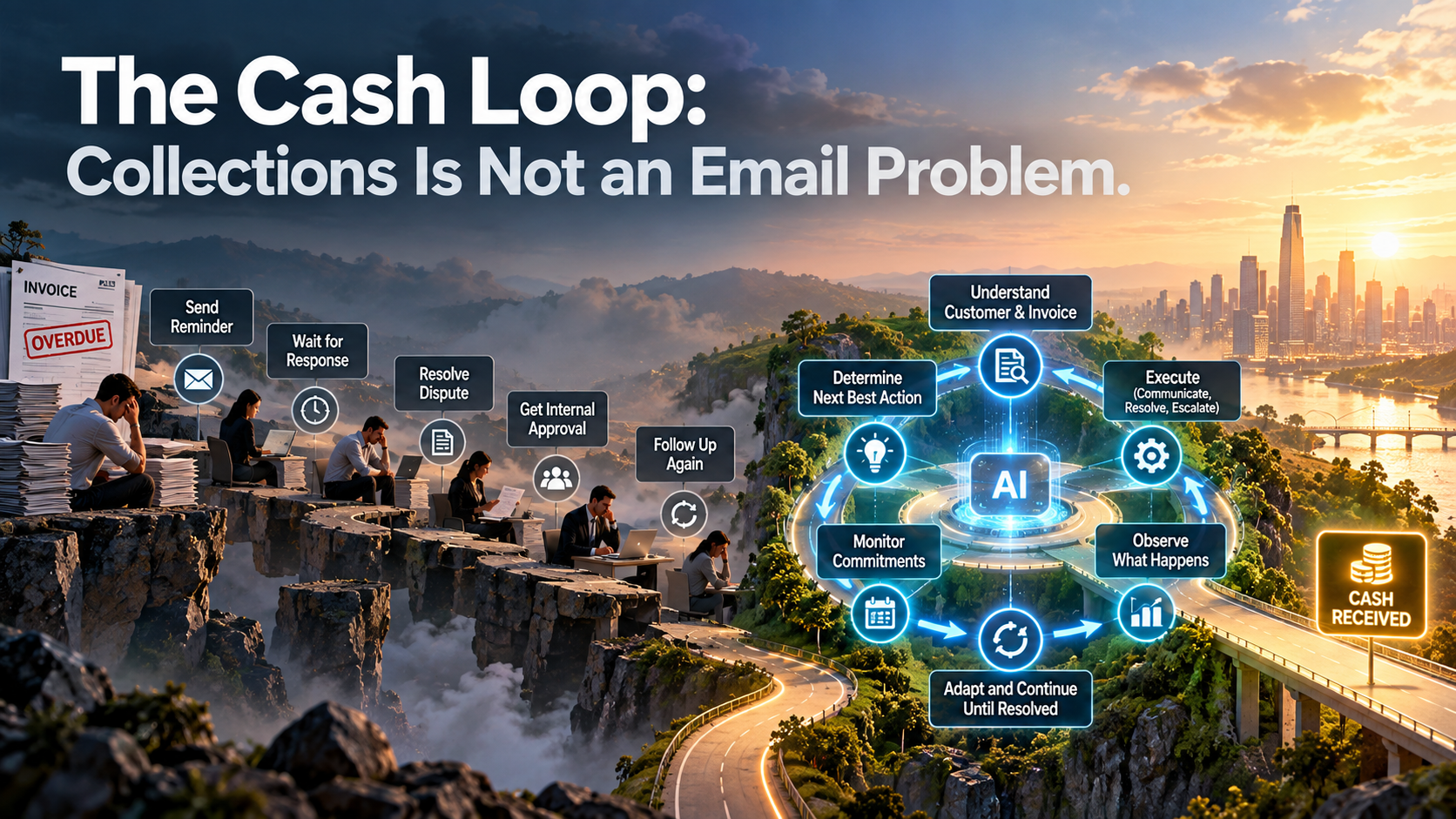
The Cash Loop: Collections Is Not an Email Problem
Most companies still manage collections as a sequence of follow-ups.
An invoice becomes overdue. Someone sends an email. If there is no response, another reminder goes out. If the customer disputes the invoice, somebody investigates. If payment is promised, someone waits. If the promise is missed, the process starts moving again.
It looks like a workflow.
In reality, it is an open loop.
The company does not actually care whether the email was sent, whether the collector completed the task, or whether the customer replied. It cares about something much more concrete.
The receivable needs to reach an acceptable financial state.
That may mean payment received. It may mean a legitimate dispute resolved. It may mean a payment plan agreed within policy. In some cases, it may mean a deliberate write-off or escalation.
Everything in between is execution.
The business outcome is cash.
That makes collections one of the clearest places to understand what Loop Engineering can mean in practice.
1. The strange economics of waiting for money that is already owed
Imagine a company has delivered the product or service.
The customer accepted it. The invoice was issued. The payment terms are clear.
Economically, much of the hard work has already happened.
Sales acquired the customer. Operations delivered. Employees performed the work. Suppliers may already have been paid. Payroll has certainly continued.
Yet the cash is still somewhere else.
Now the company begins waiting.
Perhaps the invoice lands in the wrong customer inbox. Perhaps the purchase order number is incorrect. Perhaps the customer needs a different document. Perhaps there is a genuine dispute.
Sometimes nothing is wrong at all.
The customer is simply late.
Every day that passes has a cost.
Working capital remains tied up. Finance teams spend more time monitoring. Forecasting becomes less reliable. The company may borrow money while its own money sits unpaid somewhere else.
For a small company, that can become an existential problem. For a large enterprise, it can translate into enormous amounts of capital sitting unnecessarily outside the business.
Yet collections processes are often remarkably passive.
Systems know the invoice is overdue.
The ERP knows the amount.
The CRM knows the account.
Email systems know the conversation history.
Contracts define payment terms.
Previous invoices reveal payment behavior.
The organization already possesses most of the raw material required to understand what is happening.
What it often lacks is persistent execution.
Someone still has to notice.
Someone still has to follow up.
Someone still has to remember what the customer promised.
Someone still has to determine why payment did not arrive.
The money waits because the process waits.
2. Sending the reminder is not the outcome
This distinction becomes important as companies introduce AI into finance.
One of the easiest AI use cases is collections communication.
AI can generate personalized reminder emails. It can vary tone based on customer history. It can summarize previous conversations. It can decide when another message might be appropriate.
All of that is useful.
But collections is not fundamentally an email problem.
Suppose an AI agent sends a beautifully written reminder to a customer whose invoice is twenty days overdue.
Task completed.
The customer responds:
“We cannot process this invoice because the purchase order number is incorrect.”
The AI succeeded.
The receivable did not move.
Now the actual problem begins.
Someone needs to determine whether the customer is correct. The correct purchase order may need to be located. The invoice may need to be amended. An internal approval may be required.
The revised invoice needs to reach the customer. The customer needs to acknowledge it. Payment processing needs to begin.
Then the promised payment date needs to be observed.
If the money does not arrive, the system needs to understand what changed.
None of this is unusual.
This is collections.
The email is simply one action inside a much larger loop.
That is why measuring collections automation by messages sent or touches eliminated misses the point.
The real question is whether the system moved the receivable closer to cash.
3. A receivable is a state, not a task
The conventional collections process often thinks in tasks.
Call customer.
Send reminder.
Escalate account.
Resolve dispute.
Update notes.
Schedule follow-up.
A closed-loop collections system starts somewhere else.
It starts with state.
What is true right now?
The invoice may be current, overdue, disputed, promised, partially paid, blocked by documentation, awaiting internal action or waiting for an external event.
That state can change at any moment.
A customer reply changes it.
A corrected invoice changes it.
A credit memo changes it.
A payment commitment changes it.
Money arriving changes it most decisively of all.
This is why the loop should remain active between human interventions.
It should continuously know what happened.
It should know what is supposed to happen next.
It should know when the expected event failed to occur.
If a customer says, “We will pay Friday,” the system should not create a reminder for an employee to check sometime next week.
The promise itself becomes part of the state.
Friday arrives.
Did the payment arrive?
If yes, the loop closes.
If not, the state changed again.
The system needs to decide what that missed commitment means and what action is appropriate.
That is very different from a queue of collection tasks.
The receivable becomes something the system is continuously trying to move toward closure.
4. The Cash Loop needs context, not just automation
Collections is full of situations where the same apparent problem requires very different treatment.
A $2,000 invoice from a small customer and a $2 million invoice from a strategic enterprise account cannot necessarily be handled the same way.
A customer who has paid late every month for five years is different from a historically reliable customer who suddenly stops paying.
A genuine product dispute is different from an administrative error.
A customer experiencing financial distress is different from a customer whose AP department simply needs another document.
This is why rules alone are not enough.
The loop needs context.
It needs to understand the customer relationship, invoice history, disputed items, contract terms, communications, previous payment promises and perhaps the commercial importance of the account.
It also needs constraints.
The system should not threaten a strategic customer because an invoice is three days late.
It should not offer unauthorized discounts.
It should not change payment terms without authority.
It should not escalate aggressively simply because a generic ageing rule says so.
Loop Engineering is not about giving AI permission to chase money however it wants.
It is about giving the system a clear economic objective while defining the operating boundaries within which it may pursue that objective.
That distinction is essential.
Autonomy without constraints is reckless.
Automation without context is annoying.
A well-engineered loop needs both.
5. Most collection delays are really coordination delays
One of the revealing things about collections is how often the customer is not the real bottleneck.
The outstanding invoice may be waiting because the company itself has not resolved something.
The customer asks for a corrected tax document.
Finance waits for sales.
Sales waits for operations.
Operations checks what was delivered.
Someone determines that a credit note is required.
A manager must approve it.
The collector then sends the revised paperwork.
Several days pass.
From the company's perspective, the invoice was “in collections” throughout this period.
But no collection was really happening.
The receivable was trapped inside an internal coordination problem.
This is where the idea of human latency becomes very tangible.
Perhaps each individual action required only a few minutes.
Yet the invoice remained unpaid for another week because the issue travelled slowly between people and departments.
A closed Cash Loop should not lose ownership simply because another department needs to act.
The objective remains alive.
If a sales executive needs to confirm a commercial term, the loop asks.
If finance needs to issue a document, the loop initiates the request.
If approval is required, the right approver enters.
When that human action is complete, the loop resumes immediately.
There is no reason for the process to disappear into another queue and wait to be rediscovered.
This is one of the biggest differences between workflow automation and closed-loop execution.
The loop follows the outcome across organizational boundaries.
6. Humans should handle judgment, not continuity
Good collectors do something important that software historically struggled to do.
They exercise judgment.
They understand whether a customer is genuinely struggling or simply delaying. They know when to push harder and when to preserve the relationship. They know when an account executive needs to become involved.
They can negotiate.
They can recognize nuance.
Those capabilities remain valuable.
What is far less valuable is requiring those same people to act as memory systems.
Remember to follow up Thursday.
Check whether the payment arrived.
Look again at the ageing report.
Find the previous email.
Ask legal whether the dispute was resolved.
See whether sales responded.
Update the spreadsheet.
Check the bank.
That is not where human judgment creates the most value.
A closed loop can maintain continuity.
It can observe every commitment. It can know every deadline. It can bring context together. It can decide whether the next step falls within its authority.
When human judgment is needed, it can bring the right person into the loop with the relevant context already assembled.
The collector stops being the operating system.
The collector becomes an exception handler, negotiator and commercial decision maker.
That is a much better use of human capability.
7. What a real Cash Loop would need
The architecture is surprisingly consistent with the broader Loop Engineering model.
The goal is clear: move the receivable toward an acceptable financial state.
The state describes what is true right now: overdue, disputed, promised, blocked, partially paid or escalated.
The context explains the account, the transaction, the relationship and the history.
The constraints define commercial policy, approval limits, regulatory requirements and customer treatment boundaries.
The actions might include communication, documentation requests, internal work requests, dispute initiation, escalation or authorized payment arrangements.
The observation layer watches what happened next.
Did the customer respond?
Was the revised invoice accepted?
Did the promised payment arrive?
Did the internal team complete its task?
The evaluation layer determines whether the receivable moved toward closure.
The memory layer understands what previously happened with this account and similar situations.
The escalation layer knows when authority must move to a collector, account executive, finance leader or legal team.
And the learning layer improves how similar situations are handled in future.
None of those components by itself is revolutionary.
The important change is that they are organized around persistent ownership of the outcome.
The loop does not finish when the action finishes.
It finishes when the state changes.
8. Collections may become one of the clearest examples of outcome-based AI
There is another reason the Cash Loop matters.
Its economics are unusually visible.
Many AI investments struggle to answer the question, “What was the business value?”
Collections has less room to hide.
How much overdue cash was recovered?
How quickly?
How much did Days Sales Outstanding change?
How many disputes were resolved?
How many broken promises were automatically recovered?
How much collector time moved from routine follow-up into high-value exceptions?
How much working capital returned to the business faster?
These are operating metrics.
They are also financial metrics.
This makes collections an unusually good proving ground for outcome-oriented AI.
You do not need to argue that sending emails faster has value.
You can measure whether the money moved.
And that points toward a broader change in how companies may eventually think about enterprise AI.
Instead of saying:
“We deployed an AI collections agent.”
The more meaningful statement becomes:
“We operate a Cash Loop responsible for reducing receivable latency within defined commercial constraints.”
One describes technology.
The other describes an operating capability.
That difference matters.
9. The future of collections is not autonomous chasing
There is a risk that this idea gets interpreted too narrowly.
Closed-loop collections should not mean an AI system endlessly chasing customers until they pay.
That would simply automate bad collections behavior.
The objective is not maximum pressure.
The objective is intelligent closure.
Sometimes the correct action is to wait.
Sometimes it is to fix the company's own mistake.
Sometimes it is to protect the customer relationship.
Sometimes it is to escalate.
Sometimes it is to negotiate.
Sometimes it is to stop pursuing the invoice entirely because the economics no longer justify the effort.
A good loop understands that outcomes exist inside constraints.
That is why human accountability remains important.
Someone defines what acceptable collection behavior means.
Someone defines the commercial rules.
Someone decides how much autonomy is appropriate.
Someone owns the financial outcome.
AI handles more of the continuity.
Humans remain responsible for the operating philosophy.
That is the model we should be trying to build.
10. Cash should not have to wait for someone to remember it
Accounts receivable is one of the oldest business problems in the world.
You delivered something.
Someone owes you money.
Now you wait.
Technology has improved almost everything around that basic interaction. Invoices are digital. Payments are digital. ERP systems are sophisticated. Communication is instant.
Yet the collection process itself often still moves at the speed of human attention.
That should begin to look strange.
If the invoice is important enough for the CFO to care about, why should its progress depend on whether somebody remembered to open an ageing report?
If a customer promise matters, why should the business depend on someone manually checking whether it was kept?
If a dispute is blocking payment, why should the receivable lose momentum while responsibility moves across departments?
The cash is already part of the company's economic reality.
The execution system should behave as though it matters.
This is the promise of the Cash Loop.
Not more reminders.
Not more aggressive automation.
Not fewer humans for the sake of fewer humans.
A persistent system that understands what is owed, knows what is preventing closure, brings intelligence and action to the problem, involves people when their judgment matters, and keeps the outcome alive until the financial state actually changes.
The invoice does not need another workflow.
It needs someone, or something, to own the ending.
That is what a closed loop does.