
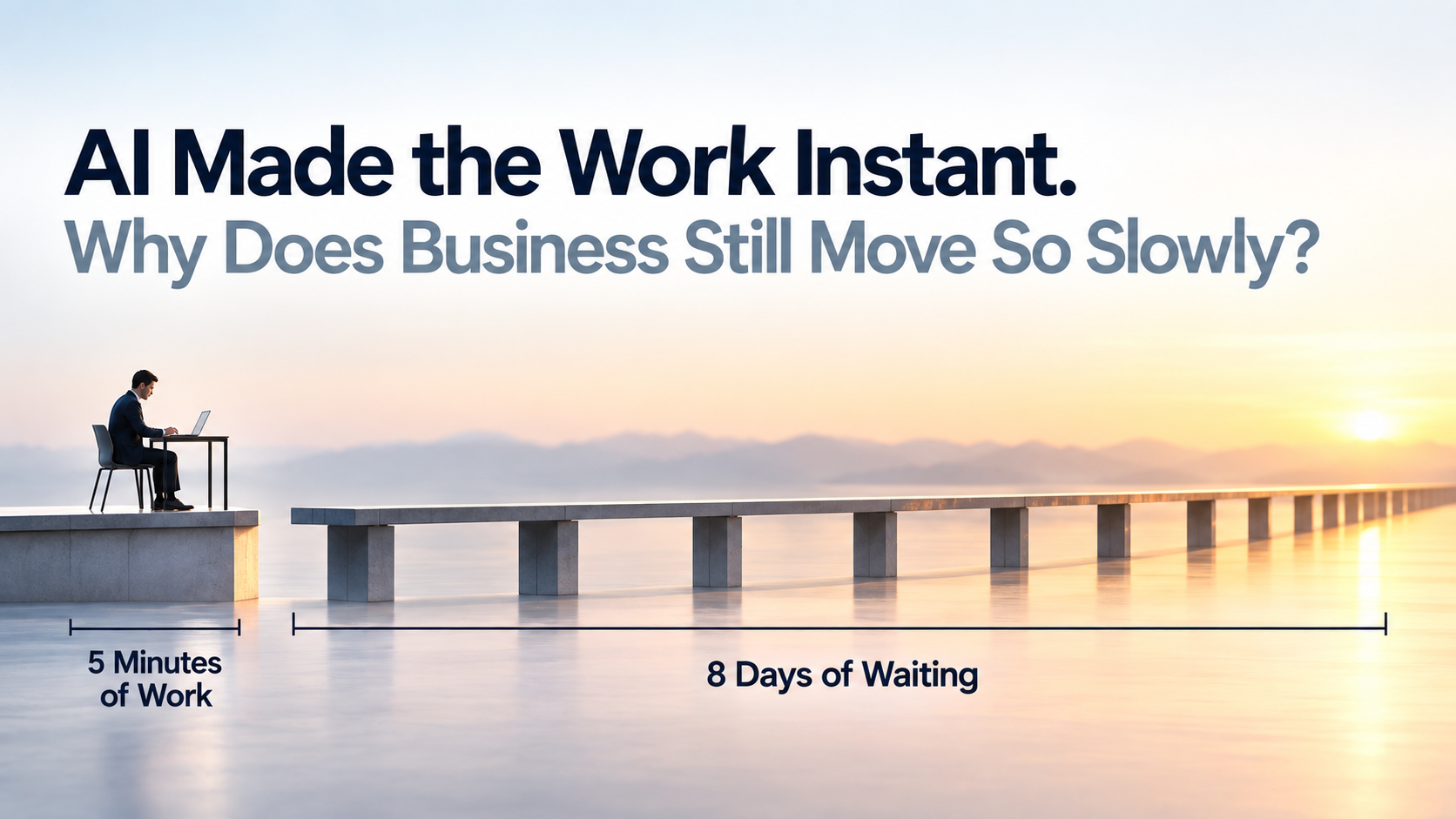
Human Latency: AI Made the Work Instant. Why Does Business Still Move So Slowly?
AI has made a remarkable number of things nearly instant. A proposal that once took hours can be drafted in minutes. A contract can be reviewed in seconds. A support ticket can be classified immediately. A claim can be analyzed before a human opens the case. A sales email can be written, personalized and sent almost instantly.
The work got faster, but the business often did not. A proposal is generated in two minutes and then waits two days for approval. A claim error is detected instantly and then sits in a queue overnight. An overdue invoice is identified in real time, but nobody follows up until the next morning.
The task became instant, but the process stayed slow. This is one of the least discussed contradictions in enterprise AI. We have spent enormous energy reducing the time required to perform work, while leaving the time between pieces of work almost untouched.
That waiting may now be the larger bottleneck. The work was never always the slow part. The waiting was.
1. We have been measuring the wrong clock
Most productivity discussions measure work time. How long does it take to write the report? How long does it take to analyze the claim? How many minutes are required to reconcile the invoice? How many hours does the developer save using a coding assistant?
These are useful measurements, but they capture only one clock. There is another clock running at the same time: elapsed time.
Imagine a business process that requires only forty-five minutes of actual work. Someone reviews a document for ten minutes. Another person approves it for five minutes. A third person updates a system for fifteen minutes. A final person sends something to the customer and records the result.
That is forty-five minutes of work. Yet the process takes eleven days.
The document waits in an inbox. The approval waits until the manager is free. The system update waits for another team. The customer reply arrives after two days. Nobody notices for another day. A reminder goes out. The process stalls again.
Almost none of the eleven days was spent doing the work. Most of the time was spent waiting for the next piece of work to begin.
This distinction matters enormously in the AI era. If AI reduces forty-five minutes of work to five minutes but the process still takes eleven days, the business has gained efficiency without gaining much speed. The employee may be more productive, but the customer may barely notice.
2. Human latency is built into the architecture of the enterprise
It is tempting to hear the phrase "human latency" and assume it means people are slow. That would be the wrong conclusion.
Humans are not slow. Humans are finite.
A person can pay attention to only so many things at once. They have meetings, priorities, interruptions, responsibilities and working hours. They sleep. They take weekends. They work across time zones. They need context before making decisions.
The modern enterprise evolved around those realities. That is why businesses have inboxes, queues, reminders, escalations, dashboards, approvals, SLAs, weekly meetings, monthly reviews and managers.
All of these mechanisms help organizations deal with one basic constraint: important work cannot receive continuous human attention. So the enterprise waits.
An invoice becomes overdue at 2:17 AM. Nobody sees it until morning. A customer changes behavior on Saturday. The account manager sees the health report on Monday. A machine begins behaving abnormally. The alert lands in a queue behind twenty-seven other alerts. A supplier misses a commitment. The issue is discussed in Thursday's supply chain review.
These delays are not usually caused by incompetence. They are a consequence of the operating architecture.
Humans historically served not only as decision makers, but also as the connective tissue between systems. People noticed that something had changed. People remembered that something remained unfinished. People chased other people. People carried context across applications. People decided whether the process should continue.
The system stopped whenever the human left. We accepted this because there was no practical alternative.
Now there may be one.
3. AI compressed task time, but not necessarily process time
This is why the first wave of enterprise AI can produce surprisingly disappointing results. Companies automate tasks and expect the entire business process to accelerate.
Sometimes it does. Often it does not.
Take accounts receivable. AI can identify an overdue invoice immediately. It can draft a highly contextual message, understand previous payment behavior and send the communication automatically. The task has become nearly instant.
But suppose the customer does not respond. Three days later, a collections analyst checks the account. The customer finally replies and says the purchase order number is wrong. The issue is forwarded to another team.
That team corrects it the next morning. The analyst notices the update later that afternoon and sends the revised invoice. The customer promises payment Friday. Friday passes. Someone follows up Monday.
The AI may have eliminated ten minutes of drafting. The business still waited nine days.
The same pattern appears in sales. An AI agent can research a prospect, prepare an intelligent proposal and personalize follow-up communication in seconds. But the opportunity may then sit untouched.
Nobody notices that the prospect read the document. Nobody responds immediately to a new question. Nobody detects that another stakeholder entered the conversation. The salesperson checks the pipeline later.
The task has become fast. The sales cycle remains human-paced.
Healthcare provides an even clearer example. AI can identify a documentation defect before a claim is submitted. That is valuable.
But if the corrected documentation waits for someone, the coding update waits for another team, the resubmission waits for a queue and the payer response waits several days before anyone investigates it, the overall revenue-cycle latency remains enormous.
The same thing happens in procurement, maintenance, logistics, customer success and IT operations. AI optimizes the action. The enterprise still waits between actions.
4. The real opportunity is to remove dead time
If we want to understand the next wave of productivity, we need a new metric. Not merely, "How long did the work take?" but, "How much of the total elapsed time contained no useful action at all?"
That number can be astonishing. A contract cycle takes twenty days, but perhaps only four hours contain actual work. A claim takes thirty days, but the cumulative human effort is under two hours.
A procurement decision takes two weeks, but the actual analysis and approvals require ninety minutes. A sales opportunity remains open for four months, but the total meaningful interaction may amount to several hours.
The rest is dead time: waiting, queueing, remembering, following up and waiting again.
We have normalized this latency so completely that we often call it "process." It may not be process. It may be absence of process. Nothing is happening.
That distinction changes the economics of AI. The most important value may not come from making the four hours of work twenty percent faster. It may come from removing ten days of inactivity.
A system that continuously observes state does not need to wait for Monday morning. A system that remembers every unfinished objective does not need a reminder. A system that can evaluate what happened after an action does not need someone to manually reopen the case.
A system that knows its constraints can decide whether another action is safe. A system that knows when human authority is required can bring the right person in at the right moment.
This is where the economics become interesting. AI's productivity effect is not simply faster execution. It is the possibility of continuous execution.
5. Closed loops attack latency, not labor
This is where Loop Engineering becomes important. Traditional automation focuses on steps: automate the email, automate the invoice match, automate the alert, automate the report.
Closed loops focus on the state the business is trying to reach.
Suppose a logistics company wants to maintain an on-time delivery promise. A traditional system detects that the shipment is late and generates an alert. That alert enters a queue.
A dispatcher eventually sees it. The dispatcher evaluates options, contacts the driver, checks the warehouse, perhaps informs the customer and makes a change. Then everybody waits again.
A closed loop behaves differently. It knows the goal: preserve the delivery promise within acceptable operational and commercial constraints.
It observes the shipment continuously. When conditions change, it evaluates whether intervention is required. It can determine available actions, execute what it is authorized to execute, observe the result and continue.
If the situation exceeds its authority, it escalates to a human. The human makes the decision, and then the loop resumes.
The important difference is not that humans disappear. The important difference is that the process no longer goes dormant whenever a human is not looking at it.
That may prove to be one of the defining properties of AI-native operations. Today, many processes are alive only while somebody is actively working on them.
Tomorrow, the loop itself may remain alive. That is a much bigger change than task automation.
6. Human attention should become an exception resource
For decades, businesses have used people as monitoring infrastructure. Someone checks the dashboard. Someone reads the inbox. Someone reviews the queue. Someone follows up on yesterday's exception.
Someone remembers that the customer still has not responded. Someone asks whether the supplier delivered.
Some of this is valuable human work. Much of it is not.
A highly capable employee should not have to spend half the day maintaining the continuity of an operating process. That is machine work.
Humans are most valuable where ambiguity, responsibility, negotiation, creativity, empathy and judgment matter. The problem is that today's enterprise mixes those activities with endless continuity management.
An account manager may spend ten minutes deciding how to save an important customer. That decision is valuable. But she may spend hours gathering context, checking what happened, finding the latest status, chasing another team and remembering to come back to the issue later.
A procurement leader may add enormous value negotiating a strategic supplier agreement. But much of the surrounding work is monitoring commitments, comparing data, identifying drift and determining when intervention is necessary.
A physician's judgment can be irreplaceable. Chasing documentation through a revenue-cycle process is not the best use of that judgment.
Closed loops allow us to separate the two. Machines can maintain continuity. Humans can provide judgment.
That may lead to a very different meaning of "human in the loop." Today, it often means a human participates in every important process.
In the future, it may mean humans are summoned by the loop when their contribution is uniquely valuable.
That is not removing humans from work. It is removing waiting from work.
7. When latency disappears, business models begin to change
The consequences go beyond productivity. When latency collapses, entirely new operating models become possible.
Imagine a sales organization where every meaningful change in a prospect's behavior is noticed immediately, evaluated in context and acted upon appropriately. Not another automated sequence sending generic emails, but a persistent revenue loop.
Imagine working capital where overdue receivables are not reviewed periodically but continuously driven toward resolution. Every response changes the path. Every promise is remembered. Every missed commitment triggers reevaluation.
Imagine inventory where thousands of positions are continuously balanced against demand, margin, lead time, supplier performance and cash. Not a planner staring at an exception dashboard, but a system maintaining an economic state.
Imagine customer success where declining engagement is investigated before it becomes churn. The system does not simply assign a red health score. It understands why the account changed, chooses an intervention, measures whether it worked and escalates when necessary.
Now something important happens. Cycle time becomes a competitive advantage.
A company that closes a business loop in four hours while competitors take four days does not simply operate more efficiently. It responds faster, collects faster, learns faster, fixes faster, recovers faster, serves customers faster and compounds faster.
This is where AI begins to change company economics rather than simply employee productivity. Speed stops being a property of individual workers.
It becomes a property of the organization itself.
8. The fastest company may not be the one with the fastest AI
Almost every enterprise will eventually have access to powerful models. Agents will become easier to build. Inference costs will continue to fall. Software vendors will embed AI everywhere.
The technology advantage will narrow.
But two companies with access to the same intelligence may operate at completely different speeds. One will use AI to help employees perform tasks faster. The other will redesign important business loops so that outcomes continue moving without waiting for humans to restart them.
The first company will have faster work. The second company will have a faster business.
That distinction matters.
The future of enterprise AI may not be won by whoever generates the fastest answer. It may be won by whoever eliminates the most unnecessary waiting between answers, decisions and actions.
This is why the next frontier is not simply automation. It is continuity.
A business loop should not sleep because the employee went home. It should not forget because the meeting ended. It should not stall because nobody refreshed the dashboard. It should not wait three days simply because that is how the process has always worked.
It should observe, understand, decide, act, verify, adapt and continue. Humans should enter where their judgment creates value, not because the operating system needs someone to remember what happens next.
AI has already made much of the work dramatically faster. Now comes the harder and more valuable challenge: making the business itself move faster.
The great productivity breakthrough may not come from reducing the time people spend working. It may come from eliminating the enormous amount of time businesses spend waiting.