What Is RAMP? The Work Framework for the AI Era
For most of modern working life, becoming good at a profession meant accumulating capability.
An accountant learned accounting. A developer learned programming languages and systems. A lawyer learned statutes, precedent and argument. A marketer learned customers, channels and persuasion.
Technology changed the tools around these professions, but the underlying bargain stayed surprisingly stable. You learned something valuable, became better at doing it than most people, and organizations paid you for that capability.
Artificial intelligence changes that bargain.
Not because AI suddenly knows everything, and not because every profession is about to disappear. The deeper change is that intelligence itself is becoming available on demand.
A person no longer needs to personally possess every piece of knowledge required to perform a task. They can retrieve it. They can ask a model to reason over it. They can delegate parts of the work to agents. They can combine several forms of intelligence and automation into a workflow that would once have required a team.
That sounds like a productivity story.
It is actually a work-design story.
The question is no longer simply, “What do you know?”
Increasingly, the question is:
Can you bring the right knowledge, models, agents and judgment together to produce a trustworthy outcome?
That is the problem RAMP is intended to address.
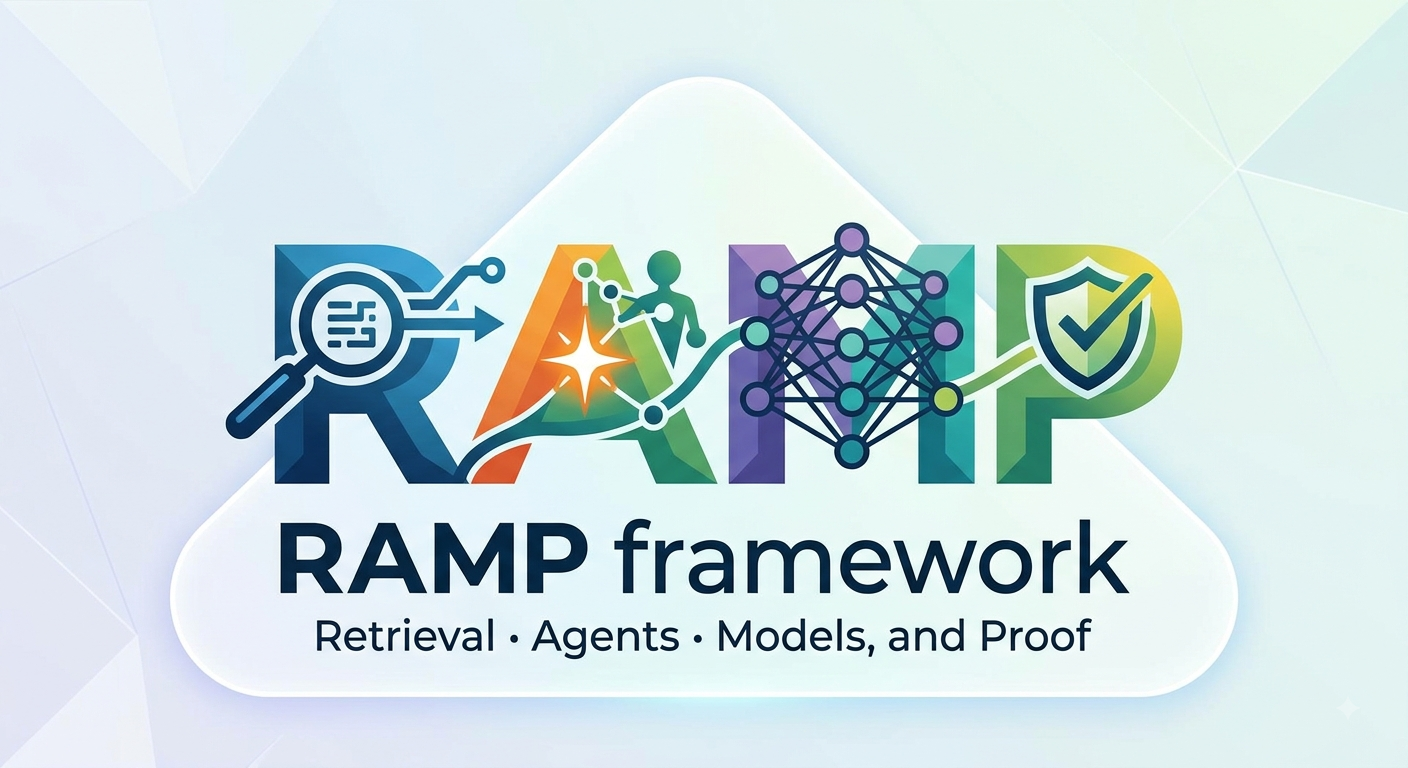
RAMP stands for:
Retrieval. Agents. Models. Proof.
It is a framework for AI-native work.
Not just for developers. Not just for people building AI products. Not just for technical teams.
RAMP is a way of thinking about what any person needs in order to work effectively in a world where human capability and machine capability are becoming intertwined.
Why we need a new work framework
Every major technology shift creates a period when people understand that something important has changed, but do not yet have a useful language for the new reality.
We are in that period now.
Organizations talk about “AI skills,” “AI literacy,” “prompt engineering,” “copilots,” “agents,” and “AI-native talent.” These phrases point in the right direction, but they describe fragments of the change.
Knowing how to write a good prompt is useful.
Knowing what a large language model can and cannot do is useful.
Knowing how to use ChatGPT, Claude, Gemini, Copilot or whatever comes next is useful.
But none of those things, by itself, makes someone capable of working in an AI-native environment.
The problem is that we are still teaching AI as if it were another software application.
It is not.
Microsoft Excel changed how accountants worked. Photoshop changed how designers worked. Salesforce changed how sales teams worked.
AI changes something more fundamental.
It changes who or what can perform the work.
For the first time, the tool is also becoming a participant.
It can research. Draft. Analyze. Code. Compare. Plan. Recommend. Transform. Monitor. Act. And increasingly, it can do several of those things without waiting for a human instruction at every step.
That means the skill required from a human changes too.
The professional of the AI era is not simply someone who knows how to use an AI tool.
It is someone who knows how to assemble intelligence into outcomes.
That requires a different framework.
R: Retrieval
The first capability is Retrieval.
Before AI can produce something useful, it needs the right context.
That sounds obvious, but it is where a remarkable amount of AI work goes wrong.
A model may be extremely capable and still produce a poor answer because it was given incomplete information, stale information, irrelevant information or no meaningful context at all.
The more powerful AI becomes, the more important this distinction becomes.
Imagine asking an AI system to review a commercial contract.
The model may know contract law broadly. But does it know your company's negotiating position? The customer's previous agreements? The clauses your legal team will never accept? The regulatory requirements that apply in this jurisdiction? The commercial history behind the deal?
Without that context, intelligence is operating in a vacuum.
Retrieval is therefore much broader than “search.”
It is the ability to identify what information matters, locate it, assess its relevance, bring it into the working context and keep the reasoning grounded in reality.
For a developer, Retrieval might involve code repositories, documentation, logs, architecture diagrams and production telemetry.
For a doctor, it might involve patient history, diagnostics, medical evidence and treatment protocols.
For a salesperson, it might involve account history, previous conversations, product usage, market intelligence and buying signals.
For a supply-chain planner, it might involve inventory, routes, orders, weather, supplier performance and demand forecasts.
The technology underneath Retrieval will change constantly.
Today it may involve search engines, vector databases, knowledge graphs, enterprise systems, retrieval-augmented generation or context engineering. Tomorrow the implementation may look completely different.
The durable capability is not knowing one retrieval technology.
It is knowing what context must be present before intelligence should be trusted.
That is a human skill.
And it becomes more important, not less, as AI gets better.
A: Agents
The second capability is Agents.
This is where AI begins to move from answering questions to doing work.
A chatbot waits.
An agent acts.
The distinction will become increasingly important because the future workplace is unlikely to consist of millions of humans sitting in front of blank chat windows asking AI systems individual questions.
Work will become more delegated.
An agent might monitor incoming support requests, classify them, investigate the customer's history, propose a solution and escalate unusual cases.
Another might examine software repositories, identify vulnerabilities, prepare fixes and submit them for review.
Another might research prospective customers, enrich account data, monitor changes and prepare personalized outreach.
Another might reconcile financial transactions and flag exceptions for a human.
The professional skill here is not merely “using an agent.”
It is knowing what to delegate, how to structure the work, where autonomy is appropriate, when humans should intervene, and how multiple agents and systems should work together.
That is orchestration.
A manager already does something similar with people.
Good managers do not personally perform every task. They understand the objective, distribute work, establish boundaries, review progress, resolve exceptions and remain accountable for the result.
AI agents introduce a new kind of workforce into that equation.
Some of the people who become exceptionally valuable over the next decade may not be the people who can personally produce the most output.
They may be the people who can coordinate the most capability.
A marketer who can effectively orchestrate twenty specialized agents may outperform a marketer who simply uses AI to write copy faster.
A software engineer who can coordinate coding, testing, documentation, security and deployment agents may have a completely different level of leverage from someone who merely uses an AI coding assistant.
A researcher who can delegate literature discovery, data extraction, contradiction analysis and hypothesis exploration to specialized agents may operate at a scale that previously required an entire research team.
This is why Agents belong in a universal work framework.
They are not just an engineering concept.
They are becoming part of how work itself is organized.
M: Models
The third capability is Models.
Much of today's AI conversation still treats “AI” as if it were one thing.
It is not.
Different models have different strengths, weaknesses, costs, speeds, interfaces and levels of reliability.
A model that is excellent at reasoning may not be the best model for extracting information from thousands of documents.
A model that generates beautiful images may be irrelevant to financial analysis.
A small, inexpensive model may be perfectly adequate for repetitive classification while using a much larger model would simply waste money and time.
Some work requires language models.
Some requires vision.
Some requires speech.
Some requires forecasting, optimization, simulation or traditional machine learning.
Increasingly, a single workflow may involve several kinds of models.
The important capability is therefore not memorizing today's model leaderboard.
Leaderboards change.
Model names change.
Vendors change.
Prices change.
Capabilities that seem astonishing today will become ordinary.
The durable skill is understanding what kind of intelligence the problem requires.
That means knowing enough about models to make good choices.
When should you use a powerful reasoning model?
When should you use a smaller model?
When is deterministic software better than AI?
When should a model have access to tools?
When should it not?
When should the model be allowed to make a recommendation but never execute the decision?
When does privacy rule out using a particular system?
When is the cost of an error so high that machine output must always be reviewed?
These are not questions only AI engineers will answer.
Professionals in every field will increasingly make them.
A lawyer choosing how AI participates in legal research is making a model decision.
A marketer selecting AI for creative generation is making a model decision.
A CFO deciding whether an AI system can classify expenses or forecast cash flow is making a model decision.
A manager deciding what should remain human work is making a model decision too.
Being AI-native therefore requires more than access to powerful models.
It requires judgment about where intelligence belongs.
P: Proof
The fourth capability is Proof.
It may eventually prove to be the most important of the four.
AI makes creation cheap.
Proof keeps outcomes valuable.
For most of history, producing sophisticated work required significant human effort. That effort itself created a kind of friction.
A twenty-page report took time.
Software took time to write.
Research took time to conduct.
A financial model took time to build.
A legal opinion took time to prepare.
AI removes much of that friction.
A person can now generate a polished report in minutes.
Code can appear in seconds.
Research can be summarized instantly.
Arguments can sound authoritative whether they are correct or completely wrong.
This creates an unusual problem.
The quality of presentation is becoming less correlated with the quality of thinking behind it.
Something can look finished long before it deserves to be trusted.
That makes Proof essential.
Proof means establishing that an outcome is correct enough, safe enough, complete enough and reliable enough for its intended use.
Sometimes that means testing.
Sometimes it means checking evidence.
Sometimes it means comparing multiple sources.
Sometimes it requires simulations, calculations, peer review or domain expertise.
Sometimes Proof simply means recognizing that the model has produced something plausible but wrong.
This capability cannot be outsourced blindly to another AI system.
AI can absolutely participate in verification. It can challenge an answer, run tests, search for contradictions and review another model's output.
But ultimately, somebody or some governed system must decide what standard counts as sufficient evidence.
That is Proof.
Consider a software engineer.
Generating code is becoming dramatically easier. But does the code work? Is it secure? Will it scale? Does it violate an architectural principle? Does it create an edge case nobody considered?
Consider a financial analyst.
AI can generate a beautiful forecast. But are the assumptions reasonable? Did it misunderstand an accounting treatment? Is the underlying data complete? Would the recommendation survive scrutiny?
Consider a healthcare professional.
An AI system may suggest a diagnosis. But what evidence supports it? What has been ruled out? How confident should anyone be? What are the consequences of being wrong?
The greater the consequence of an outcome, the more important Proof becomes.
This creates a paradox.
As AI becomes better at doing work, the human ability to evaluate work becomes more valuable.
Expertise does not disappear.
Its center of gravity moves.
RAMP is a loop, not a checklist
Retrieval, Agents, Models and Proof can be described separately, but real work rarely happens in four neat stages.
RAMP is better understood as a loop.
You retrieve context.
You choose the appropriate intelligence.
You delegate parts of the work.
You evaluate the result.
The evaluation reveals missing information.
You retrieve again.
An agent encounters an exception.
A human changes the instruction.
A different model is selected.
The result is tested again.
Work moves continuously through these four capabilities until the outcome is good enough to use.
That matters because AI-native work will not look like a person pressing an AI button and accepting whatever appears.
It will look much more like orchestration, feedback and judgment.
The quality of the outcome will depend on the quality of that loop.
RAMP does not replace domain expertise
There is a tempting but dangerous idea floating around the AI conversation: if AI knows so much, perhaps people no longer need deep expertise.
The opposite may prove true.
AI dramatically increases what someone can attempt.
Domain expertise determines whether they know what should be attempted, what matters and whether the result makes sense.
Give a brilliant AI system to someone who does not understand accounting and they may generate accounting work faster.
They may also generate mistakes faster.
Give the same system to an experienced accountant who understands Retrieval, Agents, Models and Proof, and something very different becomes possible.
That accountant is no longer constrained by how much work they can personally perform.
Their expertise becomes leverage.
The same applies to engineers, doctors, marketers, lawyers, scientists, operators, designers and tradespeople.
RAMP is therefore not a substitute for professional expertise.
It is a multiplier for it.
The strongest professional of the AI era may be neither the traditional expert who refuses AI nor the AI enthusiast who lacks domain depth.
It may be the person who combines both.
Domain expertise × RAMP capability.
That combination is difficult to commoditize.
AI-native does not mean AI-everything
Being AI-native does not mean using AI for every task.
That would be as irrational as using a spreadsheet for every business problem because spreadsheets are powerful.
Sometimes the best solution is a human.
Sometimes it is conventional software.
Sometimes it is a simple rule.
Sometimes it is an agent.
Sometimes it is a large model.
Sometimes the smartest decision is to do nothing at all.
An AI-native professional is not someone who reaches for AI reflexively.
They understand enough about the possibilities to make a deliberate choice.
That is a much higher standard than tool familiarity.
Every profession will express RAMP differently
RAMP is universal at the framework level, not identical at the implementation level.
A software engineer and a recruiter both need Retrieval.
The engineer may retrieve source code, logs and technical documentation.
The recruiter may retrieve candidate histories, role requirements, interview feedback and market signals.
Both need Agents.
Their agents will perform completely different work.
Both need Models.
The models appropriate for their tasks will differ.
And both need Proof.
But “proof” for an engineer may mean passing tests and surviving a security review, while proof for a recruiter may involve validating candidate evidence, checking assumptions and making sure an automated recommendation did not distort the hiring decision.
That distinction matters.
There cannot be one generic AI course that turns everyone into an AI-native professional.
The framework can be common.
The learning must become contextual.
A Java developer needs one RAMP journey.
A procurement specialist needs another.
A financial controller needs another.
A marine scientist needs another.
A CEO needs another.
Even two people with the same job title may require different learning paths depending on what they already know.
The framework stays stable.
The path changes.
From knowing tools to producing outcomes
This may be the biggest mindset change of all.
Traditional technology education is often organized around tools.
Learn Python.
Learn Salesforce.
Learn SAP.
Learn Excel.
Learn AWS.
That made sense when the tool itself represented a significant portion of the skill.
AI changes the unit of learning.
Knowing a particular AI product is useful today and potentially obsolete tomorrow.
The more durable question is whether a person can produce an outcome using whatever intelligence is available.
Can they identify the necessary context?
Can they determine which work should be delegated?
Can they choose the right model or combination of models?
Can they prove the output?
If they can, changing from one AI product to another becomes manageable.
If they cannot, knowing fifty AI tools will not help very much.
This is why RAMP is a work framework rather than a technology certification.
The technologies underneath it will change relentlessly.
The capabilities should survive them.
The new meaning of productivity
For decades, productivity largely meant helping people perform their existing tasks faster.
Word processors made writing faster.
Spreadsheets made calculation faster.
Email made communication faster.
Cloud software made collaboration faster.
AI certainly does all of that.
But eventually, measuring AI purely through time saved will miss the larger transformation.
The bigger opportunity comes when people stop asking:
“How can AI help me do my work faster?”
and begin asking:
“How should this work be done now that intelligence and agents are available?”
Those are completely different questions.
The first optimizes an existing job.
The second redesigns the system.
RAMP belongs to the second question.
It gives individuals and organizations a way to examine work itself.
What information does this outcome require?
Which parts need human judgment?
Which parts can be delegated?
What kind of intelligence is appropriate?
How is the result proven?
Once those questions are asked systematically, job descriptions begin to look less important.
Outcomes become more important.
The professional becomes an orchestrator
This does not mean everyone becomes a manager in the traditional sense.
It means more people will manage capability.
A professional may coordinate human colleagues, AI agents, software systems, models, external knowledge and automated workflows within the same piece of work.
The boundary between “doing” and “managing” begins to blur.
Someone may personally make the most consequential decision while machines perform ninety percent of the supporting work.
Another person may supervise hundreds of automated tasks without directly executing any of them.
A third may spend most of their time validating machine-generated outcomes because judgment is the scarce capability in their domain.
These are not science-fiction job descriptions.
They are natural consequences of making intelligence programmable and increasingly autonomous.
The vocabulary of work will have to catch up.
Organizations need RAMP too
RAMP begins with individual capability, but its implications reach much further.
An organization cannot become AI-native merely by purchasing AI licenses.
It cannot become AI-native by holding a prompt-writing workshop.
It cannot become AI-native because twenty employees built experimental agents.
Those may be useful beginnings.
But real organizational capability appears when RAMP becomes embedded in how work is designed.
Can employees access the context they need?
Can agents operate safely across systems?
Does the organization know which models are appropriate for which work?
Are there clear standards for proving outputs before those outputs affect customers, money, infrastructure or decisions?
These questions expose an uncomfortable reality.
Many organizations currently have an AI adoption strategy without having an AI work strategy.
They know which technologies they want to deploy.
They have not yet redesigned how work should happen around those technologies.
RAMP offers one way to start that conversation.
Proof may become the new trust layer
There is another reason Proof deserves special attention.
The internet dramatically reduced the cost of publishing information.
AI dramatically reduces the cost of producing convincing information.
Those are not the same thing.
A world filled with machine-generated documents, software, research, images, analyses and recommendations will not suffer from a shortage of output.
It may suffer from a shortage of trusted output.
That shifts economic value toward verification.
Who checked this?
What evidence supports it?
Which data was used?
What assumptions were made?
Which model produced it?
What did the human review?
Can the result be reproduced?
Where could it fail?
These questions will increasingly sit behind serious work.
In that sense, Proof may become for AI what quality assurance, audit and peer review became in earlier professional systems.
Except it will need to operate at machine speed.
That is not a small challenge.
It may become an entire discipline.
RAMP and the future of careers
The emergence of AI naturally creates anxiety about which jobs will survive.
That may be the wrong level of analysis.
Jobs are bundles of activities.
AI does not encounter a job title. It encounters tasks, decisions, information and workflows.
Some parts of a profession will become automated quickly.
Others will become dramatically more productive.
Some will become more valuable precisely because automation increases the consequences of judgment.
This means the better career question may be:
How much of my professional value can I amplify through RAMP?
Can I use Retrieval to operate with more context?
Can I use Agents to multiply my execution capacity?
Can I use Models intelligently rather than indiscriminately?
Can I become unusually good at Proof in my domain?
Someone who can do those things does not simply “use AI.”
They become a different kind of professional.
The goal is not to compete with AI
People often frame the future of work as a competition.
Human versus machine.
That framing may become increasingly unhelpful.
Humans are unlikely to beat machines at being machines.
We will not win by generating more text per second, scanning more documents, remembering more facts or processing more repetitive transactions.
The opportunity lies elsewhere.
Humans can decide what deserves attention.
We can understand context that is not written down.
We can recognize consequences.
We can challenge objectives.
We can interpret ambiguity.
We can exercise taste.
We can take responsibility.
And increasingly, we can orchestrate machine capability around those strengths.
RAMP is built around that relationship.
Not human versus AI.
Human with AI.
The RAMP framework
The framework can ultimately be reduced to four questions.
Retrieval
Do we have the right context?
Agents
What work should be delegated, and how should it be orchestrated?
Models
What intelligence should be used?
Proof
How do we know the outcome can be trusted?
Those questions can be asked about almost any piece of modern knowledge work.
That is what gives the framework its durability.
The answers will change constantly.
The questions should not.
What comes next
LAMP, MEAN and MERN helped define earlier generations of technology work by giving developers a shared language for the systems they were building.
The AI era needs something broader.
Because AI will not belong to one profession.
It will flow through almost all of them.
The developer will use it differently from the lawyer.
The lawyer differently from the marketer.
The marketer differently from the scientist.
The scientist differently from the operator.
But underneath those differences, the same four capabilities keep appearing.
Find the right context.
Mobilize agents.
Choose intelligence wisely.
Prove the outcome.
Retrieval. Agents. Models. Proof.
RAMP.
A framework for work in the AI era.
The technologies will change.
The models will change.
The agents will change.
The jobs themselves may change.
But as long as intelligent systems participate in human work, we will still need to answer four questions:
What should they know?
What should they do?
Which intelligence should we trust with the work?
And how will we know the result is right?
That is the work ahead.