
Priya runs operations for a regional distribution business.
Every morning, before most people have finished their first coffee, she opens the same dashboard. It shows inventory shortages, late shipments, supplier delays, unfulfilled orders, exceptions from the previous night, and a growing list of things somebody needs to investigate.
The dashboard is good. It tells her what is wrong, which is also its limitation.
When inventory for an important product falls below the expected level, the dashboard turns red. Priya's team then checks demand, incoming purchase orders, warehouse stock, supplier lead times, customer commitments, and whether another location has inventory that can be moved.
Someone sends a message to procurement. Someone calls the warehouse. Someone updates a spreadsheet. Someone makes a decision, and perhaps somebody else changes the order quantity in another system.
The next morning, Priya opens the dashboard again.
Maybe the situation improved. Maybe it did not. If it did not, the team begins another round.
Priya has always thought of this as operations.
One day, while watching her team move between systems, messages, spreadsheets, and phone calls, she realizes something uncomfortable.
The dashboard is not running the operation. Her people are.
The software sees the problem, while humans are carrying the problem from observation to decision to action and back again.
That distinction becomes much more important once AI enters the picture.
At first, Priya uses AI the same way most operations teams do. It summarizes exception reports, explains unusual movements, prepares supplier emails, and helps her team analyze historical data more quickly.
The work becomes faster, but the structure of the work does not change.
People still notice the problem, decide what to do, carry out the action, and check again later.
Then Priya encounters a different idea.
What if AI does not merely help the team operate the loop? What if the team redesigns the loop itself?
That is where RAMP and Closed Loops come together.
1. Most operations are already loops, but humans are holding them closed
Take inventory.
The business has a desired state: enough stock to meet demand without carrying excessive inventory.
Reality keeps moving away from that state.
Demand changes. Suppliers miss dates. Customers place unexpected orders. Shipments arrive late. Forecasts turn out to be wrong.
So the organization continuously tries to correct the difference.
It observes inventory, compares the current state with the desired state, decides what action to take, and then orders more, transfers stock, changes priorities, contacts suppliers, or accepts a temporary shortage.
Then it observes again.
That is already a loop.
The same pattern appears almost everywhere in operations.
A delivery is expected at 4 p.m. The system detects that it will be late. Someone investigates, contacts the carrier, informs the customer, perhaps changes the route, and then checks what happened.
A supplier's quality score deteriorates. Someone reviews the incidents, calls the supplier, agrees on corrective action, and monitors the next batch.
An invoice does not reconcile. Someone investigates the discrepancy, retrieves supporting documents, resolves the exception, and checks whether the payment can proceed.
An order misses its service level. Someone finds out why, intervenes, and measures whether the intervention worked.
The business is full of loops.
What makes many of them open is that a human must manually carry the state from one iteration to the next.
The system reports. The human interprets. The human acts, and then the human remembers to look again.
This model works because organizations have spent decades putting people between disconnected systems.
The human is often the integration layer, reasoning layer, escalation engine, and memory system at the same time.
AI creates the possibility of changing that architecture, not by removing the human from every process, but by deciding where humans are actually needed.
That is a very different ambition from using AI to write a faster status report.
2. RAMP becomes more useful when it is pointed at an outcome
Priya decides to start with one inventory problem rather than “transform operations with AI.”
Her team chooses stock availability for a group of fast-moving products.
The first question is not which agent to build or which model to use. The first question is what state the business is trying to maintain.
The objective is not simply “avoid stock-outs.”
The company wants to maintain a target level of availability while respecting working-capital limits, storage capacity, supplier constraints, and service commitments.
Now the problem becomes more precise.
What is true right now? What state do we want? What constraints must be respected while moving between the two?
This is where Retrieval, the first capability in RAMP, enters the Closed Loop.
The system needs current inventory, open orders, demand trends, supplier lead times, transfer possibilities, inbound shipments, and perhaps promotional activity.
It may also need less obvious context.
Is a particular supplier currently unreliable? Is one warehouse operating near capacity? Has sales promised a large order that has not yet appeared in the planning system?
If the loop cannot retrieve the right context, the rest of the intelligence is built on a distorted view of reality.
Priya recognizes that this is exactly what happens to human planners too.
They often make poor decisions not because they lack intelligence, but because critical information is scattered across systems or arrives too late.
Retrieval therefore becomes the foundation of the loop.
The business cannot control a state it cannot see clearly.
3. Agents are useful only when the loop knows what they are allowed to change
Once the system can see the current state, Priya's team asks what actions are available.
Some are straightforward.
An agent could recommend moving inventory between warehouses. It could prepare a purchase-order adjustment, contact a supplier for an updated delivery date, or flag an item for expedited shipment.
Other actions are more consequential.
Should an agent be allowed to increase an order automatically? Can it pay a premium for faster freight? Can it reallocate inventory away from one customer to protect another?
Can it change an agreed delivery date?
This is where the Agents capability in RAMP stops being about automation and becomes about authority.
The Closed Loop needs actions. Without actions, it is merely an intelligent dashboard.
But those actions need boundaries.
Priya starts classifying them.
Low-risk, reversible actions can be automated more aggressively. The system might send a supplier reminder, request an updated ETA, or move a recommendation into a planner's queue.
Higher-impact decisions require stronger conditions.
An agent might be allowed to transfer inventory automatically within a certain cost threshold but require approval when the transfer could affect another region's customer commitments.
A purchase-order increase might be permitted within a predefined range, while a large change requires procurement review.
This changes the role of the operations manager.
Priya is no longer deciding every individual action herself. She is designing the conditions under which machine action can happen safely.
That is a much more scalable responsibility.
The same principle can be applied across operations.
A logistics agent can reroute a shipment when the alternative is clearly better and the additional cost is small. A finance agent can resolve a routine reconciliation exception when evidence is complete.
A customer-service agent can issue a standard credit within defined limits.
The agent performs the action. The loop remains responsible for the outcome.
That distinction matters.
4. Models help decide what to do next, but the objective has to come from somewhere
After several weeks, Priya's team has a functioning loop prototype.
It can observe stock positions, retrieve related context, and trigger several bounded actions.
Now the team begins experimenting with Models.
A forecasting model estimates near-term demand. Another model reasons about possible causes when stock availability deteriorates, while a smaller model categorizes supplier communications and extracts updated delivery commitments.
The temptation is to put a model at the center and ask it what the business should do.
Priya resists that idea.
She has learned that the most intelligent model in the world cannot decide what matters unless the organization has defined what “better” means.
Suppose the model can eliminate a stock-out by ordering twice as much inventory.
Technically, it solved the availability problem. It may also have created a working-capital problem.
Suppose it protects a high-value customer by moving inventory from another location.
That may be rational, but it may also violate an explicit commitment to another account.
The model can reason. The business still has to define the objective and constraints around that reasoning.
This is the Models capability in RAMP applied to a Closed Loop.
The question is not merely which model is smartest. It is what intelligence the loop needs at each point.
A simple forecasting model may be enough for one decision. A reasoning model may be useful when several constraints conflict, while a deterministic rule may be better where the business already knows exactly what should happen.
Priya gradually sees the pattern.
The loop does not need AI everywhere. It needs the right intelligence in the right place.
That is an important difference.
An AI-native operation is not one that maximizes model usage. It is one that uses intelligence deliberately to keep the business moving toward its desired state.
5. Proof is where the loop becomes a business system instead of an AI demo
The first version of Priya's loop looks impressive.
It identifies shortages earlier, recommends transfers, contacts suppliers, and adjusts some routine orders automatically.
Everyone likes the demonstration.
Then Priya asks a question that changes the conversation.
“Did availability actually improve?”
The team checks.
In many cases, yes. In some cases, the loop took actions that looked sensible without improving the outcome.
One supplier repeatedly confirmed updated delivery dates and then missed them anyway. The agent treated each new promise as useful information, but reality kept proving the supplier unreliable.
In another case, the system recommended transferring stock from another warehouse. The transfer arrived after the customer had already accepted a delayed delivery, so the additional freight cost created no meaningful benefit.
These are not necessarily model failures.
They are failures to close the loop around the result.
This is Proof.
The system cannot consider the work complete because an action was taken. It needs to observe what happened after the action.
Did stock availability improve? Did the supplier actually deliver? Did the customer receive the order?
Did the expensive expedite prevent lost revenue, or merely increase cost?
Proof turns operational activity into learning.
Without it, the system keeps taking actions based on assumptions about what should work.
With it, the loop can compare expected and actual outcomes.
That difference is fundamental.
Suppose the system learns that one supplier's promised ETA is consistently optimistic by two days. Future decisions can adjust for that pattern.
Suppose a particular transfer strategy repeatedly solves shortages but at an unacceptable cost. The loop can change how it evaluates alternatives.
Suppose an agent's intervention has almost no effect in one class of exception. Perhaps that action should disappear from the playbook.
This is where Closed Loops go beyond automation.
They do not merely repeat actions. They observe whether the actions changed the state and adapt what happens next.
The loop is not closed because AI performed the entire workflow.
It is closed because the system can see the outcome and use that outcome to determine the next move.
6. The operations manager stops managing every exception and starts engineering the loop
Six months later, Priya's morning looks different.
She still opens an operations view, but instead of beginning with hundreds of exceptions that require somebody to decide what happens next, she sees a much smaller group of situations the loops could not resolve confidently.
One supplier problem has escalated because repeated interventions failed.
A high-value customer commitment conflicts with inventory allocation rules. A weather event has disrupted several routes at once, creating a situation outside the normal operating boundaries.
These are the kinds of problems Priya actually wants her experienced team thinking about.
Routine work continues in the background.
The inventory loop monitors state, retrieves context, makes bounded decisions, performs actions, checks the result, and adapts.
The logistics loop does something similar for delivery exceptions.
The invoice-reconciliation loop handles standard discrepancies while escalating unusual ones.
The organization has not removed humans from operations.
It has changed where humans enter.
This is the principle of humans by exception rather than humans by default.
That is a very different operating model.
In the old environment, a person was inserted into almost every loop because the systems could not reliably reason, act, and observe across boundaries.
In the new environment, the loop handles what it can and pulls a human in when judgment, ambiguity, authority, or consequence requires one.
Priya's job changes too.
She spends less time managing individual exceptions and more time engineering the system that handles exceptions.
Which state are we trying to maintain? What context is missing? Which actions should become autonomous?
Where are the constraints wrong? What evidence tells us the loop is actually improving the outcome?
Which exceptions keep reaching humans, and what do they reveal about the loop?
This is operations management becoming Loop Engineering.
Not because Priya becomes a software engineer.
Because she begins designing how intelligence, agents, systems, and people continuously move the business toward an objective.
7. RAMP is the capability; Closed Loops are what professionals build with it
This is the connection that matters beyond operations.
RAMP by itself is not the destination.
A professional can become very good at Retrieval, Agents, Models, and Proof and still use those capabilities only to perform the old job faster.
A salesperson can research better. A project manager can prepare better status reports. A finance professional can analyze more quickly, while an engineer can generate more code.
All of those improvements are useful.
But the larger opportunity appears when the professional asks whether the work itself can be redesigned as a Closed Loop.
For Priya, that means moving from manually managing inventory exceptions to engineering a system that continuously maintains inventory within acceptable business boundaries.
For a salesperson, a Closed Loop might continuously observe account signals, choose engagement actions, measure the response, and adapt until an opportunity advances or clearly does not.
For cybersecurity, the loop can move from signal to investigation to containment to observation to verified recovery.
For DevOps, it can move from incident detection to diagnosis to remediation to verification and adaptation.
For finance, a collections loop might observe overdue accounts, determine the appropriate action, execute the outreach, measure the response, and continuously adjust until cash is recovered or the case requires human intervention.
The professions remain different.
The pattern is surprisingly similar.
RAMP gives the professional the capability to work with intelligence. Closed Loops give that capability direction.
Retrieval tells the loop what is true.
Agents give it ways to act.
Models help interpret the state and choose among alternatives.
Proof tells it what actually happened.
The Closed Loop ties those capabilities to an objective, constraints, feedback, and continuous adaptation.
That is the difference between an AI tool and an AI-native operating system.
A tool helps someone perform an activity.
A Closed Loop keeps pursuing a business state.
This is why agents alone are not enough.
An agent may execute a task brilliantly and stop.
The loop asks whether the task achieved the objective and what should happen next.
That is where business value lives.
8. A practical seven-step framework for designing a Closed Loop
At this point, Priya wants something more practical than a concept.
She gathers her team around a whiteboard and chooses one real operational problem: repeated stock-outs for a particular product family.
Instead of asking what AI they should buy, she asks the team to work through seven questions.
1. State: What is true right now?
The loop has to begin with reality.
For Priya, that means current inventory, open customer orders, inbound supply, demand movement, committed transfers, supplier status, and any other context required to understand the present condition.
This step sounds simple, but many loops fail here.
If the system sees only warehouse inventory but not tomorrow's large customer commitment, its picture of the state is already wrong.
The first design task is therefore not automation.
It is establishing a trustworthy view of what is true now.
2. Objective: What state do we want?
Next, the team needs to define what “better” actually means.
“Improve inventory” is not an objective.
“Maintain at least 97% availability for this product family” is closer, but even that may need more precision.
The objective has to be concrete enough that the loop can tell whether the business is moving toward it.
Without a clear desired state, the system can act indefinitely without knowing whether it is succeeding.
This is also where the team should resist vague AI ambitions.
The objective is not “use agents for inventory.”
The objective belongs to the business.
The technology serves it.
3. Constraints: What must never be violated?
This is where many impressive AI demonstrations stop being useful in the real world.
Priya's loop could improve availability by holding enormous amounts of inventory.
The business would not consider that success.
So the team writes down the boundaries.
Working capital cannot exceed an agreed threshold. Certain customer commitments cannot be broken, warehouse capacity cannot be exceeded, and some purchase decisions require approval above a specified value.
Constraints tell the loop what it must protect while pursuing the objective.
They also define where humans may need to enter.
A good Closed Loop is not a system with unlimited autonomy.
It is a system that knows the boundaries of acceptable action.
4. Actions: What can the system actually change?
Now the team lists the levers available to the loop.
It can request an updated supplier ETA. It can recommend a stock transfer, change a replenishment quantity within limits, expedite a shipment, or escalate a conflict to a planner.
The list matters because intelligence without action cannot close anything.
A forecasting model may know that a shortage is coming.
If the system has no permissible way to respond, it is still only a prediction system.
This is also where agent design becomes concrete.
Which actions can agents perform automatically? Which can they prepare for approval?
Which actions remain human-only?
The loop needs an explicit action space rather than a vague instruction to “solve the problem.”
5. Observation: What happened after the action?
Suppose the loop expedites an inbound shipment.
The work is not finished.
Did the shipment actually arrive earlier? Did enough stock become available, and did the action affect another customer or warehouse?
Observation brings the loop back into contact with reality.
This is what distinguishes a workflow that executes steps from a loop that responds to outcomes.
The system needs a way to see the consequence of its own actions.
Without that, it will continue operating on assumptions.
6. Evaluation: Was that better or worse?
Observation provides evidence.
Evaluation gives the evidence meaning.
The shipment arrived earlier, but the expedite cost was so high that the action may not be worth repeating under similar conditions.
A stock transfer prevented one shortage but caused another.
A supplier intervention looked successful for two weeks and then failed again.
The loop needs to evaluate outcomes against the original objective and constraints.
This is where Proof becomes more than checking whether a command succeeded.
The question is whether the business state genuinely improved.
7. Adaptation: What should we do next?
The final step is what turns the sequence into a loop.
If the objective has been reached and the state is stable, perhaps nothing needs to happen.
If the intervention only partially worked, the system may choose another action.
If the situation has moved outside the defined boundaries, it can escalate to a human.
If a particular action consistently performs poorly, future decisions should change.
The loop does not repeat mechanically.
It adapts.
That is the point.
Priya writes the full sequence on the whiteboard:
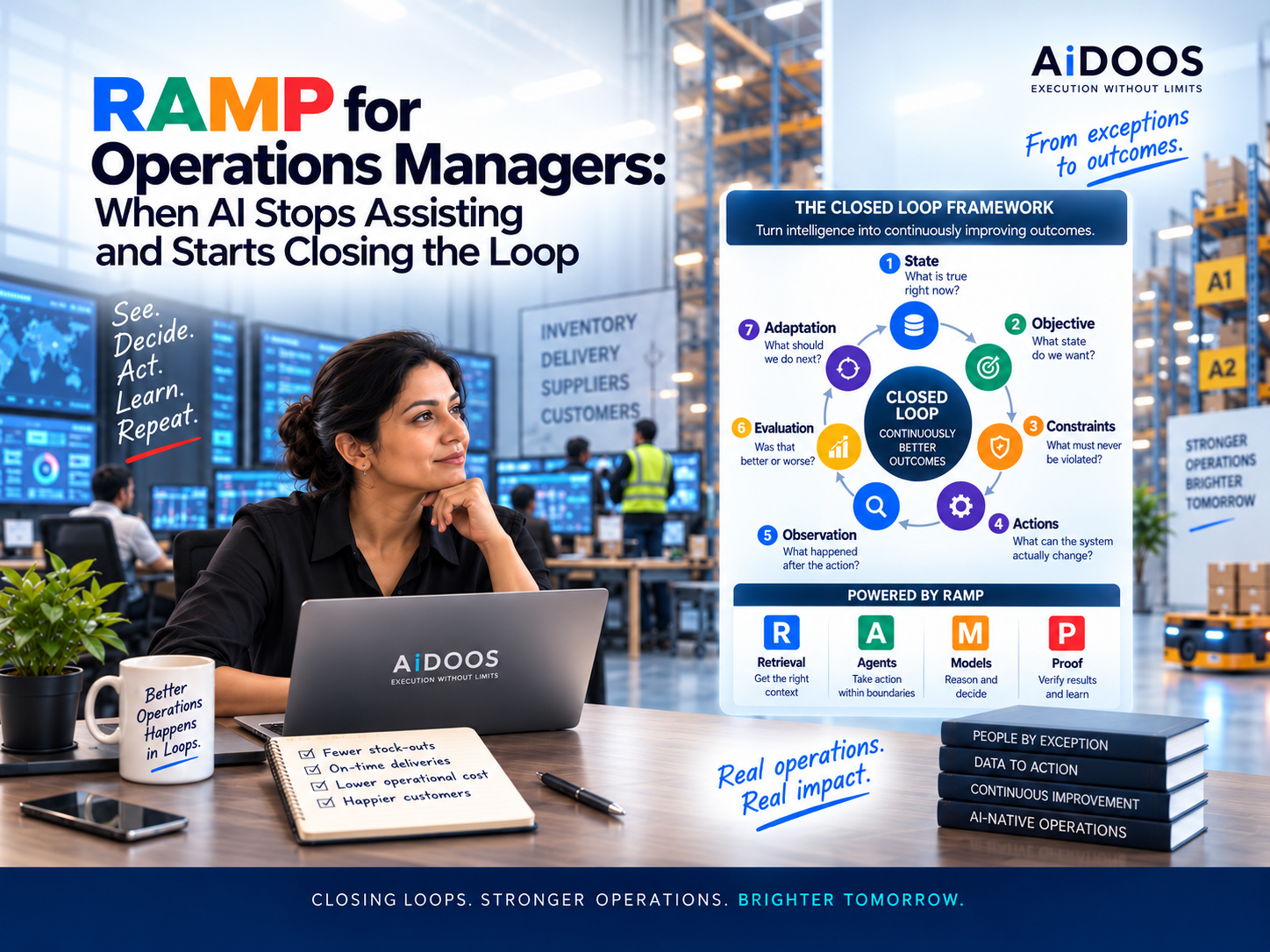
State → Objective → Constraints → Actions → Observation → Evaluation → Adaptation
Then she notices something important.
RAMP sits naturally inside it.
Retrieval helps establish State and bring in the context needed to understand it. Models help reason about the Objective, Constraints, and possible Actions.
Agents carry out Actions within defined boundaries, while Proof strengthens Observation and Evaluation.
Adaptation closes the cycle and sends the system around again.
This gives Priya a practical test for whether something is really a Closed Loop.
If the team cannot explain one of the seven elements, the design is probably incomplete.
Perhaps there is no clear objective.
Perhaps nobody has defined the action limits. Perhaps the system can act but cannot observe what happened, or perhaps it can observe but has no useful way to evaluate the outcome.
Calling it “agentic” does not fix those gaps.
The seven questions expose them.
That is why this framework can begin with a whiteboard before anyone writes code.
Take one recurring business problem and answer the seven questions honestly.
Very quickly, the team can see whether it has a genuine loop, an automation, a dashboard, or simply another AI assistant.
9. The most valuable skill may be learning to see the loops hiding inside the business
A year after Priya started, she walks through the operation differently.
She no longer sees only departments, roles, dashboards, and workflows.
She sees loops.
A customer complaint is a loop.
A delayed shipment is a loop.
Inventory replenishment is a loop.
Supplier quality is a loop.
Collections is a loop.
Employee onboarding is a loop.
Production maintenance is a loop.
Many of them are still open.
A system observes something.
A person picks it up.
Another person acts.
Someone else checks later.
The state moves slowly across organizational boundaries because human coordination is doing the work software could not previously do.
Priya's new instinct is not to ask, “Where can we add AI?”
She asks something more useful.
“What state are we trying to maintain, and why are humans still carrying this loop manually?”
Sometimes the answer is that human judgment genuinely belongs there.
Sometimes the cost of automation is not worth the benefit, while sometimes the process is so rare that redesign would be unnecessary.
But sometimes the answer reveals enormous opportunity.
The business already has the objective.
It already has the data.
It already knows the actions humans take.
It already measures the outcome.
The missing piece is connecting those elements into a system that can keep running.
That is where RAMP becomes practical.
The framework is not there so Priya can add four AI skills to her resume.
It is there so she can look at an operational problem and understand what is required to turn intelligence into execution.
Retrieve the state and bring in the right context. Decide what can act and apply the appropriate intelligence.
Then prove what happened and adapt the next move.
The system keeps going because the business state is still moving.
That is a Closed Loop.
Priya began by trying to make her team faster at managing inventory exceptions.
She ended up changing the question.
Instead of asking how quickly people could respond to another red box on a dashboard, she asked why the business needed people to manually carry the red box from detection to resolution in the first place.
That question is much bigger than productivity.
It is about how work should operate when intelligence is available continuously.
RAMP helps professionals become capable of working in that world.
Closed Loops give them something meaningful to build.
For operations managers especially, that may be the real opportunity of AI.
Not a better dashboard or a faster report, and not even simply a smarter agent.
The opportunity is a business process that can understand its current state, pursue an objective within clear constraints, act, observe what happened, evaluate the result, adapt, and keep going.
That is when AI stops assisting operations and starts becoming part of the operation itself.