
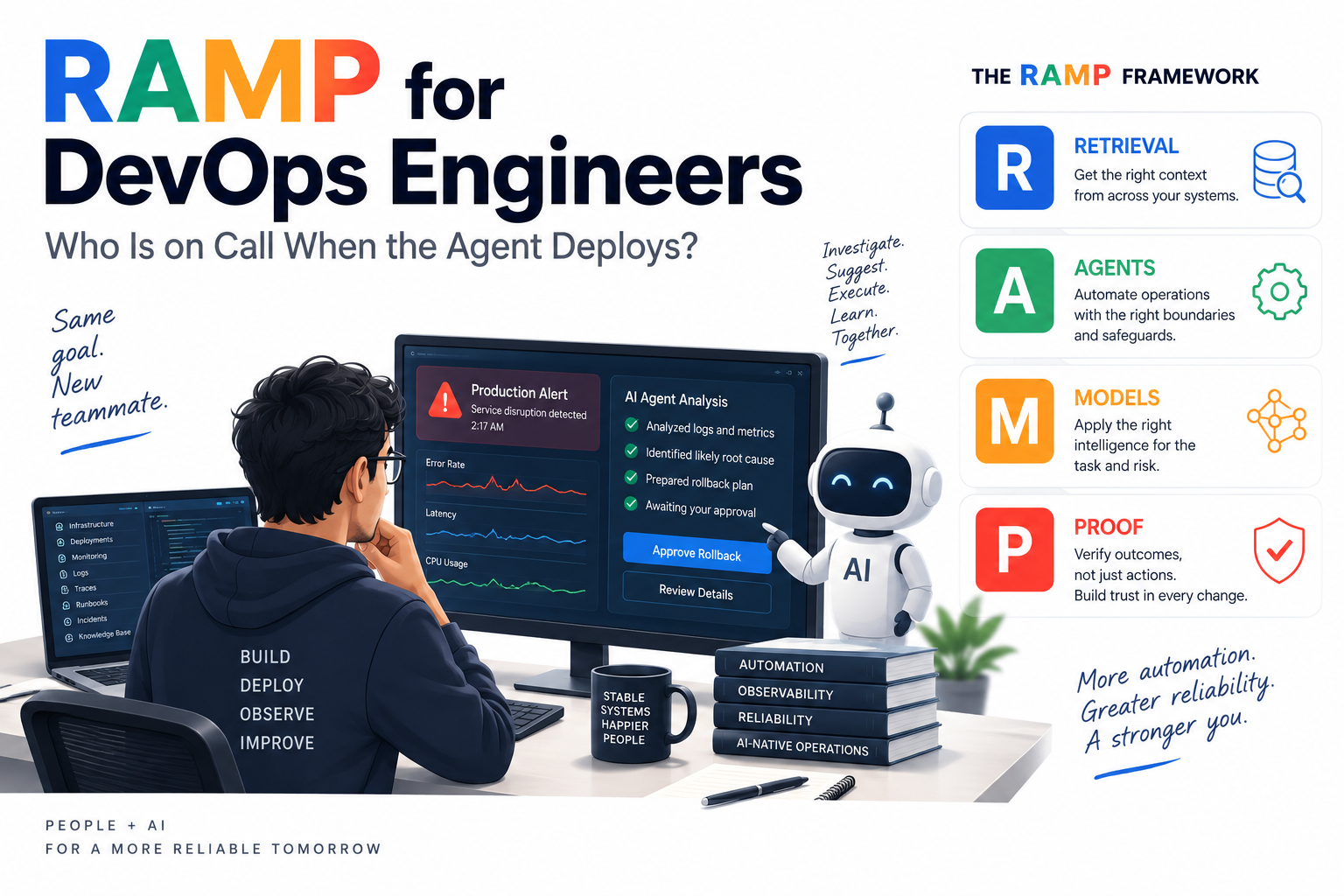
RAMP for DevOps Engineers: Who Is on Call When the Agent Deploys?
Imagine Nikhil, a DevOps engineer, waking up at 2:17 a.m. because his phone has started making the sound every on-call engineer knows too well. A production service is failing, customers are seeing errors, and the incident channel is already filling with messages.
By the time he opens his laptop, an AI agent has examined the deployment history, compared recent configuration changes, searched the logs and identified a likely cause. It has prepared a rollback and is waiting for approval.
Nikhil looks at the recommendation and feels two things at once. Relief, because the machine has done in minutes what might previously have taken half an hour, and unease, because the next click could affect thousands of customers.
The agent is probably right. But “probably right” is not quite the same thing as “safe to execute,” especially when the system is already behaving unpredictably.
This is the moment when AI stops being a productivity tool and becomes an operational responsibility.
For years, DevOps engineers have worked to automate infrastructure, deployments, monitoring and recovery. AI agents extend that ambition, but they also change the question from “Can we automate this?” to “How much authority should an intelligent system have when the consequences are real?”
That is why the RAMP framework is particularly relevant to DevOps. Retrieval, Agents, Models and Proof are not four new tools to add to the pipeline. They describe the capabilities needed to make machine-assisted operations reliable enough to trust.
1. Production has a memory, and the agent needs access to it
Nikhil's first instinct is to inspect the most recent deployment. That is sensible because the incident began shortly afterward, but experience has taught him that correlation is not always the cause.
The deployment might have introduced the problem. It might also have exposed an existing database bottleneck, interacted with a feature flag, or coincided with an upstream service failure.
A good engineer knows that production systems have histories that are rarely captured in one place. The reason a service has an unusual timeout may be buried in an incident report from two years ago, while a strange deployment sequence may exist because somebody once discovered that reversing two steps caused a difficult-to-reproduce failure.
An AI agent can search this information much faster than Nikhil. But only if the information exists, is accessible, and can be connected to the system it is investigating.
This is the Retrieval problem in DevOps.
The relevant context may include source code, infrastructure configuration, deployment manifests, runbooks, incident histories, service dependencies, change records, logs, metrics and traces. It may also include business context, such as which customers are affected and whether a particular service is currently supporting a critical operation.
The difficulty is not simply collecting more data. It is knowing which data explains the behavior of the system.
Suppose the agent sees that CPU usage increased after a deployment and recommends scaling the service. Nikhil remembers that a similar pattern once occurred when a downstream database became slow, causing requests to accumulate while the application waited.
Scaling the application might temporarily reduce the visible symptoms without fixing the underlying problem. It could even increase pressure on the database and make the incident worse.
The agent's recommendation is not necessarily foolish. It is incomplete because the context is incomplete.
This is where an experienced DevOps engineer has an advantage that is easy to underestimate. They do not merely know how to read metrics; they understand how the system behaves when several things go wrong together.
AI can help retrieve that understanding from the organization's accumulated knowledge. But the organization first has to make its knowledge retrievable.
That creates an unexpected consequence for infrastructure teams. Documentation, service ownership, dependency maps and incident reviews stop being administrative chores and become part of the operating environment for intelligent systems.
A poorly documented system has always been difficult for new engineers to operate. It may become even more difficult for agents, because the machine can act quickly on a misunderstanding that a human might have questioned.
The better the organizational memory, the more useful the intelligence becomes. In that sense, Retrieval is not merely an AI capability; it is a measure of how understandable the production environment has become.
2. The agent can act, but who decides how far?
Nikhil approves the rollback, and the service begins recovering. The immediate incident is resolved, but the team has a more interesting conversation the following morning.
Why did the agent need approval for this particular action? Could it have rolled back automatically, and if so, what would have happened if the rollback itself had been dangerous?
The easy answer is to keep a human in the loop for everything. That feels safe, but it eventually defeats much of the purpose of automation and can turn engineers into exhausted approval machines.
The opposite answer, allowing agents to act freely, is not serious either. Production systems contain irreversible actions, sensitive information and dependencies that may not be obvious from the immediate task.
The real challenge is designing appropriate autonomy.
A DevOps agent might safely restart a stateless service under predefined conditions. It might be allowed to increase capacity within an approved limit, collect diagnostic information or revert a known configuration change.
Deleting a production database is obviously different. So is changing network policy, rotating credentials, modifying infrastructure across multiple regions or deploying an unreviewed change to a critical system.
The Agents capability in RAMP is about understanding those differences and turning them into an operating model.
Nikhil's team begins thinking about agents less like clever scripts and more like contributors with defined responsibilities. Each agent needs an objective, appropriate access, boundaries around its actions and a clear path for escalation when the situation exceeds those boundaries.
This is familiar territory for DevOps because the profession has spent years building automation around permissions, deployment gates and operational controls. AI makes those disciplines more important because the system choosing the next action is no longer always following a fully predetermined path.
Consider an agent asked to “restore service health.” It might decide that scaling is the best response, then discover that scaling is insufficient and attempt to change a configuration. If that fails, it may try a rollback.
Each individual action could be reasonable. The sequence could still be dangerous if the agent does not understand the broader system or the limits of its authority.
This is why the objective alone is not enough.
The agent needs to know what it is allowed to change, what it must preserve, which actions require approval and what conditions should cause it to stop. It also needs a way to communicate uncertainty rather than treating every obstacle as another problem to solve autonomously.
The best DevOps engineers will not necessarily be the ones who create the most agents. They may be the ones who can give agents meaningful autonomy without allowing that autonomy to become an uncontrolled source of operational risk.
3. Sometimes the right intelligence is no intelligence at all
A few weeks later, Nikhil's team begins reviewing where models belong in their operational workflows. There is enthusiasm for using AI everywhere, partly because the early incident response experience was so impressive.
One engineer suggests using a reasoning model to decide whether every deployment should proceed. Another proposes letting a model interpret all monitoring alerts and determine which ones deserve attention.
Nikhil is interested, but he asks a question that slows the discussion down. Why should a model decide something that a deterministic rule can already decide reliably?
If a deployment must not proceed when a required test fails, that is not a reasoning problem. If a production change requires approval from a specific role, the system should enforce that requirement rather than ask a model whether approval seems appropriate.
This is the Models capability in RAMP, and it is often misunderstood.
Being AI-native does not mean replacing every existing control with a model. It means understanding where intelligence adds value and where predictable software remains the better choice.
Models can be extremely useful when the problem involves ambiguity. They can compare incident reports, interpret unfamiliar logs, summarize complex changes, propose hypotheses and help engineers reason across systems that would otherwise require extensive manual investigation.
They are less useful when the requirement is simply to enforce a known rule consistently.
A mature operational architecture may therefore combine several kinds of capability. Deterministic systems enforce hard boundaries, models help interpret uncertain situations, and agents execute work within the permissions and constraints they have been given.
The model choice itself also matters.
A small, inexpensive model may be sufficient for routine classification or summarization. A stronger reasoning model may be appropriate when investigating an unusual incident involving several interacting services.
Some environments may require models to operate within particular privacy or security boundaries. Others may tolerate external model access for certain kinds of operational information but not for sensitive customer data or credentials.
The DevOps engineer does not need to memorize every model release. They need to understand the operational consequences of model choice, including latency, cost, reliability, data exposure and the consequences of an incorrect recommendation.
This becomes particularly important when models are embedded inside automated workflows. A model that is occasionally wrong in a chat conversation may be inconvenient, while the same error inside an agent with production permissions can become an incident.
The right architecture does not assume intelligence is infallible. It assumes intelligence is useful and designs the surrounding system accordingly.
4. Proof is what separates a successful command from a successful recovery
Nikhil's team eventually allows an agent to perform a limited class of automated remediations. The first few weeks look promising, with routine incidents resolved quickly and fewer engineers interrupted overnight.
Then one morning, the agent reports that it successfully restarted a failing service. The restart command completed, the process came back online and the automation recorded the action as successful.
Unfortunately, the customer-facing problem continued.
The service was running, but requests were still failing because the underlying dependency had not recovered. The agent had proven that it executed the command, not that it restored the outcome.
This distinction is central to Proof.
Operational automation often measures whether an action completed. Reliable operations require evidence that the system is behaving correctly afterward.
A deployment can succeed while the application fails. A rollback can complete while customer errors continue. A service can be healthy according to one metric while an important business transaction is broken.
The RAMP-ready DevOps engineer therefore asks what the system must demonstrate before an automated action can be considered successful.
For a deployment, that might involve automated tests, health checks, error rates, latency, dependency behavior and a controlled rollout. For a remediation, it might involve confirming that the original symptom has disappeared and that the action has not created a new problem elsewhere.
The exact standard depends on the system and the consequence of failure.
This is where AI may actually encourage better operational discipline. If agents can generate and execute changes faster than humans, then verification must become more systematic because manual review cannot scale indefinitely.
The team cannot simply rely on an engineer looking at a dashboard and deciding that everything seems fine. They need clear acceptance criteria, meaningful telemetry and controls that can distinguish a completed action from a restored service.
Proof also needs to continue after the immediate action.
A system may appear healthy for five minutes and then fail again when traffic increases. A database migration may complete successfully but introduce performance problems that become visible only under production load.
This is why observability becomes more important, not less, in an AI-operated environment. The system needs to provide evidence about what happened, what changed and whether the intended outcome was actually achieved.
AI can help interpret that evidence, but it should not be allowed to manufacture confidence from incomplete signals. A model-generated statement that “the incident is resolved” is only as good as the evidence supporting it.
The real achievement is not getting the agent to say the right thing. It is building an environment where the agent can demonstrate that the right thing happened.
5. The human on call does not disappear
After several months, Nikhil's team has fewer routine interruptions. Agents handle some repetitive incidents, prepare diagnostic information and help engineers investigate unfamiliar failures more quickly.
The on-call experience is better, but it has not disappeared.
The remaining incidents are often the difficult ones.
They involve unusual interactions between systems, incomplete information, conflicting signals or consequences that make automatic action inappropriate. In other words, the routine work becomes easier to automate while the human work becomes more concentrated around uncertainty.
This creates a new kind of pressure.
If engineers spend less time performing routine operational tasks, how do they develop the intuition required to handle the exceptional ones?
Nikhil learned much of what he knows by investigating incidents that now look easy. He learned which metrics were misleading, which services tended to fail together and which “quick fixes” created problems later.
If agents absorb all of that work, junior engineers may gain productivity without gaining the same operational experience.
The answer is not to preserve manual toil for educational reasons. It is to redesign learning so engineers still develop the judgment required to supervise and challenge automated systems.
An incident can become a learning exercise rather than merely a problem the agent solved. A junior engineer might be asked to explain why the agent chose a particular remediation, what alternative causes were possible and what evidence would have changed the decision.
Teams can use historical incidents to create simulations where engineers must diagnose problems, challenge recommendations and decide when an agent should be allowed to act. The machine can become a teaching partner, but only if the organization values understanding rather than merely counting resolved tickets.
There is also a cultural change here.
DevOps has often celebrated the engineer who can fix anything at 3 a.m. AI may help the profession move away from that hero model toward systems that recover reliably without depending on one exhausted person's memory.
That would be progress.
But the goal should not be to replace the human hero with an autonomous machine that nobody understands. The goal is to make the system itself more dependable, with humans retaining the ability to intervene intelligently when the unexpected happens.
6. The infrastructure team becomes a designer of governed autonomy
A year later, Nikhil's job looks different from the one he had before agents entered the environment. He still understands infrastructure, deployment pipelines, networking, observability and incident response, but he spends less time executing routine commands himself.
More of his work involves designing the conditions under which machine execution can happen safely.
Which context should an agent receive? Which tools should it access, and for how long? What actions can be automated, what requires approval, and what evidence must exist before the system considers an outcome complete?
Those questions are not peripheral to DevOps. They are becoming part of its core.
The profession has always tried to make software delivery faster and more reliable by reducing friction between development and operations. Agents extend that ambition, but they also make the cost of weak operational foundations more visible.
A system with poor documentation, unclear ownership, broad permissions and weak observability will not become reliable simply because an intelligent agent is operating it. The agent may make the weaknesses easier to exploit or harder to detect.
A system with clear boundaries, accessible context and strong verification can use machine execution much more confidently.
This is where the RAMP framework becomes more than a learning checklist.
Retrieval makes the environment understandable. Agents provide execution capacity within appropriate boundaries, while Models contribute intelligence where reasoning is useful and Proof establishes whether the outcome can be trusted.
The four capabilities work together.
Without Retrieval, the agent may misunderstand the system. Without appropriate agent boundaries, a reasonable recommendation may become a dangerous action.
Without model judgment, the organization may use probabilistic intelligence where deterministic controls would be safer. Without Proof, the system may confuse successful automation with successful operations.
Nikhil may eventually supervise far more infrastructure than he could have managed manually. That does not mean he becomes less of an engineer.
It means his engineering judgment operates across a larger field of machine capability.
The most valuable DevOps engineer of the AI era may not be the person who can execute the most commands or remember the most obscure Kubernetes flag. It may be the person who can design an environment where intelligent systems perform useful work, recover from ordinary failures and remain understandable when something unexpected happens.
That is a more demanding version of the profession.
It also brings DevOps closer to what it was trying to achieve all along: reliable execution without unnecessary human friction.
The agent may deploy the change. It may investigate the incident and even perform the remediation, but the organization still needs engineers who understand why the system should be trusted.
When Nikhil's phone rings at 2:17 a.m. in the future, the most reassuring message may not be that an agent has already fixed the problem. It may be that the agent has identified the issue, acted within its boundaries, verified the recovery and left behind enough evidence for a human to understand exactly what happened.
That is the difference between automation and operational confidence.