RAMP for Data Scientists: When Building the Model Is No Longer the Hard Part
Arjun has been a data scientist long enough to remember when getting a model into production felt like an achievement in itself.
First came weeks of data wrangling. Then feature engineering, experiments, notebooks, model comparisons, validation, endless discussions about missing values, and finally the slightly painful transition from something that worked beautifully on a laptop to something engineering could actually run.
There was a strange satisfaction in the difficulty.
You had to know Python. You had to know statistics. You had to understand the data well enough to find the useful signal hiding inside a badly named warehouse table somebody created six years ago.
Then one afternoon, Arjun asks an AI system to analyze a new dataset.
The system inspects the schema, writes the SQL, identifies missing values, suggests transformations, generates exploratory charts, proposes several hypotheses and builds a baseline model. It even explains which variables appear important and drafts the first version of the analysis.
It takes minutes.
Arjun looks at the result and has two reactions almost simultaneously.
The first is obvious.
“This is incredible.”
The second is more uncomfortable.
“If the machine can do all of this, what exactly am I supposed to be better at?”
That question is going to visit a lot of data scientists.
The easy answer is that AI will make them faster.
That is true, but it does not go far enough.
The more interesting possibility is that AI changes where data science begins and where its real value sits. Building the model becomes cheaper, while understanding whether the model should exist, whether the data deserves to be trusted, whether the result means what everyone thinks it means, and whether anybody should act on it becomes more important.
In other words, the center of gravity shifts.
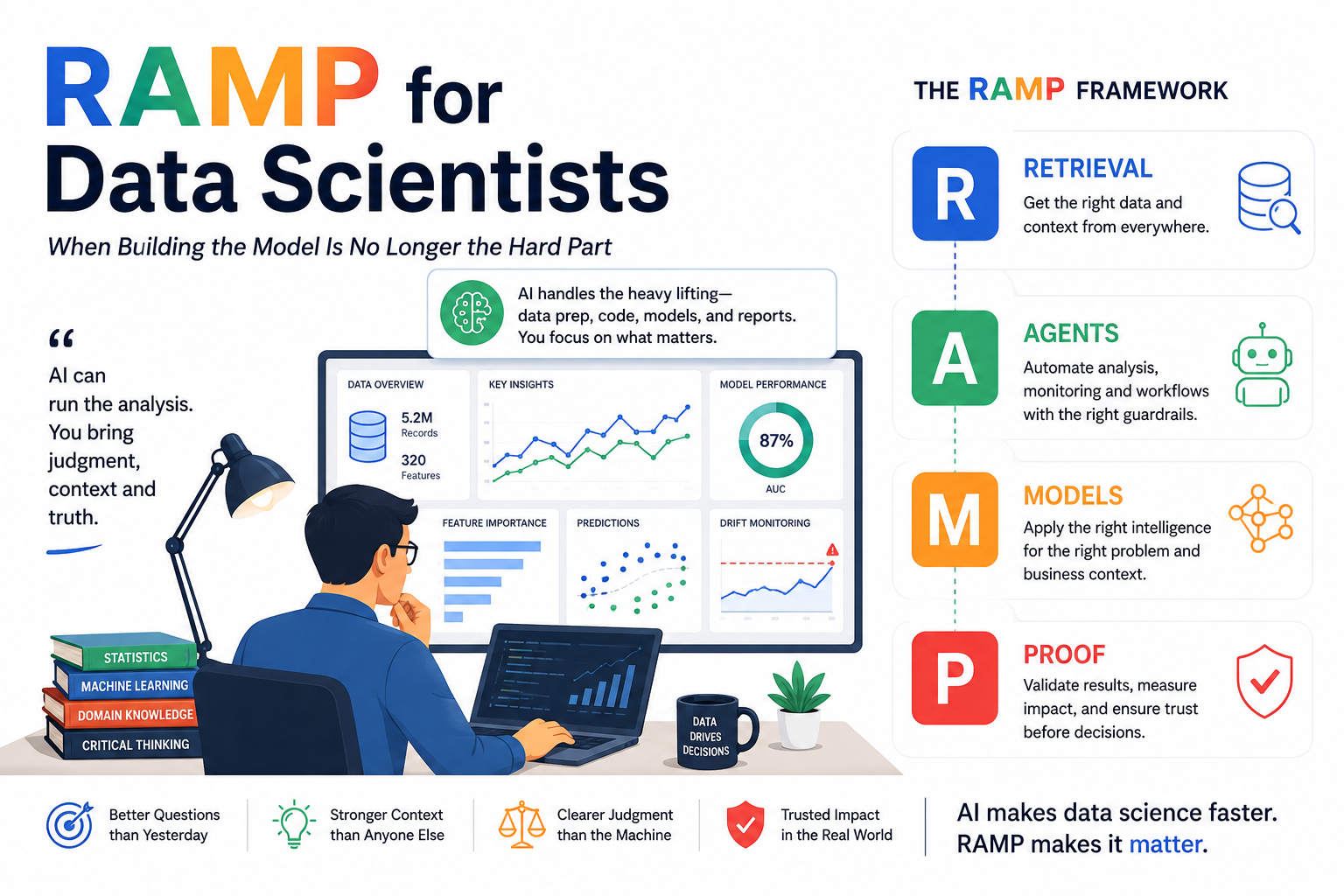
For data scientists, the RAMP framework offers a useful way to understand where it may be moving.
The data was always harder than the model
A few days later, Arjun is asked to help the sales organization answer a seemingly simple question.
Which customers are most likely to churn in the next ninety days?
This is classic data-science territory.
The company has customer information, product usage, support tickets, invoices, renewals, CRM activity and several years of historical data. There is enough information to build something sophisticated.
Arjun asks an AI coding assistant to help.
Within an hour, there is a respectable churn model.
The accuracy looks good.
Feature importance looks reasonable.
The presentation is compelling enough that sales leadership immediately wants the scores pushed into the CRM.
Arjun hesitates.
He has learned to be suspicious when a business problem becomes technically elegant too quickly.
He starts looking at the data more carefully.
One of the strongest churn predictors turns out to be the number of support tickets opened during the previous month. That makes intuitive sense.
Except high-value enterprise customers open more support tickets because they use the product more extensively and have dedicated support channels.
Another strong signal is a particular subscription status.
Then Arjun discovers that the status is updated manually, often only after the account team already suspects the customer will leave.
The model is partly predicting churn using information that contains human knowledge of the churn itself.
Technically, the model performs beautifully.
Operationally, it is much less useful than it appears.
This is where the first R in RAMP becomes critical for data science.
Retrieval is not merely retrieving more data. It is retrieving the right reality.
Data scientists have always known this.
A company can have petabytes of data and still struggle to answer a basic business question because the information was generated by processes rather than designed for analysis.
Tables contain artifacts of human behavior.
Fields mean different things to different teams.
Definitions change.
Systems capture what was easy to record rather than what was actually important.
AI does not make this problem disappear.
In some ways, it makes it more dangerous.
An AI system can explore poor data faster, build convincing models faster and produce persuasive explanations faster.
That means a bad assumption can travel much further before someone notices.
The RAMP-ready data scientist therefore develops an almost investigative relationship with context.
Where did this data come from?
Why does this field exist?
Who enters it?
When is it updated?
What behavior does it really represent?
What information is missing because the system never captured it?
Which customer knowledge lives inside conversations rather than tables?
Those questions are rarely answered by AutoML.
They come from understanding the organization.
AI turns analysis into something closer to conversation
Arjun's workflow starts changing in small ways.
Instead of writing every query himself, he describes what he wants to investigate.
The model generates the SQL.
He asks it to segment customers differently.
It does.
He asks whether the apparent churn pattern could be explained by customer size instead of product dissatisfaction.
The system explores that possibility and comes back with another view.
Something that once required hours of mechanical work starts feeling almost conversational.
This is exciting because it dramatically lowers the cost of curiosity.
A data scientist can explore ten hypotheses instead of two.
They can ask strange questions without worrying that each one requires half a day of preparation. They can inspect edge cases, generate alternate explanations and examine subgroups that would previously have been ignored because there simply was not enough time.
That could make data science much better.
It could also make it much worse.
When exploration becomes almost free, finding patterns becomes easy.
Finding meaningful patterns does not.
A large enough dataset will always contain something interesting.
Revenue went up among customers who used Feature X on Tuesdays.
Users who contacted support twice during onboarding retained better than those who contacted support once.
Customers in one region behave differently from those in another.
AI can surface thousands of such relationships.
The question is what they mean.
This is where the data scientist's role begins moving away from being the person who can perform the analysis and toward being the person who understands what deserves further investigation.
Curiosity becomes cheaper.
Discernment becomes more expensive.
The profession starts becoming less about the ability to interrogate data and more about the ability to interrogate the story the data appears to be telling.
Agents can run the analysis, but somebody still has to frame the investigation
As Arjun becomes more comfortable with AI, he stops using it only as a coding assistant.
He begins using agents.
One agent continuously monitors changes in customer behavior.
Another investigates unusual movements in retention.
A third checks whether important product metrics differ significantly from historical patterns.
When something looks interesting, the agents prepare an initial analysis before Arjun even asks.
This feels like a superpower.
Instead of waiting for someone in the business to notice a problem and submit an analytics request, the system can look for interesting changes continuously.
But autonomous analysis introduces a new challenge.
What should the agents look for?
Imagine the monitoring agent detects that weekly active users dropped 7%.
Is that important?
Perhaps.
Or perhaps a public holiday occurred in the company's largest market.
Another agent notices an unusually high conversion rate among a small group of customers.
Should the company investigate?
Possibly.
Or perhaps the sample is simply too small.
Machine systems are excellent at noticing change.
They are much less naturally equipped to know which change deserves organizational attention unless the objective and context are designed carefully.
This is what Agents means for the data scientist.
It is not merely automating notebooks.
It is deciding which parts of the analytical process can become autonomous.
An agent can collect evidence.
It can run experiments.
It can monitor metrics.
It can generate hypotheses and compare cohorts.
It can even challenge another agent's interpretation.
But somebody still needs to establish the objective.
What are we trying to learn?
Which changes are economically meaningful?
Which anomalies matter enough to interrupt a human?
When should the system explore further on its own?
When should it stop?
This starts to resemble scientific supervision more than traditional analytics.
The data scientist becomes responsible for designing an environment in which machines can investigate without drowning the organization in statistically interesting trivia.
That is a much harder problem than automating SQL.
The model is no longer necessarily the product
For years, data-science teams often organized work around models.
Build a recommendation model.
Build a fraud model.
Build a forecasting model.
Build a churn model.
The model itself became the artifact.
Arjun starts noticing that this way of thinking is becoming less useful.
Suppose the business wants to reduce customer churn.
A churn prediction model may help.
But prediction alone does not improve retention.
Someone still needs to understand why the customer is at risk, decide what intervention makes sense, perform the intervention and measure whether it worked.
In an agentic environment, the model may become only one small component in a larger execution loop.
One system retrieves customer context.
A model assesses risk.
Another model reasons about likely causes.
An agent prepares possible interventions.
A human account manager reviews the important cases.
The system observes what happened and learns from the outcome.
The value is no longer located in the predictive model.
It is located in the full system that converts intelligence into action.
This changes what Models, the M in RAMP, means for data scientists.
The profession has traditionally spent enormous intellectual energy choosing and tuning models.
That remains important in many domains.
But in a growing number of business applications, the difference between model A and model B may matter less than whether the overall system has good context, sensible action logic and trustworthy verification.
A model that is 3% more accurate may create less business value than a slightly weaker model embedded inside a much better workflow.
This can be uncomfortable for data scientists because model sophistication has often been a source of professional prestige.
But the business never wanted the model.
It wanted the outcome.
The company did not want a churn score.
It wanted fewer customers to leave.
It did not want a forecasting algorithm.
It wanted better decisions about inventory.
It did not want anomaly detection.
It wanted fraud prevented before money disappeared.
RAMP pushes the data scientist toward that broader system.
What intelligence belongs here?
How accurate does it need to be?
What does error cost?
Should the system use one model or several?
When is a simple rule better?
When is the difference between 91% and 93% accuracy economically irrelevant?
Those are often more valuable questions than chasing another decimal point on a benchmark.
Proof becomes much harder when the answer affects the business
A few months later, Arjun's churn system performs well enough that leadership wants to automate retention offers.
High-risk customers would automatically receive discounts or incentives.
The logic sounds reasonable.
If the system can identify likely churn early, why wait for a human account manager?
This is where Arjun becomes uncomfortable again.
A prediction model is one thing.
A system that spends money based on the prediction is another.
Now the cost of error changes.
If the system falsely identifies a healthy customer as high risk, the company might give away margin unnecessarily.
Worse, it might accidentally teach customers that threatening to leave produces discounts.
If the system misses a genuinely unhappy customer, the account may disappear before a human gets involved.
The accuracy number on the model dashboard suddenly seems inadequate.
This is Proof, the final part of RAMP.
Data science has always had validation.
Training sets.
Test sets.
Cross-validation.
Confidence intervals.
Backtesting.
But Proof in an AI-native business environment has to reach further.
Does the model perform equally well across important customer segments?
Did the underlying population change?
Are people changing their behavior because of the model's decisions?
Is the intervention actually improving retention, or merely correlating with customers who would have stayed anyway?
Is the system learning from its own previous actions in a way that distorts future predictions?
Once models participate directly in operations, the world begins responding to them.
That makes validation a moving target.
The data scientist can no longer prove the system only before deployment.
Proof becomes continuous.
The system must be observed while it changes the environment it is trying to predict.
This is particularly important when AI agents enter the loop.
An agent may act based on a model.
The action changes customer behavior.
That new behavior enters the data.
The model is retrained.
Now the machine is partly learning from a world it helped create.
This is not simply a statistical problem.
It is a systems problem.
The RAMP-ready data scientist needs to understand feedback loops, incentives, causality and operational behavior.
A model can be statistically correct and still create a bad business outcome.
That distinction may become one of the most valuable forms of judgment in the profession.
The uncomfortable future of the dashboard
Arjun's company has dozens of dashboards.
Sales has one.
Marketing has several.
Finance has more.
Product has enough that nobody remembers which one contains the official version of a particular metric.
People joke about dashboard fatigue.
AI may finally make the joke obsolete.
Why should an executive navigate through twelve dashboards to understand what changed yesterday?
An intelligent system can monitor the underlying data continuously, identify meaningful changes and explain what deserves attention.
Instead of opening a dashboard, the CEO may simply ask, “What changed in the business this week that I should care about?”
The system can answer.
This could sound like bad news for analytics teams.
If executives can interrogate data conversationally, who needs the person building the dashboard?
But the dashboard was never the highest-value part of analytics.
The hard part was deciding which metrics mattered, whether they were defined correctly, what changed, and what action the organization should take.
AI removes the interface between the executive and the data.
It does not remove those questions.
In fact, it may make them harder.
A dashboard exposes its limits.
The user sees the five metrics on the screen.
A conversational system can answer almost anything, which creates the impression that the organization knows almost anything.
That illusion is dangerous.
The AI may calculate the answer perfectly using a metric whose definition nobody agrees on.
It may compare two periods that are not comparable.
It may answer a causal question using correlation.
It may produce a beautifully worded explanation where the data supports only uncertainty.
The data scientist becomes the person who helps build the epistemic discipline behind the conversation.
What can we actually know from this data?
What can we infer?
What remains uncertain?
What requires an experiment?
What should never be presented as a fact?
Those distinctions become more valuable when the interface makes everything feel easy.
Data science may move from prediction toward decision science
There is a subtle evolution hidden inside all of this.
For much of the last decade, data science became closely associated with prediction.
Which customer will churn?
What will demand be next month?
Which transaction looks fraudulent?
Which product will this person buy?
Prediction is valuable because knowing what might happen can improve decisions.
But businesses ultimately care about something beyond prediction.
What should we do?
Imagine Arjun can predict with impressive accuracy that a customer is likely to leave.
That does not tell the company whether the correct response is a discount, a product fix, executive outreach, better onboarding or doing nothing.
The next generation of AI systems will increasingly bridge this gap.
They will retrieve context, predict outcomes, reason about possible actions, simulate consequences and perhaps execute the action through agents.
The data scientist's role then becomes broader.
They need to understand not just whether the prediction is accurate, but whether the resulting decision policy creates value.
This moves the profession closer to decision science.
A perfectly accurate forecast can still produce a poor decision if the organization responds badly.
A moderately accurate forecast embedded inside a strong decision system may produce far more value.
That should change the way data teams think about success.
Model accuracy is evidence.
It is not the outcome.
The outcome is what happens in the world after the intelligence is used.
The junior data scientist faces the same apprenticeship problem
There is another issue Arjun begins noticing when interviewing younger data scientists.
They are astonishingly fast.
A candidate can explore a dataset, generate code, compare models and create a polished analysis in less time than Arjun once needed just to clean the data.
AI has compressed years of mechanical learning.
That is good.
But it also makes it harder to know what the candidate actually understands.
Arjun gives one candidate a dataset with an obvious target variable and asks them to build a predictive model.
The candidate produces a highly accurate result.
Then Arjun asks a different question.
“Why should I distrust this model?”
The room becomes quieter.
This may become the more important interview question.
If AI can generate code, choose algorithms and propose transformations, technical execution becomes less useful as a proxy for understanding.
The data scientist needs to know when the analysis is misleading.
Why might this relationship be spurious?
What information leaked into the model?
Which group could be harmed by this decision?
What changed between the training environment and production?
What evidence would make you abandon the conclusion?
These questions expose judgment.
They also suggest a different way to train the next generation.
Junior data scientists may spend less time memorizing syntax and more time diagnosing deliberately flawed analyses.
They can inspect machine-generated models and find hidden leakage.
They can challenge causal claims.
They can compare competing explanations.
They can learn through hundreds of scenarios rather than waiting years to encounter them organically.
AI could weaken traditional apprenticeship.
It could also create an extraordinary new one.
The difference will depend on whether we teach people to produce analysis or to think scientifically about analysis.
The best data scientist may become the one who knows when the data cannot answer the question
Arjun eventually reaches a point where one of the executives asks him a question that sounds perfectly reasonable.
“Did the new pricing page cause the improvement in conversion?”
The company has plenty of data.
Traffic increased.
Conversion improved.
The new pricing page launched shortly before both happened.
AI can produce a convincing explanation connecting the events.
Arjun's answer is less satisfying.
“We don't know yet.”
Perhaps a marketing campaign changed the traffic mix.
Perhaps seasonality helped.
Perhaps the new page mattered.
Perhaps all three contributed.
The existing data cannot separate them confidently.
A few years earlier, saying “we don't know” could make a data scientist look unhelpful.
In the AI era, it may become a mark of quality.
Because AI will always be ready to produce an answer.
The professional advantage increasingly lies in knowing when an answer exceeds the evidence.
This is Proof at its most human.
Not checking whether the arithmetic is correct.
Checking whether the conclusion deserves to exist.
That is why I suspect strong data scientists will become more skeptical, not less, as AI improves.
They will use machines constantly.
They will automate enormous amounts of analysis.
They will explore more possibilities than any previous generation.
But they will become increasingly careful about the boundary between what the system can calculate and what the organization can claim to know.
That boundary is where trust lives.
RAMP changes what an exceptional data scientist looks like
A few years from now, Arjun may write very little SQL by hand.
Agents may continuously prepare datasets, run experiments and monitor production behavior.
Models may propose hypotheses before the business asks the question.
Executives may interact directly with organizational data through conversational intelligence rather than waiting for analysts to prepare dashboards.
None of this necessarily makes Arjun irrelevant.
But it certainly makes the old definition of his job too small.
His value moves upward.
Retrieval means understanding where the right evidence lives and whether the data actually represents the reality the business cares about.
Agents give him the ability to operate analytical processes continuously rather than only when someone submits a request.
Models become components in larger decision systems rather than trophies at the center of the work.
Proof becomes the discipline that prevents statistically persuasive analysis from turning into organizational fiction.
Together, these capabilities change what data science is for.
The profession began by helping organizations understand data.
Then it helped them predict the future.
The next stage may be helping organizations decide what to do when intelligence itself becomes abundant.
That requires something more than modeling skill.
It requires curiosity without gullibility, technical depth without fascination with complexity, and enough business understanding to know when a mathematically interesting problem is economically irrelevant.
Most importantly, it requires the confidence to tell an organization that its data does not support the story everyone wants to believe.
Arjun started his career thinking the difficult part of data science was building the model.
AI may make that part dramatically easier.
The difficult part now becomes knowing whether the model is looking at the right world, whether its conclusion means what we think it means, and whether acting on it will make that world better or worse.
That is not the end of data science.
It is the profession growing up.
And the data scientists who master Retrieval, Agents, Models and Proof may find themselves doing far less analysis manually while having far more influence over what organizations believe, decide and do.