
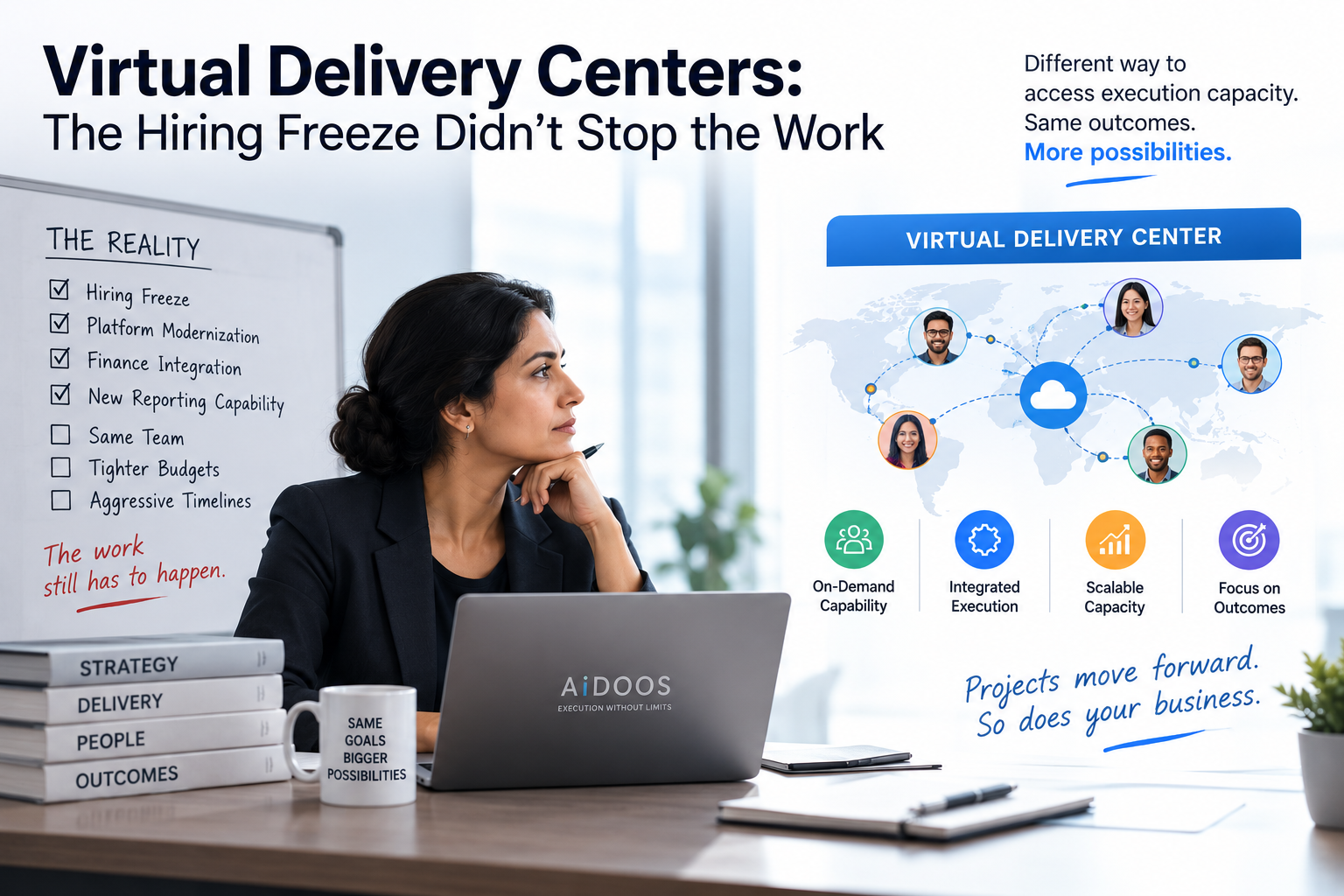
Virtual Delivery Centers: The Hiring Freeze Didn’t Stop the Work
Imagine a CIO named Leena walking out of a leadership meeting with two pieces of news.
The first is that the company is freezing hiring. The second is that the customer-platform modernization, the finance integration and the new reporting capability are all still expected to go live this year.
Nobody in the meeting thinks these decisions contradict each other. Finance is trying to protect cash, the business needs the projects completed, and the CEO expects the organization to find a way through.
Leena understands the logic. She also knows what will happen when she returns to her team.
The same engineers who are already maintaining production will be asked to absorb the modernization work. The architect who was supposed to focus on the new platform will spend another month resolving operational issues, and the delivery manager will be asked to produce a revised plan showing how everything can still happen.
The hiring freeze has stopped the requisitions. It has not stopped the work.
That distinction sounds obvious, but it exposes a problem that many organizations have lived with for years. We have become accustomed to treating headcount as the primary way to increase execution capacity, even when the work itself is temporary, uneven or difficult to predict.
When the company needs more capability, it opens positions. When budgets tighten, it closes them. Meanwhile, the work continues arriving in a rhythm that has very little respect for the annual workforce plan.
Artificial intelligence makes this tension more interesting. It can reduce the effort required for many tasks, but it does not automatically remove the need for people who understand the business, coordinate execution and remain responsible for outcomes.
The question facing Leena is therefore not simply how to get around a hiring freeze. It is whether the organization needs a different way to access delivery capacity in the first place.
1. The work and the workforce have different rhythms
Leena's technology organization has a permanent team for a good reason. The company needs people who understand its systems, maintain continuity, respond to incidents and make long-term architectural decisions.
That work does not disappear when a project ends. The internal team carries institutional knowledge that would be expensive and sometimes dangerous to lose.
But not every piece of work has the same shape.
The finance integration requires a concentrated period of engineering, testing and coordination. The customer-platform modernization needs additional capacity for several months, while the reporting capability may require a different combination of skills for a shorter period.
Once those initiatives are complete, the company may not need the same amount of capacity in the same areas. A new set of priorities will emerge, but nobody can say with confidence that they will require exactly the same people.
This is where the traditional staffing model becomes awkward.
A permanent hire is a long-term commitment. A project is often a temporary concentration of work, and the organization is trying to solve one problem with a mechanism designed for another.
That mismatch is manageable when budgets are generous. It becomes painfully visible when hiring is frozen.
Leena could ask her existing team to work harder, but she knows the cost of that approach. Production support will compete with project delivery, technical debt will accumulate, and the people who understand the systems best will become the bottleneck for every important initiative.
She could postpone the projects, but postponement has a cost too. Customers are waiting, operational inefficiencies remain, and the business may lose opportunities that do not appear neatly in the technology budget.
The organization is not short of things to do. It is short of a way to match available capability to the work that needs doing.
2. A hiring freeze is not necessarily a spending freeze
The next conversation usually begins with finance.
Leena asks whether the company can use external delivery capacity, and the CFO responds with a reasonable question: “If we cannot afford to hire, why can we afford to spend money elsewhere?”
That question deserves a serious answer. A Virtual Delivery Center is not a magical way to make work free, and changing the label on expenditure does not make an unaffordable project affordable.
The distinction is between different kinds of commitments.
A permanent employee creates an ongoing cost and a long-term organizational obligation. A defined delivery engagement can be tied to a particular scope, budget and period of need, with capacity adjusted as the work changes.
That does not automatically make external delivery cheaper. In some situations, hiring may be the better economic choice, especially when the capability is needed continuously and the organization has the time and budget to build it internally.
But the comparison should be made honestly.
Leena's finance integration may require additional capacity for a limited period. Hiring several permanent employees to solve that temporary peak could leave the organization with more fixed cost than it needs after the project is complete.
On the other hand, repeatedly buying external capacity for work that is permanently required could become expensive and weaken internal ownership.
The right question is not “Employees or external people?”
It is “Which capabilities should we own permanently, and which should we be able to access when the work requires them?”
That is a much more useful workforce-planning conversation.
It also allows the CFO to evaluate the project as an investment rather than merely an exception to the hiring freeze. What outcome is expected, what will it cost, what happens if it is delayed, and how much capacity is actually required?
The answer may still be no. But at least the decision is being made against the economics of the work rather than the mechanics of a requisition.
3. Why the usual alternatives often create another problem
Leena has several familiar options.
She can ask a staffing company for contractors. She can engage a consulting firm, or she can try to redistribute the work across the existing team and hope the schedule survives.
Each option can work in the right circumstances. The problem is that organizations often choose them without examining what they actually need.
Staff augmentation gives Leena additional people, but it may also give her additional management work. Someone still has to define the assignments, coordinate the contributors, manage access, maintain continuity and make sure the work integrates with the existing systems.
If her internal team is already overloaded, adding people without changing the delivery structure may simply create a larger team for the same exhausted managers to coordinate.
Traditional consulting can solve a different problem. A firm may bring specialized expertise, take responsibility for a defined engagement and provide a delivery structure around it.
That can be valuable, particularly when the organization needs expertise it does not possess. But it may also introduce a substantial engagement model for work that is narrower, more continuous or more variable than a conventional consulting project.
Leena does not necessarily need another organization to take over her technology strategy. She needs dependable execution capacity that can work within the strategy her team already owns.
This is where the Virtual Delivery Center becomes relevant.
A VDC is a way to organize and access delivery capacity without requiring the company to build a permanent department for every changing need. The enterprise retains its business priorities and governance, while the VDC provides a structured mechanism for bringing the required capability into the work.
The distinction matters because a VDC should not be understood as a disguised staffing agency or a consulting firm with a different name. Its value depends on whether it makes execution easier to organize, govern and scale.
If Leena still has to search for every individual, negotiate every assignment separately and rebuild the delivery structure each time, very little has changed.
The model becomes interesting when the capacity can be assembled around the work, connected to the company's existing environment and adjusted as priorities evolve.
4. The first VDC conversation should be about work, not resumes
Leena's first instinct is to ask for three developers and a QA engineer.
That is understandable because she has spent years translating project demand into staffing requirements. But the request already assumes that she knows the correct shape of the solution.
A better conversation begins with the finance integration itself.
What systems need to communicate? What data is moving between them, which business rules matter, and what does a successful reconciliation look like?
Which parts of the work are already understood, and which contain uncertainty? What can be reused, what needs to be built, and what must be validated before the business can rely on the result?
Those questions reveal the capability required.
The work may need integration engineering, data expertise, testing and a delivery lead. It may also need access to a specialist for a short period rather than a full-time person assigned for the entire engagement.
That is a different way of thinking about capacity.
Instead of beginning with a fixed collection of job titles, the organization begins with the outcome and works backward toward the capability needed to produce it.
This does not eliminate the need for people. It makes the relationship between people and work more deliberate.
It also creates room for AI to change the economics of delivery.
An integration that once required extensive manual coding may now benefit from AI-assisted development, automated testing or reusable components. The amount and composition of human effort may be different from what Leena would have estimated using an older delivery model.
But AI should not become an excuse for pretending the work is trivial.
Some of the most difficult parts may still involve understanding legacy systems, resolving ambiguous business rules, coordinating stakeholders and proving that the integration behaves correctly.
A useful delivery model should account for both realities. It should take advantage of machine capability where appropriate while preserving the human expertise required to make the outcome dependable.
5. The internal team should not have to become a second vendor manager
Leena's greatest concern is not whether external talent can write code. It is whether bringing in external capacity will create more work for the people she is trying to relieve.
Her team already has a backlog of decisions, incidents and architectural questions. If every new contributor needs extensive onboarding, repeated explanations and constant supervision, the apparent capacity gain may disappear.
This is why the operating model matters as much as the talent.
A VDC should make it easier to establish who is working on what, how they access the required systems, how work is coordinated and how continuity is maintained when contributors change.
For AiDOOS, the intended model is to connect delivery capacity into the customer's existing tools and workflows rather than force the customer to move its work into an entirely separate project-management environment.
That distinction is important for Leena.
Her engineers already use their own repositories, issue trackers, communication channels and operational systems. A new delivery mechanism should fit into that environment wherever possible, not create another disconnected place where project truth has to be reconstructed.
Access also needs to be governed carefully.
External contributors may need access to a repository, a test environment or a particular system for a defined period. They should not automatically receive broad, permanent access simply because they are participating in a project.
The organization needs to know who has access, why they have it and when that access should end.
None of this is glamorous. But it is the difference between adding execution capacity and adding operational risk.
The VDC also needs an explicit delivery structure. Someone must coordinate the work, maintain continuity and make sure the people involved understand the outcome rather than merely completing isolated tasks.
The customer should retain clear ownership of its priorities and systems, while the responsibilities of the VDC, its contributors and any delivery lead are agreed before work begins.
Without that clarity, the model can collapse into the same ambiguity that makes poorly managed outsourcing frustrating.
6. Continuity is the part organizations usually discover too late
The finance integration goes live.
Leena's team is relieved, the business is happy, and the immediate project is complete. A few months later, another initiative appears that requires knowledge of the same systems.
In a conventional project-by-project model, the organization may have to start again.
Find the people.
Explain the architecture.
Recreate the context.
Rediscover the business rules.
Rebuild the relationships.
That repeated setup cost is easy to overlook because it rarely appears as a separate line item in the original project budget.
But it can be substantial.
A useful VDC model should preserve continuity so that the organization does not lose all of its delivery knowledge every time a particular engagement ends.
That does not mean the same people must remain permanently assigned to the company. It means the delivery structure should retain enough context, governance and access to capability that future work can begin from a stronger position.
This is where the idea of a Virtual Delivery Center becomes more interesting than simply buying a project.
The company can maintain a continuing relationship with an execution environment while varying the amount and type of capacity it consumes.
Some months may involve a major implementation.
Other months may require a smaller amount of maintenance, enhancement or specialist work. A new priority may require a different combination of capabilities altogether.
The center provides continuity.
The work determines the capacity.
That is a much better fit for organizations whose demand changes more quickly than their permanent workforce can.
It also allows the internal team to remain focused on the things it should own: architecture, business context, priorities, critical decisions and the long-term health of the systems.
External capacity can expand the organization's ability to execute without requiring the company to surrender the knowledge and control that make its technology environment valuable.
7. AI makes the case for flexible execution stronger, not weaker
There is another conversation Leena has with the CEO.
“If AI is making engineers more productive, shouldn't we need fewer external people too?”
Possibly.
That is a fair question.
AI can reduce the effort required for certain kinds of work, and any delivery model that ignores that improvement will eventually become uncompetitive. Customers should not be paying for unnecessary manual effort simply because that is how projects were estimated five years ago.
But AI does not eliminate the need for execution.
It changes the amount and composition of capability required.
A company may need fewer hours of routine coding but more attention to architecture, integration, data quality, security, testing and verification. It may be able to attempt projects that were previously too expensive, which creates new demand even as individual tasks become cheaper.
The important point is that the capacity requirement becomes more variable.
Some work may be handled largely through AI-assisted execution. Other work may require deep domain expertise or human judgment, while some initiatives may need a short burst of specialist capacity followed by a much smaller ongoing commitment.
A permanent headcount model is not always well suited to that variability.
A VDC can provide a way to organize capacity around the changing work rather than assume that every increase in demand requires another permanent role.
This is also where the relationship between VDC and RAMP becomes useful.
The RAMP framework describes the capabilities professionals need to work effectively with Retrieval, Agents, Models and Proof. VDC addresses a different question: how organizations access and organize that capability around execution.
One is about the readiness of the workforce.
The other is about the delivery model through which the enterprise can use it.
They are complementary, but they should not be confused.
A company does not need to understand RAMP before it can benefit from a VDC. But as AI becomes more deeply embedded in delivery, the capability of the people operating inside that delivery model becomes increasingly important.
The enterprise wants the outcome.
The delivery model must bring together whatever human and machine capability is appropriate to produce it reliably.
8. The hiring freeze becomes a different conversation
A few months later, Leena returns to the leadership meeting.
The hiring freeze is still in place.
Some projects have been delayed because the business decided they were not worth the investment. Others have moved forward through a combination of internal capacity, AI-assisted execution and additional delivery capability brought in for defined needs.
The important change is not that the company found a clever way around finance.
It is that leadership has started separating two questions that were previously treated as one.
What permanent capability does the organization need to own?
And what execution capacity does it need access to as the work changes?
That distinction allows better decisions.
The company can hire when a capability is genuinely strategic and enduring. It can use external capacity when demand is temporary, specialized or uncertain, and it can use AI to reduce unnecessary effort wherever the technology is appropriate.
None of these choices is universally better.
The point is to stop treating permanent headcount as the only respectable answer to every execution problem.
Leena's internal team remains essential.
They understand the systems, the business and the consequences of technical decisions. Their knowledge becomes even more valuable when additional capacity can be brought around them without requiring the company to rebuild its organization every time demand changes.
The VDC does not replace that internal ownership.
It gives the organization another way to execute.
And that is the larger idea behind Virtual Delivery Centers.
Companies have spent decades building permanent structures to handle work that is often temporary, uneven and difficult to forecast. AI is now changing the amount of effort required to perform that work, but the organizational structures around it have not necessarily changed at the same pace.
A more flexible delivery model allows the enterprise to keep what should remain permanent while accessing additional capability when the work requires it.
The hiring freeze did not stop the work.
Perhaps it finally forced the organization to ask whether hiring was the only way the work could get done.