
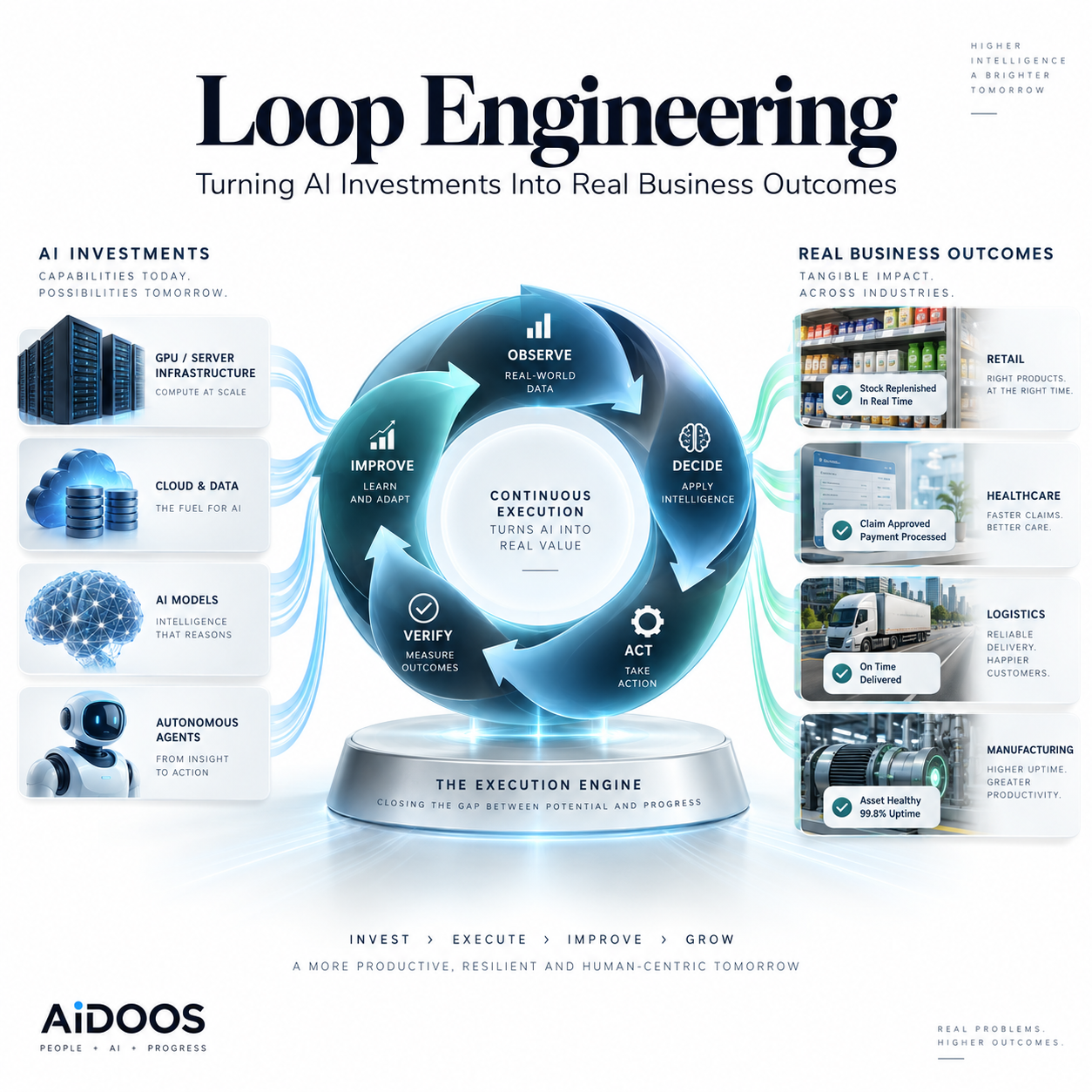
Loop Engineering: Turning AI Investments Into Real Business Outcomes
For the last few years, enterprises have been racing to acquire intelligence.
They have bought GPUs, built private AI infrastructure, moved workloads to the cloud, connected enterprise data, deployed copilots, experimented with large language models, hired AI teams, launched agents and funded dozens of pilots. Boards have approved enormous investments because almost nobody wants to be the company that wakes up too late to the AI transition.
Something important has happened as a result. Intelligence, which was once expensive and scarce, is becoming increasingly abundant.
But business outcomes have not become abundant with it.
Hospitals can have better AI models while claims still get denied. Retailers can have computer vision across thousands of stores while shelves still remain empty. Manufacturers can predict equipment failures while technicians still arrive too late. Logistics companies can optimize routes while trucks still miss delivery windows. Finance teams can deploy AI assistants while receivables continue to age.
The technology may be working perfectly.
The business loop is still open.
That distinction will define the next phase of enterprise AI.
The first phase was about acquiring intelligence.
The next phase will be about making intelligence act continuously on the business until the desired state is achieved.
That requires a different discipline.
Loop Engineering.
1. AI can understand the business without changing the business
Consider a simple retail problem.
A camera detects that a product is missing from a shelf. A computer vision model identifies the SKU correctly. An AI system checks inventory and determines that twelve units are available in the stockroom. Another system notifies an employee.
Every component has worked.
Yet fifteen minutes later the shelf may still be empty.
The customer who wanted the product may already have left the store.
From an AI perspective, the system succeeded. From a business perspective, nothing happened.
The real objective was never to identify an empty shelf. It was to restore product availability.
That requires a loop.
The system must observe the shelf, understand the condition, determine the appropriate action, initiate that action, verify that the action occurred, inspect the shelf again and continue until availability has actually been restored.
Detection is an event.
Restoration is an outcome.
Between those two sits an execution system.
This pattern appears almost everywhere.
A healthcare AI system can identify incorrect clinical documentation. But the economic outcome occurs only when the documentation is corrected, coding is updated, the claim is submitted, payer responses are monitored, exceptions are resolved and payment is eventually received.
A manufacturing model can predict that a bearing is likely to fail. But the operational outcome happens only when maintenance is scheduled, the correct component is available, the machine is serviced and subsequent telemetry confirms that the risk has disappeared.
A freight system can determine that a shipment will miss its delivery window. But the customer outcome changes only when a new route, appointment, driver, dock slot or other intervention is executed and the shipment returns to an acceptable trajectory.
AI generates understanding.
Business value appears when understanding changes the state of the world.
That difference sounds obvious when stated plainly. Yet much of enterprise AI architecture still ends at the moment a prediction, recommendation, alert, answer or generated artifact is produced.
We have spent enormous effort engineering intelligence.
Now we need to engineer what happens next.
2. From workflows to closed loops
Businesses already have workflows.
Invoices move from receipt to approval. Orders move from checkout to fulfillment. Claims move from submission to adjudication. Incidents move from detection to resolution. Leads move through sales pipelines.
So why introduce the idea of a loop?
Because a workflow primarily describes what should happen next.
A loop asks a different question:
Did the business actually reach the desired state?
That difference matters enormously.
Traditional workflow automation is usually deterministic. Event A triggers task B, which triggers approval C, which sends information to system D. Once the configured steps have executed, the workflow considers its job complete.
Business reality is rarely that cooperative.
The payment may still not arrive.
The customer may not respond.
The shelf may remain empty.
The machine may continue overheating.
The claim may be rejected again for a different reason.
The shipment may encounter another delay.
A closed loop does not assume that executing an action equals achieving an outcome.
It observes the result.
If the desired state has not been reached, it reasons again.
It may try another action, gather more information, invoke another system, assign work to a human, escalate authority, change the plan or wait for an external condition before continuing.
The loop closes only when a defined outcome condition is satisfied, deliberately abandoned, or transferred to an authorized human.
This is a fundamentally different operating model.
A simple loop can be represented as:
Observe → Understand → Decide → Act → Verify → Adapt → Repeat
But an enterprise-grade loop requires more than those seven verbs.
It needs a target state. It needs constraints. It needs permissions. It needs an understanding of which actions are available. It needs access to enterprise context. It needs thresholds for confidence and escalation. It needs memory of previous actions. It needs an evaluator capable of deciding whether progress has actually occurred.
Most importantly, it needs to know when it is finished.
Without that last condition, autonomous systems do not create outcomes. They create activity.
3. Agents are components of loops, not the loop itself
AI agents are becoming one of the dominant abstractions in enterprise technology.
That is useful progress. Agents give AI the ability to do more than generate text. They can call APIs, retrieve information, use enterprise applications, invoke software tools and increasingly coordinate with other agents.
But an agent is not automatically a business outcome.
Imagine a collections agent.
It can inspect an overdue invoice, understand the customer's history, compose an appropriate message, send it, monitor the inbox and perhaps schedule another follow-up.
That sounds impressively autonomous.
But what is its objective?
Send three emails?
Obtain a response?
Secure a payment commitment?
Receive the money?
Reduce Days Sales Outstanding?
Those are very different definitions of success.
The same problem appears with multi-agent systems.
One agent may analyze a situation. Another may formulate a recommendation. A third may execute an action. A fourth may evaluate what happened.
Connecting those agents creates an agentic workflow.
It does not necessarily create a closed business loop.
The missing abstraction is the outcome itself.
A loop needs a persistent objective against which every action is evaluated.
For example:
Keep this product available on the shelf during store hours.
Or:
Move this valid claim from clinical documentation to collected cash while remaining within payer, clinical and regulatory constraints.
Or:
Maintain this production asset within defined operational limits while minimizing unplanned downtime.
Once the objective becomes persistent, agents become interchangeable capabilities inside the loop.
One model may interpret an image. Another may reason about the appropriate action. A third may communicate with a person. Traditional software may execute the transaction. An industrial controller may operate machinery. A human may approve an exception.
The loop does not care whether a particular step is performed by an LLM, an algorithm, a SaaS product, an employee or a machine.
It cares whether the state of the business is moving toward the target.
That is why Loop Engineering is broader than agent engineering.
It is the engineering of continuous business state change.
4. The anatomy of a business loop
If closed loops become a serious enterprise architecture pattern, they need structure.
At the center is the objective.
An objective must describe a business state, not merely a technical task. "Classify incoming service requests" is a task. "Restore customer service within the agreed SLA" is an outcome.
Around that objective sits the state.
The system needs to know what is true now. What is the current inventory? Has the claim been submitted? What is the temperature of the equipment? Has the customer responded? Is a technician already on the way?
State may come from databases, APIs, sensors, documents, conversations, enterprise applications or human inputs.
Then comes context.
The same state can require different actions depending on the customer, location, contract, product, regulatory environment, operating history or business priority. Context is what prevents autonomous execution from becoming generic automation.
Next are constraints.
An enterprise loop cannot simply pursue an outcome at any cost. It must operate within financial limits, security policies, regulatory requirements, contractual obligations, approval thresholds and organizational permissions.
Constraints answer questions such as: Can this discount be offered? Can this payment be released? Can this machine be stopped? Can this patient record be changed? Can this shipment be rerouted?
Then come available actions.
This is where much of today's enterprise software becomes useful again.
The loop may call SAP, Salesforce, ServiceNow, Epic, Oracle, Jira or a proprietary application. It might activate an AI agent, execute code, trigger robotic process automation, communicate through Teams, send an email, update a PLC or ask a person to intervene.
Existing software becomes the actuator layer through which the loop changes the business.
After action comes verification.
This may be the most neglected element of all.
A task being completed does not mean the outcome was achieved. The loop therefore needs independent evidence of what happened after the action.
Was inventory actually replenished?
Was the claim paid?
Did vibration return to an acceptable range?
Did the shipment arrive?
Did the customer renew?
Verification converts automation into accountability.
Next comes adaptation.
When an action fails, the system needs alternatives. It may alter the plan, select another tool, request new information, escalate to a different authority or decide that further autonomous action is inappropriate.
Finally there is memory.
Every loop generates operational knowledge: which intervention worked, which failed, how long each path took, which exceptions required humans, which systems caused friction and which conditions predicted success.
Over time, the loop should become better at closing itself.
Put these elements together and something important changes.
AI stops being an application that employees occasionally use.
It becomes part of the operating machinery of the enterprise.
5. The economics of a loop
Enterprise technology has historically struggled to connect technical activity with financial outcomes.
Cloud platforms report consumption.
Software vendors report seats.
AI infrastructure reports utilization.
Models report accuracy.
Agents may report tasks completed.
The CFO ultimately asks a different question.
What changed economically?
Closed loops create the possibility of answering that question much more directly.
Consider a claim loop.
Suppose the enterprise can observe the amount originally billed, documentation defects, coding changes, submission timing, denial reason, remediation activity, payer response and eventual cash collected.
The organization can now associate the operation of that loop with a measurable economic result.
Not "the AI processed 80,000 documents."
Instead:
The loop recovered $4.7 million that would otherwise have remained denied or delayed.
A shelf-availability loop could be measured against lost sales, availability rate and replenishment time.
A collections loop could be measured against cash recovered and reduction in receivable age.
A maintenance loop could be measured against downtime avoided, asset utilization and maintenance expenditure.
A logistics loop could be measured against cost per delivery, missed appointments, empty miles or service-level performance.
This is where AI investment becomes far easier to understand.
The unit of value stops being the model, token, agent, GPU or software seat.
The unit of value becomes the business loop.
And each loop can eventually have its own economics.
There is a cost to operate it. There is capital underneath it. There are humans or machines it sometimes consumes. There is a business value associated with successful closure.
Some loops may be enormously valuable and worth substantial computational expense. Others may not justify autonomy at all.
That forces a healthy discipline onto enterprise AI.
Instead of asking, "Where can we use AI?"
organizations can ask:
Which important business loops remain open today, and what is the economic value of closing them faster, more reliably or with less human intervention?
That is a much better starting point.
6. The enterprise will need a control plane for autonomous execution
There is an uncomfortable implication in all of this.
If AI begins acting continuously on business systems rather than merely advising employees, enterprises will need much stronger governance than they needed for copilots.
A chatbot can be wrong.
A loop can be wrong repeatedly.
That difference changes the risk profile.
Closed loops therefore need a control plane.
Every loop should have a clearly defined owner. It should have permissions specifying what it may see and what it may change. It should have financial and operational boundaries. Every action should be attributable and auditable.
Human intervention should not be treated as failure.
It is part of the architecture.
A loop should understand when confidence is insufficient, when authority is exceeded, when an irreversible action is being considered or when a situation falls outside the operating envelope it has been given.
In some cases the human will approve an action.
In others the human becomes an actuator inside the loop. The system may ask a nurse, technician, store employee, dispatcher, account manager or finance executive to perform something that software cannot.
The important thing is that the loop remains alive afterward.
Traditional systems often hand work to a human and lose visibility.
A closed-loop system should resume observation once the human action occurs, verify the new state and continue toward the outcome.
This also creates an entirely new form of enterprise telemetry.
Executives could eventually see not only application uptime or model usage, but the actual operational condition of their business loops.
How many loops are active?
How many closed successfully?
How long did they take?
Where do they stall?
Which systems create friction?
Which loops frequently require humans?
What value did they create?
What did they cost?
Which loops are becoming more autonomous over time?
That is far closer to an operating system for execution than another analytics dashboard.
7. Loop Engineering may become a new engineering discipline
Software engineering gave enterprises applications.
Data engineering gave them reliable pipelines for information.
Machine-learning engineering gave them predictive systems.
Prompt engineering emerged as organizations learned how to interact with generative models. Agent engineering is now developing around autonomous reasoning and tool use.
But none of these disciplines owns the complete path from business condition to business outcome.
Someone still has to engineer the loop.
That job combines elements that previously lived in different organizational silos.
A Loop Engineer must understand the business outcome deeply enough to define its closure condition. They need to understand enterprise systems well enough to know where state exists and which actions are possible. They need AI knowledge to determine where reasoning or perception can help.
They also need process knowledge, security awareness, economics, exception handling and an appreciation for human behavior.
Most enterprise problems do not fit neatly inside one application.
The claim loop may cross the EHR, coding systems, billing software, payer portals, email and human review.
The shelf loop may cross computer vision, inventory, workforce systems, handheld devices and physical store operations.
The freight loop may cross a TMS, telematics, maps, driver communications, warehouse schedules, customer systems and regulatory rules.
The value lives across those boundaries.
Loop Engineering is therefore not simply a new name for automation.
Automation asks:
Can this task execute without a person?
Loop Engineering asks:
Can this outcome continuously drive its own execution?
Those questions lead to very different systems.
8. After the AI infrastructure build-out
The current AI infrastructure boom is necessary.
Enterprises need computing capacity. Models need somewhere to run. Data needs to be accessible. Security needs to be solved. AI workloads require reliable infrastructure.
But infrastructure is the beginning of the story, not the economic conclusion.
A factory full of machines has value because the machines produce something.
A power plant has value because electricity flows into homes and businesses.
AI infrastructure will ultimately be judged the same way.
What does it continuously produce for the enterprise?
The organizations that have invested early in AI infrastructure may actually have an advantage here. They already possess much of the underlying capacity required to run sophisticated autonomous systems.
The question increasingly becomes what sits one level above it.
We believe one answer is closed business loops.
At AiDOOS, we have been exploring the larger idea that as intelligence becomes abundant, execution becomes the scarce layer. The AiDOOS Manifesto describes that broader shift toward an economy where work is increasingly organized around outcomes rather than traditional organizational structures.
Loop Engineering takes that idea down to the operational level.
An organization has an objective.
The system observes reality.
Intelligence determines what should happen.
Software, machines and people act.
The result is observed again.
The system learns.
And the cycle continues until reality matches the intended business state.
That is when AI stops merely telling the enterprise what it knows.
It starts helping the enterprise continuously become what it wants to be.
The AI era may have begun with models.
Its real economic impact may arrive when we finally close the loops.