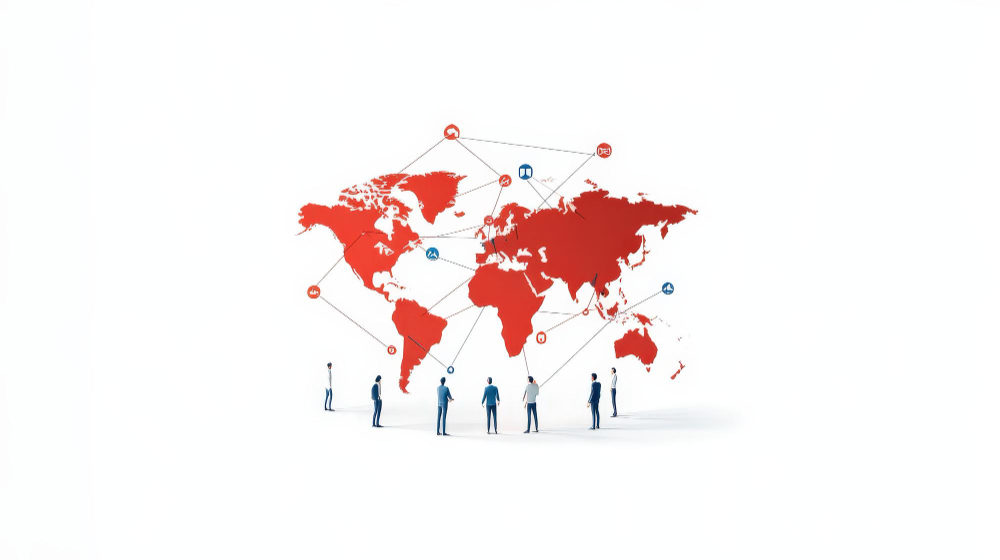
For years, the dominant story about globalization has been that it is retreating.
Supply chains are being regionalized.
Governments are subsidizing domestic manufacturing.
Companies are reducing dependence on distant countries.
Immigration has become politically charged.
Trade tensions have intensified.
National security now shapes technology decisions.
Industrial policy has returned.
“Reshoring,” “friend-shoring,” and “de-risking” have entered the executive vocabulary.
From this perspective, globalization appears to have reached its limits.
But perhaps we are looking at the wrong layer.
The globalization of physical production may be slowing, fragmenting, or reorganizing.
The globalization of work is accelerating.
Software still moves instantly.
Knowledge still crosses borders.
A design can be created in one country, reviewed in another, engineered in a third, tested in a fourth, and sold globally.
A company can access an expert without relocating that person.
A founder can assemble a team without opening an office.
An AI agent can operate across markets without holding a passport.
A specialist can contribute to multiple organizations without joining any of them permanently.
Capability is becoming less attached to location.
What is weakening is not globalization itself.
It is the employment architecture through which globalization was previously organized.
For decades, companies globalized by moving jobs.
They opened offices.
Created subsidiaries.
Built offshore development centers.
Established global capability centers.
Transferred functions to outsourcing providers.
Relocated employees.
Sponsored visas.
Constructed large delivery campuses.
The company entered a country, created employment there, and absorbed the capability into a permanent organizational structure.
That model will continue.
But it is no longer the only way global work can happen.
The next phase will be less about moving jobs across borders and more about allowing work itself to cross them.
Globalization did not end.
The traditional employment model is beginning to lose its monopoly over global capability.
The First Era of Globalization Moved Goods
The earliest form of globalization was built around trade.
Countries specialized.
Raw materials moved.
Finished goods travelled.
Ports expanded.
Shipping routes connected markets.
Companies gained advantage by producing in one place and selling in another.
Geography mattered enormously.
The location of resources, labor, infrastructure, and customers determined the structure of industry.
A business could become global without becoming a global employer.
It could manufacture domestically and export.
Or import goods created elsewhere.
The movement occurred primarily through products.
The organization itself remained relatively local.
The Second Era Moved Capital and Production
As transportation, communications, and financial systems improved, companies began distributing production.
They built factories closer to cheaper labor, growing markets, natural resources, or strategic infrastructure.
Capital moved first.
Then machinery.
Then management practices.
Then supply chains.
The multinational corporation became the defining institution of globalization.
A company no longer merely sold across borders.
It operated across them.
This required permanent structures:
-
Subsidiaries
-
Factories
-
Offices
-
Local management
-
Legal entities
-
Employees
-
Vendor networks
-
Tax arrangements
-
Physical infrastructure
Globalization became organizational.
The company reproduced itself in multiple countries.
This created extraordinary economic growth.
It also created complexity.
Every new geography brought regulation, employment law, management layers, cultural differences, financial controls, and coordination burdens.
Global reach required global structure.
The Third Era Moved Jobs
The internet and telecommunications created another transformation.
Many forms of knowledge work no longer needed to be performed near the customer.
Software development, finance operations, customer support, design, analytics, and back-office processes could move across borders.
Companies responded through offshore outsourcing.
A business in New York could send work to Bangalore.
A company in London could build a shared services center in Eastern Europe.
A global enterprise could establish a development hub in Southeast Asia.
The economic logic was powerful.
Access more talent.
Lower cost.
Operate across time zones.
Scale large teams.
Standardize processes.
This created millions of opportunities.
It helped build major technology ecosystems.
It expanded the global middle class.
It turned cities into international centers of professional work.
But the operating model still depended on employment.
If the work was performed internally, the company hired people in the new location.
If it was outsourced, the provider hired them.
The employee remained the primary unit of productive capacity.
The work crossed the border because a permanent employment structure had been created to carry it.
The logo on the payslip might have changed.
The architecture did not.
The Next Era Will Move Capability
We are now entering a different phase.
A company may need a particular capability without needing a permanent job.
It may require:
-
An AI governance specialist for a policy review
-
A cybersecurity architect during a system redesign
-
A multilingual research team for market entry
-
A data engineer during migration
-
A product implementation pod for several customers
-
A supply-chain expert during a disruption
-
A specialist engineering group for a new product module
-
An agent workflow that operates continuously
-
A domain expert for a few hours each week
The requirement is real.
But it may be temporary, variable, or highly specific.
The traditional model converts this need into employment.
Hire someone.
Create a role.
Build a team.
Open a location.
Expand an outsourcing contract.
The emerging model begins elsewhere.
What capability is required?
Where does it exist?
For how long?
Under what governance?
How should it be combined with internal teams, AI agents, software, and other specialists?
How will the outcome be verified?
Capability can move without the person moving.
It can cross borders without the company constructing an entire employment structure around it.
This is a profound change.
The employee was once the vehicle through which capability entered the enterprise.
Now capability can be accessed, composed, governed, and released through multiple forms.
Employment becomes one option.
Not the universal default.
Employment Was Never Just a Contract
To understand why this transition is difficult, we must acknowledge what employment does.
Employment is not simply a commercial arrangement in which time is exchanged for money.
It provides structure.
Identity.
Income stability.
Benefits.
Career progression.
Professional community.
Learning.
Social status.
A daily rhythm.
A sense of belonging.
For organizations, employment provides:
-
Availability
-
Control
-
Continuity
-
Loyalty
-
Institutional memory
-
Cultural alignment
-
Legal clarity
-
Managerial authority
-
Predictable capacity
This is why the employment model has remained so powerful.
It solves many problems at once.
But bundling so many functions into one relationship also creates rigidity.
The company must employ the whole person even when it needs only part of their capability.
The employee often depends heavily on one organization even when they could create value across several.
The business absorbs permanent cost.
The individual absorbs concentrated economic risk.
The company controls access to opportunity.
The employee’s reputation remains largely trapped inside the employer.
The arrangement is stable until it is not.
A restructuring, acquisition, market downturn, or leadership change can abruptly end the relationship.
The model appears permanent.
Its security is conditional.
The One-Employer Assumption Is Weakening
For much of modern professional life, a person was expected to work primarily for one organization at a time.
The company purchased most of the person’s productive availability.
In return, the employee received income and stability.
This exclusivity made sense when:
-
Work happened in offices
-
Tools belonged to the employer
-
Knowledge was stored internally
-
Collaboration required proximity
-
Professional identity was tied to the company
-
Opportunities were difficult to discover
-
Payments across borders were cumbersome
-
Remote coordination was expensive
These conditions have changed.
People can work remotely.
Tools are cloud-based.
Knowledge is more portable.
AI increases individual productive capacity.
Global opportunities are easier to discover.
Payments can move digitally.
Distributed teams have become normal.
A professional can contribute meaningfully without being physically present.
The practical reasons for complete exclusivity are weakening.
The cultural assumption remains.
Companies still ask:
“Do you work for us?”
The future question may be:
“What commitments do you hold, and can you reliably deliver ours?”
This is a subtle but significant shift.
It moves the relationship from ownership of time toward responsibility for outcomes.
Global Talent Markets Solved Discovery, but Not Trust
Digital platforms made talent visible across borders.
A company can search for professionals almost anywhere.
This was a major breakthrough.
But discovering talent is not the same as executing work.
A profile may reveal a title, skills, ratings, and past projects.
It does not automatically establish:
-
Context
-
Trust
-
Accountability
-
Secure access
-
Team composition
-
Decision rights
-
Knowledge retention
-
Delivery continuity
-
Independent verification
This is why global freelance markets often work best for bounded tasks.
Design a logo.
Translate a document.
Build a small feature.
Conduct research.
As the outcome becomes more complex, the organization must integrate multiple people and systems.
Coordination returns.
The company effectively becomes the delivery manager.
Global talent is available.
Global execution remains difficult.
The next phase of borderless work requires more than discovery platforms.
It requires execution infrastructure.
Outsourcing Globalized Labor, Not Work Architecture
Traditional outsourcing made global delivery possible at scale.
It created mature processes, large talent pools, delivery centers, account governance, and operational discipline.
It solved problems that individual freelancers could not.
But outsourcing generally retained the same underlying assumption:
Capability should be organized into a large, stable workforce.
The provider employs the people.
The client purchases their capacity.
Work is divided into roles.
Rates are attached to seniority.
Contracts define volumes.
Utilization shapes economics.
Managers coordinate layers of teams.
The provider has globalized employment on the customer’s behalf.
This is valuable.
But it is not the same as making execution truly dynamic.
A company may avoid hiring directly and still carry many characteristics of fixed capacity:
-
Long commitments
-
Dedicated teams
-
Minimum volumes
-
Change requests
-
Account overhead
-
Slow ramp-up
-
Role-based pricing
-
Utilization pressure
The employment model survives behind the vendor boundary.
Global Capability Centers Internalized the Model
Global capability centers represented another step.
Companies wanted greater control, stronger institutional knowledge, and closer alignment than traditional outsourcing provided.
They created their own delivery organizations in global talent markets.
This solved real problems.
A well-run capability center can become strategically important.
It can hold deep product knowledge, support innovation, and create enduring enterprise capability.
But the model still depends on permanent structure.
The company must:
-
Establish a legal presence
-
Hire at scale
-
Build leadership
-
Create facilities
-
Manage local operations
-
Develop career paths
-
Maintain utilization
-
Absorb long-term cost
-
Plan for capability shifts
For stable, strategic work, this may be justified.
For volatile or rapidly changing work, it may be too heavy.
Global capability centers are not necessarily obsolete.
But they are unlikely to be the final form of global execution.
They are a powerful model for owning capability.
The next model must also make capability accessible without requiring ownership.
The Globalization of Work Is Becoming Granular
Earlier globalization moved large blocks of work.
A factory.
A call center.
A finance function.
An application-development team.
A regional office.
The unit was large because the cost of establishing cross-border operations was high.
Today, the unit can be smaller.
A task.
A capability.
A project.
A workflow.
An agent.
A specialist.
A temporary pod.
This granularity changes who can participate.
A multinational corporation could afford to create a 1,000-person delivery center.
A mid-sized company could not.
A startup certainly could not.
But a startup may be able to access a small, globally distributed execution unit.
A specialized manufacturer may use an international engineering team for one program.
A regional business may access regulatory expertise from another market.
A professional in a smaller city may contribute to a global enterprise without relocating.
Globalization becomes less dependent on scale.
That can distribute opportunity more widely.
But only if the infrastructure supports trust, payment, governance, and continuity.
The Enterprise Boundary Is Becoming Porous
The traditional enterprise has a relatively clear boundary.
Employees are inside.
Vendors and contractors are outside.
Internal systems belong to the company.
External contributors receive limited access.
AI complicates this boundary.
A workflow may involve:
-
An employee
-
An external specialist
-
A SaaS platform
-
An AI model
-
A delivery partner
-
Customer data
-
An automated verification system
Where does the organization end?
Legal boundaries remain.
Operational boundaries become more fluid.
The future enterprise will be defined less by who appears on payroll and more by:
-
Who can access what
-
Who can make which decisions
-
Which systems may act
-
Who owns the outcome
-
How activity is governed
-
Where accountability resides
The boundary becomes a governance layer rather than merely an employment boundary.
This requires stronger design.
A loose network is not enough.
Borderless execution without clear control creates risk.
The future is not boundaryless.
It is governed across new kinds of boundaries.
AI Agents Are Global by Default
Human work crosses borders with difficulty.
People require visas.
Employment contracts.
Tax treatment.
Local compliance.
Time-zone coordination.
Cultural adaptation.
AI agents do not face these barriers in the same way.
An agent can operate across markets, languages, and systems.
It can support teams in multiple countries.
It can work continuously.
This makes AI intrinsically global.
But it also creates new governance questions.
Which country’s rules apply?
Where is the data processed?
Who is accountable for the output?
Can an agent make decisions affecting people in another jurisdiction?
How are language and cultural differences handled?
Which organization owns the agent’s actions?
The global organization of the future will not consist only of distributed humans.
It will contain digital workers operating across jurisdictions.
This makes the traditional employment map even less descriptive of reality.
The Labor Arbitrage Model Is Reaching Its Limit
Much of global work was built around labor arbitrage.
Move work to where people cost less.
The economic logic was straightforward.
But AI is changing the value equation.
If AI can accelerate routine work, the advantage of simply adding lower-cost labor decreases.
The new question is not:
“Where can we find the cheapest people?”
It is:
“How can we combine human judgment, domain expertise, AI, and software to deliver the outcome most effectively?”
This is orchestration arbitrage.
The advantage comes from designing a better execution system.
A company may use specialists from several countries, internal owners, AI agents, and automated verification.
The winning configuration may not have the lowest hourly rate.
It may deliver the outcome faster, with fewer handoffs, better quality, and greater adaptability.
This moves global work away from geography-based cost reduction and toward capability-based execution.
That is a healthier direction.
It values contribution rather than location alone.
But the transition will be uneven.
Many organizations and service providers remain economically dependent on large labor pools.
AI will create difficult adjustments.
The future should not be romanticized.
Borderless Work Can Expand Opportunity—and Exploitation
The positive vision is compelling.
A talented person should not be excluded because they were born far from a major economic center.
A specialist should be able to contribute globally.
Companies should be able to access capability wherever it exists.
People should have more control over where they live and how they work.
But borderless work also carries serious risks.
Companies may seek the cheapest possible labor.
Workers may compete globally without social protections.
Income may become unstable.
Platforms may control access to opportunity.
Ratings may become permanent barriers.
Benefits may disappear.
People may work across time zones in unhealthy conditions.
Tax and legal uncertainty may fall disproportionately on individuals.
The employment model may weaken before a fair alternative exists.
This is the central moral challenge.
The future of borderless work cannot be built only for corporate flexibility.
It must also create durable economic infrastructure for people.
Otherwise, the new model becomes globalization’s old inequality problem in digital form.
Flexibility Must Be Mutual
Companies want flexible capacity.
People want flexible lives.
These goals can align.
But only if flexibility works in both directions.
A company should be able to access capability without making a permanent hiring commitment.
A professional should be able to access opportunity without surrendering their entire economic identity to one company.
A company should be able to scale work up and down.
A person should be able to build relationships across multiple sources of income.
A company should be able to assemble specialist teams.
A person should be able to accumulate reputation and value across assignments.
The old employment model often provides security in exchange for control.
The new model must create security without requiring complete dependency.
That may require:
-
Portable benefits
-
Verified work histories
-
Reliable payments
-
Transparent contracts
-
Professional communities
-
Continuous learning
-
Dispute resolution
-
Fair matching systems
-
Multiple recurring relationships
-
Protection against arbitrary platform decisions
Flexibility without infrastructure becomes precarity.
Infrastructure without flexibility recreates employment.
The future must find a better balance.
Reputation Must Become Portable
Today, much professional reputation belongs to the employer.
Inside the company, leaders know who delivers.
Outside, the market sees a title and a résumé.
When the person leaves, much of the evidence remains behind.
A borderless capability economy requires portable reputation.
A professional should be able to demonstrate:
-
Outcomes delivered
-
Capabilities used
-
Complexity handled
-
Decisions trusted
-
Quality verified
-
Teams supported
-
Systems operated
-
Repeat relationships
-
Learning progression
This record should not become a simplistic score.
Work is contextual.
A failed initiative may contain excellent individual contribution.
A successful initiative may conceal limited contribution.
Reputation systems must preserve nuance and give people the ability to challenge errors.
But without portability, borderless work remains transactional.
Every new relationship begins with uncertainty.
Portable reputation creates continuity across episodic work.
The Organization Will Retain a Core
The decline of the traditional employment model does not mean companies should employ nobody.
That would be both unrealistic and undesirable.
Every serious organization needs a core.
The core carries:
-
Purpose
-
Strategy
-
Culture
-
Institutional memory
-
Customer trust
-
Ethical responsibility
-
Product judgment
-
Risk ownership
-
Long-term accountability
Some capabilities should remain permanently inside the enterprise.
The mistake is assuming every capability must.
A company should own what defines it.
It should govern what affects it.
It can access much of the rest.
This produces a different structure.
A smaller, durable core.
A wider, adaptable execution network.
The core remains responsible.
The network expands reach.
The enterprise becomes more capable than its payroll suggests.
From Global Headquarters to Global Delivery Cells
The multinational organization was traditionally designed around headquarters and regional branches.
Authority flowed outward.
Information flowed inward.
Work was assigned through geographic and functional structures.
The emerging organization may rely more on global delivery cells.
A delivery cell forms around an outcome.
It may include:
-
An internal owner
-
Specialists from multiple countries
-
An AI agent
-
A software platform
-
A partner organization
-
Customer participants
-
Verification mechanisms
The cell is not necessarily permanent.
It exists while the outcome requires it.
It can be recomposed.
The members do not need to share one employer, office, or country.
They require shared context, governance, authority, and accountability.
This is not informal collaboration.
It is a deliberately designed execution structure.
The company stops asking:
“Which location should own this?”
It asks:
“What is the best configuration for this outcome?”
Geography Will Still Matter
Borderless work does not eliminate geography.
Time zones matter.
Languages matter.
Culture matters.
Regulation matters.
Data residency matters.
Customer proximity matters.
Physical operations matter.
Trust networks often remain local.
People live in communities governed by national institutions.
The claim is not that location becomes irrelevant.
It becomes one variable among many rather than the defining container for professional opportunity.
A cybersecurity expert may work globally but still operate under local law.
A product team may be distributed but require customer proximity in certain markets.
A company may use global capability while keeping sensitive work in specific jurisdictions.
Borderless does not mean placeless.
It means location no longer determines the full boundary of contribution.
Immigration Will Change, Not Disappear
Historically, accessing global talent often meant moving people.
Companies sponsored visas.
Professionals relocated to economic centers.
Countries competed to attract skilled workers.
Mobility will remain important.
Some work benefits deeply from physical presence, cultural immersion, and local networks.
But remote capability access reduces the need for every opportunity to require migration.
A person may contribute globally while remaining in their community.
This could distribute economic value more widely.
It could also create a new form of inequality.
High-value work may move to people without the countries receiving the full benefits of physical investment, taxation, or institution-building.
Policymakers will face difficult questions:
-
Where is value created?
-
Where should income be taxed?
-
What protections apply?
-
How should benefits work?
-
How do countries develop talent without losing all economic upside to foreign platforms?
-
How should digital labor be measured?
The globalization of capability will eventually force institutional redesign.
Cities Will Need a New Economic Purpose
Modern economic centers grew by concentrating work.
Companies located near talent.
Talent moved near companies.
Professional services followed.
Universities supplied workers.
Real estate, transport, hospitality, and retail formed around commuting populations.
If high-value work becomes less geographically anchored, cities cannot rely only on employment concentration.
They will need to compete through:
-
Quality of life
-
Research ecosystems
-
Culture
-
Community
-
Physical infrastructure
-
Education
-
Health
-
Entrepreneurship
-
Creative exchange
-
Natural advantages
Cities will remain important.
But their value may shift from being mandatory places of employment to desirable places for living, learning, building relationships, and creating.
That could be liberating.
It could also destabilize urban economies built around office occupancy and commuter spending.
The future of work will reshape the future of place.
The Company After Borders Will Be Governed Digitally
A borderless execution model cannot depend on informal trust alone.
It requires digital governance.
This includes:
-
Identity
-
Access control
-
Task boundaries
-
Time-limited permissions
-
Data restrictions
-
Audit logs
-
Contractual terms
-
Conflict checks
-
Competitor exclusions
-
Payment rules
-
Verification
-
Reputation
-
Offboarding
-
Knowledge retention
In the old model, the employment relationship handled many of these controls.
Employees received broad access because they belonged to the company.
Managers supervised their work.
Policies applied through the organizational hierarchy.
In a mixed execution environment, belonging is not binary.
A person may contribute to one outcome but not access another.
An AI agent may perform a task but not make a final decision.
A partner may use certain systems for a defined period.
Governance must become granular.
Access should follow the work.
Authority should follow responsibility.
Permissions should expire.
Activity should be visible.
The enterprise boundary becomes programmable.
The Virtual Delivery Center Is a Borderless Execution Container
A Virtual Delivery Center is one response to this emerging reality.
It is not merely an offshore team without an office.
It is not another name for outsourcing.
It is a governed environment in which an organization can assemble human capability, AI agents, software, operating rules, and delivery structures around an area of work.
The VDC can persist while its internal composition changes.
An internal leader may remain accountable.
Specialists may join for specific outcomes.
AI agents may perform repeatable work.
External teams may expand capacity during peaks.
Customer tools remain the operating environment.
Access is granted according to need.
Knowledge and governance remain connected to the VDC.
This creates a different form of continuity.
Traditional employment creates continuity by keeping the person permanently attached to the company.
A VDC creates continuity through:
-
Context
-
Governance
-
Relationships
-
Systems
-
Delivery history
-
Outcome ownership
The capability can change.
The execution environment remains.
From Hiring Plans to Capability Portfolios
Leadership teams traditionally ask:
How many people should we hire next year?
Which locations should grow?
Which functions need headcount?
These questions remain useful.
But they are no longer enough.
Leaders should also ask:
-
What outcomes must the organization produce?
-
Which capabilities are permanently required?
-
Which needs fluctuate?
-
Which are specialist?
-
Which can be automated?
-
Which can be accessed globally?
-
Which require local presence?
-
Which carry regulatory constraints?
-
How will external capability be governed?
-
How quickly can the organization reconfigure?
This creates a capability portfolio.
Some capability is employed.
Some is developed internally.
Some is accessed through partners.
Some is automated.
Some is assembled temporarily.
The organization stops treating payroll as the complete representation of productive capacity.
The New Global Competition Is for Orchestration
In the previous era, countries and companies competed for talent.
Who could attract the best people?
Who could build the largest engineering center?
Who could create the lowest-cost delivery operation?
Those questions remain relevant.
But the next advantage will come from orchestration.
Who can combine:
-
Domain expertise
-
Human judgment
-
AI
-
Software
-
Global specialists
-
Local context
-
Customer knowledge
-
Governance
-
Verification
into reliable execution?
The winning organization may not employ the most people.
It may not operate in the cheapest location.
It may not possess the largest office network.
It will be the one that can assemble the right capability faster, govern it better, and convert it into outcomes more reliably.
This is execution globalization.
What Leaders Should Do Now
Separate strategic capability from variable capability
Define what must remain permanently inside the organization and what can be accessed dynamically.
Stop using location as a proxy for capability
Ask where the best execution configuration exists, not simply where labor is cheapest.
Map the real enterprise boundary
Identify all employees, partners, agents, and systems participating in critical outcomes.
Build governance before expanding external access
Borderless work requires explicit identity, permissions, accountability, and verification.
Measure outcomes, not labor volume
Do not judge global delivery by the number of people assigned or hours consumed.
Create continuity beyond individuals
Preserve context, knowledge, and delivery history so capability can change without restarting the work.
Design for mutual flexibility
Ensure the model benefits professionals as well as companies.
Prepare for mixed workforces
Future execution will combine employees, specialists, partners, software, and AI agents.
Replace global staffing strategy with global capability strategy
The question is not only where people should sit.
It is how capability should move.
Employment Will Remain. Its Monopoly Will Not.
People will continue to seek stable jobs.
Companies will continue to hire.
Permanent teams will remain essential.
Many forms of work require continuity, trust, culture, and deep institutional context.
The employment model is not disappearing.
Its monopoly is.
For generations, employment was the default gateway through which capability entered an organization and economic opportunity reached an individual.
That gateway is opening.
People will contribute through multiple forms.
Companies will access capability through multiple structures.
Teams will form across organizational boundaries.
AI agents will participate in workflows.
Professional identity will become more portable.
The line between inside and outside will become more governed and less absolute.
The world is not moving from employment to chaos.
It is moving from one dominant model toward a portfolio of execution relationships.
The Next Chapter of Globalization Is Work Without Relocation
The great story of globalization was once the movement of goods.
Then capital.
Then factories.
Then jobs.
The next story will be the movement of capability.
A person in one country will contribute to an outcome in another without leaving home.
A company will build global execution capacity without opening an office in every market.
An AI agent will support work across jurisdictions.
A specialist will participate in several delivery environments.
A small business will access capability once reserved for multinational corporations.
Opportunity will become less dependent on physical migration.
Organizations will become less defined by payroll boundaries.
This will not happen automatically or fairly.
It must be designed.
Governance must travel with the work.
Accountability must remain clear.
Economic security must not disappear.
People must retain agency.
Reputation must become portable.
The system must reward capability without commoditizing the human being.
If we get this right, globalization’s next chapter could distribute opportunity more widely than its previous ones.
If we get it wrong, it could create a more efficient form of exploitation.
That choice remains open.
But the direction is becoming clear.
Globalization did not end.
It is moving deeper—from goods and offices into the architecture of work itself.
What is ending is the assumption that global capability must always arrive through a permanent job, inside a permanent team, within a permanent organizational boundary.
The world will continue to work across borders.
Only the container is changing.
Globalization didn’t end.
The employment model is.