The Four Capabilities Every Professional Needs in the AI Era
Most conversations about AI skills begin with tools.
Learn ChatGPT. Learn Claude. Learn Copilot. Learn how to prompt better, build an agent, generate an image, automate a workflow, or use whichever application has become popular this month.
There is nothing wrong with learning tools. The problem is that tools change much faster than careers do.
A professional may work for forty years. The AI products they use today may look completely different three years from now. Some will disappear, some will merge into larger platforms, and many capabilities that currently require specialist knowledge will become ordinary features.
If we are preparing people for the AI era, we need something more durable than a product tutorial.
We need to ask a different question.
What capabilities will still matter even when the tools underneath them change?
That is the question behind the RAMP framework.
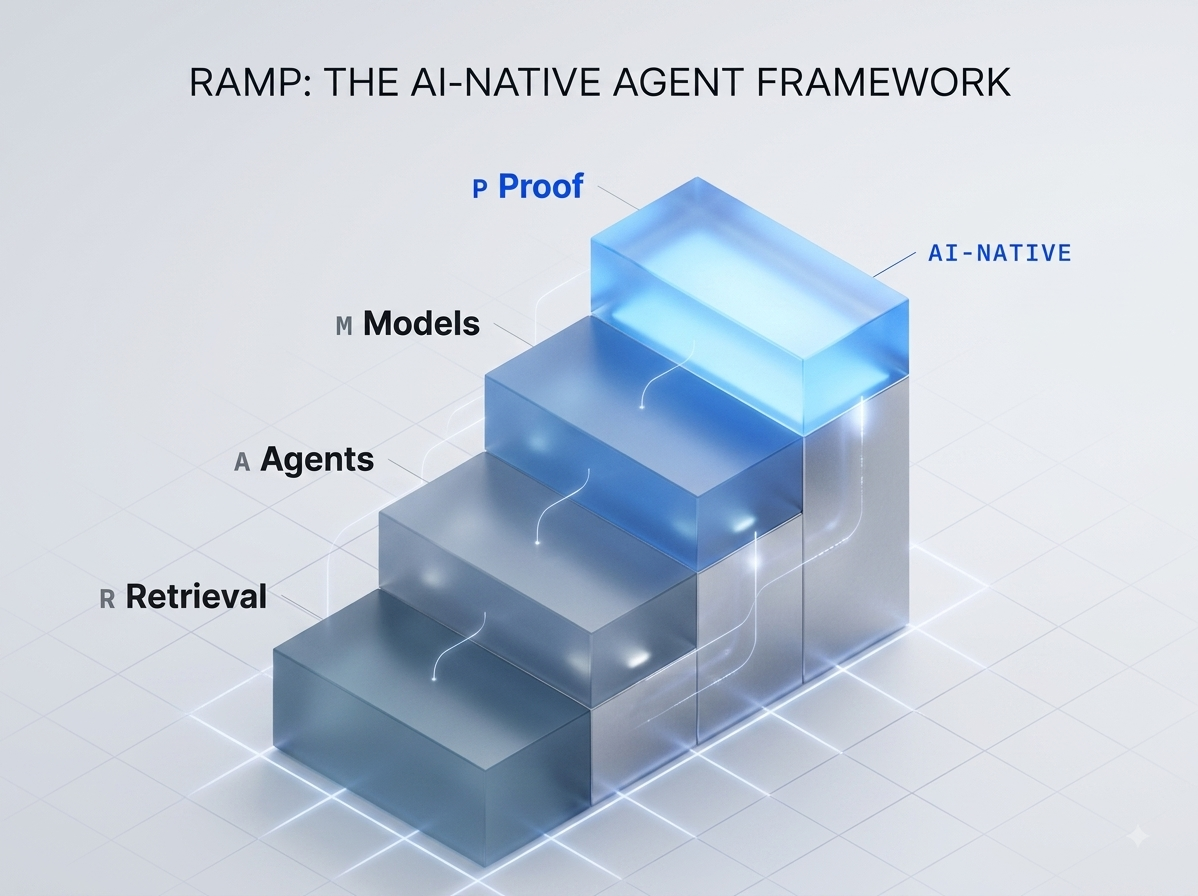
RAMP stands for Retrieval, Agents, Models and Proof. Together, these four capabilities describe a practical way for professionals to work when artificial intelligence becomes part of everyday execution.
They apply to software engineers, lawyers, accountants, researchers, marketers, designers, operators, recruiters, managers and executives. The implementation changes from profession to profession, but the underlying capabilities remain surprisingly consistent.
The shift is bigger than learning AI
When personal computers arrived in offices, people learned software. When the internet arrived, people learned browsers, email and search. When smartphones arrived, people learned apps.
AI is different because it does not merely give us another interface.
It increasingly performs parts of the work itself.
An AI system can read a document, examine data, generate code, prepare an analysis, summarize research, compare alternatives, create content and suggest decisions. Agents can increasingly perform sequences of those activities without needing a human instruction at every step.
That changes what competence looks like.
A highly capable professional can no longer be defined only by what they know and what they can personally execute. Their effectiveness increasingly depends on how well they can combine their own expertise with information, models, agents and verification.
This is why AI literacy alone is not enough.
Knowing what AI is matters. Knowing how to use it safely matters. Knowing how to write a useful prompt matters too.
But those are entry-level capabilities.
The deeper skill is learning how to turn machine intelligence into a trustworthy outcome.
Capability 1: Retrieval
The first capability is Retrieval.
The word may sound technical because retrieval is often discussed alongside RAG systems, vector databases and enterprise search. But the underlying idea is much simpler, and much more universal.
Before intelligence can be useful, it needs the right context.
Consider a sales manager preparing for a meeting with an important customer. A powerful AI model might know almost everything publicly available about the customer's industry, but that is not enough.
What did the customer tell the company six months ago? Which products are they using? What problems remain unresolved? Who attended previous meetings? What did the account executive promise? Has their business changed recently?
Without that information, the model may produce an impressive briefing that completely misses what matters.
The same problem appears everywhere.
A lawyer reviewing a contract needs more than general legal knowledge. They need the contract, relevant precedent, internal policies, jurisdictional requirements and the commercial context surrounding the agreement.
A software engineer investigating an outage needs source code, system architecture, deployment history, logs and telemetry. A financial analyst needs reliable numbers, assumptions, historical performance and relevant market information.
The AI can be extraordinarily intelligent and still fail because it was looking at the wrong reality.
Retrieval is not the same as search
Searching means finding information.
Retrieval means understanding which information the work depends on.
That distinction becomes important when AI enters professional workflows. A search engine can return thousands of documents, but the professional still needs to know which evidence matters, which sources are authoritative, which information is stale and what context is missing.
Someone who cannot make those judgments may feed an AI system large amounts of information and still get poor results.
In many fields, the ability to identify the right context has always separated experts from beginners. Experienced professionals know what to look for because they have seen similar situations before.
AI makes that skill even more valuable.
The more work we delegate to machines, the more carefully we need to decide what those machines should know.
Every profession has a retrieval problem
For a recruiter, Retrieval might include role requirements, candidate evidence, interview history, compensation constraints and organizational context.
For a marketer, it might include customer interviews, conversion data, campaign history, competitor activity and brand guidelines. For a doctor, it might involve patient history, diagnostics, clinical evidence and treatment protocols.
A supply-chain manager might need inventory positions, orders, routes, supplier performance, weather events and transportation constraints. A CEO might need financial data, customer signals, market developments, operating metrics and board commitments.
The technologies used to retrieve this context will continue to change.
The professional capability does not.
The enduring question is:
Do we have the right context before we ask intelligence to act?
That is Retrieval.
Capability 2: Agents
The second capability is Agents.
This is the part of the AI transition that may eventually change work most visibly because it introduces a new form of delegation.
Traditional software waits for instructions. An employee opens an application, performs an action, receives a result and decides what happens next.
Agents begin to break that pattern.
An agent can receive an objective, use tools, examine information, make intermediate decisions, perform actions and continue working toward the objective. The degree of autonomy varies enormously, but the direction is clear.
AI is moving from answering toward acting.
That means professionals need to learn something humans have been learning for thousands of years: how to delegate.
Delegation becomes a technical and professional skill
Good delegation is harder than it looks.
A manager cannot simply tell someone, “Handle everything,” and expect consistently good results. The person needs an objective, context, authority, constraints and clarity about when to return for guidance.
Agents are no different.
What exactly should the agent accomplish? Which tools should it access? What information should it see? What actions should it be allowed to take? What happens when the situation falls outside its instructions?
These are not purely technical questions.
They are questions about responsibility.
A customer-service agent might be allowed to refund $20 automatically but require human approval for $2,000. A coding agent might be allowed to create a pull request but not deploy directly to production.
A procurement agent might gather supplier proposals autonomously while a human retains the final purchasing decision.
The challenge is not simply getting agents to do more.
The challenge is deciding what they should be allowed to do without us.
Professionals will manage machine capacity
This introduces an interesting change in leverage.
Historically, a person's productive capacity was limited largely by time. An employee could only perform so many analyses, write so many proposals, review so many contracts or investigate so many accounts in a day.
Organizations increased capacity by adding people.
Agents create another possibility.
A salesperson might supervise agents that continuously research accounts, monitor buying signals and prepare meeting briefs. A marketer might coordinate agents for research, content production, campaign operations and analytics.
A software engineer might use agents for implementation, testing, documentation and security review. A financial controller might have agents continuously monitoring transactions and escalating unusual patterns.
The professional does not disappear from this picture.
Their role changes.
Instead of personally executing every unit of work, they increasingly become responsible for orchestrating a larger field of capability.
That is a different kind of productivity.
Capability 3: Models
The third capability is Models.
The early generative AI experience made it easy to think of AI as a single thing. You opened a chatbot, typed a question and received an answer.
That simplicity was useful for adoption, but it hides what is happening underneath.
There is no single intelligence called “AI.”
There are different models with different capabilities, costs, strengths, limitations and risk profiles. Some are strong at reasoning, others at extraction, coding, image understanding, speech, classification or generation.
Some models are cheap and fast enough to run thousands of times inside a workflow. Others make sense only for difficult problems where better reasoning justifies the additional cost.
And sometimes the best answer is not an AI model at all.
A simple rule might be safer. Traditional software might be more predictable. A human may need to make the decision.
Model judgment will become ordinary professional judgment
Today, model selection still sounds like something AI engineers should worry about.
That will change.
You do not need to understand how an internal combustion engine is designed to decide when driving is better than walking. You do not need to build a database to understand when your organization should store information in one.
Professionals will develop a similar practical understanding of models.
A lawyer may know that one type of model is appropriate for reviewing thousands of documents while another is better suited to complex reasoning. A marketing team may choose one model for image generation and another for research.
An operations manager may use a small model to classify routine incidents but escalate unusual cases to a stronger reasoning model or a human.
The question becomes less about knowing the name of every available model and more about understanding the shape of the problem.
What kind of intelligence does this task require?
Knowing when not to use AI is part of AI capability
This deserves emphasis because the current market often rewards the opposite behavior.
A company announces that it has added AI everywhere, and that is treated as progress.
But maturity is not measured by the percentage of workflows that contain AI.
It is measured by whether the right capability is being used for the right problem.
Some decisions require deterministic behavior. Some require explainability. Some cannot tolerate a plausible but incorrect answer.
Some involve highly sensitive information. Some are so simple that inserting AI merely increases cost and complexity.
An AI-native professional should be comfortable saying:
We do not need AI here.
That is not resistance to technology.
It is evidence of understanding it.
Capability 4: Proof
The fourth capability is Proof.
Of all four parts of RAMP, this may ultimately become the most consequential.
AI has already changed the economics of creating things.
A report that once required days can be drafted in minutes. Software that once required hours of coding can appear in seconds. Presentations, images, analyses, research summaries and proposals can be produced almost instantly.
That is extraordinary.
But there is an uncomfortable consequence.
It is becoming easier to create something that looks complete without knowing whether it is correct.
Polished is no longer evidence of good
Humans have always used presentation quality as a rough signal.
A carefully researched report usually took more effort than a careless one. Professional-looking software usually represented significant development work. A detailed financial analysis suggested that somebody had spent time building it.
AI weakens that relationship.
A completely wrong analysis can now look beautifully structured.
Code can compile and still contain subtle security flaws. A research summary can confidently cite evidence that was misunderstood. A legal argument can sound persuasive while relying on incorrect precedent.
The surface has become cheap.
Trust has not.
This is why Proof becomes essential.
Proof depends on the domain
Proof means establishing that an outcome has met an appropriate standard before it is trusted or used.
The standard changes depending on the work.
A software engineer may prove an outcome through automated tests, code review, security testing, performance validation and production monitoring.
A financial analyst may verify data sources, reproduce calculations, test assumptions and reconcile results against independent evidence.
A researcher may examine methodology, source quality, reproducibility and peer scrutiny. A marketer may ultimately look at customer behavior, conversion or revenue rather than whether an AI evaluator liked the campaign.
A doctor faces an entirely different standard because the consequence of being wrong is much higher.
There cannot be one universal mechanism for Proof.
But every profession needs one.
AI can help with Proof, but it cannot eliminate responsibility
AI will increasingly participate in verification too.
One model can critique another. Agents can run tests. Systems can compare outputs against policies, databases and expected behavior.
That is useful and necessary.
But verification cannot become an infinite chain of machines asking other machines whether they were right.
Eventually, somebody has to determine what evidence is sufficient for the consequence involved.
That may be an individual professional, a regulated process, an automated control system or some combination of all three.
The core principle remains simple.
Work should not be considered finished merely because AI produced something.
It is finished when the outcome has been proven to the standard that matters.
The four capabilities reinforce each other
RAMP is easiest to explain as four capabilities, but real work does not happen in four isolated boxes.
Retrieval affects Models because the available context may determine which intelligence is useful. Model choice affects Agents because different agents may need different reasoning capabilities.
Agents affect Proof because autonomous work requires stronger verification. Proof often sends us back to Retrieval because a failed check reveals missing information.
The framework behaves more like a loop than a checklist.
Imagine an analyst investigating why a company's sales dropped.
They retrieve internal sales data, customer feedback and external market information. They use agents to examine different segments and identify possible explanations.
They choose models capable of reasoning over the evidence. They then test those explanations against additional data and reject the ones that cannot be supported.
That final Proof step may reveal that important information is missing.
So the analyst retrieves again.
This continues until the result deserves to influence a business decision.
That is closer to how AI-native work actually happens.
Why these four capabilities are universal
At first glance, Retrieval, Agents and Models may still sound heavily connected to technology.
But look at what they mean at the capability level.
Retrieval is the ability to establish context.
Agents are about delegation.
Models are about choosing intelligence.
Proof is about judgment and trust.
Professionals have always done versions of all four.
AI makes them explicit.
A senior executive already retrieves information before making an important decision. They already delegate work. They already choose which experts to rely upon. They already seek evidence before committing the organization.
What changes is that a significant part of the information, work and intelligence can now come from machines.
RAMP provides a way to reason about that new environment.
The accountant needs RAMP
Consider an accountant preparing a monthly close.
Retrieval means assembling transactions, ledgers, policies, supporting documents and historical context.
Agents may reconcile transactions, identify exceptions and gather missing information. Different models may assist with classification, document interpretation or anomaly analysis.
Proof still belongs at the center.
Do the accounts reconcile? Are classifications correct? Are unusual entries supported? Does the result comply with relevant accounting standards?
The accountant's professional knowledge remains essential.
AI expands the scale at which that knowledge can operate.
The marketer needs RAMP
A marketer faces a different environment.
Retrieval might involve customer research, campaign history, conversion data, competitor positioning and brand guidelines.
Agents might research markets, produce creative variations, coordinate distribution or analyze responses. Models might participate in writing, reasoning, image generation and audience analysis.
Proof looks different again.
Did customers care?
Did conversion improve?
Did the positioning become clearer?
Did revenue move?
AI can generate more content than the world could ever consume.
The marketer's value therefore moves away from simply producing content and toward knowing what is worth producing.
The engineer needs RAMP
Software engineering may move faster than many other professions because agents can already perform meaningful technical work.
Retrieval means giving the system enough understanding of the repository, dependencies, architecture, documentation and production environment.
Agents may implement features, write tests, investigate bugs and prepare documentation. Different models may handle planning, coding, review or debugging.
Proof becomes the boundary between plausible software and dependable software.
Does it work?
Is it secure?
Will it scale?
Does it break something elsewhere?
The engineer may eventually type far less code while being responsible for far more code.
That is not the end of engineering.
It is a shift toward engineering judgment.
The manager needs RAMP
Managers may encounter RAMP in an even more interesting form.
Their traditional leverage came through people.
They gathered information, delegated work, reviewed results and made decisions. Much of their day was spent coordinating the movement of information across teams.
AI agents can participate in that operating system.
A manager might have agents monitoring project risks, analyzing customer feedback, preparing operational reviews or following up on routine actions.
The manager's scarce capability becomes deciding what deserves attention.
As machine execution grows, human prioritization may become increasingly valuable.
The framework is common, the learning cannot be
If all professionals need RAMP, it would be tempting to create one RAMP curriculum and teach everyone the same thing.
That would miss the point.
An accountant does not need the same Retrieval depth as a software engineer.
A software engineer does not need the same standards of Proof as a lawyer. A recruiter needs different agent workflows from a supply-chain manager.
The framework should remain common because it gives us a shared language.
The learning underneath it should become deeply contextual.
There is also another dimension.
Two software engineers may have very different starting points. One may already be excellent with AI-assisted development but weak at verification. Another may understand models well but have little experience orchestrating agents.
Teaching both people the same course wastes time.
The better principle is:
Standardize the capabilities. Personalize the path.
That is how professional learning should evolve in the AI era.
Domain expertise becomes more valuable, not less
One of the strangest assumptions in the AI conversation is that because models know so much, professionals no longer need to.
That misunderstands expertise.
Knowledge is not merely remembering facts.
An experienced professional recognizes patterns, notices anomalies, understands consequences and knows which questions matter.
They can tell when something feels wrong even before they can explain exactly why.
AI gives that expertise extraordinary leverage.
A finance professional who understands the domain deeply and can use RAMP effectively may analyze far more possibilities than before.
A scientist can explore more literature. A lawyer can investigate more precedent. An engineer can examine more approaches.
The machine expands the search space.
Expertise helps decide what is worth believing.
The durable professional advantage may therefore be described quite simply:
Domain expertise × RAMP capability.
Neither side replaces the other.
Together, they create leverage.
The scarce resource is moving
For much of the knowledge economy, producing professional work was expensive.
Research took time.
Writing took time.
Analysis took time.
Software took time.
Coordination took time.
AI reduces the cost of many of these activities.
When production becomes abundant, scarcity moves somewhere else.
The scarce resource increasingly becomes judgment.
What deserves to be produced?
What should be delegated?
Which context matters?
Which result can be trusted?
What action should follow?
This is why the future of work cannot be understood only through the lens of automation.
The interesting question is not merely which tasks AI will perform.
It is which human capabilities become more valuable when machines can perform so many tasks.
RAMP is one answer to that question.
AI skills will eventually stop being a separate category
For now, organizations will continue talking about AI training.
That is necessary because the transition is still new.
Eventually, however, “AI skills” may become a strange phrase.
We rarely talk about email skills anymore.
We do not describe a modern accountant as digitally enabled because they use spreadsheets. A salesperson is not considered a technology specialist because they use a CRM.
The technology disappears into the profession.
AI will probably follow the same path.
An accountant will simply be expected to know how to work with available intelligence. So will the lawyer, engineer, marketer and manager.
At that point, RAMP will not be about learning AI.
It will be about being capable of doing the job.
Four questions for the AI era
The technologies underneath work will continue changing.
New models will arrive.
Agents will become more capable.
Interfaces will disappear and reappear in new forms.
Much of what feels sophisticated today will become ordinary.
A durable work framework therefore needs to survive all of that change.
RAMP can ultimately be reduced to four questions.
Retrieval: Do we have the context this outcome depends on?
Agents: What work should be delegated, and under what boundaries?
Models: What kind of intelligence should participate?
Proof: How will we establish that the result deserves to be trusted?
Those questions can be asked by a developer.
They can be asked by a lawyer.
They can be asked by a salesperson, a financial analyst, a researcher, a recruiter, a designer or a CEO.
That universality is the point.
LAMP, MEAN and MERN gave earlier generations of developers a common language for assembling technology.
The AI era needs a common language for assembling capability.
Not because everyone is becoming a developer.
Because intelligence is becoming part of everyone's work.
Retrieval. Agents. Models. Proof.
RAMP.
Four capabilities that may matter long after today's AI tools are forgotten.