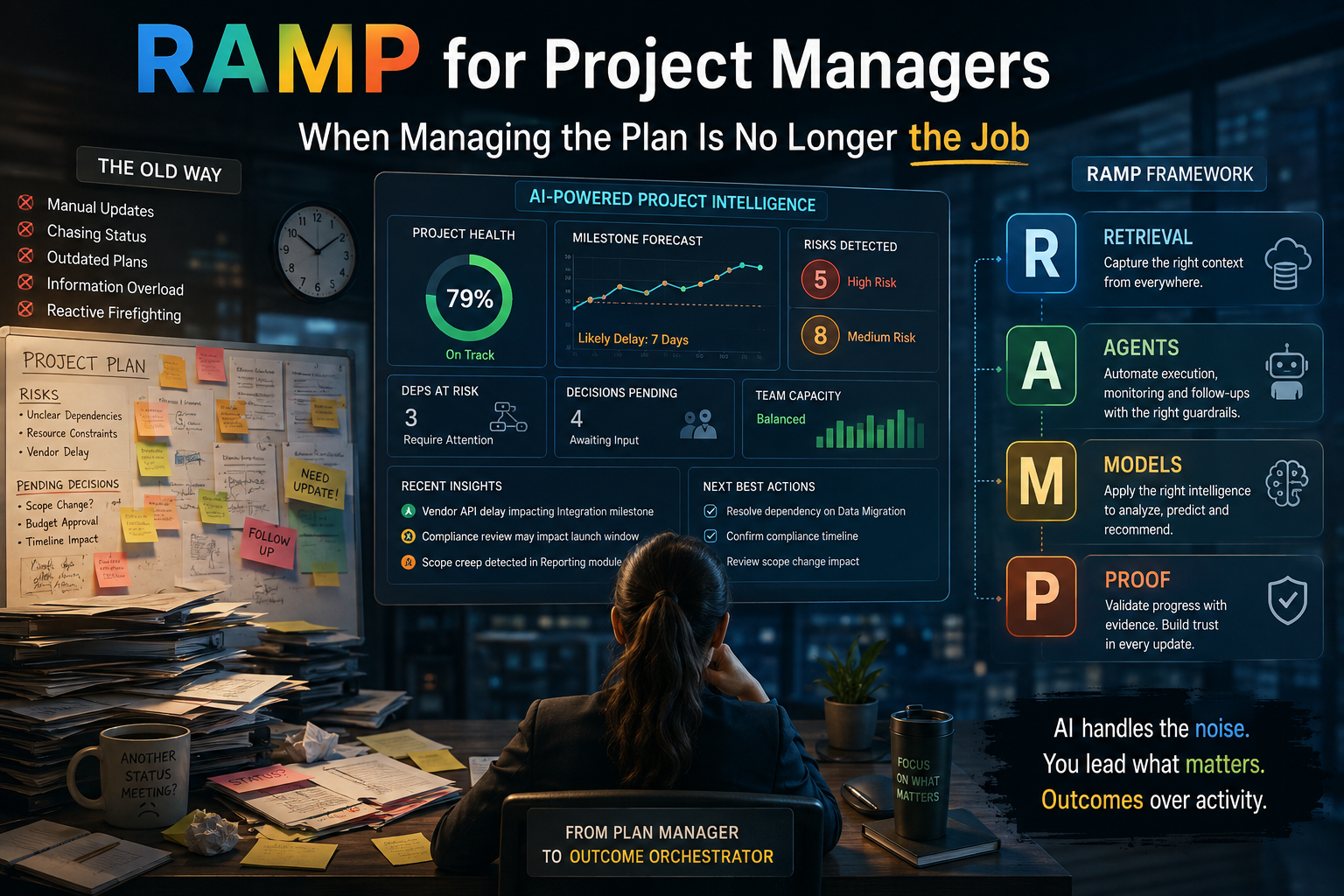
RAMP for Project Managers: When Managing the Plan Is No Longer the Job
Meera has been managing projects for almost fifteen years, and she knows exactly what Monday mornings feel like.
Before the first coffee is finished, three people have already asked for status. One workstream is apparently “90% complete” for the third consecutive week, an engineer has discovered a dependency nobody mentioned during planning, and the steering committee wants to know whether the October launch date is still safe.
Meera opens the project plan, checks Jira, scans Slack, looks at the latest spreadsheet from finance and searches through email for the decision somebody vaguely remembers making two weeks ago. By 11 a.m., she has spent most of the morning doing something project managers rarely put on their resumes: reconstructing reality.
This is the hidden job behind project management.
The project plan says what should be happening. Meera's actual value comes from discovering what is really happening, understanding what it means, and getting a group of people with different priorities to move toward the same outcome.
Then AI agents arrive.
Suddenly, an agent can read every ticket, summarize every meeting, identify overdue dependencies, compare actual progress with the plan and prepare the weekly status report. Another can chase owners for updates, while another watches risks and flags changes before somebody remembers to update the risk register.
At first, this sounds like fantastic news for Meera.
Then an uncomfortable thought appears.
If AI can maintain the plan, collect status, prepare reports, schedule meetings and follow up on actions, what exactly is the project manager supposed to do?
The answer is not that project management disappears.
The answer is that we may finally discover what project management was really for.
The administrative shell around the profession can shrink dramatically. What remains is much harder and much more valuable: understanding context, orchestrating human and machine work, recognizing when the plan is lying, and proving that progress is real.
That is where the RAMP framework becomes surprisingly relevant to project managers.
1. Most project plans are outdated the moment they are approved
Meera is leading a customer-platform transformation involving engineering, operations, finance, compliance and an external implementation partner.
The project begins the way large projects usually begin. Workshops are held, milestones are agreed, responsibilities are assigned and a detailed plan is approved.
Everyone feels good for approximately four days.
Then reality starts moving.
A vendor API turns out to behave differently from its documentation. Compliance raises a requirement nobody anticipated. Engineering discovers that an old service contains logic the new platform still depends on, while finance delays approval for infrastructure that was assumed to be available.
None of these events is catastrophic on its own. The danger comes from the fact that each one changes the meaning of everything around it.
A milestone may still show green even though the dependency underneath it has slipped. A team may report that development is complete even though integration testing has not started. Two departments may use the word “done” to mean entirely different things.
This is why experienced project managers develop a healthy distrust of status reports.
They learn to listen for hesitation in meetings. They notice when the same dependency appears in three conversations but nowhere in the plan, and they know that the sentence “we should still be okay” often means nobody has calculated the impact yet.
AI can collect far more project information than Meera ever could.
It can read tickets, transcripts, documents, emails and system activity continuously. It can compare what teams said last week with what they are saying now, detect missing updates and identify work that appears stalled.
That sounds like a reporting capability.
It is actually a Retrieval capability.
For the project manager, Retrieval means assembling the context required to understand the real state of execution.
The formal plan is only one source.
The truth may be buried in a code repository, a procurement email, a support ticket, a meeting transcript or a conversation between two specialists who never realized their decision affected somebody else's milestone.
A RAMP-ready project manager therefore thinks differently about project visibility.
They do not ask only, “Is the plan updated?”
They ask whether the execution system has enough context to understand what is changing and why.
This distinction becomes enormously important once agents start acting on project information.
An agent working from stale status can automate the wrong escalation with impressive efficiency. Better automation does not fix poor context.
It simply distributes the misunderstanding faster.
2. The project manager may soon have more agents than direct reports
A month into the project, Meera begins experimenting with agents.
The first agent is straightforward. It reviews meeting transcripts, extracts decisions and action items, then compares those actions against the project tracker.
The second monitors dependencies.
The third prepares a weekly executive summary.
Before long, she adds another agent that looks for emerging risks by analyzing schedule movement, unresolved blockers and repeated mentions of the same issue across different workstreams.
Something strange starts happening.
Meera is spending less time collecting project information.
The Monday morning ritual that once consumed several hours begins happening almost continuously in the background.
But the reduction in administrative work creates a new problem.
The agents keep finding things.
One agent believes the integration milestone is at risk because two dependencies are incomplete. Another says the milestone remains achievable because development velocity increased during the previous sprint.
A third identifies a potential compliance delay based on a meeting comment that the compliance lead considered merely exploratory.
Meera now has more information than before.
What she needs is not another dashboard.
She needs judgment.
This is where Agents changes project management more deeply than meeting transcription or automated reporting.
The project manager is no longer simply coordinating people.
They are beginning to coordinate a mixed execution environment of humans, agents, software systems and organizational processes.
That requires a new kind of delegation.
What should the agent merely observe?
What should it be allowed to update?
Can it automatically chase an owner?
Should it reschedule dependent activities?
Can it recommend a change in priority?
Could it notify executives when risk crosses a threshold, or should a human interpret the situation first?
These decisions matter because project management contains an enormous amount of social context that rarely appears in software.
Imagine an important workstream is late because its lead engineer has been pulled into a production incident for three days.
An agent sees delay.
Meera sees circumstance.
Automatically escalating the engineer to senior leadership may technically follow the governance process while damaging trust with someone who was solving a more urgent business problem.
A project manager has always needed to understand the difference between accountability and bureaucracy.
Agents make that distinction more important because machines are exceptionally good at enforcing processes that humans forgot were supposed to serve a purpose.
The best project managers will not be the ones who automate the most coordination.
They will be the ones who know which coordination should never become mindless automation.
3. AI exposes how much project management was really information management
There is a moment in almost every large project when someone asks Meera for a status report she has already prepared in three different formats.
Engineering wants detailed task status.
Executives want five bullets.
Finance wants forecast variance.
The customer wants milestone confidence.
The PMO wants red, amber or green.
Much of project management became an industry of translating the same execution reality into different reporting structures.
AI is extremely well suited to eliminating much of this work.
If the underlying context is available, a model can explain the same project differently to an engineer, CFO and customer without Meera manually rebuilding the story each time.
This is where the Models capability in RAMP becomes useful.
Project managers do not need to become experts in model architecture. They do need to understand that different forms of AI are appropriate for different kinds of project work.
A lightweight model may be perfectly capable of categorizing tasks or summarizing routine updates. A stronger reasoning model may be useful when examining a complicated dependency chain or challenging a recovery plan.
Some work should not use generative AI at all.
Schedule calculations, financial controls and contractual milestone rules may be better handled by deterministic systems where the answer must behave consistently every time.
That distinction matters.
AI enthusiasm can easily lead organizations to insert models into activities where traditional software is safer, cheaper and easier to audit.
A RAMP-ready project manager learns to ask a more mature question than “Where can we use AI?”
They ask, “What kind of intelligence does this part of the project actually need?”
Sometimes that means a model.
Sometimes an agent.
Sometimes a rule.
Sometimes a human conversation.
The sophistication is not in maximizing AI.
It is in designing the right execution system around the outcome.
4. AI may finally kill the most dangerous phrase in project management
Two months into Meera's transformation project, the steering committee asks whether the launch date is still achievable.
Every workstream lead says yes.
Engineering says yes, although integration testing has slipped.
Compliance says yes, provided the final review begins on time.
The external vendor says yes, assuming the client completes data migration according to the original schedule.
Operations says yes, but training has not yet been scheduled.
Individually, nobody is lying.
Collectively, the project is in trouble.
This is one of the oldest problems in project management.
Each team reports its local truth while the project manager is responsible for understanding the system truth.
AI could become exceptionally valuable here.
An agent can continuously examine dependencies rather than waiting for people to recognize the implications manually. It can compare milestone confidence with evidence and identify situations where several individually reasonable assumptions cannot all be true at the same time.
But there is a catch.
The machine can also create a new version of the same illusion.
Suppose an AI-generated status report says the project is “82% likely to meet the target date.”
That number looks sophisticated.
Where did it come from?
Which assumptions were used?
What historical evidence supports the estimate?
Did the model understand that the external vendor's “complete” actually means ready for customer testing rather than production ready?
The polished confidence score can become more dangerous than the old red-amber-green dashboard because people may assume the machine calculated something objective.
This is where Proof becomes central to RAMP for project managers.
The job is not merely to produce status.
It is to establish whether status can be believed.
If a milestone is marked complete, what evidence demonstrates completion?
If testing is 70% finished, what does that percentage actually represent?
If a dependency is closed, has the downstream team confirmed it?
If an agent predicts a delay, which evidence drove the prediction?
Project management becomes much stronger when teams stop treating status as an opinion and begin treating it as a claim that needs evidence.
This could be one of AI's most valuable contributions to the profession.
Not better dashboards.
Better truth.
5. The project manager's real product is confidence
Meera has never thought of herself as selling anything.
But in a sense, every good project manager produces one product for everyone around the project.
Confidence.
Executives need confidence that commitments are realistic.
Teams need confidence that decisions will hold long enough for them to execute. Customers need confidence that problems will surface early rather than appearing as surprises at the end.
That confidence does not come from cheerful status reports.
It comes from accurate information, honest tradeoffs and the feeling that somebody understands how the pieces fit together.
This is why the arrival of AI does not make the project manager irrelevant.
It makes superficial project management irrelevant.
If someone's primary contribution is scheduling meetings, collecting updates and formatting status reports, agents will absorb a large part of that work.
That is already happening.
But if the project manager understands how execution behaves across people, systems, incentives and dependencies, AI gives them enormous leverage.
Meera can now monitor a much larger project surface without manually chasing every update. Agents can prepare the raw material while she focuses on what the raw material means.
She can spend more time resolving contradictions between teams.
She can examine whether the recovery plan is realistic.
She can notice when everybody is optimizing their own workstream at the expense of the outcome.
She can have the difficult conversation earlier.
In other words, AI can remove the work that made project managers busy and expose the work that made the good ones valuable.
That may be uncomfortable for part of the profession.
It is also an opportunity to elevate it.
6. The future project manager may manage outcomes, not projects
A year later, Meera's way of working looks very different.
She no longer spends Friday afternoons preparing the weekly report.
The execution environment already knows what changed, which milestones moved, where dependencies accumulated and which risks deserve attention.
The report can be generated whenever someone needs it.
Her meetings have changed too.
There are fewer meetings whose purpose is simply exchanging status.
When people gather, they are there because something needs judgment, negotiation or a decision.
Agents handle much of the follow-up.
They record what was decided, track the consequences and bring issues back when reality diverges from the decision.
Meera's project plan still exists.
But she no longer treats it as the center of the project.
The center is the outcome.
This distinction matters because the traditional project was designed partly around the limitations of human coordination.
Work was broken into tasks.
Tasks were assigned.
People reported progress.
Project managers assembled those reports and tried to reconstruct whether the overall outcome remained possible.
An AI-native execution environment can observe much of that movement continuously.
The project manager does not need to be the human API connecting every workstream.
That frees them to ask a better class of questions.
Are we still solving the right problem?
What changed since we approved the plan?
Which assumptions are no longer true?
Where is the organization pretending to have certainty that does not exist?
Which delay actually matters?
What decision are we avoiding?
Should the project itself still exist?
That last question may become more important than project managers expect.
Organizations often continue projects because stopping one feels like failure.
A strong project manager understands that protecting the outcome sometimes means killing the project.
AI can generate a recovery plan.
It cannot make courage easier.
7. RAMP turns project management from coordination into orchestration
When Meera first encountered AI, she assumed it would help her manage projects faster.
That turned out to be the least interesting part.
The larger change was that AI forced her to examine what management meant once information gathering, reporting and routine coordination could happen automatically.
She discovered that Retrieval was not about searching project documents. It was about maintaining a truthful picture of execution across fragmented systems and conversations.
She discovered that Agents were not digital assistants waiting to take meeting notes. They were new execution capacity that needed boundaries, objectives and supervision.
She discovered that Models were not simply smarter chatbots. They were different forms of intelligence that could help interpret risk, challenge plans and explain complicated situations, provided they were used in the right places.
Most importantly, she discovered that Proof was what she had been doing all along when project management was at its best.
Was the work really complete?
Was the date really safe?
Was the risk really understood?
Did everyone mean the same thing when they said yes?
Those questions become even more important when machines participate in execution because AI can create an enormous amount of apparent progress.
Agents can close tasks.
Models can generate plans.
Systems can produce reassuring summaries.
None of that guarantees the outcome is getting closer.
The RAMP-ready project manager therefore becomes something closer to an execution orchestrator.
They understand the context surrounding the work, coordinate human and machine capacity, choose where intelligence belongs and insist that progress survives contact with evidence.
That version of project management has much less administration in it.
It also has much more responsibility.
A few years from now, Meera may manage projects with twice the complexity and half the manual coordination she handles today.
She may have dozens of agents watching execution, preparing options and resolving routine work in the background.
Yet the reason the organization still wants Meera in the middle will not be because she knows how to maintain a Gantt chart.
It will be because when everyone else sees tasks, reports and percentages, she can still see the outcome.
And she knows when the story the project is telling is different from the truth.
That has always been the rare skill in project management.
AI may finally make it impossible to hide.