 ★ 4.3 · 125 reviews
Mend.io
Unified governance for software, code, and AI.
About Mend.io
Mend.io is a comprehensive application security posture management (ASPM) platform that unifies software composition analysis (SCA), static application security testing (SAST), and AI security into a single workflow. It provides full-stack visibility into every component in a codebase—including open source packages, AI models, agents, and system prompts—and continuously updates SBOM and AI-BOM to support compliance. The platform offers AI-powered remediation, runtime guardrails for AI applications, and integrates directly into CI/CD pipelines to automate scanning and provide real-time feedback to developers. Its capabilities include supply chain blind spot identification, dynamic AI behavioral testing with over 1,000 concurrent tests, runtime in-application protection, and compliance support for EU AI Act, Executive Order 14028, and Cyber Resilience Act. Mend.io is designed to reduce alert noise by prioritizing vulnerabilities based on reachability, and includes features like differential scanning to focus on new or modified code, thereby reducing risk and improving remediation efficiency. With AiDOOS deployment, organizations can leverage the platform's full potential across hybrid environments, ensuring seamless integration and enhanced adoption.
Challenges It Solves
- Lack of visibility into open source dependencies and AI components in modern codebases
- Difficulty prioritizing vulnerabilities due to alert noise and false positives
- Inability of traditional security tools to detect and mitigate dynamic AI security risks like prompt injection
- Compliance pressure from regulations requiring verifiable evidence of security testing and inventory
Screenshots

Use Cases
Dependency Management
Automate tracking and updating of open source dependencies to reduce vulnerabilities.
AI Security Posture Management
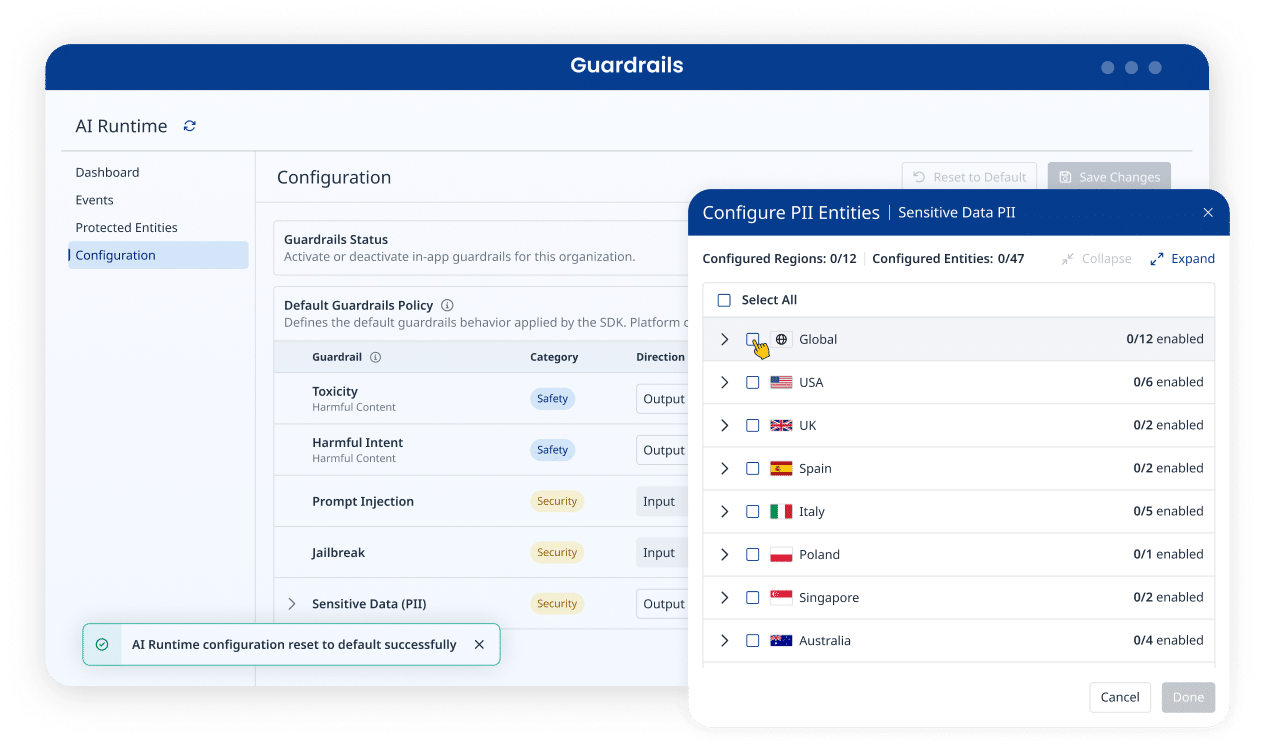
Map AI components, test for vulnerabilities, and enforce runtime guardrails to secure AI applications.
DevSecOps Integration
Integrate security scanning directly into developer workflows and CI/CD pipelines for shift-left security.
Compliance and Reporting
Generate SBOM/AI-BOM and audit-ready documentation to meet regulatory requirements.
Pricing
Custom pricing — built for your team
Mend.io pricing is tailored to your organisation's size, integrations, and requirements. AiDOOS generates your proposal instantly — scoped & ready in seconds.
Key Features
Combine software composition analysis and static application security testing in one platform.
Map AI models, agents, and system prompts with AI-BOM; test and protect against AI-specific threats.
Inspect LLM inputs and outputs in real-time to enforce security policies against prompt injection and data leakage.
Automated dependency updates at scale to keep dependencies healthy.
Prioritize vulnerabilities based on actual reachability in the code to reduce alert noise.
Generate SBOMs and AI-BOMs to support compliance with standards like EU AI Act and CRA.
What Reviewers Say AI-synthesized from 125 reviews
What works well
- Ease of use and effective integration with CI/CD pipelines
- Comprehensive vulnerability management and dependency tracking
- Unified platform for open source, code, and AI security
Common concerns
- Pricing not publicly disclosed
- Full potential requires custom configuration
Reviews
125 verified reviewsReviewer Demographics
Top Industries
No data available
Company Size
No data available
Enterprise Readiness
Identity & Access
Data Security
SLA & Availability
Compliance & Portability
Integrations
GitHub
Integrates with GitHub repositories to scan for vulnerabilities in open source dependencies and AI components.
GitLab
Integrates with GitLab repositories to provide security scanning and dependency management.
Bitbucket
Integration with Bitbucket repositories for vulnerability scanning and remediation workflows.
Jenkins
Integrates with Jenkins pipelines to automate security scans and dependency checks.
Jira
Creates and updates Jira tickets for vulnerabilities found, enabling tracking and remediation.
Slack
Sends security alerts and notifications to Slack channels for real-time awareness.
GitHub Copilot
Integrates with GitHub Copilot to secure AI-generated code by scanning and providing remediation guidance.
OpenAI
Secures AI applications built on OpenAI models with runtime guardrails and behavioral testing.
Governance & Compliance
EU AI Act
Classification: High-risk (self-declared)
Data Processing Agreement
Data Processing Agreement DPA available
Sub-processors
Fully disclosed
Right to Erasure
✓ Supported
Change Notifications
No data available
NIST AI RMF
✓ Aligned
AiDOOS Managed Deployment
Deploy Mend.io in 72 hours
AiDOOS handles setup, CRM integration, SSO config, and user provisioning. Your team goes live — not your IT department.
Prerequisites
- Administrative access to version control systems
- Valid credentials for CI/CD pipelines
- Compliance requirements (e.g., SOC 2, GDPR) confirmation
Configuration Options
- Integration with GitHub, GitLab, Bitbucket
- Customizable scanning policies
- Integration with Jira, Slack, and other tools
Often Deployed With
Common Setup Issues (& how AiDOOS handles them)
How Mend.io Compares
| Product | AI & Analytics | Ease of Use | Enterprise Features | Pricing | Integrations | Mobile Experience | Quick Setup | Customer Support | Rating | Price/mo |
|---|---|---|---|---|---|---|---|---|---|---|
|
M
Mend.io This product
|
Excellent | Good | Excellent | Fair | Excellent | Poor | Good | Excellent | ★ 4.3 | $Custom/user |
|
SN
Snyk
|
Good | Excellent | Good | Good | Excellent | Poor | Excellent | Good | — | $Custom/user |
|
SO
Sonatype
|
Good | Fair | Excellent | Fair | Good | Poor | Fair | Good | — | $Custom/user |
|
CX
Checkmarx
|
Good | Fair | Excellent | Fair | Good | Poor | Fair | Good | — | $Custom/user |
A Virtual Delivery Center for Mend.io
Pre-vetted experts and AI agents in the loop, assembled as a delivery pod. Pay in Delivery Units — universal pricing across roles, seniority, and tech stacks. No hiring, no contracting, no procurement cycle.
- Plans from $2,000 — Starter Pack, 10 Delivery Units, 90 days
- Refundable on unused Delivery Units, anytime — no questions asked
- Re-delivery guarantee on acceptance miss
- Pre-flight delivery sizing — you see the plan before you commit
How a Virtual Delivery Center delivers Mend.io
Outcome-based delivery via AiDOOS’s VDC model. Why VDC vs traditional consulting? →
Outcome-Based
Pay for results, not hours
Milestone-Driven
Clear deliverables at each phase
Expert Network
Access to certified specialists