Most companies don't have an AI strategy problem.
They have an AI work strategy problem — and they can't tell the difference.
Here's what I mean. Buying licenses is easy. Running a prompt-writing workshop is easy. Having twenty employees spin up experimental agents feels like progress. So leadership checks the box: "we're doing AI."
But none of that redesigns how the work actually happens. And that's the real question:
→ Can your people reach the context they need, or is it locked in five systems nobody can search? (Retrieval)
→ Can agents operate safely across those systems, or does every automation need a human babysitter? (Agents)
→ Does anyone know which model fits which job — or is it "use ChatGPT for everything"? (Models)
→ And before AI output touches a customer, money, or a real decision — who proves it's right? (Proof)
Those four questions are RAMP. And most organizations can answer the adoption questions confidently while going quiet on the work ones.
An org doesn't become AI-native by purchasing AI. It becomes AI-native when RAMP is built into how work is designed — especially Proof, because a world full of cheap, convincing, machine-generated output doesn't suffer from a shortage of work. It suffers from a shortage of trusted work.
So the question worth sitting with: does your company have an AI adoption plan, or an AI work plan?
They are not the same thing.
Most companies don't have an AI strategy problem.
They have an AI work strategy problem — and they can't tell the difference.
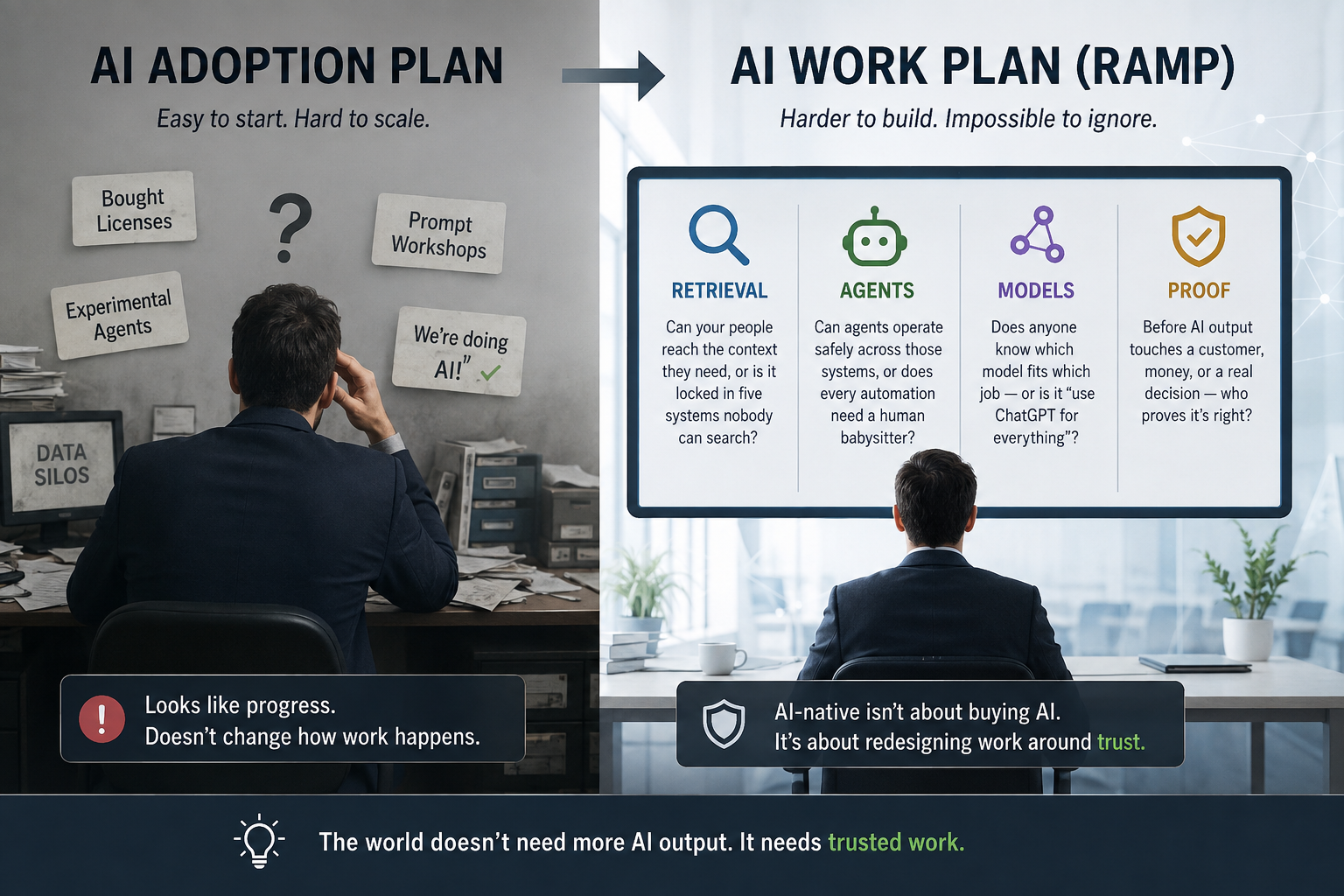
Here's what I mean. Buying licenses is easy. Running a prompt-writing workshop is easy. Having twenty employees spin up experimental agents feels like progress. So leadership checks the box: "we're doing AI."
But none of that redesigns how the work actually happens. And that's the real question:
→ Can your people reach the context they need, or is it locked in five systems nobody can search? (Retrieval)
→ Can agents operate safely across those systems, or does every automation need a human babysitter? (Agents)
→ Does anyone know which model fits which job — or is it "use ChatGPT for everything"? (Models)
→ And before AI output touches a customer, money, or a real decision — who proves it's right? (Proof)
Those four questions are RAMP. And most organizations can answer the adoption questions confidently while going quiet on the work ones.
An org doesn't become AI-native by purchasing AI. It becomes AI-native when RAMP is built into how work is designed — especially Proof, because a world full of cheap, convincing, machine-generated output doesn't suffer from a shortage of work. It suffers from a shortage of trusted work.
So the question worth sitting with: does your company have an AI adoption plan, or an AI work plan?
They are not the same thing.