
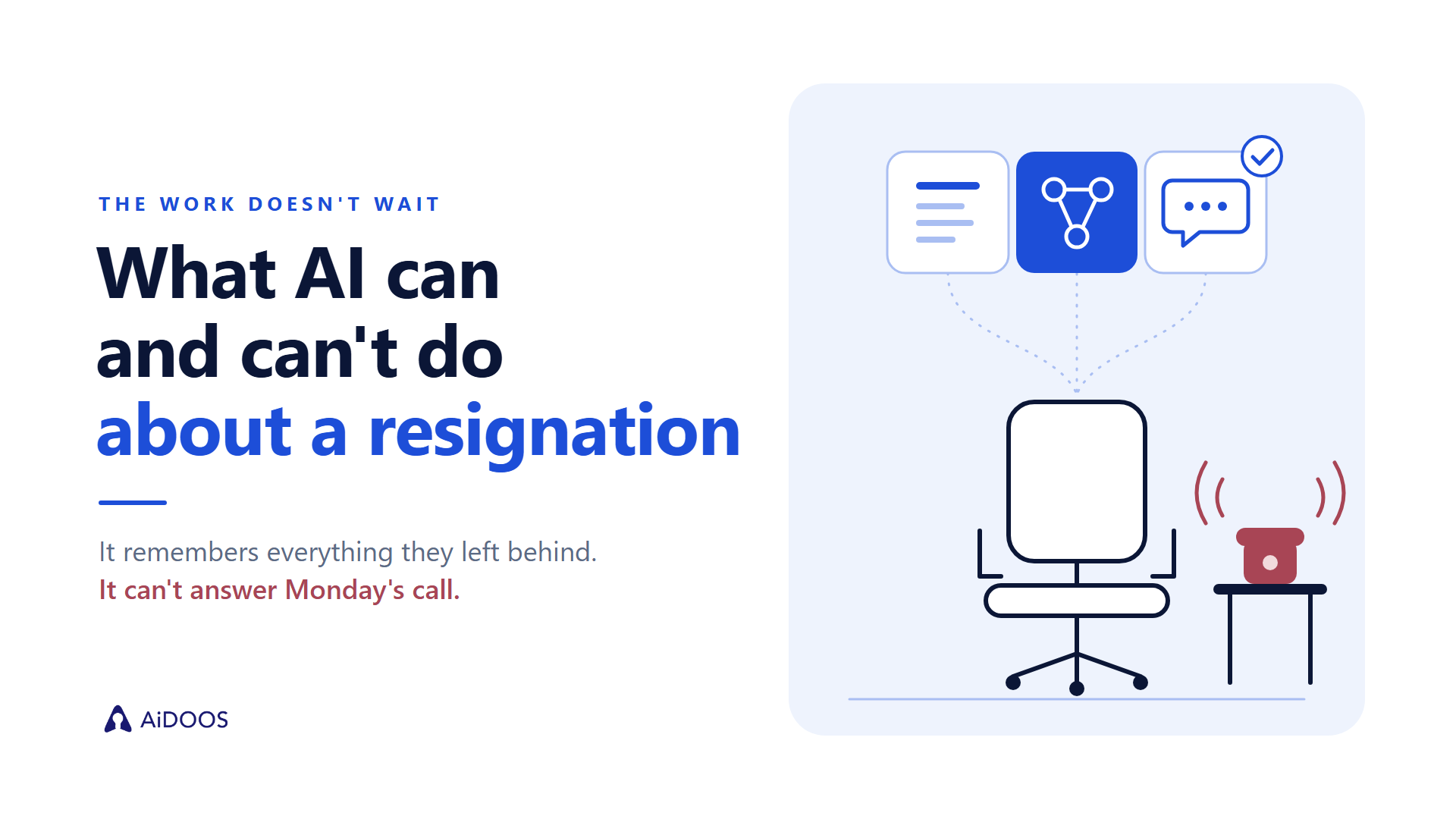
It usually arrives on a Friday afternoon.
"I've decided to move on. My last day will be the 14th."
You read it twice. Then the questions start, quietly, one after another. Who else knows how the month-end report works? Who talks to that one supplier? Where is the password for the system nobody else touches? Why does that job have to be run by hand every Tuesday?
You have two weeks to find out. Filling the role will take about six weeks at the median, according to SHRM. Getting the new person fully up to speed will take months after that.
Every manager has lived this moment. What has changed is that in 2026, there is a new promise: AI will capture what they know.
Some of that promise is real. Some of it isn't. Here is an honest look at both, so you know what to expect the next time that email arrives.
First, what we all already know
A few things nobody disputes:
- People leave. Good people leave. It's normal, and it will keep happening.
- Two weeks is never enough to hand over a job someone spent years learning.
- The handover document written in the last week is always shorter than the job.
- Colleagues end up covering, on top of their own work, for longer than anyone planned.
- The new hire spends their first months asking questions nobody can answer.
In a Panopto survey, employees said 42% of the knowledge in their role was unique to them. Their colleagues couldn't cover that part when they left. Whatever the exact number at your company, you know the feeling. A big piece of the job lives with one person.
So it makes sense that AI is being pointed at this problem. Let's look at what it actually does.
What AI can do today
1. Collect everything they left behind
The person who resigned created a trail: documents, spreadsheets, tickets, emails, meeting notes, shared folders. Nobody has time to read all of it during a notice period. AI does.
ServiceNow, for example, now has an offboarding workflow with AI agents in it. One agent asks the manager whether a handover is needed. Another finds the documents the departing employee created, sorts them, and asks the employee to approve them before they go to the manager.
That's useful. Weeks of digging become a sorted pile in an afternoon.
2. Interview them, and ask better questions
Most exit interviews ask how the person felt about the job. Very few ask how the job actually runs.
AI interviewers change that. Tools like Sensay hold a conversation with the person who is leaving, ask follow-up questions, and turn the answers into something the team can search later. An AI never gets tired of asking "and then what happens?"
3. Answer the new hire's questions
Once knowledge is collected, AI can make it searchable. The new hire asks, "Why do we send this invoice manually?" and gets an answer, with a link to where it came from. That alone can save weeks of awkward questions to busy colleagues.
4. Keep the offboarding checklist honest
Access removed, laptop returned, tasks reassigned, approvals signed. Tools like Gloat's offboarding agent run this checklist and keep an audit trail. Nothing important slips through because someone forgot.
5. Read the systems themselves
This one is less talked about, and it matters most.
The person's knowledge isn't only in their documents. It's built into the systems they ran: the custom fields, the scheduled jobs, the reports with a manual fix, the integration that breaks if one setting changes. AI can now read those systems directly and write down, in plain language, how things really work. Then it can list what it can't explain, so you know exactly which questions to ask before the person leaves.
That's a big shift. Most tools start with the person. This starts with the system.
The eye-opener: the person is the weakest source
Here is something people rarely say out loud.
During the notice period, the departing person is probably the worst place to get knowledge from. Not because they're unhelpful. Most people genuinely want to leave things in good shape. But think about their situation:
- They are mentally halfway into their next job.
- They're finishing their own work and saying goodbyes.
- They don't know what they know. The things they do every day have become automatic, so they forget to mention them.
That last point is old wisdom. The philosopher Michael Polanyi put it simply: "we can know more than we can tell." Ask an expert to write down their job and they'll describe the parts they think about. The parts they no longer think about, the shortcuts and the fixes, are exactly the parts that break after they're gone.
The system doesn't have that problem. It remembers the custom field added three years ago. It remembers the job that runs at 2 a.m. It remembers the exception in the billing rule. It doesn't need the person to remember.
So the smart order is: system first, process second, person last. Let the system speak. Then ask the person only about the gaps. Their two weeks go much further that way.
And there's a bonus. If you start from the system, it still works when the person has already gone.
What AI can't do
Now the honest part.
1. It can't do the work on Monday
This is the big one, and it's almost never mentioned.
A perfect record of how the work runs doesn't run the work. On the Monday after someone leaves, customers still call. Month-end still comes. The integration still breaks. Someone has to actually do the job, not just read about it.
The AI offboarding tools we looked at are all about capturing. None of them is about delivering. You end up with a beautiful library of knowledge and nobody to use it. The seat is still empty for six weeks or more, and the work is still waiting.
A perfect map doesn't drive the truck.
2. It can't capture what was never anywhere
Some knowledge lives in no system and no document. The supplier who only picks up if you call his mobile. The customer who needs a phone call before any price change. The reason a decision was made, five years ago, in a hallway.
AI can find the edges of this. It can notice that something unusual keeps happening and ask about it. But it can't invent what was never recorded. A person still has to ask, listen and write it down.
3. It can't make anyone share
Tools that start with the person depend on that person's time and goodwill. If the departure is difficult, or sudden, or the person is simply too busy, those tools have little to work with. Sometimes there is no notice at all.
4. It can't take responsibility
When the month-end numbers are wrong, someone has to own it. When a customer is unhappy, someone has to call them back. AI can prepare, draft, check and remind. It can't be accountable. That still takes a person, or a team, who answers for the result.
5. It can't build trust
Your customers and suppliers trusted a person. That trust has to be passed on, by people, with introductions and follow-through. No transcript does that.
So what does a good answer look like?
Put the two lists side by side and the answer is fairly clear. AI is excellent at the remembering. People are still needed for the doing.
A good response to a resignation needs three things:
- Capture what they know, starting from the systems, then asking people only about the gaps.
- Keep the work moving while the seat is open, with real people who can do the job, helped by AI.
- Hand over cleanly when the new hire arrives, with a written record and a guided start, so they don't spend months guessing.
Most companies today have, at best, part of the first one.
Questions to ask any AI offboarding vendor
If you're looking at tools, these five questions will tell you a lot:
- Does it start from the person or from the systems? Person-first tools fail when the person is busy, unwilling or already gone.
- Does it still work if the person has already left?
- Who does the actual work while the seat is open? If the answer is "your team", that's the problem you started with.
- Who owns the record afterwards? It should be yours, in a form you can read without the tool.
- What does it do with what it can't explain? A good tool lists its gaps. A bad one hides them.
One thing to do this week
You don't need a resignation to start.
Pick the one person whose departure would hurt the most. Then ask yourself one question:
"If they left tomorrow, who would know how their work runs?"
If the answer is "nobody", list the systems they touch. Pick one. Have someone, or something, read it and write down how it really works, and what it can't explain. Then ask that person about only those gaps, while they're still happy and still here.
The best time to capture knowledge is before anyone resigns. The second best time is the day they do.
How we approach it at AiDOOS
At AiDOOS we built our answer around the gap in this article. AI that reads the systems a person ran and writes down how the work really runs. An expert team that keeps that work moving, starting within days. And a clean handover to the new hire, or you keep us. Your choice. You pay only for results you accept, not for hours or headcount.
We started here because of a lesson we learned years ago, rescuing business systems after the one person who understood them had left: finding the expert cost more than the fix.
People will always leave. AI means their knowledge doesn't have to leave with them. But the work still needs someone to do it, starting Monday.