
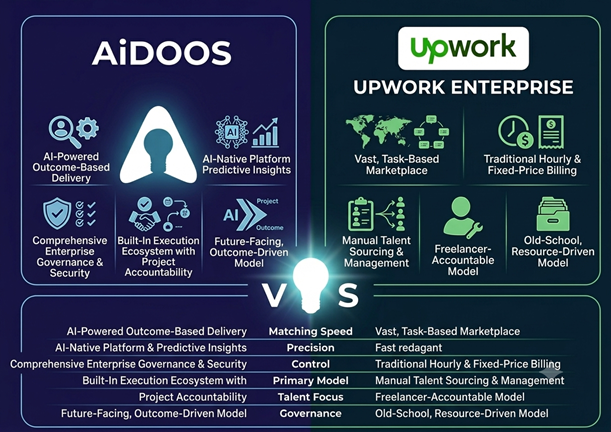
Upwork Enterprise and AiDOOS occasionally show up in the same evaluation — both promise "global on-demand talent." That's where the similarity ends. Upwork Enterprise is a freelance marketplace at scale: vetted individual freelancers, hourly billing, customer-managed delivery. AiDOOS is an outcome-based delivery platform: pre-vetted talent assembled into Virtual Delivery Center pods, embedded delivery management, pricing per Delivery Unit shipped.
This piece walks through the categorical difference, where each fits, and how to decide based on the actual problem you're solving.
The fundamental difference
Upwork Enterprise sells access to individual freelancers, with enterprise-grade procurement and compliance wrappers around the underlying freelance marketplace. The customer browses freelancer profiles, conducts interviews, hires individuals, manages their work, and verifies output quality. Upwork's role is sourcing, vetting, and the legal/payment infrastructure. The customer's role is everything downstream.
AiDOOS sells shipped outcomes. Customers describe what needs to be delivered; AiDOOS commissions a Virtual Delivery Center pod with the right composition, runs the engagement under embedded delivery management, and ships against milestone acceptance gates with DU pricing economics. The customer doesn't hire individuals. The customer doesn't manage delivery. The customer reviews shipped output and accepts (or rejects) milestones.
Comparison table
| Dimension | Upwork Enterprise | AiDOOS |
|---|---|---|
| Category | Enterprise freelance marketplace | Outcome-based delivery platform |
| What you buy | Access to individual freelancers | Shipped, accepted Delivery Units |
| Pricing model | Hourly rate × hours billed (vendor-set rates) | $/DU × DUs shipped (one rate card) |
| Who sources talent | Customer browses; Upwork curates | AiDOOS AI-matches per engagement |
| Who vets per engagement | Customer conducts interviews | Pre-vetted bench; engagement matching |
| Who manages delivery | Customer | Embedded Delivery Manager (platform-funded) |
| Bench tax / ramp tax | Customer absorbs (hourly billing) | Platform absorbs |
| Refunds | None (hours billed are sunk) | Refundable unused DUs, no questions asked |
| Re-delivery on miss | Customer pays for fixes | Platform-funded |
| Best fit | Single-specialist short engagements; many parallel sourcing needs | Multi-specialist sustained outcome-based delivery |
Where Upwork Enterprise wins
- High-volume single-specialist sourcing. If your engineering org needs to fill 30 part-time specialist gaps across a year — copywriters, illustrators, occasional senior architects for short reviews — Upwork's marketplace breadth and self-service flow is the right tool. AiDOOS isn't built for that pattern.
- Customer wants direct freelancer relationships. Some procurement cultures prefer contractor relationships they can manage individually. Upwork supports it; AiDOOS abstracts it away.
- Existing Upwork operations at scale. Companies with mature freelancer-management operations (talent-acquisition specialists, contractor onboarding processes, delivery-review workflows) can extract value from Upwork's marketplace where the management overhead is amortized across many engagements.
- Compliance-driven procurement. Some enterprises prefer the formality and auditability of Upwork's per-contractor agreements. AiDOOS provides single-platform contracting which is simpler for outcome-based engagements but different in shape.
Where AiDOOS wins
- Multi-specialist sustained engagements. A 6-month product build needs 2 frontend, 2 backend, 1 designer, 1 QA, with embedded delivery management. Through Upwork that's six freelancer relationships plus 30+ hours/month of in-house management. Through AiDOOS it's one pod, one contract, one DM.
- Outcome accountability. Upwork pricing is hourly — you pay for the freelancer's time regardless of shipped output. AiDOOS pricing is per shipped DU. The platform earns when work ships and is accepted, not when hours rack up.
- Bench tax and ramp tax avoidance. The 30–50% hidden cost of hourly engagement (management overhead, ramp time, scope-change cycles) compounds against Upwork bills. AiDOOS absorbs all of this at the platform layer.
- Risk-bounded buyer posture. Refundable unused DUs + re-delivery on miss + pre-flight DU estimation create structural risk bounds Upwork's hourly model cannot match.
- Procurement-friendly Starter tier. $2K credit-card checkout for a managed pod operational in days. Upwork Enterprise typically requires legal review and a master agreement.
The pricing comparison
Upwork Enterprise pricing is hourly and varies wildly by freelancer level: junior engineers at $20-50/hour, mid-level at $50-100/hour, senior US-based at $80-180/hour. Plus Upwork's enterprise platform fee.
AiDOOS pricing is per DU shipped:
- Starter — 10 DUs / $2,000 / $200 per DU / 90 days
- Small ★ Most Popular — 60 DUs / $10,000 / $167 per DU / 6 months
- Scale — 300 DUs / $40,000 / $133 per DU / 12 months
- Enterprise — Custom DU commitment / $120-$140 per DU
For multi-specialist engagements, the comparison tilts heavily toward AiDOOS once hidden costs are normalized. Use the Total Cost of Delivery framework to convert both into per-shipped-feature cost.
How to choose
- Single specialist or multi-specialist pod? Single specialist → Upwork is often cleaner. Multi-specialist pod → AiDOOS dramatically simpler.
- Short engagement or sustained? Under 6 weeks → Upwork's setup speed wins. 3+ months → AiDOOS economics dominate as bench tax accumulates.
- How much in-house management capacity? Plenty → Upwork-managed contractors are fine. Constrained → AiDOOS embedded DM is a major value lever.
- What's the procurement constraint? Need fast scope-to-shipped under discretionary spend → AiDOOS Starter ($2K, credit-card). Multi-vendor procurement appetite → Upwork works.
FAQ
Can I use both?
Yes. Common pattern: Upwork for occasional specialist gaps (single freelancer, short engagement) and AiDOOS for sustained outcome-based delivery (multi-specialist pod, multi-month engagement). Different jobs, different tools.
Is AiDOOS cheaper than Upwork on rate-card basis?
Different units. Upwork is hourly; AiDOOS is per DU. The honest comparison is Total Cost of Delivery, which accounts for management overhead, ramp tax, bench tax, scope-change overhead. On TCD basis, AiDOOS is typically 25-40% cheaper for sustained multi-specialist engagements. For single-specialist short engagements, Upwork can be cheaper.
Does AiDOOS vet talent as rigorously as Upwork's enterprise tier?
AiDOOS uses a multi-stage vetting: portfolio + GitHub review, AI-driven technical assessment scored against the role rubric, live engineering interview. Continuous performance signals from delivered work feed back into platform-level talent ranking. Both platforms position on rigorous vetting; the difference isn't strict cutoff but the governance layer — Upwork hands you the vetted individual, AiDOOS embeds vetted talent into a managed pod.
Can AiDOOS work for SaaS implementation projects?
Yes — that's a core wedge. See the SaaS Implementation Partner page for how AiDOOS Implementation VDCs absorb implementation backlog.
Where to start
If your engagement is multi-specialist and runs 3+ months, AiDOOS is the cleaner economic and operational choice. Schedule a 30-minute call to walk through your scope and get a DU estimate.
For broader cost modeling, see Total Cost of Delivery framework. For the structural alternative framing, see Staff Augmentation Alternative. For terminology, see the AiDOOS glossary.