
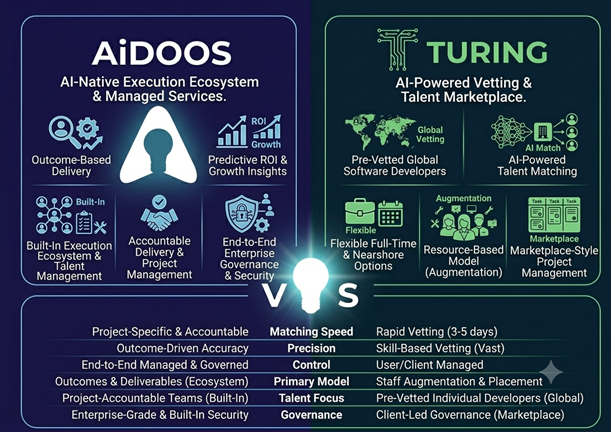
Turing positions itself as an "AI-vetted" remote developer platform — match-quality through deep technical assessment, billed monthly per developer. AiDOOS positions itself as the outcome-based delivery platform — fully managed Virtual Delivery Center pods, priced per Delivery Unit shipped. Same broad space, fundamentally different categories.
This piece walks through the structural difference, where each fits, and how to choose based on the actual problem.
The fundamental difference
Turing sells access to AI-vetted individual developers on monthly contracts. The customer interviews the matched developer, hires them onto an engagement, manages their work, and pays a monthly per-developer rate plus Turing's platform fee. Turing's value proposition is the vetting — a rigorous AI-driven assessment that filters for top engineering talent.
AiDOOS sells shipped outcomes via managed delivery pods. The customer describes scope; AiDOOS commissions a Virtual Delivery Center pod (multiple specialists + embedded delivery manager); pricing is per Delivery Unit shipped, not per developer-month. The customer never hires individual developers — the platform handles all staffing.
Different layers of the stack: Turing solves the vetting + matching layer for individual developers; AiDOOS solves the delivery layer for outcome-bounded engagements.
Comparison table
| Dimension | Turing | AiDOOS |
|---|---|---|
| Category | AI-vetted developer marketplace | Outcome-based delivery platform |
| What you buy | Access to vetted individual developers | Shipped, accepted Delivery Units |
| Pricing model | Monthly per-developer rate | $/DU × DUs shipped |
| Customer manages delivery | Yes | No (embedded Delivery Manager) |
| Multi-specialist pods | Customer assembles per developer | Pre-assembled by platform |
| Bench tax | Customer pays via monthly fee | Platform absorbs |
| Scope changes | Add hours / add developers | Consume DUs differently — no contract changes |
| Refundable unused capacity | No (monthly fees are sunk) | Refundable unused DUs, no questions |
| Re-delivery on acceptance miss | Customer pays for fixes | Platform-funded |
| Best fit | Single-developer long engagements | Multi-specialist outcome-based delivery |
Where Turing wins
- You have a long-term role for a specific developer. If you're filling a long-running individual engineering position (e.g., "we need a senior Python engineer for the next 12 months"), Turing's matching + monthly contract is a clean fit. AiDOOS is over-engineered for that.
- You want to manage the developer directly. Some engineering organizations prefer to integrate the contractor into their team rituals, set the standards directly, and own performance management. Turing preserves that control; AiDOOS abstracts it.
- You want geography-flexibility for a single hire. Turing's strength is the breadth of its talent pool. For one-off senior hires from non-traditional geographies, the matching capability is real.
Where AiDOOS wins
- Multi-specialist sustained delivery. Building a product or modernizing a platform needs multiple specialists working as a team — designers, frontend, backend, QA. Through Turing that's multiple monthly contracts plus customer-managed integration. AiDOOS commissions one pod with one DM and one rate card.
- Outcome accountability. Turing pricing is monthly per developer — the customer pays regardless of shipped output. AiDOOS pricing is per shipped, accepted DU. The platform's incentive is to ship faster, not to keep developers on the engagement longer.
- Embedded delivery management. AiDOOS pods include a full-time Delivery Manager. The customer's engineering manager spends 1-2 hours/week on the engagement instead of 8-10. The 30+ hours/month of management time Turing pushes onto the customer, AiDOOS absorbs.
- Refundable unused capacity. If your needs change mid-engagement, unused DUs refund. Turing monthly fees are sunk costs.
- Risk-bounded contracts. Pre-flight DU estimation, re-delivery on acceptance miss, refundable unused DUs — structural risk bounds Turing's per-developer monthly cannot match.
The pricing comparison
Turing pricing is monthly per-developer. Senior US-quality developers commonly run $5,000-$10,000/month base, plus Turing's platform fee. For a 4-engineer team over 6 months, total cost runs roughly $130K-$280K depending on seniority mix and whether senior or junior matches.
AiDOOS Scale-tier engagement (300 DUs / $40,000) covers an equivalent 6-month multi-specialist engagement with embedded delivery management included. The economic gap widens further once management-overhead and ramp-tax savings are accounted for in TCD analysis.
How to choose
- Single developer or multi-specialist team? Single developer → Turing fits cleanly. Multi-specialist team → AiDOOS dramatically simpler operationally.
- Long-term hire vs outcome-bounded engagement? Indefinite-duration role → Turing. Outcome-bounded engagement (project, transformation, modernization) → AiDOOS.
- Customer-managed or platform-managed delivery? You want direct relationship → Turing. You want delivery accountability with the platform → AiDOOS.
- What's your risk posture for unused capacity? Comfortable with monthly sunk costs → Turing. Want refundable unused DUs → AiDOOS.
FAQ
Doesn't Turing's AI vetting beat AiDOOS's vetting?
Different optimization. Turing optimizes for individual-developer match quality. AiDOOS optimizes for pod-fit + sustained-delivery quality. AiDOOS's vetting is also multi-stage (portfolio + AI assessment + live interview), with continuous performance feedback feeding into platform-level talent ranking. Both are rigorous; they're solving different problems.
Can I assemble a multi-specialist team through Turing?
Technically yes — Turing matches you with multiple developers on parallel monthly contracts. Operationally that means you manage the integration, the cross-discipline coordination, the standups, the code reviews. By the time you've added a fractional engineering manager to coordinate, the cost difference vs an AiDOOS pod with embedded DM has narrowed considerably.
Is AiDOOS missing any geography Turing covers?
AiDOOS's talent pool is 100k+ globally with similar breadth to Turing. The platforms differ on operating model, not on geographic reach.
Can I convert AiDOOS pod members to direct hires later?
Yes. The VDC-to-captive conversion path is a deliberate operating mode — pod members can be converted to direct hires (typically through Deel or similar EOR mechanisms) at engagement end if both sides want it.
Where to start
If your engagement is multi-specialist and outcome-bounded, AiDOOS dominates. Schedule a call to walk through your scope.
If your engagement is single-developer long-term, Turing may be the better fit. The goal is the right tool for the job.
For the structural framing, see Staff Augmentation Alternative and Outcome-Based Delivery. For terminology, see the AiDOOS glossary.