
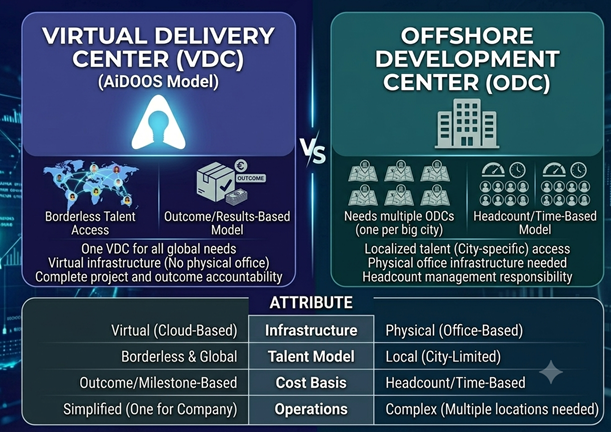
An Offshore Development Center (ODC) is a dedicated offshore team that operates as an extension of the customer's engineering organization — typically with named staff, dedicated facility, and multi-year setup. AiDOOS sells outcome-based delivery via virtual pods priced in Delivery Units. Both target enterprises wanting external engineering capacity. The economics, setup time, and accountability model differ substantially.
For the broader VDC-vs-ODC framing, see VDC vs ODC. This piece focuses on the AiDOOS-specific comparison.
The fundamental difference
An ODC sells the customer a dedicated offshore engineering function. The vendor stands up a facility, hires named staff for the customer's engagement, handles employment compliance in the offshore geography, and operates the team under the customer's direction. Setup typically takes 3-6 months. Engagement contracts run multi-year. Pricing is typically per-engineer-per-month with tiered seniority rates.
AiDOOS sells shipped, accepted Delivery Units via virtual pods. There is no facility, no named long-term staff, no offshore-specific overhead. Pods are AI-matched globally — geography is a deployment detail, not the value proposition. Pricing is per DU shipped.
Different categories: ODC is captive offshore capacity for a single customer. AiDOOS is global outcome-based delivery for any customer.
Comparison table
| Dimension | Offshore Development Center (ODC) | AiDOOS |
|---|---|---|
| What you buy | Dedicated offshore team (capacity) | Shipped, accepted DUs (output) |
| Pricing model | Per-engineer-per-month + setup fees | Per DU shipped |
| Setup time | 3-6 months | Days from scope alignment |
| Engagement duration | Multi-year typical | 90 days - 12 months tier-aligned, refundable |
| Staff allocation | Named, dedicated to customer | AI-matched; platform handles staffing internally |
| Geography | Specific offshore location (real estate) | Global; geography is a deployment detail |
| Bench tax | Customer pays through monthly fees | Platform absorbs |
| Ramp tax | Customer pays during 60-90 day ramp | Platform absorbs |
| Refunds for unused capacity | None (captive headcount) | Refundable unused DUs, no questions |
| Re-delivery on miss | No structural mechanism | Platform-funded |
| Best fit | Long-running captive engineering for $50M+ programs | Outcome-bounded delivery; SaaS, mid-market, sub-$50M |
Where ODC wins
- Long-running captive engineering at large scale. If the engagement is genuinely 5+ years of stable engineering work for a single $50M+ program, ODC's headcount-aligned economics can amortize the setup overhead favorably over time.
- Geography-specific compliance or customer-presence requirements. Some regulated workloads (defense, certain government contracting, specific finance regulations) require named offshore staff with documented background. ODC's captive model handles this; AiDOOS's virtual model isn't built for it.
- Customer wants the offshore facility brand on their org chart. Some enterprises value showing "we have an offshore engineering center in [country]" for board-level optics or partnership conversations. ODC delivers that; AiDOOS doesn't.
- Existing offshore operating model that works. Companies with mature ODC management practices (regional engineering leadership, established communication patterns, in-flight long-running engagements) can extract continuing value where the operational machinery is already amortized.
Where AiDOOS wins
- Setup speed. ODC takes 3-6 months to stand up. AiDOOS pods are operational in days from scope alignment. For most engagements, the time-to-shipped-value gap alone justifies the choice.
- Outcome-bounded engagements. Most software engagements aren't 5-year captive engineering — they're builds, transformations, modernizations, or implementation backlogs. ODC economics break for sub-multi-year engagements; AiDOOS scales cleanly from $2K Starter to multi-million-DU Enterprise.
- No fixed-headcount commitment. ODC engagements lock in the headcount for the duration. AiDOOS scales DU consumption with actual scope; no headcount lock-in.
- Refundable unused capacity. If your needs change, AiDOOS unused DUs refund. ODC monthly fees are sunk regardless.
- No vendor lock-in. ODC engagements famously concentrate knowledge in the offshore team — switching vendors is expensive. AiDOOS preserves customer IP in artifacts the customer owns.
- Embedded delivery management included. ODC vendors typically offer engagement management at extra cost. AiDOOS includes the embedded DM in the DU economics.
The pricing comparison
ODC pricing typically runs $4,000-$10,000 per engineer per month for senior offshore (India, Eastern Europe, Latin America), plus 10-30% management overhead, plus setup fees that amortize over 12-24 months. A 10-engineer ODC at $7,000/month average all-in runs roughly $840K/year base.
AiDOOS Enterprise tier with multi-year DU commitment scales from sub-$140/DU. A program consuming 6,000 DUs/year at $130/DU runs $780K/year — comparable on rate, but with all the management overhead absorbed and no setup amortization required.
For sub-multi-year engagements, AiDOOS economics dominate. For multi-year captive engineering at $50M+ scale, the comparison gets closer and depends on customer-specific factors.
How to choose
- Engagement duration? Sub-multi-year → AiDOOS dominates. 5+ years stable scope → ODC can fit.
- Captive presence required? Yes, for regulatory or organizational reasons → ODC. No → AiDOOS is structurally better economics.
- Setup speed matters? Need to ship fast → AiDOOS (days vs months). Comfortable with 3-6 month setup → ODC.
- Headcount commitment vs output commitment? Want fixed-headcount stability → ODC. Want output accountability → AiDOOS.
FAQ
Can AiDOOS replace an existing ODC?
Yes for many engagements. Common pattern: customer has aging ODC engagement that's gotten expensive and inflexible; they wind down the ODC and migrate the work to AiDOOS Virtual Delivery Centers with DU pricing. The handoff requires customer-side knowledge capture (which ODC engagements often delay), but the economic case typically justifies the effort.
Doesn't ODC have stronger sector-specific compliance?
Depends on the sector. For workloads requiring documented offshore staff with cleared backgrounds in specific compliance regimes (some defense / government work), ODC's named-staff model does carry advantages. For standard regulated industries (HIPAA, SOX, PCI, GDPR), AiDOOS handles compliance via co-authored data-handling addenda with similar rigor.
Can AiDOOS deliver from specific geographies if my customer requires it?
For most customer requirements, yes — AiDOOS can match talent from specific geographies as part of pod composition. For requirements that mandate captive presence (specific defense contracts, certain government SOWs), AiDOOS isn't structurally a fit.
What about Build-Operate-Transfer (BOT) arrangements?
If the customer's goal is to eventually own a captive offshore team, BOT may be the right path. AiDOOS isn't a BOT vendor — the operating model is fundamentally different. See the VDC vs BOT comparison for details.
Where to start
If your engagement is outcome-bounded with sub-multi-year horizon, AiDOOS dominates economically and operationally. Schedule a call.
If you genuinely need long-running captive offshore presence for regulatory or organizational reasons, ODC may fit better.
For broader context, see VDC vs ODC, Outcome-Based Delivery, and the AiDOOS glossary.