
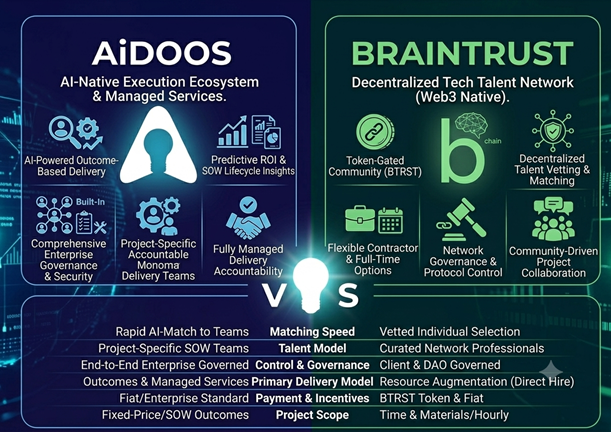
Braintrust positions itself as the "user-owned" talent network — decentralized governance, low platform fees, freelancers paid in stablecoins or fiat, customer-managed engagement. AiDOOS positions itself as the outcome-based delivery platform — pre-vetted talent assembled into Virtual Delivery Center pods, embedded delivery management, priced per Delivery Unit shipped. Both target enterprise buyers; the operating models are fundamentally different.
This piece walks through the categorical difference, where each fits, and how to choose.
The fundamental difference
Braintrust sells access to vetted freelancers via a decentralized marketplace. Customers post engagements, browse freelancer profiles, conduct interviews, hire individuals, manage delivery, and pay either hourly or fixed-bid through the platform. Braintrust's value proposition is the marketplace economics — low platform fees compared to traditional vetted marketplaces (Toptal charges ~2x what Braintrust charges in platform fees), with token governance giving freelancers a stake in the network.
AiDOOS sells shipped outcomes via fully managed delivery pods. Customers describe scope; AiDOOS commissions a Virtual Delivery Center pod with appropriate composition, runs the engagement under embedded delivery management, and ships against milestone acceptance gates. Pricing is per Delivery Unit shipped — the customer never hires individuals.
Different layers: Braintrust solves the cost-of-the-marketplace layer for individual-freelancer hiring. AiDOOS solves the delivery-accountability layer for outcome-bounded engagements.
Comparison table
| Dimension | Braintrust | AiDOOS |
|---|---|---|
| Category | Decentralized vetted-freelancer marketplace | Outcome-based delivery platform |
| What you buy | Access to individual freelancers | Shipped, accepted Delivery Units |
| Pricing model | Hourly or fixed-bid; low platform fee | $/DU × DUs shipped |
| Vetting model | Network-governed (token-holder vetting) | Platform-managed multi-stage vetting |
| Customer manages delivery | Yes | No (embedded Delivery Manager) |
| Pod composition | Customer assembles per freelancer | Platform composes |
| Bench tax | Customer pays via hourly billing | Platform absorbs |
| Refundable unused capacity | Limited (depends on engagement type) | Refundable unused DUs, no questions |
| Re-delivery on acceptance miss | Customer-vendor negotiation | Platform-funded |
| Best fit | Cost-conscious freelance hiring at scale | Multi-specialist outcome-based delivery |
Where Braintrust wins
- Cost-sensitive freelance procurement. Braintrust's lower platform fees vs traditional vetted marketplaces (Toptal, Turing) is a real economic advantage when the customer's operating model is "we hire freelancers directly and want lower marketplace overhead."
- Customer prefers direct freelancer relationships. Some procurement cultures value direct contracting. Braintrust enables that with rigorous vetting at lower platform cost.
- High volume of single-freelancer engagements. Companies running many short-engagement freelancer hires get marketplace economics that AiDOOS can't match — AiDOOS isn't built for high-volume individual sourcing.
- Token-economic alignment matters to your procurement. If your organization values the user-owned governance model Braintrust represents, that's a category-of-one consideration.
Where AiDOOS wins
- Multi-specialist sustained delivery. A typical product engagement needs 4-6 specialists working as a coordinated pod. Through Braintrust that's individual freelancer hires plus customer-managed coordination. Through AiDOOS it's one commissioned pod with one DM and one rate card.
- Outcome accountability. Braintrust freelancers bill hourly or fixed-bid; the customer absorbs delivery risk. AiDOOS prices per shipped DU — the platform's economics align with shipping faster.
- Embedded delivery management. AiDOOS pods include a full-time DM. The 30+ hours/month of in-house management Braintrust requires (across multiple freelancer relationships), AiDOOS absorbs at the platform layer.
- Risk-bounded buyer posture. Refundable unused DUs + re-delivery on acceptance miss + pre-flight DU estimation create structural risk bounds. Braintrust's marketplace model can't replicate them — they're properties of the AiDOOS engine, not contract terms.
- Procurement-friendly fast start. Starter tier ($2K credit-card checkout) for a managed pod operational in days. Braintrust requires per-engagement setup with the freelancers you select.
The pricing comparison
Braintrust pricing is the freelancer's hourly or fixed-bid rate plus Braintrust's platform fee (lower than Toptal/Turing equivalent). For a senior US-quality engineer at $90/hour through Braintrust, total cost lands around $95-100/hour all-in — competitive on the marketplace dimension.
AiDOOS pricing is per DU shipped:
- Starter — 10 DUs / $2,000 / $200 per DU
- Small — 60 DUs / $10,000 / $167 per DU
- Scale — 300 DUs / $40,000 / $133 per DU
- Enterprise — Custom / $120-$140 per DU
For multi-specialist engagements, the comparison swings to AiDOOS once management overhead and ramp tax are accounted for in TCD analysis. For single-freelancer engagements, Braintrust's marketplace economics often win on rate-card basis.
How to choose
- Marketplace cost-sensitive vs delivery-accountability sensitive? Optimizing freelance marketplace fees → Braintrust. Optimizing for delivery accountability → AiDOOS.
- Single freelancer or multi-specialist pod? Single freelancer → Braintrust often cleaner. Multi-specialist pod → AiDOOS dramatically simpler.
- Customer-managed delivery vs platform-managed delivery? You want direct contractor relationships → Braintrust. You want delivery accountability with the platform → AiDOOS.
- How long is the engagement? Under 6 weeks single-specialist → Braintrust. 3+ months multi-specialist → AiDOOS economics dominate.
FAQ
Is Braintrust's vetting as rigorous as AiDOOS's?
Both are rigorous; different governance models. Braintrust uses network-governed vetting (token-holders adjudicate); AiDOOS uses platform-managed vetting (multi-stage process with continuous performance feedback). For pure individual-freelancer match quality, both produce strong outcomes.
Can I assemble a pod through Braintrust?
Yes, by hiring multiple freelancers in parallel. Operationally that means coordination overhead lands on you. Once you add an internal engineering manager to coordinate, the apparent platform-fee savings narrow against AiDOOS's pod model.
Does AiDOOS have user-owned governance like Braintrust?
No — AiDOOS is a centrally-operated platform. The trade-off: AiDOOS owns delivery accountability (re-delivery guarantee, refundable unused DUs) which a decentralized governance model can't make at the engine level.
Can I use both Braintrust and AiDOOS?
Yes. Use Braintrust for cost-sensitive single-freelancer hiring; use AiDOOS for outcome-bounded multi-specialist delivery. Different operating models, different problems.
Where to start
If your engagement is outcome-bounded and multi-specialist, AiDOOS dominates economically once TCD is normalized. Schedule a call to walk through your scope.
If your engagement is single-freelancer and you optimize for marketplace fee economics, Braintrust may be the better fit.
For the structural framing, see Outcome-Based Delivery and Staff Augmentation Alternative. For terminology, see the AiDOOS glossary.