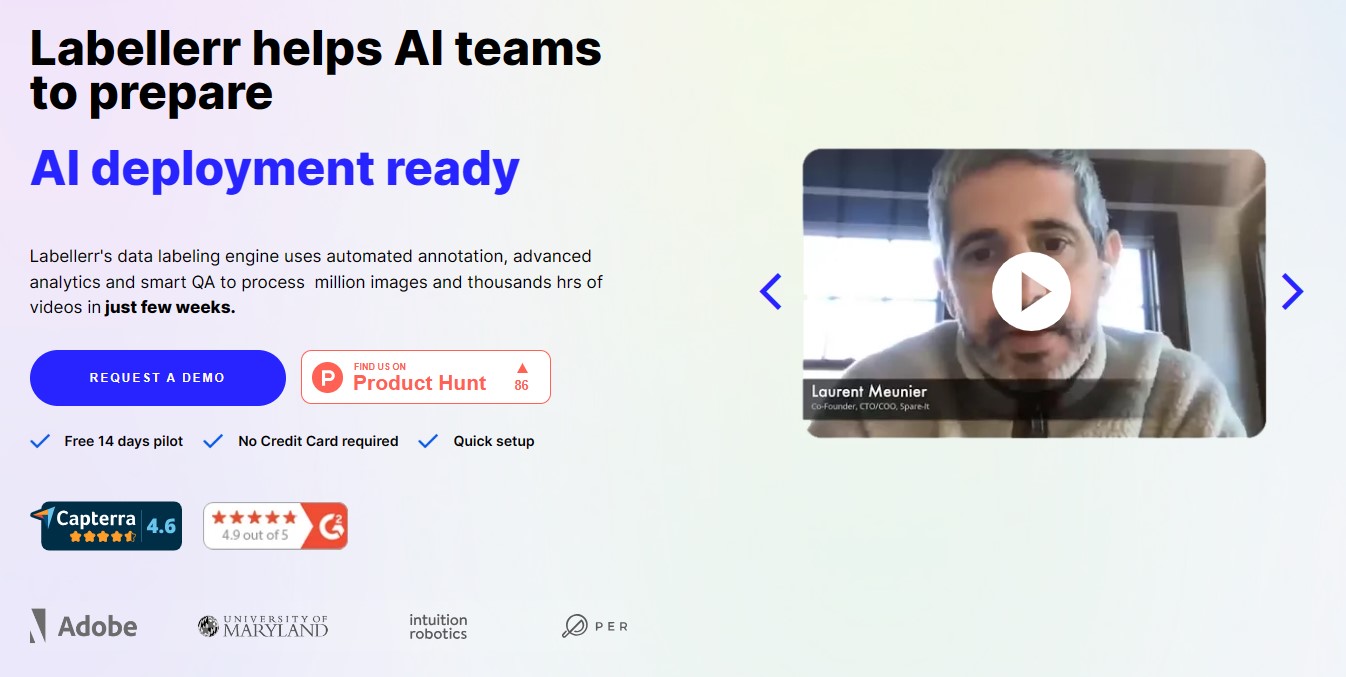
Looking to implement or upgrade Labellerr?
Schedule a Meeting
Computer Vision

Labellerr

Accelerate AI development with intelligent data labeling and team collaboration.

Category
Software
Ideal For
Machine Learning Teams
Deployment
Cloud
Integrations
None+ Apps
Security
Role-based access control, data encryption, audit trails
API Access
Yes - RESTful API for workflow integration

About Labellerr

Labellerr is an advanced computer vision workflow automation platform engineered to streamline the entire AI development lifecycle. The platform enables machine learning teams to efficiently manage data labeling at scale, facilitate seamless collaboration across teams, and accelerate model iteration cycles. Labellerr reduces manual labeling overhead through intelligent automation features, quality assurance mechanisms, and version control for labeled datasets. By centralizing data management and annotation workflows, organizations achieve faster time-to-market for computer vision models while maintaining high accuracy standards. When deployed through AiDOOS, Labellerr benefits from enhanced governance frameworks, optimized resource allocation, and integrated scaling capabilities that ensure consistent performance across distributed teams. The platform supports multiple annotation types including bounding boxes, polygons, segmentation masks, and classification tags—catering to diverse computer vision use cases from object detection to semantic segmentation.

Challenges It Solves

  • Manual data labeling processes consume excessive time and resources, delaying model development
  • Lack of centralized collaboration tools leads to inconsistencies and rework in annotation quality
  • Scaling labeling operations across distributed teams introduces coordination and quality control challenges
  • Version control and audit trails for labeled datasets remain fragmented across tools

Proven Results

64
Reduction in labeling cycle time through automation
48
Improvement in annotation consistency and quality
35
Faster model deployment with optimized workflows

Key Features

Core capabilities at a glance

Collaborative Data Labeling

Enable real-time team annotation with unified visibility

Multiple teams annotate simultaneously with synchronized updates

Intelligent Quality Assurance

Automated validation and consensus-based review

Reduce annotation errors by up to 40% through smart QA

Workflow Automation

Streamline repetitive tasks with rule-based automation

Eliminate manual task routing and assignment overhead

Version Control & Audit Trails

Track all changes and maintain annotation history

Complete audit compliance and reproducibility for models

Multi-Format Support

Support diverse annotation types and data formats

Handle bounding boxes, polygons, masks, and classifications

Analytics & Insights

Monitor team performance and labeling metrics

Data-driven decisions improve labeling efficiency

Ready to implement Labellerr for your organization?

Real-World Use Cases

See how organizations drive results

Autonomous Vehicle Development
Annotation of road scenes, pedestrians, vehicles, and traffic signals for self-driving car models. Teams collaborate on large-scale dataset labeling with strict quality requirements.
72
30% faster dataset preparation for model training
Medical Image Analysis
Labeling of X-rays, CT scans, and pathology images for diagnostic AI models. Ensures regulatory compliance with complete audit trails and quality control.
58
Improved diagnostic accuracy through consistent annotations
E-Commerce Product Recognition
Annotation of product images for visual search and recommendation systems. Scale labeling operations across global teams with unified quality standards.
65
50% reduction in annotation cost per image
Industrial Defect Detection
Labeling of manufacturing inspection images to train quality control models. Real-time collaboration between quality assurance and engineering teams.
71
Faster defect detection model deployment

Integrations

Seamlessly connect with your tech ecosystem

A

AWS S3

Explore

Direct integration for storing and retrieving large-scale image datasets from cloud storage

G

Google Cloud Storage

Explore

Seamless data pipeline for accessing and managing labeled datasets in GCP environment

T

TensorFlow

Explore

Export labeled datasets in TFRecord format for direct model training integration

P

PyTorch

Explore

Compatible dataset export formats for PyTorch-based computer vision model training

O

OpenCV

Explore

Integration with OpenCV for advanced image preprocessing and validation workflows

S

Slack

Explore

Team notifications for project updates, QA reviews, and labeling task completions

J

Jira

Explore

Project tracking integration for managing labeling sprints and team assignments

W

Webhooks

Explore

Custom API webhooks for event-driven automation with external systems

Implementation with AiDOOS

Outcome-based delivery with expert support

Outcome-Based

Pay for results, not hours

Milestone-Driven

Clear deliverables at each phase

Expert Network

Access to certified specialists

Implementation Timeline

1
Discover
Requirements & assessment
2
Integrate
Setup & data migration
3
Validate
Testing & security audit
4
Rollout
Deployment & training
5
Optimize
Performance tuning

See how it works for your team

Alternatives & Comparisons

Find the right fit for your needs

Capability Labellerr Nuance Vocalizer Jupitrr Collect.chat
Customization Excellent Excellent Good Excellent
Ease of Use Good Good Excellent Excellent
Enterprise Features Excellent Excellent Good Good
Pricing Fair Fair Good Excellent
Integration Ecosystem Good Excellent Good Excellent
Mobile Experience Fair Good Fair Good
AI & Analytics Excellent Good Excellent Good
Quick Setup Good Good Excellent Excellent

Similar Products

Explore related solutions

Nuance Vocalizer

Nuance Vocalizer

The Complete Text-to-Speech Engine for IVR & Mobile Self-Service Transform your customer interactio…

Explore
Jupitrr

Jupitrr

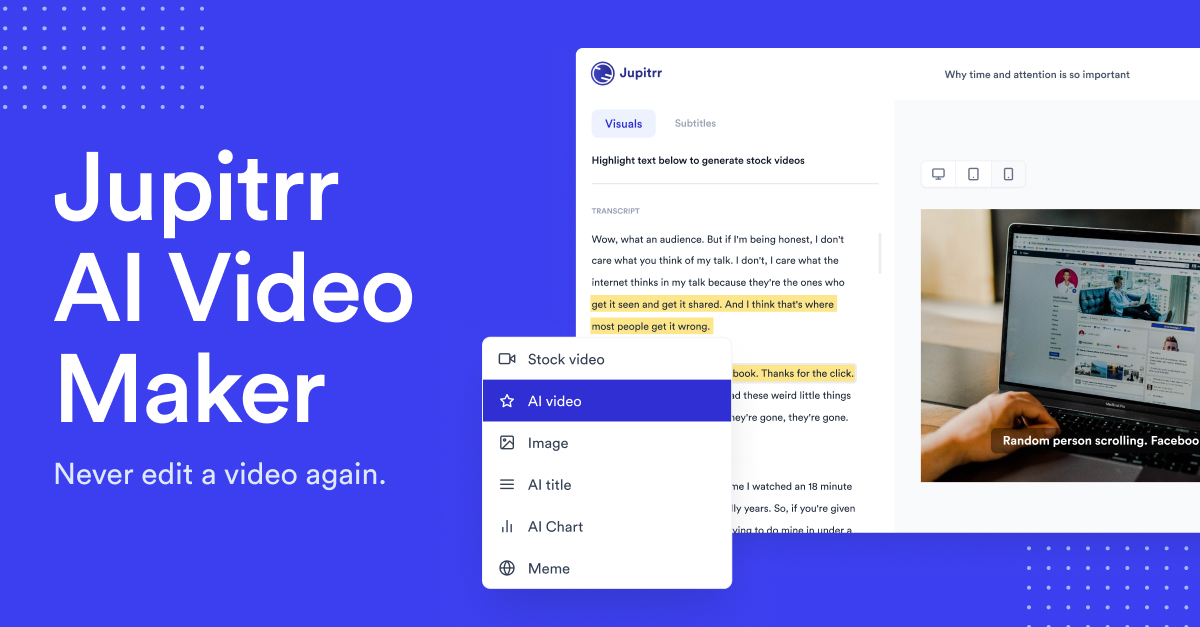
Jupitrr AI Video Maker revolutionizes the process of creating dynamic and compelling content market…

Explore
Collect.chat

Collect.chat

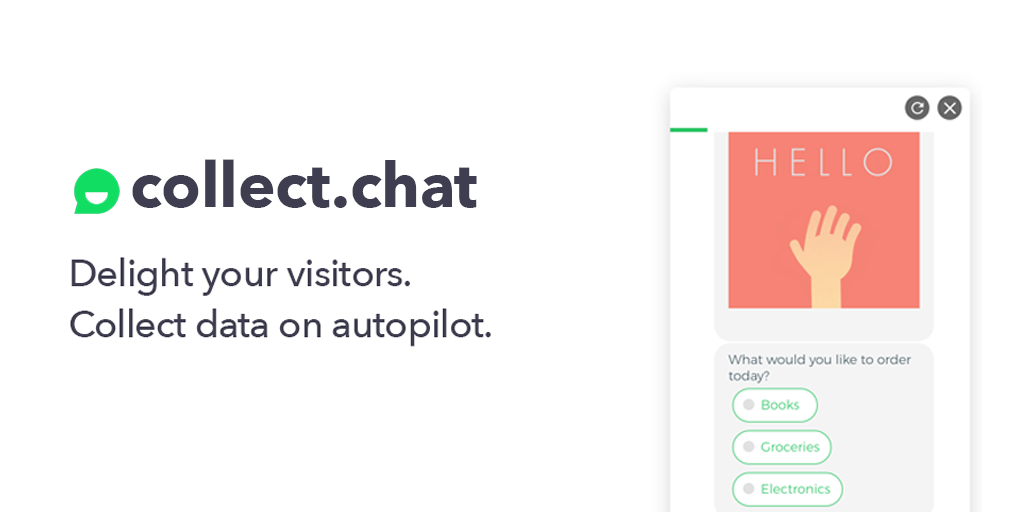
Effortless Chatbot Creation with Collect.chat Collect.chat empowers businesses to engage, qualify, …

Explore

Frequently Asked Questions

What file formats does Labellerr support for image data?
Labellerr supports all major image formats including JPEG, PNG, TIFF, and WebP. For video annotation, MP4, MOV, and AVI formats are supported. Data can be imported from local storage, cloud buckets (S3, GCS), or direct URLs.
How does Labellerr ensure annotation quality across large teams?
Labellerr employs consensus-based review, automated QA validation rules, inter-annotator agreement metrics, and expert reviewer workflows. The platform flags inconsistencies and recommends rework, maintaining 95%+ annotation accuracy standards.
Can Labellerr integrate with our existing ML pipeline?
Yes. Labellerr provides REST APIs, Python SDKs, and direct export formats (TFRecord, COCO JSON, YOLO format) compatible with TensorFlow, PyTorch, and other frameworks. AiDOOS marketplace deployment ensures seamless CI/CD pipeline integration.
What is the typical onboarding timeline?
Basic project setup takes 1-2 days. Full team onboarding with custom workflows typically takes 1-2 weeks. AiDOOS provides managed onboarding services to accelerate deployment and governance setup.
Does Labellerr support distributed team collaboration?
Yes. Labellerr's cloud-native architecture supports real-time collaboration across multiple geographic locations with automatic conflict resolution, change synchronization, and unified quality controls.
How are labeled datasets versioned and tracked?
Labellerr maintains complete version history for all datasets with branching capabilities. Teams can compare versions, review annotation changes, and rollback to previous states. All changes are logged for audit compliance.