
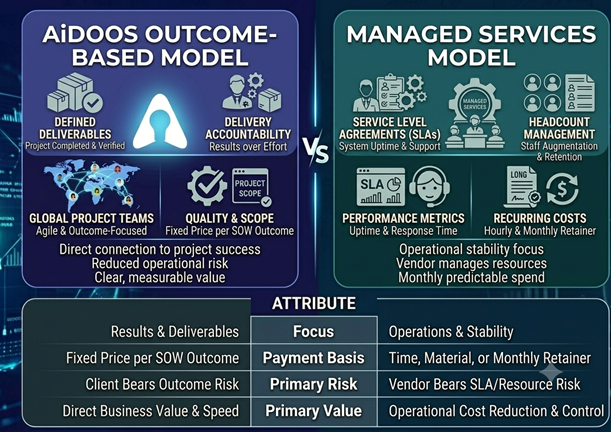
"Managed services" is the umbrella for long-running vendor engagements where a third party operates an ongoing IT, engineering, or business function on the customer's behalf — application maintenance, infrastructure operations, security operations, support functions. AiDOOS sells outcome-based delivery via Virtual Delivery Center pods priced in Delivery Units. Different categories that occasionally overlap.
The fundamental difference
Managed services sell ongoing operations under a long-term contract. The vendor takes over a function (application support, infrastructure ops, etc.) and operates it under SLAs for years at a time. Pricing is typically fixed monthly fee, sometimes tiered by ticket volume or asset count, sometimes T&M with milestone overlays. The vendor's economic interest is in keeping the contract renewed.
AiDOOS sells shipped, accepted Delivery Units against engagement scope. Engagements are bounded — Starter (90 days), Small (6 months), Scale (12 months), Enterprise (custom). The vendor's economic interest is in shipping faster — DUs only earn against accepted output, and unused DUs are refundable.
Different categories. Managed services solve the "I don't want to operate this function in-house, vendor takes it" problem. AiDOOS solves the "I want this delivered" problem.
Comparison table
| Dimension | Managed Services | AiDOOS |
|---|---|---|
| What you buy | Ongoing operations under SLAs | Shipped, accepted DUs |
| Pricing model | Fixed monthly fee or tiered | Per DU shipped |
| Engagement duration | Multi-year typical | 90 days - 12 months tier-aligned |
| Vendor incentive | Renew the contract | Ship faster (more DUs through same capacity) |
| Scope | Defined function (ongoing) | Defined deliverables (bounded) |
| SLAs | Function-level (uptime, ticket TAT) | Milestone-level (acceptance criteria) |
| Refunds | None (monthly fees sunk) | Refundable unused DUs |
| Re-delivery on miss | SLA penalties (usually capped) | Platform-funded re-delivery |
| Best fit | Long-running operational functions | Outcome-bounded delivery work |
Where managed services win
- Genuinely operational functions you don't want to operate in-house. Application support for a stable enterprise platform, infrastructure operations for a steady-state environment, security operations centers (SOCs) — these are continuous functions, not deliverable-bounded engagements. AiDOOS isn't built for these.
- Multi-year stability outweighs flexibility. Some customer-vendor relationships value the long-term operational continuity. Managed services contracts bake this in.
- Tier-1 vendor brand requirements. Some procurement cultures require named tier-1 managed services vendors (the big consultancies' MS arms) for political or audit reasons.
Where AiDOOS wins
- Project-bounded delivery. Building features, modernizing platforms, completing transformations. These are bounded engagements with clear deliverables — exactly what AiDOOS DU pricing is built for. Managed services contracts force these into the wrong unit (multi-year ongoing operation).
- Vendor incentive alignment. Managed services vendors win when contracts renew and grow — economic incentive to keep work going, not to ship and exit. AiDOOS wins when DUs ship — incentive to ship faster.
- No multi-year commitment. AiDOOS validity windows run 90 days to 12 months. If the engagement isn't working, refund unused DUs and exit. Managed services contracts famously are difficult to exit cleanly.
- Risk-bounded posture. Pre-flight DU estimation + re-delivery on acceptance miss + refundable unused DUs — structural risk bounds managed services contracts cannot replicate.
- Procurement-friendly start. Starter tier ($2K credit-card checkout) for a managed pod operational in days. Managed services typically require multi-month procurement cycles, legal review, and master agreements.
When customers conflate the two (and why it matters)
Common confusion: "We need a managed service for our SaaS implementation backlog" or "We need managed services to take over our engineering pipeline." These are usually NOT managed services problems — they're outcome-bounded delivery problems incorrectly framed.
Symptoms of the conflation: customer signs a multi-year managed services contract for what's actually a 6-month build, then can't exit cleanly when the build is done. Or: customer pays managed services rates for outcome-bounded work that AiDOOS would have shipped at 30-50% lower TCD with cleaner exit.
The diagnostic question: Is this an ongoing operation, or a defined deliverable? Ongoing operations → managed services. Defined deliverables → outcome-based delivery via AiDOOS.
Hybrid patterns
Many enterprises run both. Common patterns:
- AiDOOS for build, managed services for ops. AiDOOS pod ships the new product or platform; once live, a managed services contract takes over ongoing operations. Clean handoff at the operations boundary.
- AiDOOS for transformation, managed services for steady-state. AiDOOS modernizes the legacy platform; managed services maintains the modernized platform. Each plays to its strength.
- AiDOOS for backlog absorption, managed services for predictable pipeline. Managed services handles the predictable feature pipeline; AiDOOS pods absorb backlog spikes and special projects.
The pricing comparison
Managed services pricing varies enormously — entry-level offshore application support might run $30K-$60K/month per FTE-equivalent; tier-1 consultancy MS contracts can run multi-million dollars per year for substantial enterprise functions.
For outcome-bounded engagements, the comparison is rarely apples-to-apples. The honest framing: if the work is genuinely a defined deliverable, run the AiDOOS DU sizing first and compare TCD via the TCD framework. If the work is genuinely ongoing operations, AiDOOS isn't the right tool.
How to choose
- Ongoing operation or defined deliverable? Operation → managed services. Deliverable → AiDOOS.
- Multi-year horizon required? Yes → managed services natural fit. No → AiDOOS DU pricing is structurally better.
- Vendor brand requirements? Tier-1 MS vendor required → managed services. Outcome-accountability prioritized → AiDOOS.
- What's the exit path if it's not working? Multi-year contract OK → managed services. Want refundable, no-questions-asked exit → AiDOOS.
FAQ
Can AiDOOS handle ongoing operations like managed services?
Not natively. AiDOOS economics are output-based per shipped DU. For ongoing operations where the "output" is uptime or ticket TAT rather than shipped deliverables, the unit doesn't match. Some Enterprise-tier engagements do include ongoing-operations components, but the natural fit is outcome-bounded delivery.
What about hybrid managed services + outcome-based?
Some enterprises structure hybrid arrangements where the underlying work is ongoing operations but the contract has milestone-based components for specific deliverables (e.g., "operate the platform AND deliver these specific modernizations"). For the deliverables portion, AiDOOS can replace the outcome-based component while the customer keeps managed services for true operations.
Are managed services going away?
No. For genuine operational functions (security ops centers, infrastructure operations, application support for stable platforms), managed services remains the right operating model. What's changing is the conflation — work that should be outcome-based delivery is being forced into managed services contracts because that's the buyer's familiar model.
Where to start
If your engagement is outcome-bounded — a build, transformation, modernization, or backlog absorption — AiDOOS is the cleaner economic and operational choice. Schedule a call.
If your engagement is genuinely ongoing operations, managed services may be the right tool — and that's fine.
For broader framing, see Outcome-Based Delivery, Staff Augmentation Alternative, and the AiDOOS glossary.