
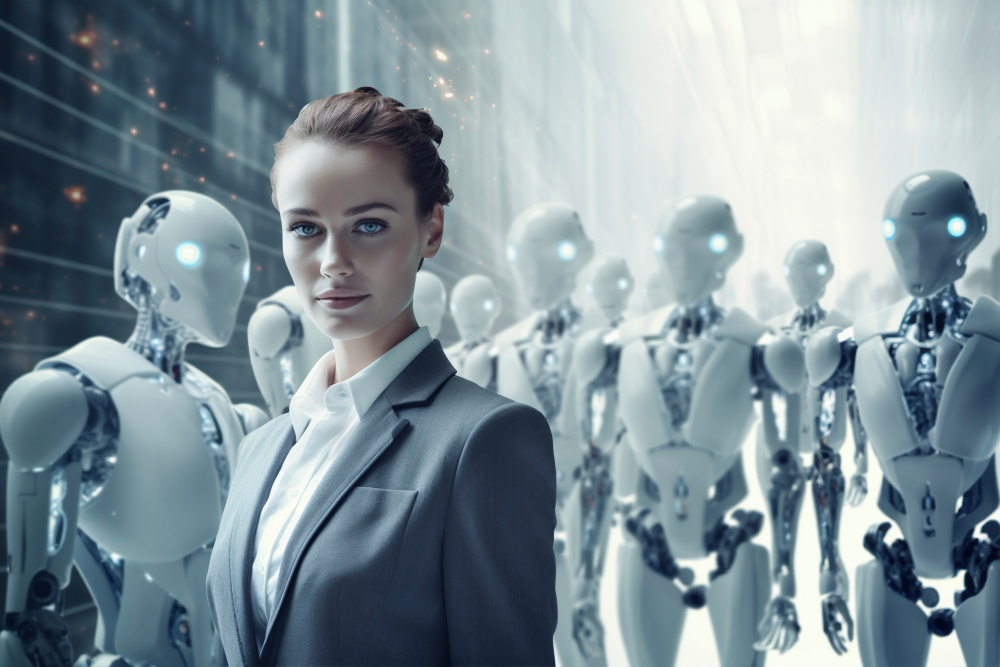
For most of modern history, the workforce of the world consisted of humans.
People built companies.
People ran factories.
People wrote code, analyzed data, and answered support calls.
Even when machines assisted us, the workforce was still fundamentally human.
But we are approaching a moment when that assumption will quietly break.
A moment when AI agents outnumber humans participating in economic activity.
Not in some distant science fiction future.
In the coming decade.
And when it happens, it will fundamentally reshape how organizations operate.
The Quiet Population Explosion
Today, there are roughly eight billion humans on Earth.
Not all of them participate in the global economy.
Only a fraction are knowledge workers.
But AI agents will not follow the same constraints.
A single company may deploy:
-
Thousands of AI coding assistants
-
Hundreds of research agents
-
Automated customer service agents
-
Compliance monitoring agents
-
Analytics agents
-
Security agents
And that is just one organization.
Multiply this across millions of companies.
Add individuals deploying personal AI agents.
Add autonomous systems operating inside digital infrastructure.
Suddenly the number of active AI agents could reach billions — even trillions.
This will be the first time in human history that the workforce is not primarily human.
The First Wave Is Already Here
The shift has already begun.
Developers now use AI copilots to write and review code.
Researchers deploy agents to scan thousands of papers.
Customer service platforms automate first-line support.
Marketing teams generate campaigns with AI assistance.
Legal teams use AI to review contracts.
None of these agents operate alone yet.
They augment humans.
But augmentation has a natural trajectory.
As systems improve, humans supervise more agents than they directly collaborate with.
Eventually, a single human may oversee the work of dozens — even hundreds — of AI agents.
At that point, the population math changes dramatically.
The Future Workforce Is Hybrid
The future organization will not consist of:
-
only humans
or -
only AI.
It will consist of hybrid workforces.
Teams where humans provide:
-
Judgment
-
Architecture
-
Strategy
-
Accountability
And AI agents provide:
-
Execution throughput
-
Pattern recognition
-
Repetitive processing
-
Knowledge synthesis
This hybrid structure will become the new baseline.
But a hybrid workforce introduces a new challenge.
How do you manage it?
The Chaos Scenario
Without structure, the proliferation of AI agents can quickly create chaos.
Imagine an organization where:
-
Dozens of AI tools operate independently
-
Different departments deploy separate agents
-
Data flows inconsistently
-
Accountability becomes unclear
-
Compliance oversight disappears
What begins as productivity improvement becomes operational fragmentation.
Different teams automate the same tasks.
Security risks multiply.
Decision traceability becomes impossible.
Instead of accelerating execution, AI creates organizational disorder.
This is the risk few leaders are discussing openly.
The Agent Coordination Problem
Once AI agents multiply inside organizations, a new category of challenge emerges.
Not “how to use AI.”
But how to coordinate thousands of AI agents working simultaneously.
Questions leaders must answer include:
-
Which agents operate where?
-
Who supervises them?
-
What data can they access?
-
How do agents collaborate with humans?
-
How do agents collaborate with other agents?
-
How do you measure their output?
-
Who is accountable when something fails?
These are not technical questions.
They are organizational design questions.
The Coming Digital Labor Market
As AI agents become more capable, they will increasingly behave like digital workers.
Organizations will deploy them to complete tasks.
Individuals may own personal AI agents performing services on their behalf.
Agents will interact with agents across companies and platforms.
This creates something entirely new:
A digital labor market.
Not a marketplace of freelancers.
A marketplace of autonomous agents executing tasks across networks.
And just like human labor markets, this ecosystem will require infrastructure.
Infrastructure for the Agent Economy
When humans dominated the workforce, organizations relied on systems like:
-
HR structures
-
Reporting hierarchies
-
Governance frameworks
-
Performance management
But when AI agents become the majority workforce, new infrastructure is required.
Infrastructure that can:
-
Orchestrate human and AI collaboration
-
Monitor agent activity
-
Enforce governance and compliance
-
Coordinate tasks across distributed systems
-
Scale execution without chaos
This is the missing layer in most current AI strategies.
Why Tool Adoption Is Not Enough
Many companies believe they are “implementing AI” because they have deployed tools.
But tools are not systems.
When organizations adopt AI tools without structural orchestration, they create silos of automation.
Each team optimizes locally.
The organization loses global visibility.
AI capability increases while organizational coherence decreases.
The real challenge is not adoption.
It is orchestration.
The Rise of Execution Platforms
To manage hybrid workforces, organizations will increasingly rely on execution platforms.
Platforms that combine:
-
Human talent
-
AI agents
-
Workflows
-
Governance
-
Compliance
-
Security
Into a unified operational environment.
Instead of managing tools individually, leaders manage execution capacity.
These platforms become the operating system of the modern enterprise.
Virtual Delivery Centers: The Structural Container
This is where the concept of a Virtual Delivery Center (VDC) becomes powerful.
A VDC acts as the structural container where hybrid workforces operate.
Inside a VDC:
-
Humans and AI agents collaborate
-
Work is modularized into outcomes
-
Orchestration ensures alignment
-
Governance and compliance are embedded
Instead of chaotic tool usage, the organization gains structured execution.
As AI agents increase in number, the system absorbs them naturally.
Gradual Evolution, Not Disruption
The goal is not to replace human teams overnight.
The goal is to evolve organizational capability gradually.
As AI improves:
-
Agents handle more structured tasks
-
Humans shift toward architecture and judgment
-
Capacity expands without proportional headcount growth
This transition must happen smoothly.
Without destabilizing the organization.
Without creating cultural resistance.
Without introducing operational risk.
The right structure makes this possible.
Why Leaders Must Prepare Now
The population explosion of AI agents will not happen suddenly.
It will happen quietly.
One team adds an AI assistant.
Another team automates analysis.
Another team deploys agents for monitoring.
Over time, the number of digital workers grows.
By the time organizations notice, they may already be managing hundreds or thousands of agents.
Leaders who prepare early will build systems capable of absorbing this growth.
Those who delay will find themselves overwhelmed by the complexity.
The Strategic Question
The question leaders must now ask is not:
“Should we adopt AI?”
The real question is:
How do we structure our organization for a future where AI agents outnumber humans?
This is not a tool decision.
It is an architectural decision.
The organizations that answer it early will operate calmly while others scramble to regain control.
The Opportunity
The coming era of AI agents is not a threat.
It is an extraordinary opportunity.
Organizations will gain access to:
-
Unprecedented execution capacity
-
Faster innovation cycles
-
Global talent collaboration
-
Dramatically lower operational friction
But only if they can orchestrate the new workforce effectively.
The companies that master orchestration will unlock a level of productivity never seen before.
The Future of Work Is Not Human vs AI
It is Human + AI at planetary scale.
Billions of digital workers collaborating with millions of human leaders and specialists.
A hybrid economic system where capability is no longer limited by human headcount alone.
This future is closer than most leaders realize.
And the organizations preparing for it today will define the next era of enterprise.