
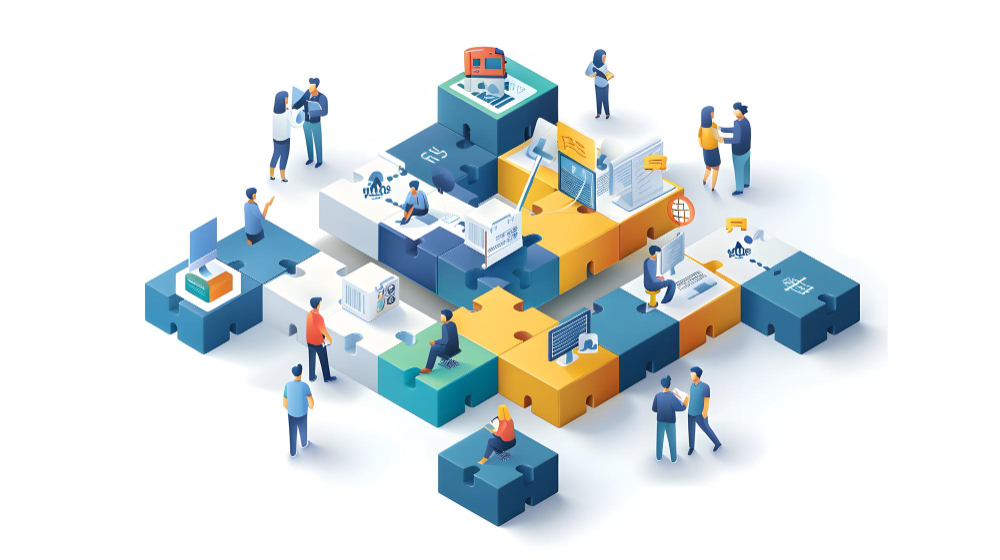
In software engineering, modularity is one of the oldest and most powerful design principles. A modular system is composed of distinct components — modules — each with a well-defined interface, clear internal coherence, and limited dependencies on the internal implementation of other modules. Modular systems are easier to understand, easier to change, and easier to extend than monolithic systems, because changes to one module don't require understanding or modifying the rest of the system. Modular systems are resilient: a failure in one module doesn't cascade through the entire system if the module boundaries are well-designed. And modular systems are composable: new capabilities can be built by combining existing modules in new configurations rather than by rebuilding from scratch.
These properties — comprehensibility, changeability, resilience, and composability — are exactly the properties that enterprise IT organizations need in 2026. The technology landscape is changing faster than any fixed organizational design can track. The AI integration agenda is requiring capability combinations that didn't exist eighteen months ago. The talent market is demanding engagement models that traditional permanent employment structures can't provide. The competitive environment is requiring delivery at a pace that monolithic organizational structures can't sustain.
What enterprise IT organizations need, in short, is the organizational equivalent of modular software design.
The case for modular IT organizations is not an analogy. It is an application of the same design principles that make software systems maintainable and adaptable, applied to the organizational systems that build and operate those software systems. The principles transfer because the underlying challenge is the same: managing complexity in a system that must change rapidly, without the change process destroying the coherence of the whole.
What Organizational Modularity Means in Practice
Organizational modularity is distinct from the related concepts of agility, flexibility, and scalability — though it enables all three. Modularity is specifically about the design of organizational components and their interfaces: how the units of the organization are bounded, how they interact with each other, and how the boundaries can be maintained as the organization evolves.
A modular IT organization has four defining structural characteristics.
Characteristic One: Bounded, coherent delivery units. The primary delivery units of a modular IT organization are bounded by clear, meaningful scope — a specific business capability, a specific technology domain, or a specific customer segment — rather than by functional specialization. The boundary defines what the unit owns: end-to-end accountability for its scope, including the full stack of technology and the business outcomes that technology produces.
Within its boundary, the unit is designed for coherence: the skills, tools, processes, and governance required to deliver its scope are all within the unit, rather than being shared across the organization through functional pools. The unit can work without extensive ongoing coordination with other units — not because it is isolated from them, but because its scope is designed to minimize the coordination overhead that cross-unit dependencies generate.
This is the organizational equivalent of high cohesion in software design — the principle that a module should contain everything needed for its function, and nothing that isn't needed for its function. High-cohesion delivery units are more productive, more accountable, and more adaptable than low-cohesion units whose capability is distributed across organizational boundaries.
Characteristic Two: Well-defined inter-unit interfaces. Modular IT organizations design the interactions between delivery units as carefully as they design the units themselves. The interfaces — the points at which units exchange information, share dependencies, or coordinate on shared concerns — are explicit, documented, and governed.
In software engineering, interfaces between modules are defined as APIs: specified contracts that describe what one module provides to another, without exposing the internal implementation details that the consuming module doesn't need to know. The organizational equivalent is the explicit definition of how teams interact: what one team provides to another, through what mechanism, on what timeline, and with what accountability.
Most organizational interactions are implicit: teams coordinate through informal communication, organizational hierarchy, and shared participation in governance processes whose interaction protocols are not explicitly designed. Implicit interfaces generate the coordination overhead that consumes delivery capacity — the meetings to align on shared decisions, the escalations to resolve inter-team conflicts, the delays while waiting for input from teams with competing priorities.
Modular IT organizations make their inter-unit interfaces explicit — designing the interaction protocols, the information exchange mechanisms, and the dependency governance that allow units to coordinate efficiently without continuous ad-hoc negotiation.
Characteristic Three: Composable capability configuration. Modular IT organizations treat capability configuration — the assembly of specific skills, tools, and resources for a specific initiative — as a dynamic, composable process rather than a fixed organizational assignment.
In a modular organization, an initiative that requires capabilities spanning multiple delivery units is served by a composed configuration — bringing together the relevant capabilities from the units that own them, for the duration of the initiative, without requiring permanent reorganization of those units' structures. The configuration is temporary and initiative-specific. The units that contribute to it maintain their permanent boundaries and return to their baseline configurations when the initiative is complete.
This composability is what makes modular organizations adaptable: new capability combinations can be assembled from existing modules without the organizational disruption of restructuring. The organization doesn't need to redesign itself every time the technology agenda requires a new capability combination. It assembles the required combination from its existing modular components.
Characteristic Four: Independently evolvable units. Modular IT organizations design their delivery units to be independently evolvable — capable of adopting new technologies, new practices, and new talent configurations without requiring synchronized change across the entire organization.
In a monolithic IT organization, significant changes to technology or practice require organization-wide coordination: the new technology standard must be adopted by all teams simultaneously, the new practice must be trained across the entire function, the governance framework must be updated centrally before any unit can operate differently. This synchronization requirement makes large IT organizations slow to adopt new capabilities and conservative about technology change — because the cost of synchronization is proportional to the size of the organization.
In a modular IT organization, a delivery unit can adopt a new AI tooling approach, a new deployment architecture, or a new talent engagement model independently — within its module boundary — without requiring synchronization with units that aren't affected by the change. The organizational standard is the inter-unit interface, not the internal implementation. Units can evolve their internal implementation freely, as long as they maintain their interface commitments to the units that depend on them.
The Modular Talent Architecture
The modular organizational design principle applies not just to team structure but to the talent architecture that staffs those teams — and it is in the talent dimension that modular design is most differentiated from the conventional approaches to IT workforce design.
A modular talent architecture distinguishes between three types of contribution to delivery units, each with different engagement models and different structural roles.
Core module contributors are the permanent organizational members of a delivery unit — the individuals whose institutional knowledge, organizational relationships, and domain expertise provide the continuity and context that define the module's coherent identity. Core contributors are permanent employees or long-term associates whose tenure is measured in years rather than months. They own the module's architectural direction, its organizational relationships, and its accumulated domain knowledge.
Core modules are intentionally small — smaller than traditional team sizes in most IT organizations. The coherence of a delivery unit is maintained by its core, and coherence is harder to maintain as core size increases. A core of four to eight people is capable of maintaining the architectural integrity, the domain knowledge, and the organizational relationships that define a module's identity. A core of twenty-five requires governance overhead that compromises the modularity benefit.
Specialist augmenters are on-demand contributors who join a delivery unit for a specific initiative or capability requirement — bringing skills that the core doesn't permanently own but that the initiative requires. Specialist augmenters are engaged through the talent access infrastructure described in Articles 3 and 6: on-demand, project-based, with outcome accountability and context transfer infrastructure that allows them to contribute effectively within the module context.
The specialist augmenter model is what allows modular IT organizations to access capability breadth without carrying capability breadth as permanent overhead. A delivery unit whose core owns five deep skills and can access twenty specialist skills on demand has a more effective capability architecture than a permanent team of fifteen who collectively own twelve skills at average depth.
Platform service contributors are the shared infrastructure, tooling, and service capabilities that multiple delivery units depend on — staffed through platform teams whose service is available to all delivery units through the well-defined interfaces that the modular architecture specifies. Platform service contributors are neither core members of individual delivery units nor temporary specialists. They are the providers of the shared infrastructure that the modular system depends on — maintaining the platform capabilities that individual units use without building or owning.
This three-tier talent architecture — core, specialist augmenters, and platform services — is the operational implementation of modular organizational design. It provides delivery units with the stability of a coherent permanent core, the flexibility of on-demand specialist access, and the efficiency of shared infrastructure — without the overhead of either maintaining all required capability permanently or rebuilding infrastructure capability unit by unit.
The Interface Design Challenge
The most demanding aspect of building a modular IT organization — and the one most commonly underestimated — is the interface design challenge: the work of explicitly designing the interactions between delivery units so that they are efficient, unambiguous, and maintainable.
Most IT organizations that attempt modular design successfully redesign their delivery units but fail to explicitly design their inter-unit interfaces. The result is modules that are internally coherent but externally chaotic: units that work well within their boundaries but create coordination overhead at their boundaries that is as bad as — or worse than — the coordination overhead of the functional structures they replaced.
Well-designed inter-unit interfaces have three properties.
Specificity. The interface specifies exactly what one unit provides to another — what data, what service, what decision, what output — without ambiguity about scope or content. Ambiguous interfaces generate the alignment conversations and coordination overhead that specific interfaces are designed to eliminate.
Stability. The interface is stable over time — changing only through an explicit change management process rather than drifting with the internal evolution of the providing unit. Stable interfaces allow consuming units to depend on the interface without needing continuous visibility into the providing unit's internal evolution. This is the organizational equivalent of interface versioning in software design.
Accountability. The interface specifies who is accountable for providing the interface commitment — not in the aggregate sense of "the platform team provides X" but in the specific sense of which individual or role within the platform team owns the accountability for delivering the interface commitment. Accountable interfaces surface problems faster because accountability can be activated when the interface commitment is not met.
Building well-designed inter-unit interfaces requires the organizational work of making explicit what has been implicit — documenting interactions that have historically been managed through relationships and informal communication. This documentation work is culturally uncomfortable in many IT organizations, where the ability to navigate informal communication networks is a valued and status-conferring skill. Making interactions explicit and formal can feel like a loss of the human dimension of organizational life.
The discomfort is real. The alternative — an organization where coordination depends on informal communication that doesn't scale, doesn't onboard, and doesn't survive personnel changes — is more expensive than the cultural discomfort of explicit interface design.
The Evolution Path: From Monolith to Modular
Most large enterprise IT organizations in 2026 are not modular — they are organizational monoliths, in the same sense that early web applications were software monoliths: coherent from the outside, deeply interdependent internally, and extremely difficult to change because changes ripple through the entire system.
The path from organizational monolith to modular organization is not a single redesign. It is an incremental decomposition — identifying module boundaries, extracting units, designing interfaces, and evolving the configuration over time — that mirrors the strangler fig pattern used to migrate monolithic software systems to microservices architectures.
The strangler fig pattern for organizational modularity works as follows.
Begin by identifying the natural module boundaries — the scopes of ownership that, if clearly bounded and made coherent, would eliminate the most costly coordination overhead. These are typically the areas where the current organization has the most cross-team conflict, the most inter-team dependency latency, and the most ambiguous accountability.
Extract one module at a time — redesigning one delivery unit to meet the modular design criteria before proceeding to the next. Build the module's coherence: assemble the cross-functional capability it needs within its boundary, establish its outcome accountability, design its interface to the rest of the organization. Demonstrate the performance improvement that modular design produces in the extracted unit before using it as the template for subsequent extractions.
Design interfaces as you extract — making explicit the interactions between the extracted module and the units it depends on, using the interface design work to identify and resolve the implicit dependencies that the extraction has surfaced.
Evolve the talent architecture of each module as it matures — building the on-demand specialist access infrastructure that allows each module's core to remain small while accessing the capability breadth that its initiative requirements demand.
Over three to five years of consistent incremental extraction, an organizational monolith can be decomposed into a modular architecture — not through a single big-bang reorganization that creates disruption without producing change, but through the sustained accumulation of modular design decisions that progressively replace monolithic interdependence with deliberate interface design.
Why Modularity Is the Right Frame for 2026 and Beyond
The case for modular IT organizational design is ultimately a case about the pace of change that enterprise technology organizations must be able to absorb in the years ahead.
The technology landscape of 2026 will not be the technology landscape of 2028. The AI capabilities that are frontier in early 2026 will be commoditized by 2027 and superseded by 2028. The talent market will continue to restructure. The competitive dynamics of every industry will continue to evolve faster than the planning cycles of most enterprises can track.
An IT organization designed as a monolith — deeply interdependent, requiring synchronized change, carrying the full weight of its accumulated structure in every adaptation — will absorb this pace of change with increasing difficulty. Each new technology generation requires a bigger reorganization. Each competitive shift requires a more disruptive restructuring. The organizational overhead of maintaining the monolith grows faster than the pace of change it is trying to keep up with.
A modular IT organization absorbs the same pace of change at a fraction of the cost: independent module evolution without organizational synchronization, capability composition without structural reorganization, talent configuration without workforce restructuring. The modular organization is not merely more efficient at the current pace of change. It is architecturally suited to a pace of change that is going to accelerate — and that monolithic organizational architectures are architecturally unsuited to.
The case for modularity is not that it makes the organization more efficient at what it currently does. It is that it makes the organization capable of doing what the next decade will require — at a pace and with an adaptability that the organizational architecture of 2005 was never designed to provide.
AiDOOS Virtual Delivery Centers are the operational implementation of modular IT organization design — bounded, coherent delivery units with well-designed external interfaces, composable capability configuration, and independently evolvable talent architecture. See how modular delivery works →